


Confession of love in Bogota: see the bouquet before it goes
When you order a confession of love in Bogota, the florist photographs the finished bouquet before the courier leaves, so you see it before the recipient does. If a stem is missing, it gets replaced with one close in shade and price, and the change shows up in that same photo. The choice that matters first is what the bouquet says: colour and flower, then size and shape, then how and when it reaches the person you mean it for.
Which flowers say "I love you" without a word
Victorian flower dictionaries gave colour a voice long before anyone thought to write it on a card. A red rose stood for passionate love, pink for a gentler feeling, white for purity, yellow for friendship. No single dictionary ever agreed with another on every point, so these readings work as a guide rather than a rulebook.
The bouquets here lean into that softer register. Lavender spray roses come in bunches of eleven or twenty-five, and pale purple carries through a bouquet of fifteen peony-style roses, through Blue Field and through Lavender Smoothie. Peonies sit close by, in a bunch of thirty-five or paired with peony-style roses, and the two-tone Jumilia arrives wrapped loosely enough to show both colours at once. Anyone set on tradition can start with red roses instead and build from there.
Picking the colour first narrows everything that follows: once the tone of the confession is set, the flower and the format follow more easily.
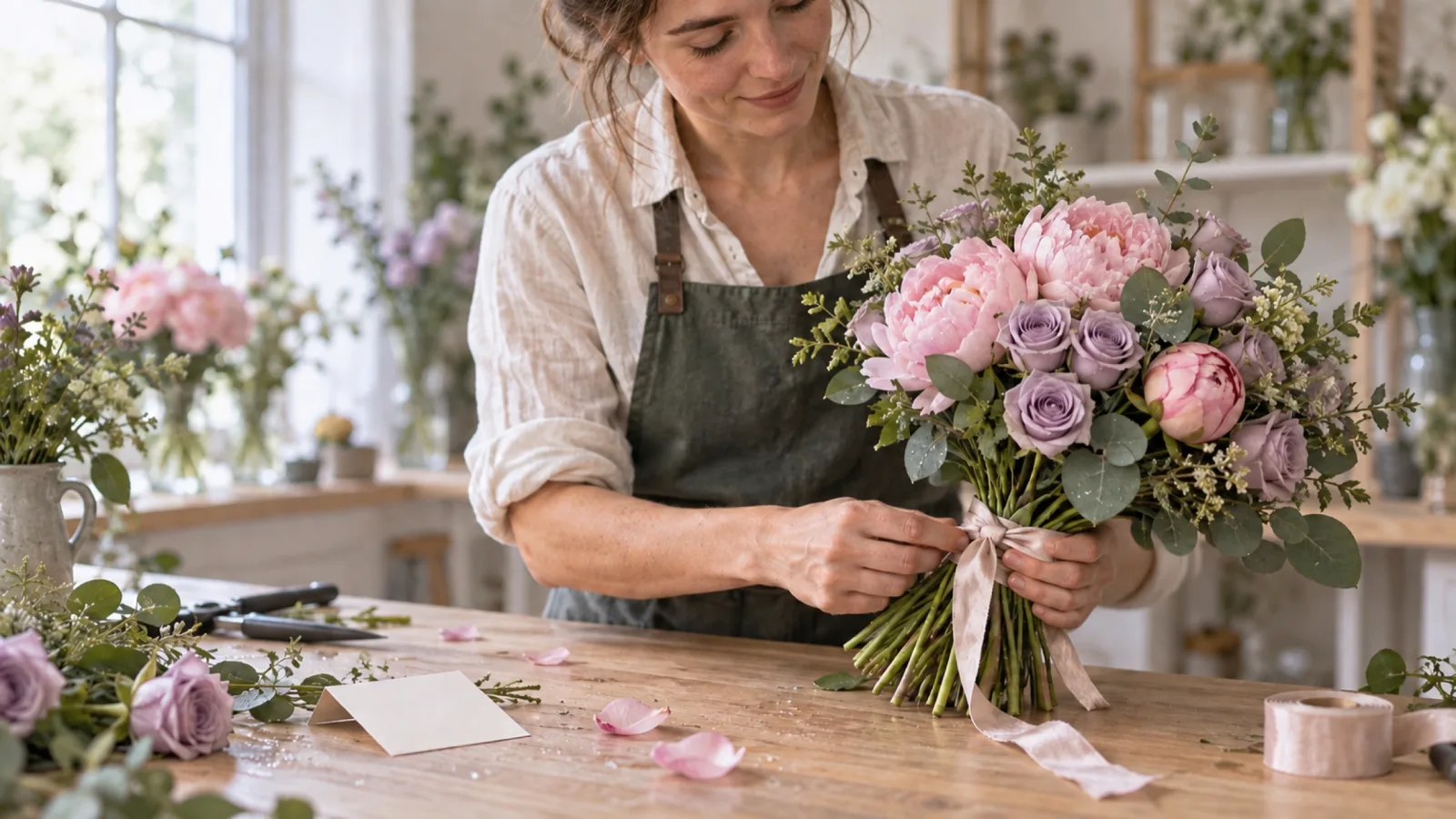
Three shapes cover the range: a hand-tied bouquet, flowers in a box such as a mix of twenty-five roses, and a basket, where lilies fill either a single arrangement or a larger mixed one. Both the box and the basket stand without a vase, their stems set in wet foam that gets watered daily in a thin stream over the whole surface.
Size depends on the flower as much as the stem count. A few lilies or hydrangea heads already read as a full bouquet, because each head is large on its own; spray roses or alstroemeria need two dozen stems or more before the same density shows. Treat that as a rough guide rather than a fixed rule.
One flower needs a warning regardless of format: every part of a lily, including the pollen and the water in the vase, is toxic to cats, so a household with a cat is worth asking about before lilies go on the card.
Delivering a confession of love in Bogota: signed or anonymous
A card comes free with every order, and it can carry a signature or say nothing about who sent it. The courier works from the recipient's name and address alone; the sender's own contact details never reach them. Nobody calls ahead unless the sender asks for it, except where a building simply cannot be entered without a call from the door.
No address on hand is not a problem: a phone number for the recipient is enough to arrange delivery. Orders for a set date and time are taken in any zone, and the earlier one is placed, the wider the choice of time slots left to pick from.
A restaurant delivery works the same way: the timing goes through the venue's staff, so the bouquet can arrive with dessert or right before a toast rather than at a guessed moment. Valentine's Day is the one date that strains the system, with far more orders moving through fewer open slots and no promise down to the minute, which makes ordering a few days ahead worth doing. Outside that peak, most orders reach the recipient on the day they are placed; the exact timing for any bouquet shows on its own page, next to delivery terms.
Choosing where to start is easier with a narrower question in mind. Flowers for loved ones works well when the occasion matters more than the exact flower, peonies suit a fuller bouquet while they are in season, and classic red roses remain the most literal way to say it.