


Designer bouquets in Milan: when a florist composes rather than assembles
There is a bouquet with a furniture era in its name. The Biedermeier bouquet, named after the plain middle-class style of the German-speaking lands between 1815 and 1848, is built as tight concentric rings, one kind or colour of flower per ring and no gap between the heads. It is still made for weddings, and it can be described in one sentence. Designer bouquets in Milan are the opposite case: there is no set pattern to copy, the shape comes from a florist's idea, and that changes what you buy and why the photo before dispatch matters more than the listing.
What makes a bouquet a designer bouquet
A single-variety bouquet is one flower and nothing else: roses, tulips or peonies. A mixed bouquet puts several kinds together by working rules, and its name usually lists the contents, as in "Roses with Lisianthus". A designer bouquet starts from the other end: the florist decides on an image first and then finds the flowers for it, which is why these works carry names like paintings or perfumes, "Miracola", "Celeste", "Queen's Heart", "Cleopatra".
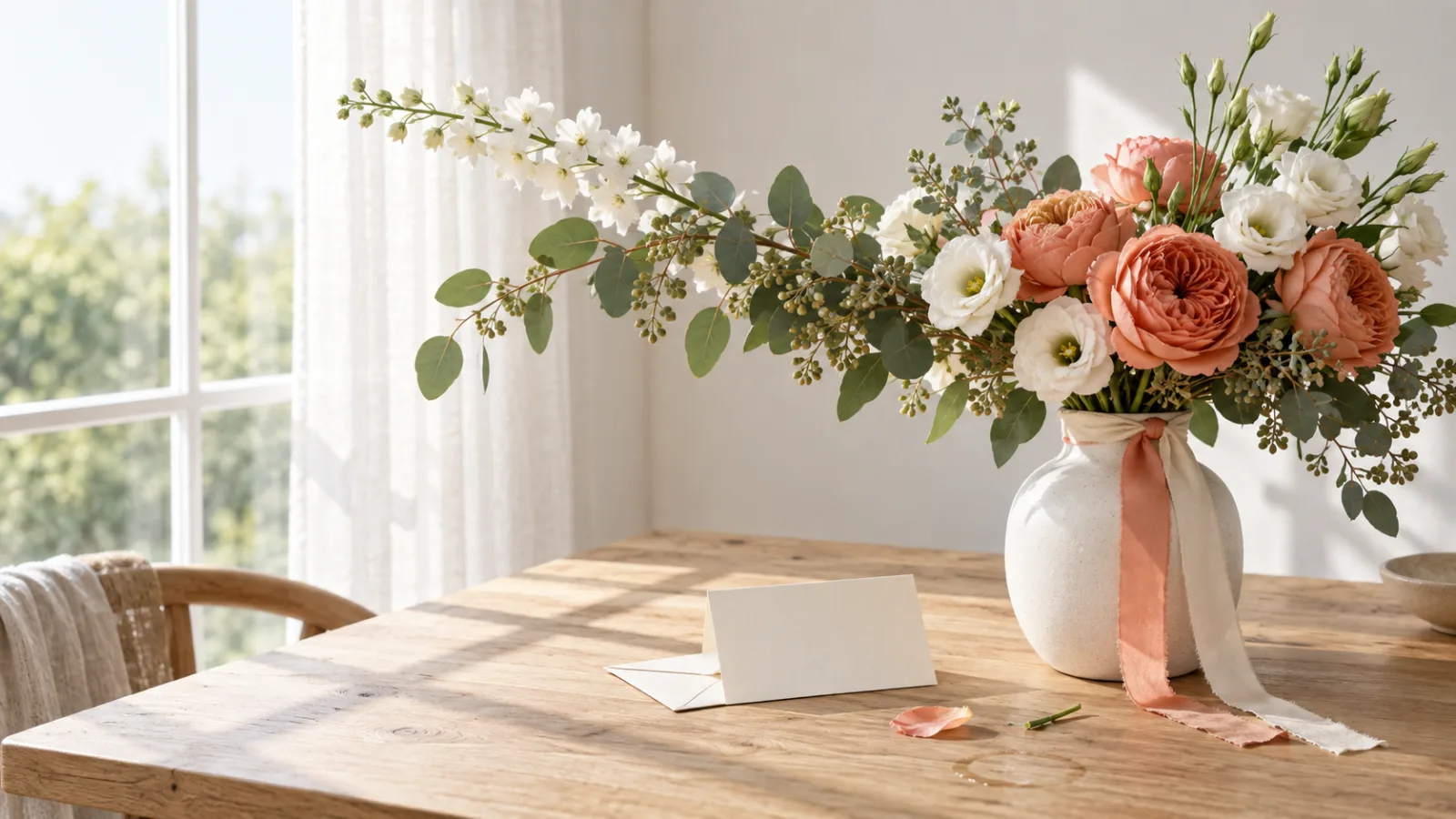
A mixed bouquet is most often an even dome, while a designer bouquet may lean to one side, send a long branch past its outline and leave air between the heads. The material may be the less usual kind: garden roses with a many-petalled cup, or so-called French roses, whose outer petals the florist reflexes by hand so the bloom opens wider. Designer boxes and baskets sit in the same section, the composition standing in wet floral foam instead of a vase.
How a florist composes one: line, mass and air
A free shape is not an accidental one: the vocabulary is the same as in any composition. Line flowers and branches, delphinium or eucalyptus for instance, draw the outline and set the height. Mass flowers such as roses, hydrangeas and peonies carry the weight and take the eye first, fillers like gypsophila sit in the gaps, and foliage holds the structure together. A mixed bouquet shares these roles out evenly around a circle; a designer bouquet unbalances them on purpose, moving the mass to one side, leaving the other open and running one line out beyond the silhouette.
The palette follows the schemes painters use: shades of one colour, neighbours on the colour wheel, or two opposites for contrast. The stems are tied in a spiral, each laid at a slight angle to the last so that they cross at a single binding point, and a properly tied bouquet stands on the table by itself.

A designer bouquet is the right order when the recipient knows flowers and will notice the difference between a tidy mixed bunch and a composition with an idea behind it. That usually means an anniversary, a proposal, or a gift to a designer or an architect. For a hall, a stage or a wedding table there is a separate section of designer giants, built on the same principles at the scale of a room.
A corporate order for a run of identical bouquets is easier to fill from catalogue positions. If the recipient loves one particular flower, a single-variety bouquet of it is the more honest gift than a composition where it is one of many. For a hotel or an office, where flowers may wait for the recipient without a vase, a designer box or flowers in a box is the practical choice. Wet foam keeps the composition about as long as a vase if it is watered daily across the surface. Ready selections by date are gathered under Occasions.
Why the photo before dispatch matters more than the listing
The price of designer bouquets in Milan depends on the composition and the season as much as on the stem count. Peonies, tulips and lilac are around for weeks or months of the year, while chrysanthemums, gerberas and lisianthus come from greenhouses all year round. JFLOO makes every bouquet to order and buys the flowers for that order after payment.
So a designer bouquet may not be repeated petal for petal from its photograph. If a flower from the picture is missing from the day's delivery, the florist substitutes one close in shade and price, and the substitution is visible in the photo of the finished bouquet sent before the courier leaves. At that point changes can still be asked for. When no ready-made work fits the budget or the occasion, message the florist: a manager sends several pieces with photos and prices before payment, and an example picture brings back similar compositions.
Designer bouquets in Milan travel on the same terms as any other bouquet. The courier brings flowers to the city centre free of charge, and other districts carry a fixed price for their zone, added to the order before payment. Most orders are handed over on the day they are placed, and the bouquet card shows the delivery time when faster delivery is possible, but only if the bouquet is already in stock with the florist. A designer piece is better booked for a set date and time: such orders are accepted for any zone, and the earlier you book, the more slots remain. Before 14 February, 8 March and Mother's Day the convenient ones go days ahead; zones and rates for Milan are on the Delivery page.
The recipient is not called in advance unless the sender asks, and the courier knows only a name and an address. The card goes in free of charge and can be signed or left anonymous, and if there is no exact address, a phone number is enough. Payment is by Visa or Mastercard, the cart total is final, nothing is paid to the courier, and orders are taken around the clock. At home the stems are recut at an angle, leaves below the waterline are stripped, the water is changed every day or two, and the vase stays away from radiators, direct sun and ripe fruit.
Start with the recipient: someone who values an idea will notice a work from this section, a hall calls for the giants, and when a predictable list of flowers matters more, a mixed bouquet is the safer order. If the choice will not settle, message the florist with the occasion and budget; a photo with a price arrives before anything is paid.