





Tulips with delivery in Minsk: varieties, the Belarusian spring, and freshness from greenhouse to door
In Minsk the tulip opens the floral year. Winter in central Belarus is long and snowy, so the first firm buds on the stalls in late February read as an early sign of spring. The main peak falls on 8 March: by that date Belarusian greenhouse farms cut tulips by the million, and in early March the city noticeably smells of them. That tie to local production makes the tulip here a seasonal symbol rather than an "office" flower.
The category gathers single-variety bouquets from 11 to 51 stems, mixed spring arrangements, and gift boxes pairing tulips with narcissi, ranunculus, and hyacinths. It is a seasonal flower: its peak is March to May, and outside spring the tulip arrives less often and costs more.

Groups and varieties
More than 3,000 tulip varieties are registered worldwide. Around 30–40 key ones reach the shelf, split into groups by bud shape, stem length, and flowering time.
- Triumph — the classic cup-shaped bud, stem 40–50 cm. The most widespread group. Varieties: Strong Gold (yellow), Negrita (purple), Ile de France (red).
- Darwin Hybrids — large-headed, up to 12 cm across, with a very firm stem. Apeldoorn (scarlet), Ivory Floradale (cream). For voluminous single-variety bouquets.
- French Tulips — long-stemmed, up to 70 cm. Maureen (white), Menton (soft pink). For wedding floristry.
- Parrot — parrot tulips with fringed, "torn" petals. Rococo (red), Blue Parrot (purple). For expressive arrangements.
- Double / Peony — double "peony-flowered" tulips. Mount Tacoma (white), Foxtrot (pink). An alternative to peonies while those are out of season.
- Queen of Night — an almost-black, deep purple. For a dark or vintage palette.
Season and occasions
The natural tulip season here is spring, March to May. The main and most massive occasion is International Women's Day, 8 March: that week takes the lion's share of the year's demand. After it, spring weddings, the Last Bell, and graduations in late May hold things up. Mother's Day in Belarus is marked on 14 October — an autumn date, outside the tulip season — so in spring 8 March stays the key driver.
Tulips are given by the single stem less often than roses — formats of 15, 25, and 51 stems are more typical. They are ordered in any quantity, with no strict odd-number rule.
A tulip's quirk: it keeps growing
A cut tulip remains a living plant — the stem keeps growing in the vase by 2–3 cm over the first days. This is a rare trait among cut flowers, and it is taken into account when assembling an arrangement.
Because of this, tulips change the shape of the bouquet every day and by the end of the week bend toward the light — that is normal, not a defect. To keep an even shape, stand the bouquet in a tall, narrow vase that holds the stems upright.
"The tulip is the most honest flower on sale. A fresh stem is firm and cool in the hand. In March the main task is not to overheat the bud: in a warm flat after the frosty street it opens within a day."
— Alesya Kravtsova, florist, Minsk-Tsentralny, 9 years of practice
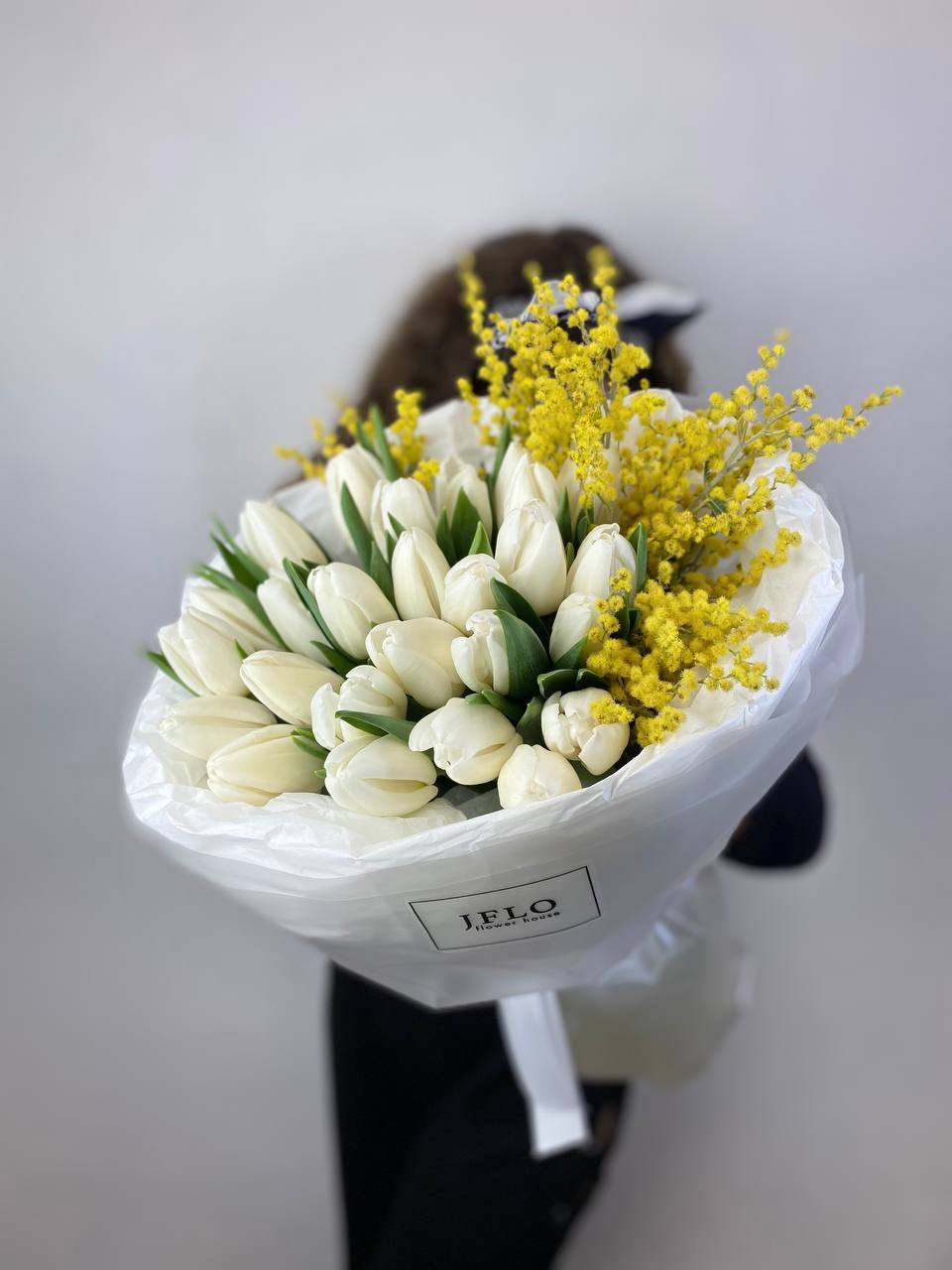
Freshness and logistics
The tulips in the catalogue come from two sources. Local Belarusian greenhouses supply the fresh spring cut, at its firmest for 8 March, while imported batches of Dutch-bred stock arrive through wholesale channels and cover demand outside the peak. Tulips arrive in closed buds; ripening happens at the recipient's home — standard practice that extends freshness.
We move tulips in cold hydroboxes: the stems stay in water at +6–8°C and the bud keeps its firmness. In winter and early spring we add an insulated box so the bud doesn't freeze in transit; in summer the same box protects the flower from stuffiness and dehydration. Until assembly, bouquets are kept in cold storage at +4–6°C.
Delivery specifics in Minsk
Minsk sits on the Svislach river at roughly 220–280 m, with a temperate continental climate. Winter is cold and snowy: January is usually −4 to −8°C, dropping to −20 to −25°C in cold spells. Summer is warm and moderately humid, +18–24°C, climbing to +30°C in heat waves. Spring arrives late and gradually, so by 8 March the tulip is almost entirely greenhouse-grown, with outdoor flowering not expected until late April.
We deliver across all districts of Minsk: Tsentralny, Savetski, Pyershamayski, Partyzanski, Zavadski, Leninski, Kastrychnitski, Maskouski, and Frunzenski. We take corporate orders for offices, restaurants, and hotels throughout the season. Catalogue prices are in Belarusian rubles (BYN, Br). For 8 March, book 3–5 days ahead — demand for tulips rises noticeably on peak days and popular varieties sell out fast.
Care at home
A tulip is handled differently from roses and peonies. The main rules: only cold water at +6–10°C, refreshing the cut with a straight (not angled) knife every 2 days, and a minimum of water in the vase (5–7 cm from the bottom). The tulip won't tolerate deep water — the stems rot.
Don't place tulips next to narcissi or hyacinths — their sap speeds the ageing of the bud. In March, when flats are still heated and the air is dried out, keep the bouquet away from the radiators, and move it to a cool spot overnight to slow the opening. A temperature of +15–18°C extends a tulip's life to 8–10 days.

