





Flowers in New York: the route they take, the seasons and delivery by borough
Nine in ten cut flowers imported into the United States land in Miami, not New York. In the six weeks before Valentine's Day 2018 the airport there cleared 1.3 billion stems, three quarters of them from Colombia. From its cold rooms the boxes went north by refrigerated truck, about 1,300 miles by road. That route is worth knowing before you choose flowers in New York: it decides how fresh the stems are, what they cost this month and which format will survive a wait at the doorman's desk.
Where the flowers sold in New York come from
Nearly four fifths of the cut flowers on the American market are imported. More than half of that import comes from Colombia and another quarter from Ecuador. Colombia sends carnations, alstroemeria and everyday roses; Ecuador, with farms at around 3,000 metres and twelve hours of daylight all year, sends the roses with the biggest heads and stems from 70 centimetres to a metre. Almost all of it flies into Miami, where the warehouses are kept a few degrees above freezing and the trucks leave within hours of the inspection.
The city's own link in the chain is the Flower District on West 28th Street between Sixth and Seventh Avenues. Wholesalers began moving there in the late 1870s, and at its height the district had more than two hundred wholesale and supply businesses. Far fewer remain, and they still open before dawn on weekdays.
How long the stems last depends on the hours they spent warm: in the aircraft and the warehouse they travel at about two degrees, and every warm hour on a loading dock comes off the vase life. At JFLOO the flowers are bought for your order after you pay, and the florist sends a photo of the finished bouquet before the courier leaves.
Roses carry the New York catalogue: the roses section alone holds more than five hundred bouquets, sorted by colour, stem count, height and type. All of them grow under glass all year, so a rose bouquet suits any date.
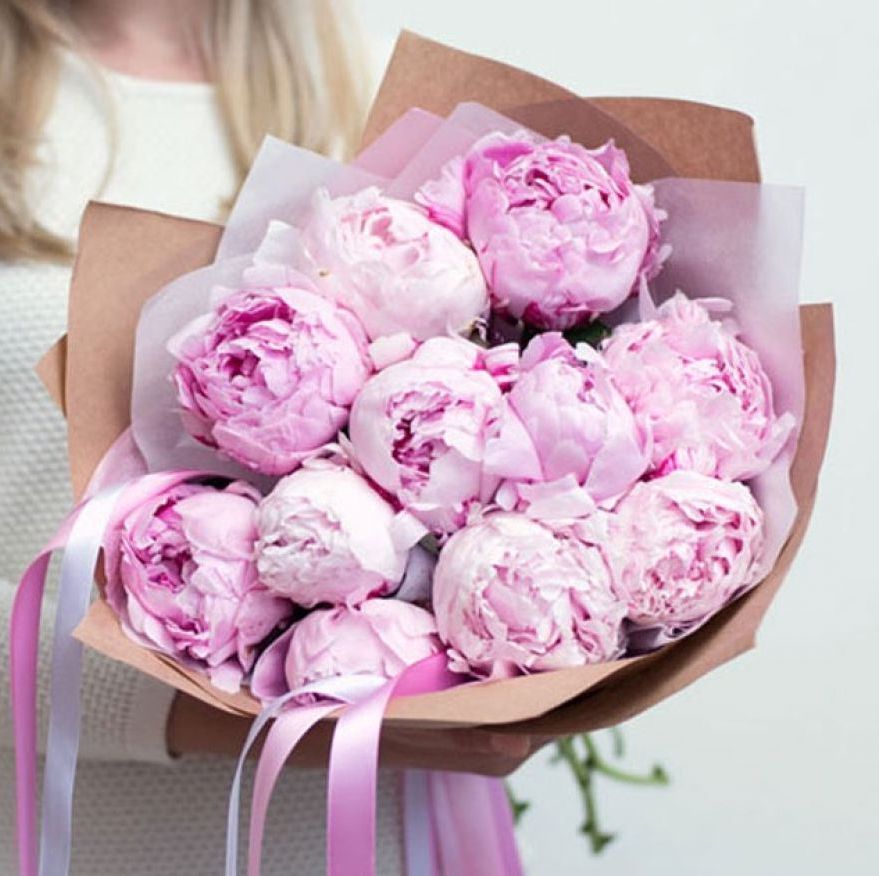
Peonies keep to a few weeks. In the Northeast the season runs from late May into early June, and from October to December the crop comes from the southern hemisphere. In their own season peonies are largest and cheapest; in the other months they are flown in from the far side of the world and cost more. Dutch greenhouse tulips are cut from December to May. Chrysanthemums, alstroemeria, gerberas, lilies and lisianthus are on sale all year, so mono bouquets of one flower are the safe choice when the date matters more than the variety. When the palette matters more than the name, there are designer bouquets.
The American calendar adds two dates of its own. Mother's Day falls on the second Sunday of May, and Thanksgiving, the fourth Thursday of November, is a holiday built around a dinner table.
Hand-tied bouquet, hat box or basket: choosing by New York address
Midtown is the largest central business district in the world, and Lower Manhattan the second financial centre. A hand-tied bouquet in paper suits a handover in person with a vase waiting at home. A doorman's desk in a prewar building, a reception on the fortieth floor or a hotel room in Midtown may have no vase at all, and the flowers can wait there for hours. For those addresses there are flowers in boxes and flower baskets: the stems stand in floral foam soaked with water, so the arrangement needs no vase and tolerates the wait.
The order form asks for what each address needs: for a hotel, the surname the guest is registered under and the room number if you know it; for an office, the company name and the floor. Where there is access control, the bouquet goes through reception and you are told who took it.
The big hospital systems ban fresh flowers in every intensive care unit, and some extend the ban to oncology and transplant floors, because standing water in a vase breeds bacteria and fungi. The manager checks the ward's rules before the bouquet is made and, if flowers are not accepted, arranges a handover at the nurses' station or on discharge. For a room full of people there are armfuls and designer giants.
What flowers cost in New York
Prices are in dollars and vary by format, not just by flower: a mono bouquet costs less than a box or basket, and designer bouquets and giants cost most of all. What is charged is the cart total, bouquet, extras and delivery included; a card in another currency is converted by your bank at its own rate, and the shop adds no fee.
Two things move the price inside a category. The first is stem length: roses are sorted into 40, 50, 70 and 80 centimetre stems, and the longer the stem, the more each flower costs. The second is the calendar. A peony in June costs less than the same peony in November, and before Valentine's Day and Mother's Day wholesale prices follow demand: about half of the roses the country imports in a year arrive for those two dates. To buy flowers in New York at a sensible price, go with the season and let the florist swap a scarce variety for a close one.
Flower delivery in New York: Manhattan, the boroughs and the handover
Flower delivery in New York is free in the centre, which at checkout means Manhattan below 96th Street, from 7 am to 11 pm. Most bouquets are delivered on the day they are ordered, and the bouquet card shows the delivery time for each one. Every other district has a flat rate that is added in the cart before you pay:
- Closer boroughs — Harlem and Washington Heights, Long Island City and Astoria, Williamsburg and Greenpoint, Downtown Brooklyn and Park Slope, the South Bronx: delivery here is a paid add-on shown in the cart;
- Further boroughs — Forest Hills and Jackson Heights, Flushing, Bay Ridge, Brighton Beach and Coney Island, Riverdale and the North Bronx, Staten Island, Jamaica and the Rockaways: delivery costs more, also shown in the cart;
- Night — 11 pm to 7 am, any zone by prior arrangement, priced individually.
The bouquet card shows the express delivery time when the florist already has the bouquet in stock, and a chosen date and time slot is available in every zone too. Around Valentine's Day, 8 March and Mother's Day the volume is several times the usual and the convenient slots go days ahead. The recipient is not called in advance unless you ask, except where a building cannot be entered without a call. If nobody is home, the courier waits up to fifteen minutes and calls the recipient; with your consent the bouquet can be left with the doorman or concierge, and you are told who took it. Zones and rates are on the delivery page.
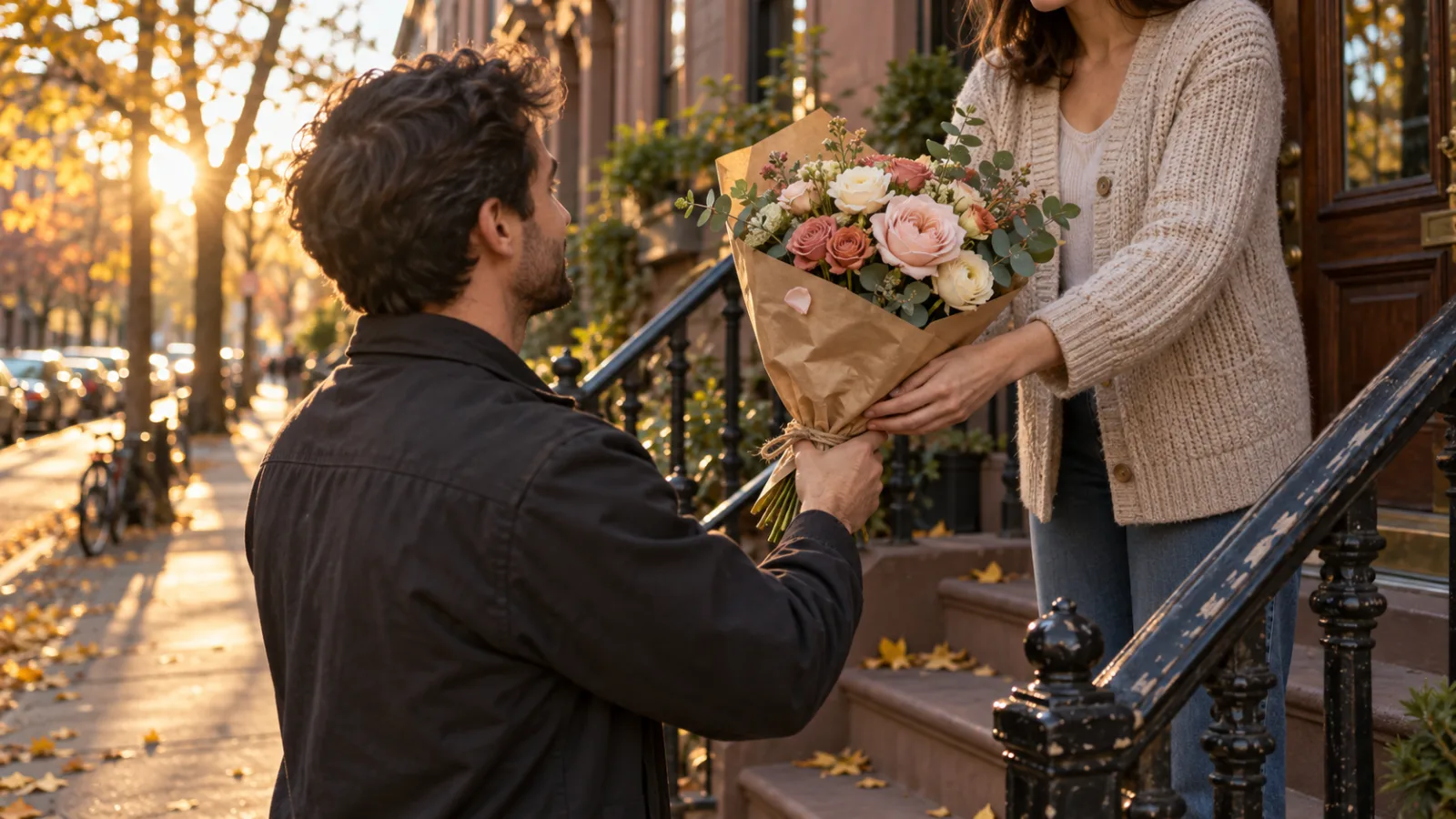
Flowers in New York can be ordered from another country, as a family with relatives in Brighton Beach might do. That stretch of southern Brooklyn has been home to Soviet émigrés since the mid-1970s, and 8 March is still a date there, though it is not a holiday anywhere else in the city. No account is needed, only a name and a phone number, and that number receives the bouquet photo and the delivery report. If you do not know the address, the recipient's phone number is enough: the manager finds out discreetly where to deliver, and the recipient learns who sent the flowers only if you sign the card.
Payment is by Visa or Mastercard from any bank, on a secure page; the courier takes no money at the door. The order can be changed while the bouquet is still with the florist, up to six hours before delivery. An address outside the listed zones, in Westchester or across the Hudson in New Jersey, is quoted before you pay. For someone landing at JFK or LaGuardia, the courier waits at the exit with the bouquet and a name card.
A bouquet in a New York apartment: steam heat and July
January in New York averages about a degree above freezing and July runs to twenty-nine by day. Indoors the enemy changes with the calendar. From 1 October to 31 May the city's heat season obliges landlords to keep apartments at 68 °F, about 20 °C, by day. The steam radiators of prewar buildings usually do a good deal more than that, drying the air and drawing water out of the petals faster than the stem can replace it; in summer the air conditioner does the same job. Get the flowers into water as soon as they arrive and keep to a few habits:
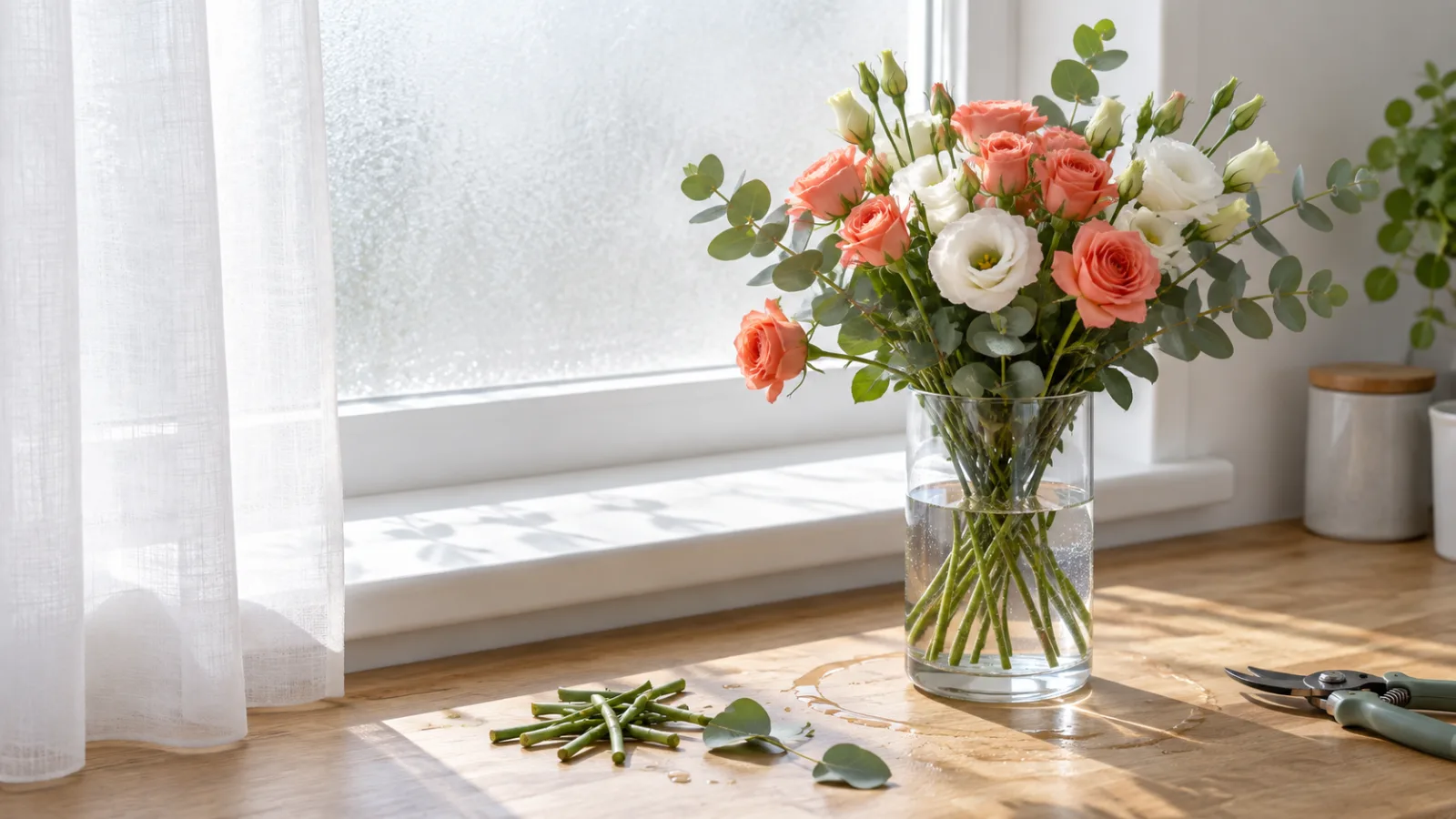
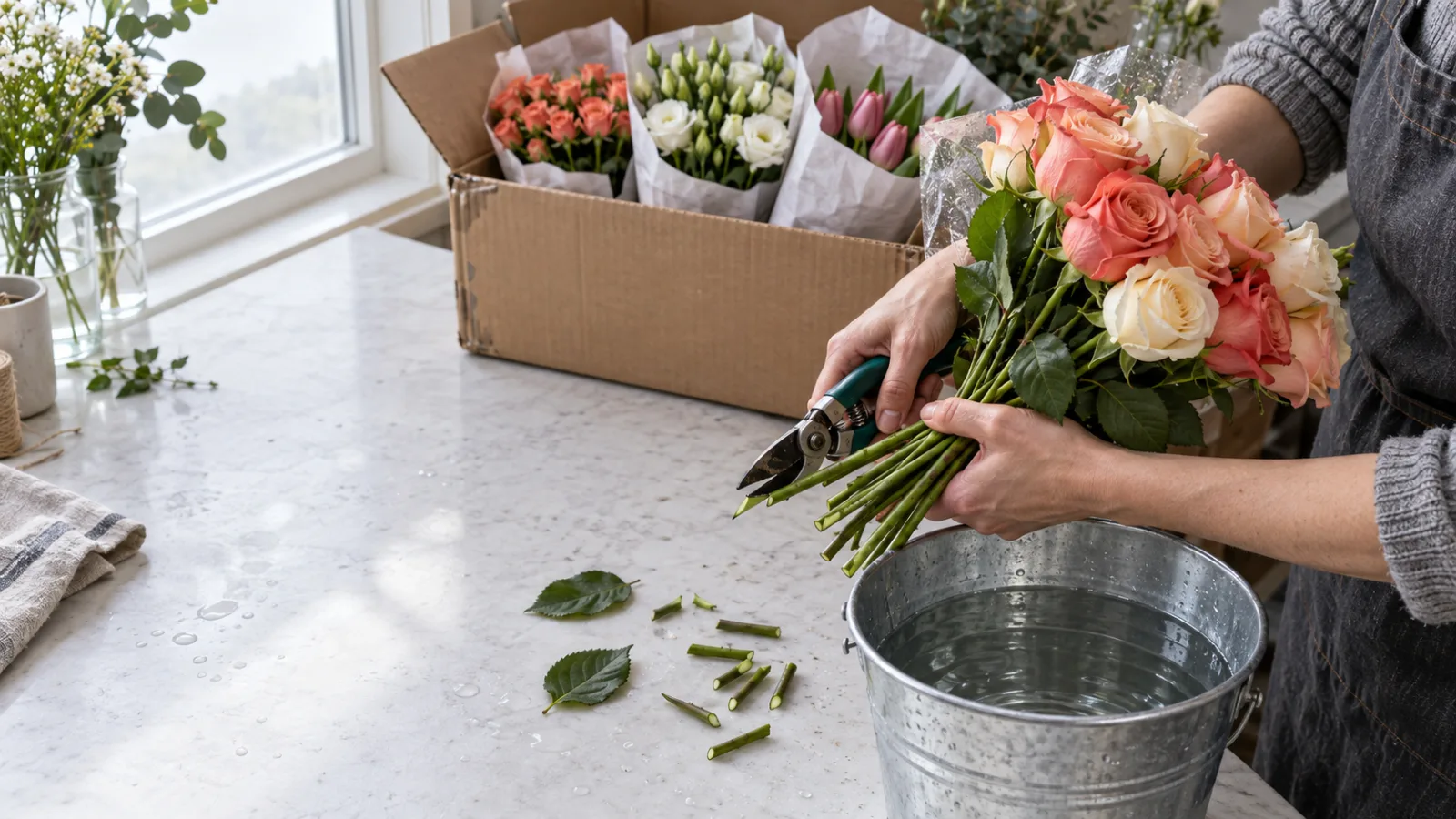
- recut the stems at an angle with a sharp knife or secateurs, taking off 1–2 cm, and strip any leaves that would sit below the waterline;
- keep the vase away from the radiator, the air conditioner's draught, the sunny window and ripe fruit, which gives off ethylene;
- change the water every day or two;
- water a boxed or basket arrangement into the foam across its whole surface and never tilt it;
- if a hydrangea droops, submerge the whole head in cool water for an hour or two.
With that routine roses last about a week, and chrysanthemums, carnations and alstroemeria two to three.