


Forever roses in Pattaya: a month to make, years to fade
Under the 1994 patent for preserving roses, a fresh rose stands for three to seven days in a warm glycerine bath and then hangs head-down for about four weeks to dry. The flower sold as lasting for years therefore takes more than a month to make. That month is what separates forever roses in Pattaya from a fresh bouquet: the rose no longer opens, no longer drinks and never needs a vase, which changes how you choose one.
What a forever rose is, and how it is made
A forever rose, also sold as a preserved or stabilised rose, is a real rose cut as it opens and treated so that it stops ageing. Its own sap is drawn out and replaced with a glycerine-based solution that the stem pulls up by itself. Glycerine holds moisture, so the petal stays soft and bends instead of turning brittle the way a dried flower does. The patent was filed by Lars Sellegaard in 1994 and granted the following year. It has the stem cut to about a centimetre below the head, so that the solution has the shortest possible path to the petals, and that is why a forever rose has almost no stem at all.
Colour goes in with the solution. Because the dye travels up the stem alongside the glycerine, the trade can offer shades no bush produces: blue, purple, black and gold heads. In the JFLOO catalogue a purple and a blue rose sit next to the red, powder-pink and white ones.
Ecuador is one home of the trade. Preserving companies work around Cayambe and Tabacundo, where roses with large heads grow at roughly three thousand metres. Head size matters here because a preserved rose stays at the exact stage at which it was cut.
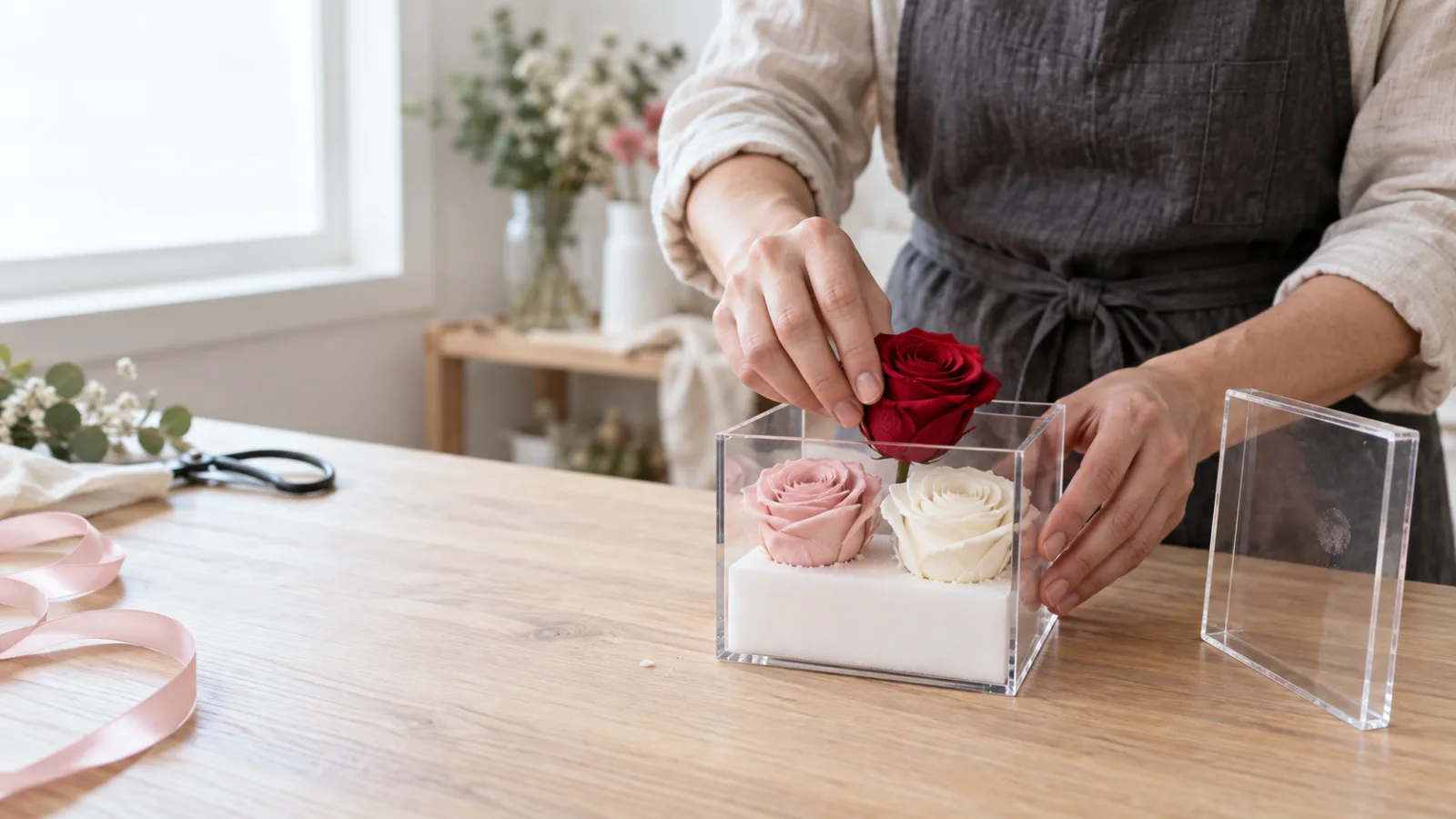
Producers quote one to three years, and the spread comes from the room rather than the rose. A rose under a glass dome sits at the top of that range because the glass keeps dust and damp off the petals.
The care list is short. Keep the rose indoors and out of direct sunlight, which bleaches the dye. Never water it or mist it, and keep it away from bathrooms and kitchens where the air stays humid. A radiator or a fireplace dries the petal, so the shelf above the heating is the wrong shelf. Dust comes off with a soft dry brush or a can of compressed air, and under a dome you only ever wipe the glass.
For contrast, a fresh rose stands in a vase for about a week, sometimes ten days, and wants its stem trimmed and its water changed. A forever rose needs none of that: no cutting, no water, no vase.

Dome, acrylic box, hat box or heart: which format suits the address
With no stem to speak of, the format is the base, and the base is chosen for the place where the rose will stand. The smallest format, roses in a glass dome, holds one or three roses under a cloche on a wooden stand and lasts longest, so it goes on a bedside table or a desk. Clear on every side, roses in an acrylic box are packed edge to edge in fours, nines and twenty-fives, and they suit a coffee table or a reception desk.
Velvet roses in a hat box hold nine or nineteen heads in a tight cap with no greenery and read as a gift before the lid comes off. Thirteen red roses laid out as a heart are sold as heart box roses, the format for a proposal, an anniversary or Valentine's Day. Nearly every count in the range is odd: one, three, nine, thirteen, nineteen, twenty-five. The four-rose box is the exception, and it is worth swapping for nine if the recipient grew up in Russia or a neighbouring country, where even numbers are kept for remembrance.
Who forever roses in Pattaya are for
Forever roses in Pattaya are bought first by anyone marking a date they want to keep: an engagement, a wedding anniversary, 14 February. A year on, the dome is still on the shelf while the fresh bouquet from the same evening is long gone. Japan's first preserved-flower competition ran in 2003, the market grew sharply afterwards, and the country is now one of the largest buyers of preserved flowers anywhere.
The second buyer is a business. A reception desk, a meeting room or a restaurant dining room can carry forever roses for months with nobody assigned to change the water. The same logic covers a recipient who is rarely at home through travel, shift work or a rented flat: fresh flowers wilt in an empty room, while a rose under glass simply waits. Ready-made picks for specific dates are gathered under occasions.
Forever roses delivery in Pattaya
Forever roses delivery in Pattaya follows the same routine as any JFLOO bouquet, with one difference: the arrangement needs no water, so it can wait at a hotel reception without coming to harm. For a hotel, the order needs the surname the guest is registered under and the room number if known; for an office, the company name and the floor. Before the courier leaves, the florist photographs the box or dome and sends the picture, so a ribbon colour or a card can still be changed.
Delivery in the city centre is free, and if the dome or box is in stock with the florist, the bouquet card shows the delivery time. Orders for a set date and hour are accepted for any zone. Nobody calls the recipient in advance unless the sender asks, the courier knows only a name and an address, and the card can be signed or left blank. Payment goes through Visa or Mastercard on the site, with nothing to pay the courier. Zones and terms are on the delivery page.
Start from where the rose will stand: a single rose under glass for a desk or a bedside table, a velvet hat box or an acrylic box of nine or more for a big occasion. Anyone unsure can message the florist, who will match a format to the occasion and budget and send a photo with the price before payment.