
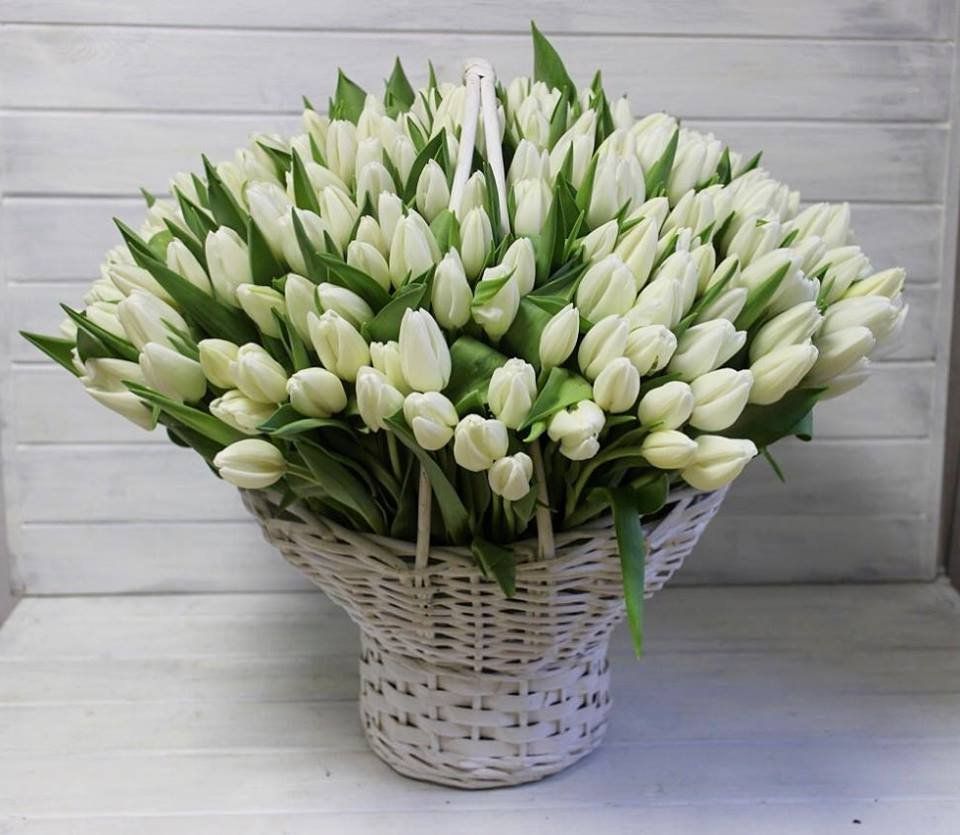

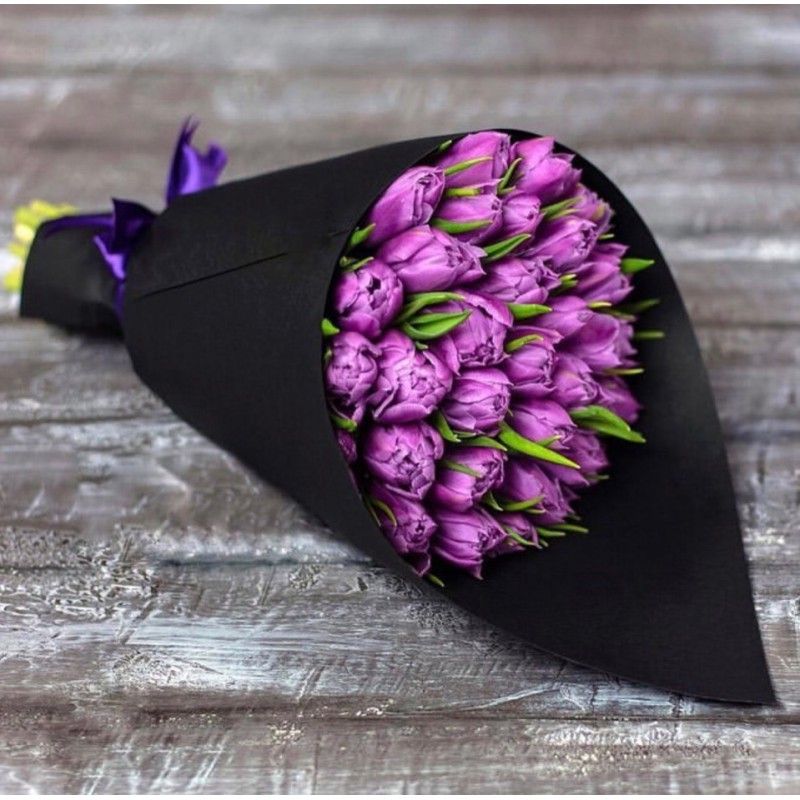


Tulip delivery in Rotterdam: the country's emblem flower, Dutch groups and freshness straight from the glasshouse
For the Dutch the tulip is no exotic — it is part of the national code. It was here, in the 17th century, that the famous "tulip mania" flared up; from here the flower spread across the world, and today the Netherlands is its largest producer. A Rotterdammer buys tulips readily and by the armful, simply to set a bunch on the kitchen table. And the proximity of the Westland and Bleiswijk glasshouses makes the bouquets genuinely fresh.
This category covers single-variety bouquets, market bunches in kraft, box arrangements and mixed builds with hyacinths, ranunculus and eucalyptus. Tulips work at any budget: a modest bunch of 9–11 stems looks no worse than a monumental armful of 51 — it all comes down to variety and presentation.

Groups and varieties in the catalogue
Over 3,000 tulip varieties are registered worldwide, and the lion's share is bred and grown in the Netherlands. Some 35–45 key ones make it onto the working shelf, sorted by bud shape, stem length and flowering character.
- Triumph — the classic cup-shaped bud, 40–50 cm stem. The most widespread group. Varieties: Strong Gold (yellow), Negrita (purple), Ile de France (red), Purple Prince (purple).
- Darwin Hybrid — large-headed, bud up to 12 cm across. Apeldoorn (scarlet), Ivory Floradale (cream). For large armfuls and accent bouquets.
- French Tulips — long-stemmed elite tulips up to 70 cm. Maureen (white), Menton (soft peach). For weddings and high-end floristry.
- Parrot — parrot tulips with fringed petals and a "torn" texture. Rococo (red), Blue Parrot (blue-violet). For signature, dramatic compositions.
- Double / Peony — double "peony-form" tulips. Mount Tacoma (white), Foxtrot (pink), Angelique (pastel pink). An alternative to peonies out of season.
- Queen of Night — an almost-black deep purple shade. A favourite of interior designers and signature floristry.
Season and main occasions
The natural tulip season is April–May, when the Bollenstreek fields near Lisse and Leiden break into stripes of colour and Keukenhof opens its gates. Through glasshouse forcing the Dutch run flowering from October to June, and the cut-flower season officially starts on the third Saturday of January — Nationale Tulpendag, which opens the tulip season across the country. That covers all the main occasions: Valentijnsdag, Pasen, Koningsdag and Moederdag. For Moederdag (the second Sunday of May) and Valentijnsdag (14 February), arrange orders seven to ten days ahead.
Rotterdam's climate suits the tulip well: a cool maritime spring is its natural element. The tulip also takes winter transport calmly: with a properly packed hydro-box the stems do not suffer, even when it is around freezing and windy outside.
A tulip quirk: it keeps growing
A cut tulip is a living plant. In the vase the stem grows another 2–3 cm in the first days, and the bouquet changes shape from day to day: by the end of the first week the tulips "lean" toward the light — that is normal and lovely, not a flaw. To keep an even shape, use a tall narrow vase that holds the stems upright.
A fresh tulip is easy to spot: a firm, cool stem, a tightly closed coloured bud, leaves without yellow spots. If the stem is warm and soft, the lot is already at its final stage. In Rotterdam we have almost no logistics haul, so every delivery is no more than one to two days from the cut.
"The tulip in the Netherlands is almost a people's flower — we grew up among these fields and glasshouses. A Rotterdammer knows the groups, can tell a Darwin from a French — it's a pleasure to talk shop with them. And they are spoiled for freshness: a tired tulip simply won't sell here."
— Joost van Dijk, florist, Rotterdam, 12 years in the trade
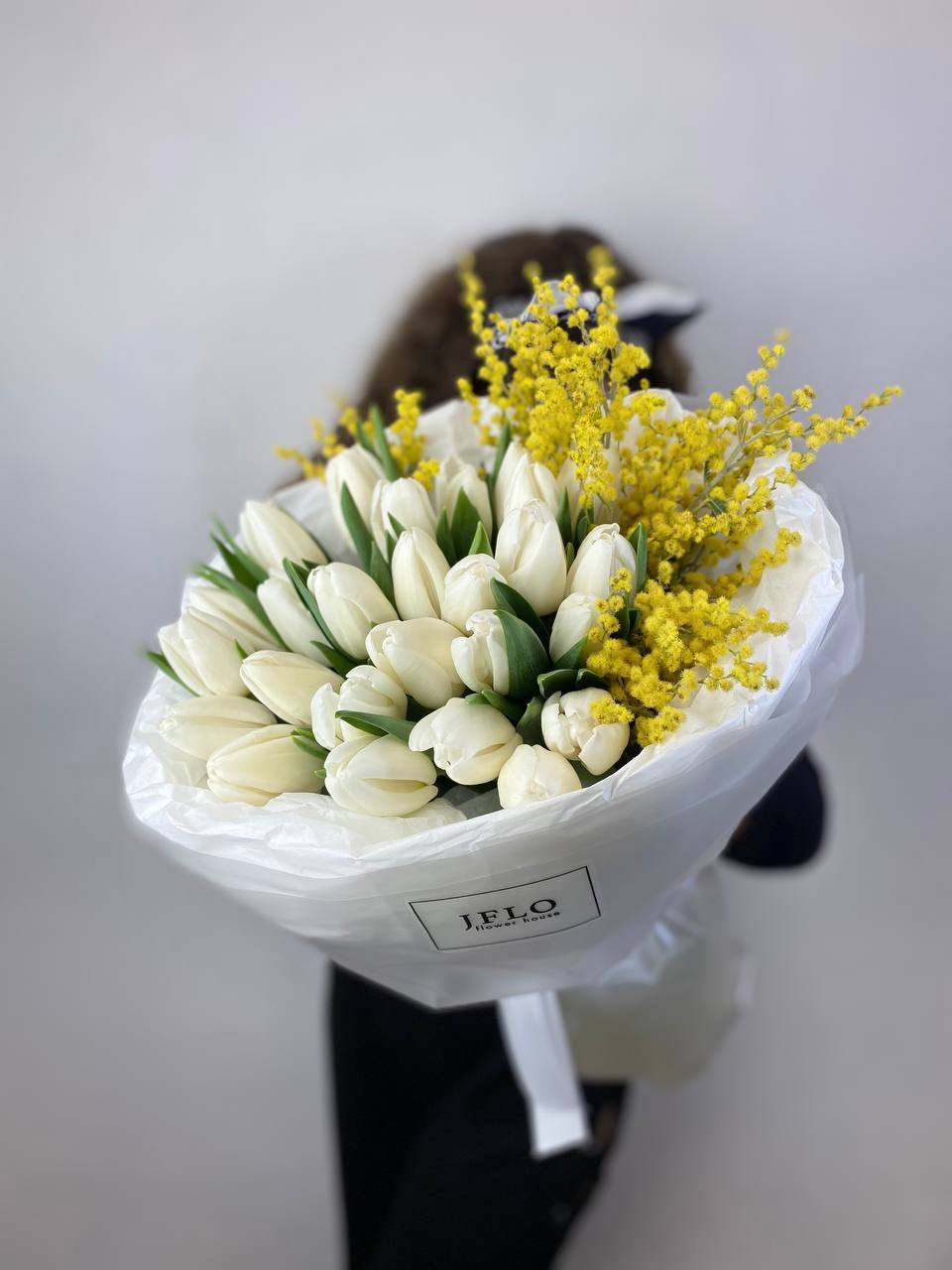
Freshness and logistics
Here Rotterdam is almost in a league of its own. The Westland and Bleiswijk glasshouses and the Royal FloraHolland auction sit 15–25 km from the city, and a tulip cut in the morning reaches the bouquet the same day. We carry tulips in cold hydro-boxes, stems in water at +6 to +8 °C until delivery. A recipient in Kralingen or Noord gets the full flowering cycle of 5–7 days with proper care — and that with minimal time in transit.
Delivery specifics in Rotterdam
Rotterdam has a maritime climate: mild, damp winters around +2 to +6 °C, moderate summers of +18 to +22 °C, North Sea wind and changeable weather year-round. The tulip is well adapted to this, but damp and wind in the wrapping are best avoided, so in winter bouquets travel in thermal bags with the bud protected from moisture. The best season for delivery is March–May and September–October.
We deliver tulips across all districts of Rotterdam: Centrum, Kralingen, Delfshaven, Hillegersberg, Noord, Kop van Zuid, Charlois, IJsselmonde, Prins Alexander and Hoek van Holland. Payment is in euros (€, EUR). Order ahead — three to seven days, and a full week for Moederdag.
Home care
The tulip needs a different approach from roses. The key rules: cold water only, +6 to +10 °C; re-cut with a straight (not angled) cut every two days; a minimal water level of 5–7 cm from the bottom. The tulip cannot stand deep water — the stems start to rot.
Do not place tulips next to daffodils without preparation: daffodil sap speeds ageing by 30–40%. If you want a mixed bouquet, keep the daffodils separately for 24 hours, rinse the stems and only then add them to the shared vase. Rotterdam flats are heated to +20–22 °C in winter — keep tulips by a cool window, away from the radiator. At night you can move them to an unheated hallway: that adds 2–3 days of life.

