



Bouquets in San Francisco: what's in them, which colour, how they arrive
San Francisco's Bouquets section keeps a dedicated Bouquets in Planters subsection right next to kraft paper and bags, so the first thing to settle about bouquets in San Francisco is whether the flowers will be held or left to stand on their own. After that comes the flower mix, then the colour, then the form the bouquet takes on arrival, and this guide follows that order.
Ecuadorian roses, spring hyacinths and no dahlias in the mix
The flowers section carries Ecuadorian and French roses, lisianthus, lilies, gerberas, hydrangea, peonies and hyacinths; the US cut-flower market relies heavily on imports. Almost four-fifths of the cut flowers sold in the United States are imported, Colombia supplies more than half of that total and Ecuador around a quarter, while California grows roughly seventy per cent of the flowers the country cuts at home. No single stem in the catalogue can fairly be called a local one.
Hyacinth is a spring bulb flower native to the northern hemisphere, so it tends to show up in a bouquet as the season turns toward spring rather than through the summer or autumn months. A French rose is not a separate variety: it is an ordinary rose whose outer petals a florist turns back by hand to open the bloom wider.
The dahlia has been the city's official flower since 1926, though it sits outside the bouquet catalogue entirely; anyone set on one can look through flowers in San Francisco instead.

Bouquet delivery in San Francisco: settle the colour for the family first
The Bouquets by Color subsection lets a buyer start from a palette instead of a single flower, which helps when the recipient's taste is a guess rather than a certainty. Victorian flower dictionaries read white as purity, red as passion and pink as a softer version of the same feeling, though no single agreed list of meanings ever existed.
Chinatown and Chinese-American families in the city keep a different tradition, where white flowers and yellow chrysanthemums belong to mourning and are not given as gifts. For a family like that, the whiter end of the palette is the one to skip, which makes the colour subsection worth a look before the flower one. Among the single-flower options, something like eleven red French roses sidesteps the question by keeping to one shade throughout.
Every bouquet here is put together to order once payment clears, and a photo of the finished arrangement goes to the sender before the courier leaves. Most orders reach their recipient the same day they are placed, and delivery zones and timing are set out on the delivery page. Dates such as Valentine's Day or Mother's Day are worth ordering ahead for, since the easy slots go first.
Kraft paper, a planter or a giant: how the bouquet arrives
That is the real decision behind sending bouquets in San Francisco: whether the flowers get carried or left to stand. Kraft paper and a bag both suit a bouquet that will travel in hand and go into a vase once it arrives. A bouquet wrapped in kraft paper is the plainer of the two, with nothing more claimed for it than that.
A planter solves the opposite problem, for a recipient who might not own a vase at all: the flowers travel in their own container and stay there once delivered. Size runs from a small compliment bouquet, suited to a quick thank-you, up to a giant arrangement built from a far larger armful of stems.
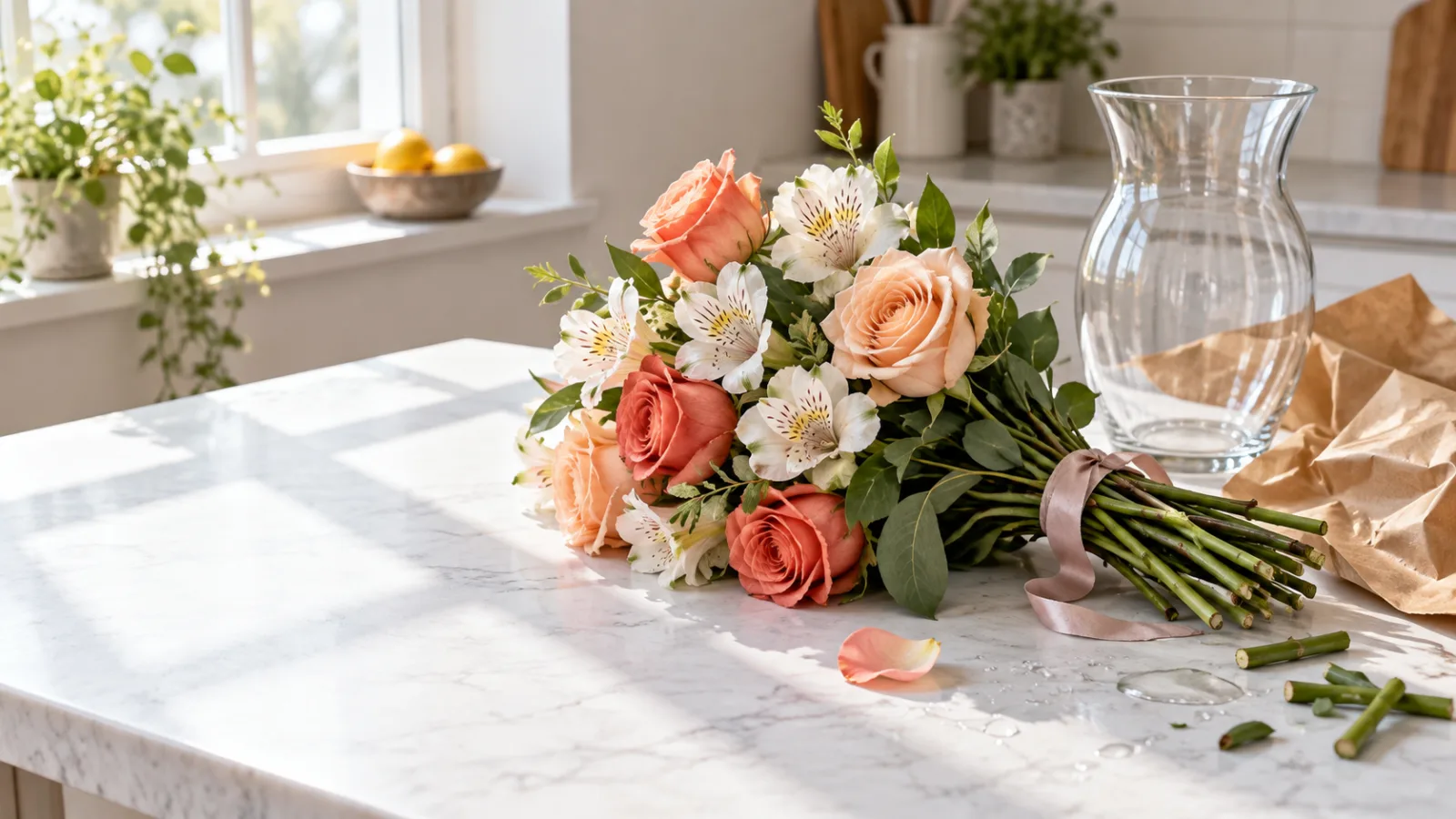
Anyone who has seen a bouquet they liked, rather than described one, can send the photo in chat, and the florist replies with similar work and prices attached before any payment is taken. A bouquet that arrives wrapped still needs a minute's work before the vase: the paper comes off, the stems are cut at an angle, and any leaf that would sit below the waterline is stripped away.
Start with choose by colour if the recipient's taste matters more than the flower, or try bouquets in planters if a vase is in doubt. Giant bouquets suit a bigger gesture, and a bouquet from your photo works once you already know the look you want.