


Red roses in San Francisco: a cold journey, then the right stem, count and format
Red roses in San Francisco begin their journey in the cold. In the US alone, more than 250 million roses are grown for Valentine's Day, and Colombia ships around 1.5 billion stems a year against Ecuador's roughly 1 billion. Most of them fly north in chilled holds at about 1–2 °C, and from farm to shop the cold chain holds the flower at around two degrees. Every hour it then spends in the warm shortens its life in the vase. What is left for the buyer to decide is the stem, the count and the format, and at JFLOO each bouquet is put together to order once payment clears.
Dutch, tall or French: what sets one red rose apart
Dutch roses are greenhouse-grown classic varieties, and their stems run shorter than those grown in Ecuador. The longest stems in the trade come from Ecuador, where farms sit at around 2,800–3,000 metres and daylight holds close to twelve hours all year. Those roses can run from 70 centimetres to a metre or more. The tall roses in this section, such as the "25 Tall Red Roses" and the "Tall Country Roses", are not labelled by country here, so length is the only claim worth making about them. A "French" rose is not a variety or a country of origin: it is a technique, where the outer petals are bent back by hand until a tight bud opens into a wide, layered head. The "11 Red French Roses" and the "201 French Red Roses" are both finished this way, and the technique works on almost any long-stemmed rose. The same shaping shows up across the full rose collection.

Victorian flower dictionaries read red as passionate love, though the books never agreed on a single list of meanings, and rival editions gave the same bloom different ones. In the US, 83% of the flowers bought for Valentine's Day in 2022 were roses, and 65% of those were red, which says a lot about how firmly the colour is tied to the day. That preference is easy to trace among roses sorted by colour. The counts in this section are all odd, from eleven up to two hundred and one. In Russia, Ukraine, Belarus and most of the former Soviet Union, an odd number is what you give the living, while an even number is kept for remembrance. Outside that custom, a dozen is the ordinary choice. Valentine's Day and Mother's Day are the busiest dates for red roses in San Francisco, and around them the convenient slots go first, so ordering a few days ahead leaves more room to choose.
Ribbon, box or basket: choosing a format for red roses
A ribbon-tied bouquet, such as the "15 Red Roses with Ribbon" or the "35 Red Roses with Ribbon", needs a vase soon after it arrives. A box, like the "45 Red Roses in a Box 'Senorita'", holds its stems upright in wet floral foam, a material invented in 1954. The foam is watered daily in a thin stream across its whole surface. A basket, such as the "101 Red Roses in a Basket", works differently: wicker does not hold water, so it is lined and fitted with its own block of foam, and needs no vase. Not every bouquet here stays strictly red: the "Bouquet of 15 Red and White Roses" pairs the colour with white, for anyone who wants it softened rather than solid.
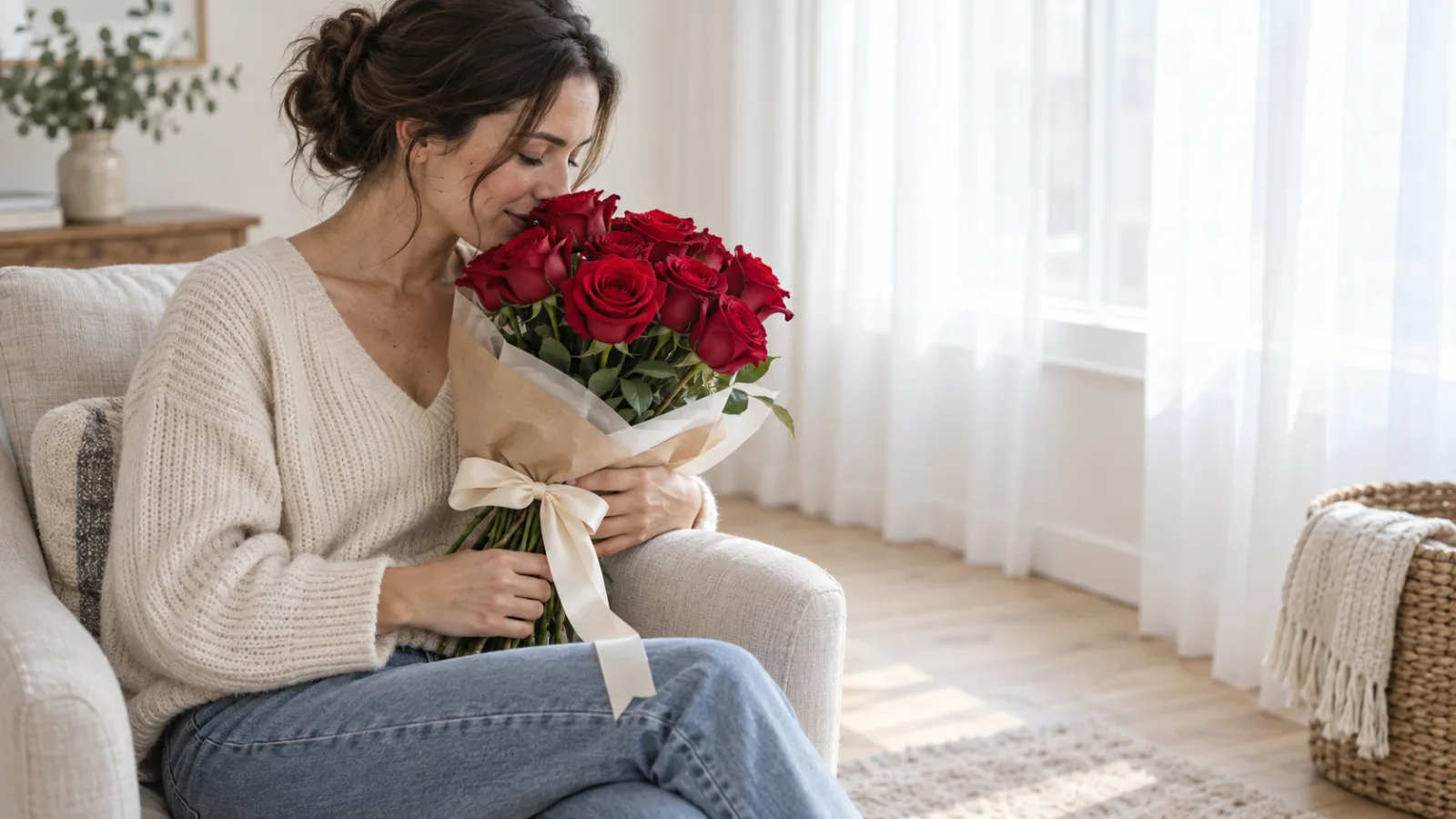
Before a courier sets off, the finished bouquet is photographed, and that photo is the last chance to ask for a change to the arrangement. If a particular shade of red is out of stock, the florist substitutes a close rose in tone and price, visible in the same photo — worth checking, since a shift is easy to spot. The card is free and does not need a signature; the recipient's phone number is enough to arrange everything. Delivery to the centre in San Francisco costs nothing, and most orders reach the recipient on the day they are placed, though the timing for a given bouquet appears on its page, alongside the delivery page. A red rose usually lasts about a week, sometimes closer to ten days. Keeping it that long comes down to a short routine:
- cut the stem at an angle
- strip any leaves that would sit under water
- change the water every day or two
- keep the vase away from radiators, direct sun and a bowl of fruit
Choosing where to start is easiest with the full rose collection, or narrower still with roses sorted by colour if red is only one option being weighed. For anything beyond roses, the wider flower catalogue covers the rest.