


White Roses in Sharjah: Dutch, Tall or French, and How to Choose
White roses in Sharjah are sold under names that describe where the stem grew or how the flower was shaped, and in the same section "Dutch" and "Tall" roses sit side by side. Ecuadorian stems run from seventy centimetres to a metre and more, while Dutch greenhouse classics are usually shorter, so two white bouquets with the same stem count can look different in height before you count anything. The choice really starts with height, stem count and format.
Dutch, French or tall: what the names in the section mean
Dutch roses are greenhouse classics, grown under glass in the Netherlands and cut on a shorter stem than the tall roses standing next to them in the same section. Roses grown at altitude in Ecuador have some of the longest stems in the trade, from seventy centimetres to a metre and more.
French is not a country of origin or a variety: it describes what a florist does with the flower after it is cut. Working petal by petal, the florist turns back the outer layer of a tight, closed bud by hand, a technique called reflexing, until the head opens into a wide, many-layered rose. The result looks fuller and more open than an unreflexed bud of the same size.
Named bouquets such as "Rybka" or "Notte Bianca" are simply how the section labels particular arrangements on the shelf, not separate rose varieties, so there is no meaning to look for behind the name. What matters when choosing between the options is the stem itself: Dutch for a shorter, classic head, tall stems for length, French for an open, layered bloom.

The section is built around a fixed scale, from eleven stems up to a hundred and one, and each step changes the look of the bouquet. Eleven or thirteen stems make a compact hand-tied bunch, twenty-five and fifty-one fill out into a fuller round shape, and a hundred and one white roses reads as a statement rather than something you tuck under one arm.
Counting roses has a tradition worth knowing before choosing between the options. In Russia, Ukraine, Belarus and most of the former Soviet Union, an odd number of stems goes to someone living, while an even number is reserved for remembrance; outside that tradition a dozen is the usual choice. The section's scale — eleven, thirteen, fifteen, nineteen, twenty-five, fifty-one and a hundred and one — keeps to odd numbers throughout, so the count already fits the custom.
A hundred and one white roses come in two different shapes on this shelf: the "Bunch of 101 White Roses" is gathered loosely by hand, and the "Bouquet of 101 White Roses" is arranged and finished by a florist. Both hold the same number of stems, so the choice between them comes down to how formal the finished shape should look.
White on its own or with pink and red, wrapped or boxed
White roses stand alone in the mono bouquets that give the section its name. The same shelf also mixes them with colour: "11/15 White and Pink Roses" pairs white with a blush shade, while "Bouquet of 15 Red and White Roses" sets it against deep red. "101 Roses Mixberry" folds white into a wider mixed palette.
Wrapping changes how the bouquet is carried and handed over:
- Designer wrapping — finishes the stems in paper chosen to match the flowers.
- Coffee-coloured wrapping — wraps the stems in a plain warm brown.
- Purse — gathers a smaller bouquet, fifteen white roses for instance, into a fabric handle bag that can be carried like an accessory.
A box holds the stems differently again: instead of a paper wrap or a vase, the roses sit in floral foam soaked with water inside the box itself. The foam is watered every day in a thin stream over its whole surface, and the box should never be tilted, or the water pools on one side while the stems on the other dry out.
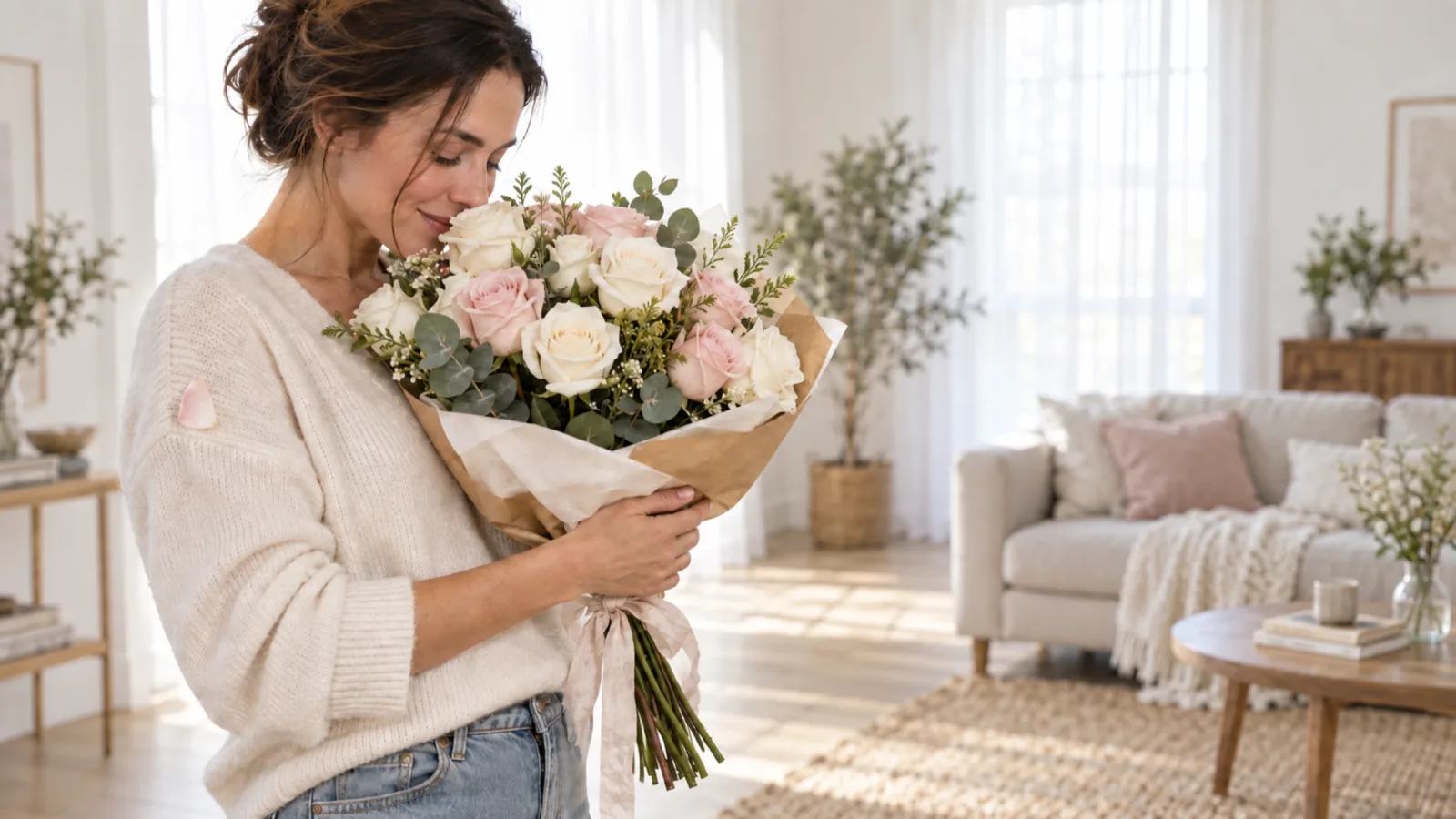
Every bouquet in the section is put together to order, and the flowers themselves are bought only after payment goes through. Before the courier leaves, the florist sends a photo of the finished bouquet, and that photo is the moment to ask for a change if something looks off.
If a particular white rose is out of stock on the day, the florist substitutes it with a flower close in shade and price, and that substitution shows up in the same photo rather than as a surprise at the door. A card comes with every order at no extra cost, and it can carry a message or stay unsigned if the sender prefers to remain anonymous. Where there is no address to give, the recipient's phone number is enough.
Payment is taken online by Visa or Mastercard, and the courier brings flowers only, with nothing extra to pay at the door. Most orders are delivered on the day they are placed, though the timing for each bouquet is shown on its own product page; coverage and details sit on the delivery page.
How long white roses last in a vase
A white rose typically lasts about a week in a vase, and a well-kept stem can stretch closer to ten days. Getting that out of the bouquet starts with the cut: trim each stem at an angle before it goes into water, and strip off any leaf that would otherwise sit below the waterline.
Change the water every day or two, since it clouds faster once leaves or petals have been sitting in it. Keep the vase away from radiators, direct sun and a bowl of ripe fruit, all of which speed up how quickly the flowers age.
White is one shade among many in roses sorted by colour, useful for comparing it against red, pink or yellow before deciding. For every stem count and wrapping in one place, the full rose section covers the whole range, and all flowers opens the wider catalogue beyond roses.