


Floralariums in Beijing: open glass gardens with succulents
In 1829 London doctor Nathaniel Ward found a fern and grass sprouting inside a sealed jar; by 1833 his glazed cases had carried plants to Sydney and back, the direct ancestor of the florarium. Ward's case was closed glass, while floralariums in Beijing here are open geometric shapes holding succulents, so the first choice is the shape of the glass and the plant inside it.
Open glass or closed: what kind of florarium this is
A closed florarium runs its own water cycle: moisture rises from the soil, settles on the glass and drips back down, which suits moss and fern more than plants that prefer dry air. Succulents and cacti do better in an open bowl, since a lid would trap humidity they don't need.
The range here sticks to open glass, in five shapes: cube, truncated cube, icosahedron, dodecahedron and droplet, each holding a plant in full view with no lid to open or close.
A closed florarium is watered with a spray bottle, only once the condensation on its walls has cleared. The idea has history: in the 1840s, Ward's sealed cases carried tea plants from China to India, keeping them alive through a voyage no open pot could survive.
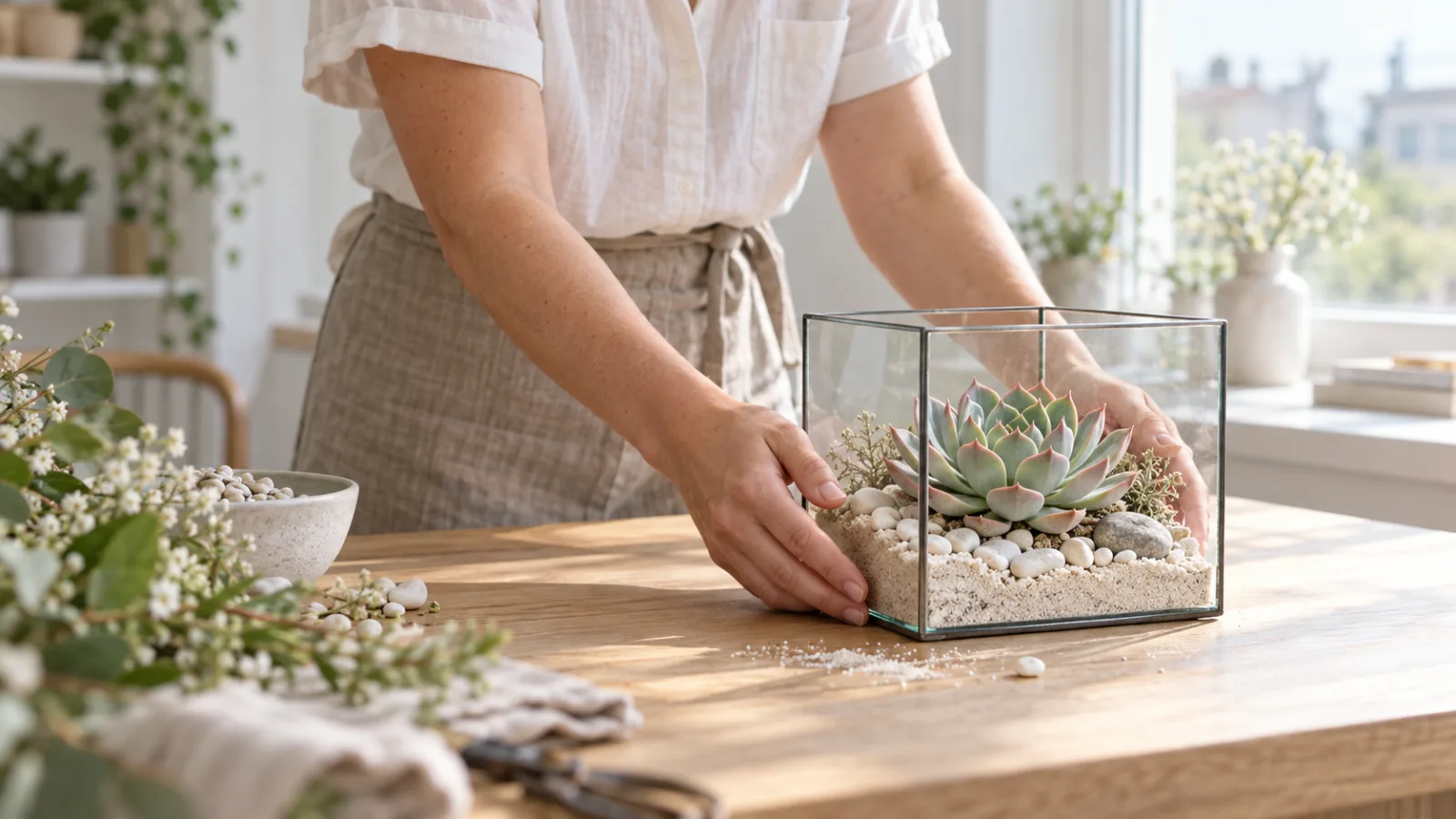
A succulent stores water in thick, fleshy leaves or stems that can hold up to nine-tenths of the plant's weight. A waxy or slightly fuzzy skin and fewer pores cut down on evaporation, letting the plant go without rain for long stretches.
Most succulents come from hot places where rain falls rarely, and roughly a third of all species grow wild in South Africa. Stone rose is the trade name for a rosette-shaped succulent sold here, its tight ring of leaves close to the rim of the pot. Sedum, haworthia, hobbit and hobbit jade fill the rest of the pots, each a different shape and shade of green under the same open glass.
ZZ plant and peace lily in geometric pots
Two plants in the range skip the glass and sit in geometric pots instead: the ZZ plant in an icosahedron pot, the peace lily in a pentagon pot. The ZZ plant comes from east Africa; its leaves are about 91 per cent water, held in reserve by a rhizome underground. In low light it can go around four months without watering, though long shade doesn't suit it, and it grows slowly enough that a small pot works for years. Eaten, it's poisonous, so keep it out of reach of anyone who might chew the leaves.
The peace lily isn't a lily: its white "flower" is a spathe, a leaf-like sheath wrapped around the small spadix at its centre. It prefers shade to direct sun and is watered about once a week. Unlike a true lily, it's only mildly toxic, though it's still worth keeping away from a curious pet.
Floralarium delivery in Beijing: card, add-ons and a photo first
Floralarium delivery in Beijing starts with a photo: before the courier leaves, the finished florarium is photographed and sent to the sender, who can still ask for a change. A card goes with it free of charge, left unsigned for anonymity or signed as asked, and balloons or sweets can be added at checkout.
Delivery to the centre is free, as shown on the delivery page, and most orders are handed over on the day they're placed; the exact timing shows in the product card. Payment is taken by Visa or Mastercard, and the total in the cart is final once confirmed.
A florarium makes a fitting companion gift alongside dried flowers, since neither needs a vase. Flowers in boxes suit the same kind of address, and the cart also lists gifts to go with bouquets to send alongside either one.