


Dutch Roses in Karlovy Vary: Greenhouse Classics and How to Choose Them
Dutch roses in Karlovy Vary take their name from the Netherlands, home to the Aalsmeer auction, which handles around forty million flowers a day and ranks among the largest cut-flower marketplaces anywhere. The label points to a greenhouse tradition of classic varieties, not to a trip through that auction floor itself. With the breeding line settled by the name, what is left to choose here is colour, the number of stems and how they are wrapped.
What makes a rose Dutch
A Dutch rose is not a variety of its own; it is a rose bred and cut in Dutch greenhouses, among the classic lines growers there have worked with for decades. The Netherlands built its position on Aalsmeer, where the flower auction moves around forty million stems a day and stands among the largest cut-flower marketplaces in the world. That scale is why the word "Dutch" reads as a mark of the trade rather than of one grower or one field.
For a florist, a rose is a workhorse flower. Each stem usually carries a single head, and that is what gives a hand-tied bouquet its weight and its centre: a dome of even, rounded blooms rather than a spray of small ones. In this range Dutch roses sit in the same grid as roses labelled Tall, and the two are told apart by name and photograph, not by colour or shape alone. The wider range of roses groups both together by shape and colour, which is the quickest way to compare them side by side.
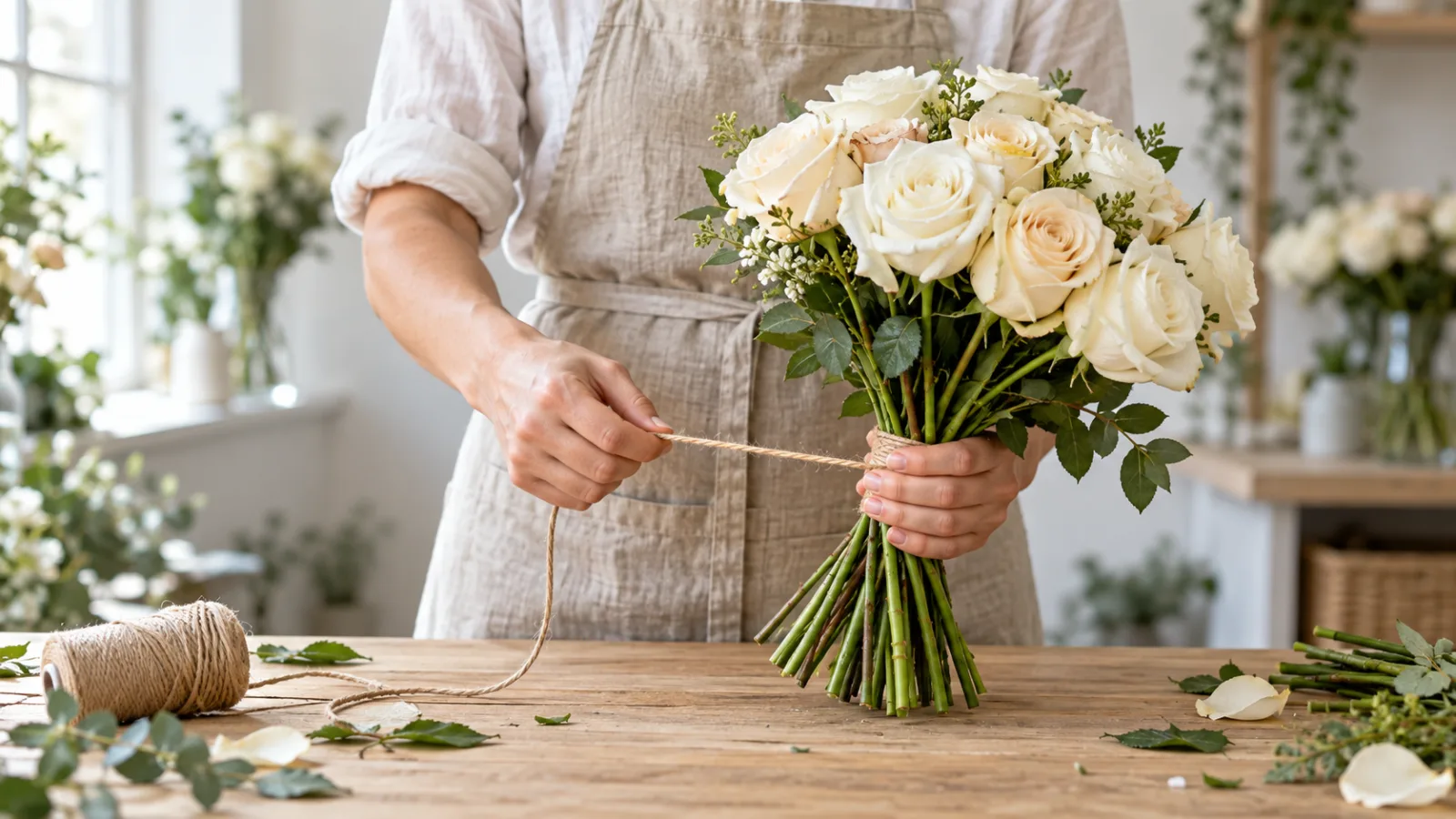
Stem length is where the two ranges pull apart. The longest roses on the market are grown in Ecuador, on Andean slopes at around 2,800 to 3,000 metres, where the day holds close to twelve hours all year; their stems commonly run from seventy centimetres to a metre or more. Dutch greenhouse roses are cut shorter as a rule, though the range here does not give an exact figure for any one bouquet.
That difference shows up inside a single colour. "25 Dutch White Roses" and "51 Tall White Roses" share the same white, but the plant behind each name is not the same height, and only the name and the photograph in the listing show which is which. The other rose types in the wider range follow the same rule: read the title before the picture.
Choosing colour, count and wrapping for Dutch roses
The grid holds three colours: white, cream and red. Victorian flower dictionaries read red as passion and white as purity, though no single dictionary was ever agreed on, and the meanings shifted from one book to the next.
Counts run from eleven to a hundred and one, and every number in the range is odd. In Russia, Ukraine, Belarus and most of the former Soviet Union an even number of flowers is brought to a grave, so a bouquet for a living person stays odd; outside that custom a dozen is a perfectly ordinary gift.
Wrapping marks the rest of the choice.
- 11 Dutch Roses in Wrap — sleeved in film, straight and simple.
- Red Roses with Ribbon — a tied ribbon runs through the stems.
- Dutch Roses with Styling — greenery added around the stems.
- 101 Dutch Roses — gathered loose, as an armful, with no wrap at all.

Each bouquet is put together to order here: the florist buys the flowers only after the order is paid. A photo of the finished bouquet goes to the sender before the courier leaves, and there is still time to ask for a change once it arrives. If the exact rose asked for is out, the florist substitutes one close in shade and price, and that swap shows up in the same photo.
Delivery in the city centre is free, most orders go out on the day they are placed, and the how delivery works page shows the time window for a given bouquet. A street address helps, but the recipient's phone number is enough on its own.
On arrival, three things keep a rose going. Cut each stem at an angle with a sharp knife, strip any leaf that would sit under water, and change the water every day or two, keeping the vase away from radiators, direct sun and fruit bowls. Kept this way, a Dutch rose lasts about a week, sometimes closer to ten days.
Where to start: the full range of all roses sits one level up, sorted by shape and colour rather than by name. For an arrangement that fills a table instead of one vase, the broader flowers section covers other shapes entirely.