


Mixed bouquets in Kemer: what belongs together in one bunch, and why
In 1929 Constance Spry opened a London shop called Flower Decoration and dressed the window of Atkinsons, a perfumery on Old Bond Street, with plants from the hedgerow that no florist of the day would have sold. Passers-by stopped in crowds, and hedgerow greenery beside hothouse flowers, kale beside roses, became the look she was known for. A mixed bouquet still turns on the same question, and mixed bouquets in Kemer in the JFLOO catalogue answer it with a few working rules about roles, colour and vase life.
What a mixed bouquet is, and when it beats a single-flower one
The catalogue keeps three neighbouring sections. A single-flower bouquet is one variety, read at a glance: roses, tulips or peonies and nothing else. A designer bouquet is a florist's own composition, often with unusual varieties and a shape built around an idea. A mixed bouquet sits between the two: several kinds of flower in one bunch, put together by rules of combination rather than an author's concept.
It is the safer choice when the recipient's taste is only half known. One variety can miss, but among three or four one of them is likely to please.
Focal, line, filler, foliage: how a florist builds a mixed bouquet
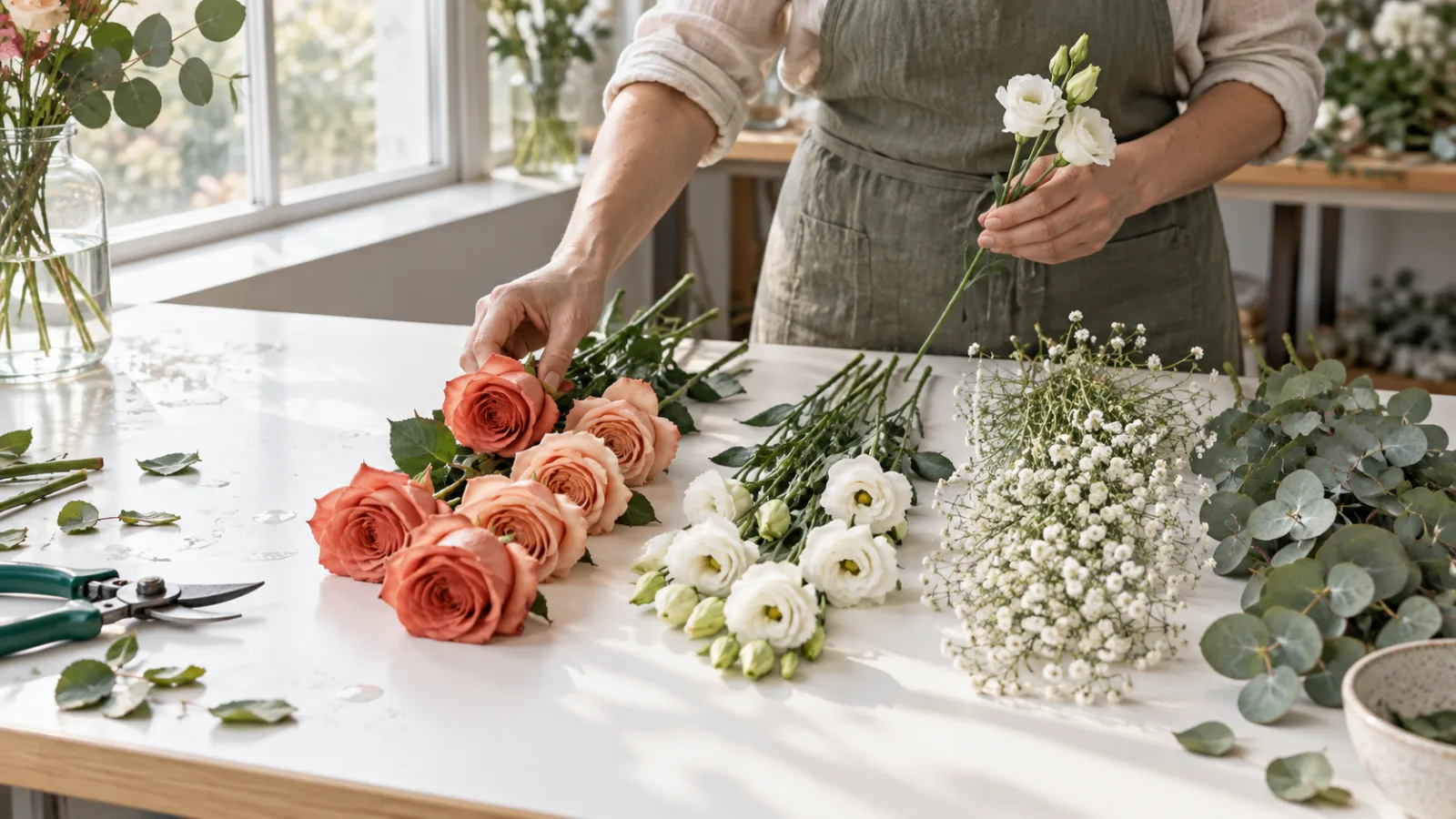
Florists sort flowers by the job they do in a bunch. Large round heads carry the weight and draw the eye first: roses, gerberas, hydrangeas, lilies, chrysanthemums and, in season, peonies. Tall spikes such as gladiolus, delphinium and stocks draw the outline and set the height. Small-flowered fillers, among them gypsophila, statice and spray chrysanthemum, put air between the heads, and foliage, most often eucalyptus or ruscus, ties the whole thing together and defines the edge. In "Roses with Lisianthus" the roses are the focal flower and the lisianthus sits a size down beside them.
A rose lasts about a week in water, sometimes ten days, while chrysanthemums, carnations and alstroemeria go on for two or three weeks. A tulip keeps growing after it is cut and changes the shape of the bunch within a day or two. So a florist matches neighbours with similar vase life and places the short-lived flower where it can be pulled out without collapsing the shape.
Some flowers are bad company. A daffodil releases a slimy sap from the cut that blocks the stems around it and shortens their life, so it is conditioned alone for about a day and then not recut. A lily is a poor gift for a house with a cat: every part of the plant, including pollen and vase water, is toxic to cats. After the handover, the care is the same for any mixed bouquet:
- cut the stems at an angle with a sharp knife and strip any leaves that would sit below the waterline;
- change the water every day or two and keep the vase away from radiators, direct sun and ripe fruit;
- take out a fading flower straight away, and when half the flowers are done, rebuild the rest into a smaller bunch.
One palette or a contrast: choosing the colours
Colour is the simplest filter, and the catalogue sorts bouquets by colour. Florists borrow the painter's schemes: shades of one colour, neighbours on the wheel such as pink, peach and coral, or two opposites like violet and yellow for the strongest contrast. A bouquet in one palette is calmer and hard to get wrong; a contrasting one is noticed across the room but asks for confidence in the recipient's taste.
The occasion narrows both palette and contents. A birthday usually gets a bright mix with big heads, a thank-you or a business meeting is safer in restrained white and green, and for a declaration roses are often softened with lighter company. Ready selections by date are gathered under Occasions. If the choice still will not settle, the florist can be messaged with the occasion and budget and will send a few options with photos and prices before anything is paid.

Mixed bouquets in Kemer depend on the season more than single-flower ones, because several varieties arrive on several timetables. Roses, chrysanthemums, carnations, gerberas, alstroemeria and lisianthus are greenhouse crops available all year; peonies, tulips, lilac and ranunculus appear for weeks or months.
JFLOO makes every bouquet to order and buys the flowers for that order after payment. If a flower from the picture is not in the delivery, the florist substitutes one close in shade and price. The substitution is visible in the photo of the finished bouquet sent before the courier leaves, and anything can still be changed at that point. When a particular flower is the point of the gift, a single-flower bouquet of what is in season is the safer order: roses all year, peonies in late spring and early summer.
Delivery in the city centre is free; other districts carry a fixed price for their zone, added to the order before payment. Most orders are handed over on the day they are placed, and if the bouquet is already in the studio, the bouquet card shows how fast express delivery can go after confirmation. A set date and time can be booked for any zone, and the earlier the order, the more slots are open; before 14 February, 8 March and Mother's Day the convenient ones go days ahead. Zones and rates for Kemer are on the Delivery page.
The recipient is not called in advance unless the sender asks, and the courier knows only a name and an address; the card, which goes in free of charge, is the only thing that says who sent the flowers. Payment is by Visa or Mastercard, the cart total is final, nothing is paid to the courier, and orders are accepted around the clock.
Start with the palette and the occasion: one palette for a quiet gesture, a contrast for a celebration with guests. For a hotel or office where the flowers may wait for the recipient, flowers in boxes stand in wet floral foam and need no vase at all.