





Plants in Melbourne: from the Garden Show halls to a desk or sill
Each late March or early April, the Melbourne International Flower and Garden Show fills the Royal Exhibition Building and the surrounding Carlton Gardens, drawing more than 100,000 visitors to what has been, since 1995, the southern hemisphere's largest horticultural event. Plants in Melbourne are chosen the same way a visitor picks a favourite garden bed there: by where the plant will stand: on a desk, sill or shelf, and by who is actually going to water it.
Moth orchids in Melbourne: a jute pot, a hat box, roses alongside
The flowering plants in this section lean heavily on orchids, and the florists set them up in different ways. One moth orchid comes planted in a jute pot with a few roses beside it, sold as Orchid and Roses in Jute Pot. Another sits in a hat box next to lisianthus, as Orchid and Lisianthus in a Hat Box. A third keeps the orchid company with chocolate rather than a second flower.
The genus name, Phalaenopsis, comes from the Greek for moth, after the shape of the open flower. Grown as a houseplant, it stays in bloom for two to three months before the spike needs a rest.
What makes it flower again is temperature: a new spike forms once daytime readings drop below 27°C, and a Melbourne January sits right at that mark, with direct summer sun strong enough to scorch the leaves. Through summer the orchid is better off away from a sunny window altogether.
Care stays simple the rest of the year: the pot is clear so the roots can be checked at a glance, water goes in about once a week, and the pot is never left standing in it. The plant grows in bark rather than soil, and that is what the water drains through.

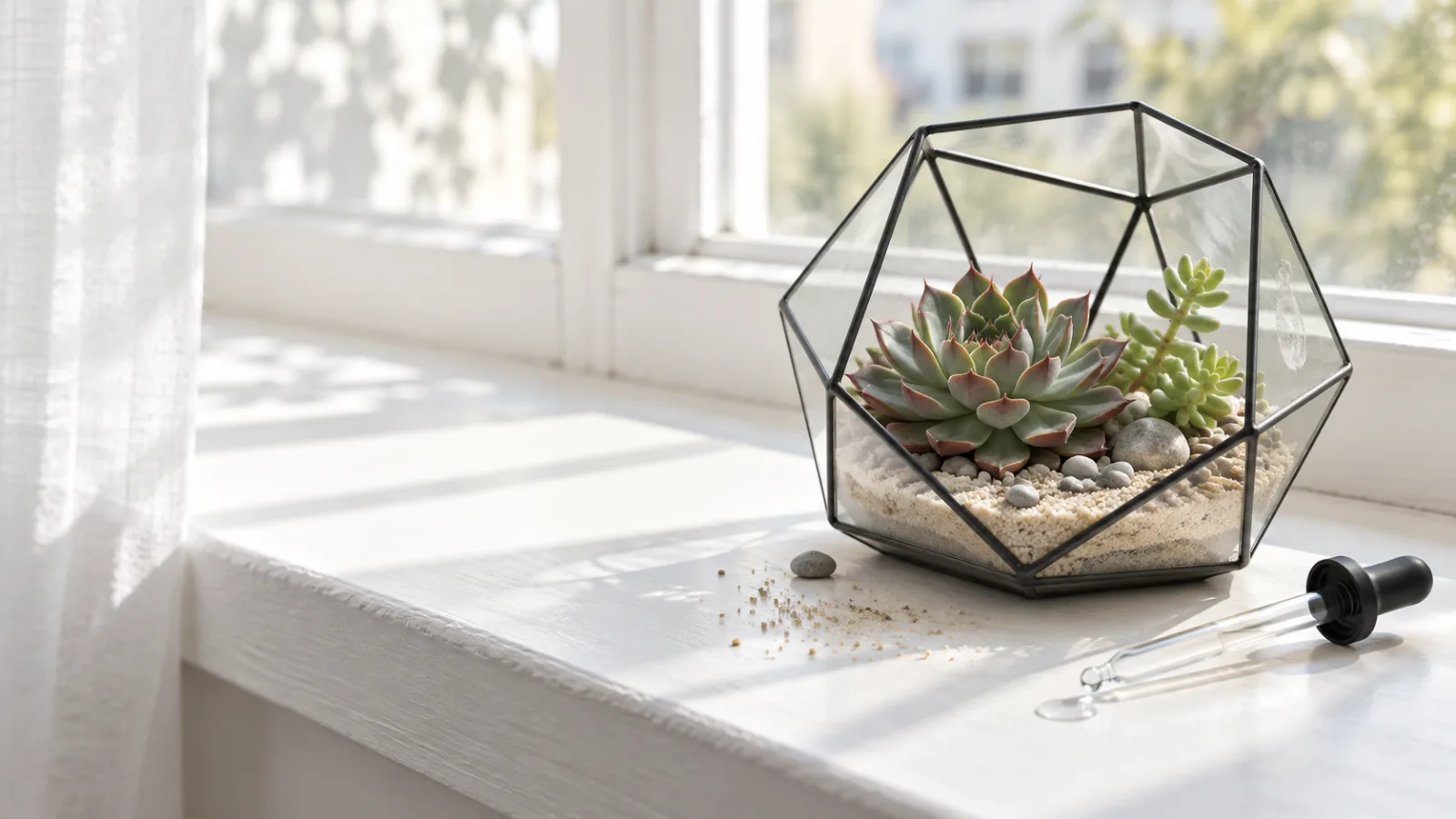
The florariums here are small succulents, a stone rose, a sedum, a haworthia, set inside glass cut into a cube, a truncated cube, a droplet or an icosahedron. One of them, sold as Droplet Florarium with Succulent, stands as the plainest example of the shape: everything else in the group is the same idea in a different cut of glass.
Succulents grow where rain is rare, and they store water in their own fleshy leaves rather than drawing it up through long roots. That is why an open bowl suits them better than a sealed terrarium, and why the right way to water one is a few sprays from a mister rather than a soak.
Moving plants this far in glass is not new to Australia: in 1833 a set of sealed Wardian cases carried living plants from London to Sydney, and the return cases went back full of Australian plants.
Melbourne winters bring their own version of the same care point. A July afternoon sits around 14 to 15°C, and most homes answer with a heater running somewhere nearby; the glass does better kept a little distance from it.
Melbourne's centre is the Hoddle Grid, laid out in 1837 to a mile by half a mile, and the address changes what an office gift should be. Collins Street holds banks and business offices, while the newer office towers of Docklands and Southbank stand just outside the grid itself, across the water or the rail lines. A desk in either place can take a cactus or one of the potted plants by type, depending on how much attention the desk actually gets.
A cactus is a succulent too, holding its own water in thick tissue, which is exactly why it suits a desk nobody waters every day. Beyond that, the section is better browsed than described: the plants on offer vary, and the shapes speak for themselves.
Office delivery needs the company name and floor; with access control, reception takes the plant. Plant delivery in Melbourne is free within the centre, and the same pattern covers hotels, hospitals and orders placed from overseas, detailed on the Flowers in Melbourne page.
Where to start depends on the recipient more than the budget. Flowering plants suit someone who wants a show lasting a couple of months, florariums suit a desk that might get forgotten for a week, and cactus plants ask the least of anyone.