


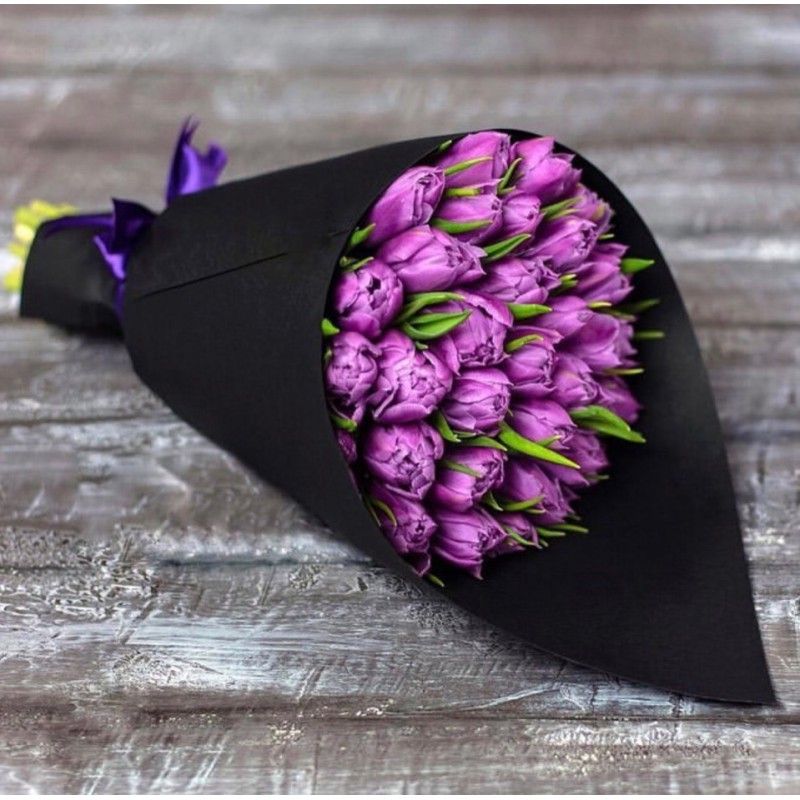


Tulips with delivery in Mexico City: varieties, Dutch import, and freshness from arrival
The tulip is floristry's most "spring" flower and the second most recognisable after the rose. A clean goblet shape, calm elegance, thousands of varieties of Dutch breeding. Mexico City doesn't grow the tulip: it needs cold winters that the Mexican climate doesn't give. So here it's an imported category — the buds fly in from the Netherlands, the world capital of the tulip. Yet the moderate cool of the highlands works in its favour: in the capital it lasts longer than in hot coastal cities.
The category covers single-variety bouquets, kraft-wrapped armfuls, boxed arrangements, and pairings with ranunculus, hyacinths, and daffodils. Supply is strongest in the Dutch season — roughly December to April, when the choice of varieties and colours is widest and the price is steadiest.

Groups and varieties in the catalogue
More than 3,000 tulip varieties are registered worldwide. Thirty to forty key ones make it onto the shelf, split into groups by bud shape, stem length, and bloom time.
- Triumph — the classic cup-shaped bud, stem 40–50 cm. The largest group. Varieties: Strong Gold (yellow), Negrita (purple), Ile de France (red).
- Darwin Hybrids — large-headed, up to 12 cm across. Apeldoorn (scarlet), Ivory Floradale (cream). For voluminous bouquets.
- French Tulips — long-stemmed tulips up to 70 cm. Maureen (white), Menton (soft pink). For wedding work.
- Parrot — parrot tulips with fringed, "torn" petals. Rococo (red), Blue Parrot (purple). For dramatic arrangements.
- Double / Peony — double "peony-style" tulips. Mount Tacoma (white), Foxtrot (pink). An alternative to peonies, which are scarce in Mexico City.
- Queen of Night — an almost-black purple, a legend of its own. For a gothic and vintage palette.
Season and occasions
Tulip supply to Mexico City follows the Dutch calendar: the peak runs roughly December to April. In those months the flower is at its freshest and most affordable, and it lands neatly on Día de San Valentín (14 February) and Día de la Mujer (8 March) — two occasions for which the tulip sells out first. By Día de las Madres on 10 May the Dutch season is already winding down, and a tulip for that date becomes a rarity.
The tulip needs cool nights, and here Mexico City differs sharply from the country's warm coastal cities: at 2,240 metres the temperature stays moderate year-round, and in the dry season the nights are especially crisp. The bud doesn't "slump" from heat as it does on the lowlands, and it's easier to deliver in shape. It's a rare case where the local climate works for an imported flower.
The tulip's quirk: it keeps growing
A cut tulip stays a living plant — the stem keeps growing in the vase by 2–3 cm over the first 2–3 days. This is a rare trait among cut flowers and must be allowed for when building an arrangement.
Because of it, tulips reshape the bouquet every day. By the end of the week they bend toward the light source — that's normal and beautiful, not a flaw. To keep an even shape, place the bouquet in a tall, narrow vase that holds the stems upright.
"The tulip is the most honest flower on sale. It doesn't fake freshness. Held the stem in your hand — soft, warm? Then the bouquet is at its final stage. A fresh tulip is firm in the hand, cool, almost 'ringing' to the touch."
— Mariana Reyes, florist with 11 years of experience
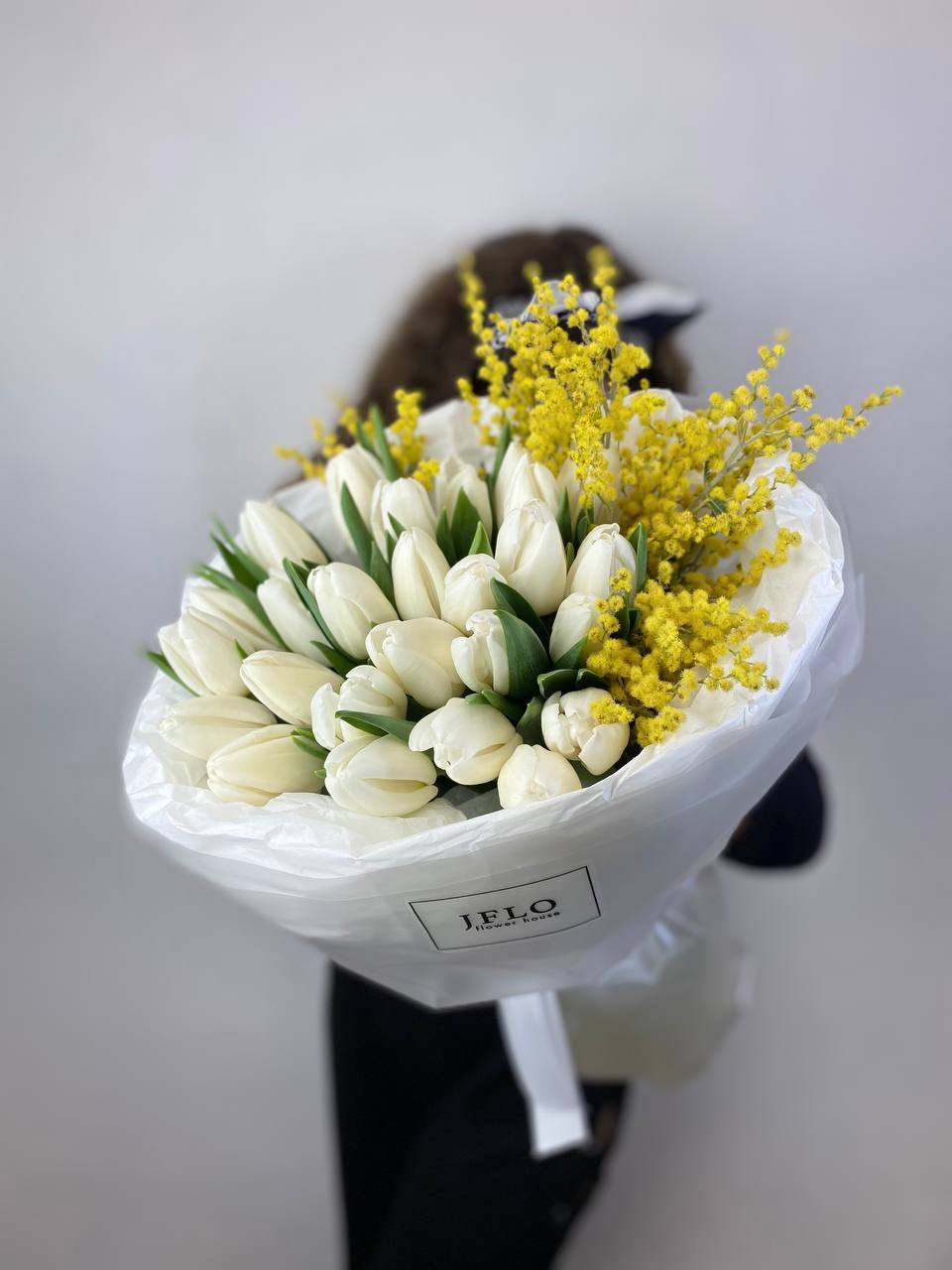
Freshness and logistics
A fresh tulip shows in several signs: a firm stem, a tightly closed coloured bud, leaves with no yellow spots, no wilted edges. Tulips arrive from the Netherlands in closed buds and move through the city's flower wholesale; ripening happens at the recipient's home.
We carry tulips in cold hydration boxes: the stems stay in water at +6…+8°C until delivery, and the bud keeps its firmness. On rainy days we add protective packaging so the box doesn't get soaked. Before assembly, bouquets are kept in cold storage at +4…+6°C.
Delivery specifics
Mexico City's climate is high-altitude and moderate year-round: +20…+24°C by day, cool at night, with no pronounced heat. For the tulip that's close to ideal. The year splits into a dry season (November–April) and a rainy one (May–October) with afternoon thunderstorms; in delivery the point is to shield the bouquet from a downpour, not from heat.
We cover the key districts: Polanco, Roma, Condesa, Del Valle, Coyoacán, San Ángel, Santa Fe, Lomas de Chapultepec, Nápoles, Narvarte, Juárez, and Satélite. Catalogue prices are in Mexican pesos (MXN, $), paid by card online. For Día de San Valentín and Día de la Mujer, order 3–4 days ahead — peak dates sell out fast.
Care at home
The tulip's handling differs from roses and peonies. The main rules: cold water only, +6…+10°C; refresh the cut with a straight (not angled) knife every 2 days; minimal water in the vase (5–7 cm from the bottom). The tulip can't take deep water — the stems rot.
Don't place them near daffodils and hyacinths — their sap speeds tulip ageing by 30–40%. If you want such an arrangement, keep the daffodils apart for 24 hours, rinse the stems, and only then add them to the shared bouquet.
In Mexico City's moderate climate the tulip is comfortable, yet still protect it from direct midday sun through the window and from dry air in the dry season. Place the bouquet in the coolest room, away from any heater used on cool nights. Fresh cold water and shade are all the tulip needs in Mexico City to last longer.

