


Weddings and events in Oslo: bridal bouquets and flowers for the party
On 29 July 1981 Lady Diana Spencer walked into St Paul's Cathedral with a cascade about a metre long of gardenias, lily of the valley and a sprig of myrtle. By order of the court the Longman florists had made two of them: in 1947 the Queen's own bouquet had gone missing between the ceremony and the wedding breakfast, so a second one waited for the photographs. Most brides get one bouquet, and it has to last from the morning to the last picture without a vase. That is why weddings and events in Oslo are ordered differently from a gift bouquet: the date, the hour and the way a flower copes with a long day matter more than the variety.
What the weddings and events section in Oslo holds
The section holds two kinds of things. The first is the bride's flowers: bridal bouquets and the numbered wedding bouquets, among them a protea bouquet, a peony bouquet and "Pur-Pur". The second is flowers for the party and for the couple: giant baskets with lilies, armfuls of jumilia roses in airy wrapping, a duo of peony roses and peonies. Guests send these to the newlyweds, and everything together is in the wedding subsection.
The two are ordered differently. A bridal bouquet starts with a conversation: a photo of the dress or of a bouquet the bride likes goes to the florist in the chat, with the date and the budget. The florist shows similar work with prices, and once paid the finished bouquet is photographed before it leaves. A basket or an armful of roses for the couple is an ordinary order for a date and a time, and the courier brings it to the restaurant or to the door at the agreed hour.
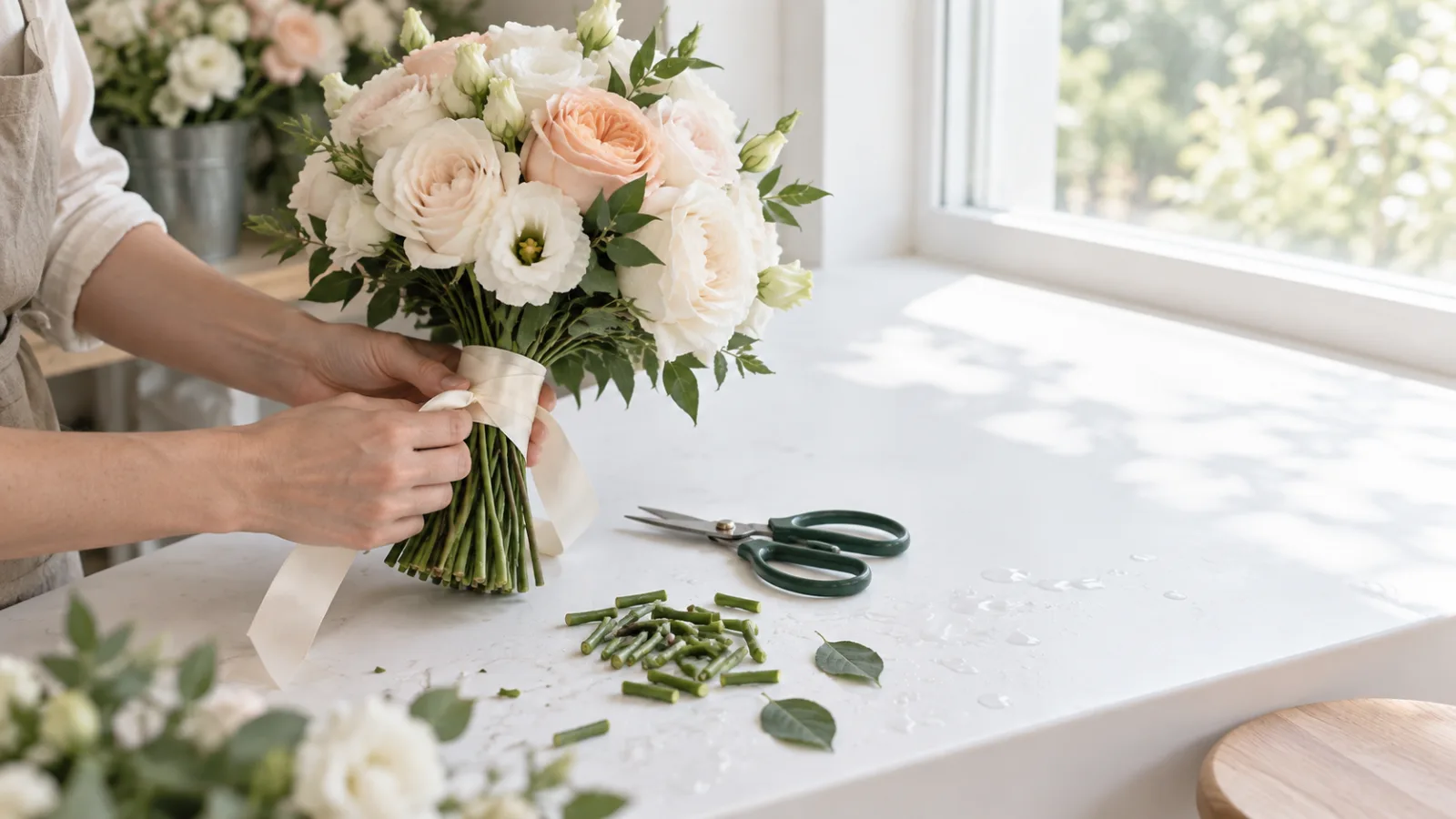
The shapes in use today all have names. A posy is small and round. A cascade is a large bouquet that tapers towards the bottom and hangs below the hands; after 1981 it was the shape of the decade. A presentation bouquet is made of long stems, most often callas, and is cradled in the crook of the arm. A pomander is a ball of flowers on a ribbon worn on the wrist, and a Biedermeier bouquet is built in tight concentric rings, each ring one flower or one colour.
Which flowers are in season for the wedding date
The date narrows the choice more than taste does. Spring cutting brings tulips, daffodils and ranunculus, May brings lilac, late spring to June is peony time, summer is hydrangea, and dahlias come with autumn. Roses, lisianthus, lilies, chrysanthemums and alstroemeria are greenhouse flowers and are there all year, so a winter wedding is usually built from them. Lilies belong in the hall rather than in the bride's hands, because their pollen leaves stains on fabric that are hard to get out; fresh pollen on a dress is lifted with sticky tape, never rubbed. Every part of a lily, pollen and vase water included, is poisonous to cats, so a basket of lilies should not go to a home with a cat.
How a bouquet gets through a day without water
A rose stands in a vase for about a week and a chrysanthemum or carnation for two or three, but a bridal bouquet spends the day out of water, and the count is in hours. Hydrangea suffers first: it drinks more than other flowers and takes water in through its petals, so in a warm hand it drops its head early. The cure is to submerge the whole head in cool water for an hour or two. Peonies have the opposite problem: they are cut at the marshmallow stage, when the coloured bud gives softly under a finger, and in warm water and light such a bud opens in a day or two. A bud as hard as a marble may never open at all, so a peony bouquet is ordered with time to spare, not on the morning of the wedding.
Between the ceremony and the dinner the bouquet is helped by the simplest care: stems cut at an angle and put into water as soon as there is a pause, away from the sun. Flowers for the tables are easier because they sit in floral foam: a wicker basket does not hold water, so it is lined with a waterproof liner, and the foam is laid on water and left to sink by itself. The finished basket stands on the restaurant table or by the entrance all evening. It is watered in a thin stream over the whole open surface and never tilted. For a wedding there are the giant baskets with lilies; other flower baskets are in the flowers section, and flowers for silver and golden anniversaries in the wedding anniversary section.

Wedding flower delivery in Oslo is almost always an order for a date and a time, and such orders are accepted for any zone without restriction; the earlier the order is placed, the more free slots there are. If the flowers must arrive to the minute, for the first dance or the toast, that is agreed separately with the manager for a small surcharge named in advance. For a restaurant the time is agreed with the manager on site and the flowers arrive at the moment, to the dessert, the toast or the stage. Delivery to the city centre is free, other districts carry a flat fee shown before payment, and the zones for Oslo are on the delivery page.
Every bouquet is made to order and the flowers are bought after payment, so the florist photographs the finished bouquet before the courier leaves. Changes can be asked for before dispatch, and a substitute for a missing flower is visible on the same picture. The date, the slot or the address can be changed until the bouquet has left and no later than six hours before delivery. A bouquet already made cannot be cancelled, which is the reason to settle the composition in the chat before paying. Payment goes through Visa or Mastercard, and a company decorating an event gets an invoice and closing documents.
The simplest way into weddings and events in Oslo is the date: it decides which flowers are in season and which bridal bouquet the florist will suggest, while guests find baskets and armfuls in the wedding subsection. Anyone still undecided can write to the florist, who sends a photo and a price before payment.