


Giant bouquets in Tashkent: baskets, boxes and a hundred roses
Giant bouquets in Tashkent do not always travel in a florist's hands: many arrive already sitting in a wicker basket, since the vine itself holds no water. The basket gets a waterproof liner, and the soaked foam block is set in gently and left to sink on its own — forced down, it leaves dry pockets inside. The choice really runs from format to flower to stem count, so it helps to ask first where the bouquet will sit: in hand, on a table, or on the floor.
What makes a bouquet giant: a hundred roses, a basket or a box
Three formats appear across this collection. Held in the hands: 101 Dutch Roses, 201 French Red Roses, 101 Multi-Colored Julie Roses, and smaller mixes such as 15 Lilies or the Hydrangea and Misty Bouquet. In a basket: 101 Ecuadorian Roses, 51 Lilies, a Giant Mixed Basket with Lilies. In a box: Giant Box No. 3, Box "The Very Best".
A hand-held bouquet this size is usually built as a spiral: each stem goes in at a slight angle, all leaning one way, so the stems converge at a single point near the base. Tied correctly, it stands on a table by itself, though it still needs water.
A basket or a box stands without a vase at all, since the stems sit in damp floral foam rather than water. Roses and lilies act as the mass flowers, carrying the weight and the centre, while smaller blooms and foliage fill the gaps between them.
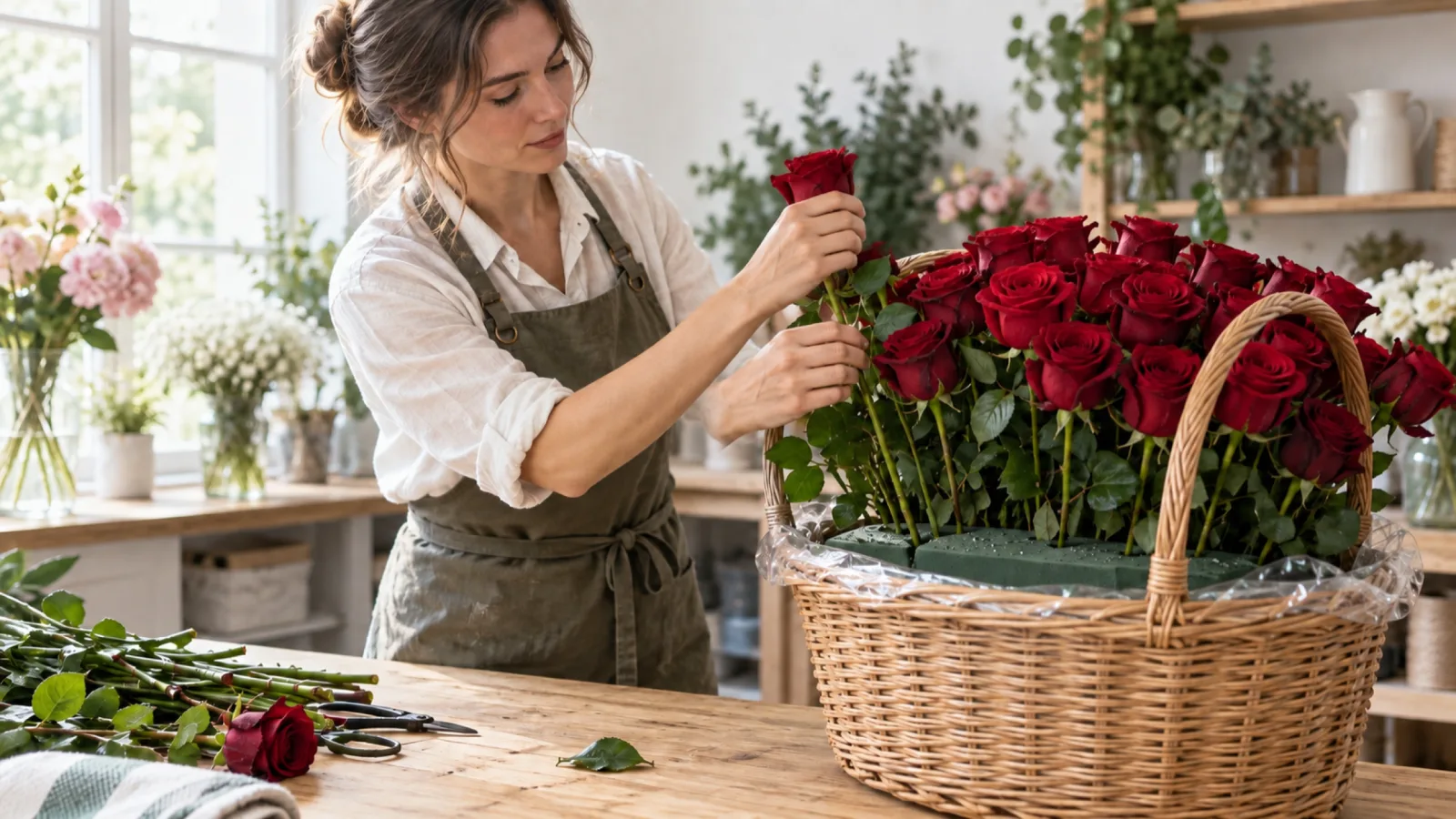
Ecuadorian roses grow high in the Andes, around 2,800 to 3,000 metres, where day length stays close to twelve hours all year. The 101 Ecuadorian Roses in a Basket carries some of the longest stems here, from about seventy centimetres to a metre and beyond.
Dutch roses come from greenhouses and cover the classic varieties, with stems usually between forty and seventy centimetres — the 101 Dutch Roses bouquet sits right beside the Ecuadorian basket in the catalogue. Both belong among roses by the stem count, where the full list runs from a single stem up to two hundred and one.
"French" roses are not a variety but a technique: the florist bends each outer petal back by hand, as on the 201 French Red Roses. Peony-style roses lean on David Austin's English varieties and roses bred to look like them, as in the 101 Peony-Style Bush Roses.
Every stem count in this section is odd, from 15 and 37 up to 51, 101 and 201. In Russia and most of the former Soviet Union an odd number goes to the living, while a dozen is the usual count elsewhere.
Lilies, hydrangeas and peonies when size comes from the flower
With large-headed flowers, the stem count matters less than it does with roses: a handful of lily or hydrangea stems can already read as a full bouquet, because the size comes from the flower head itself.
Every part of a lily is toxic to cats, including the pollen and the water left in the vase, so the 15 Lilies, 51 Lilies in a Basket and Giant Mixed Basket with Lilies are worth skipping in a home with a cat. Lily pollen also stains fabric on contact; once a flower opens, the anthers are usually removed, and any pollen that has fallen is lifted off with sticky tape rather than rubbed.
Hydrangea drinks more water than most flowers around it and takes some of that water in through its petals as well as its stem. Peonies are on sale for most of the year, though not for the whole of it.
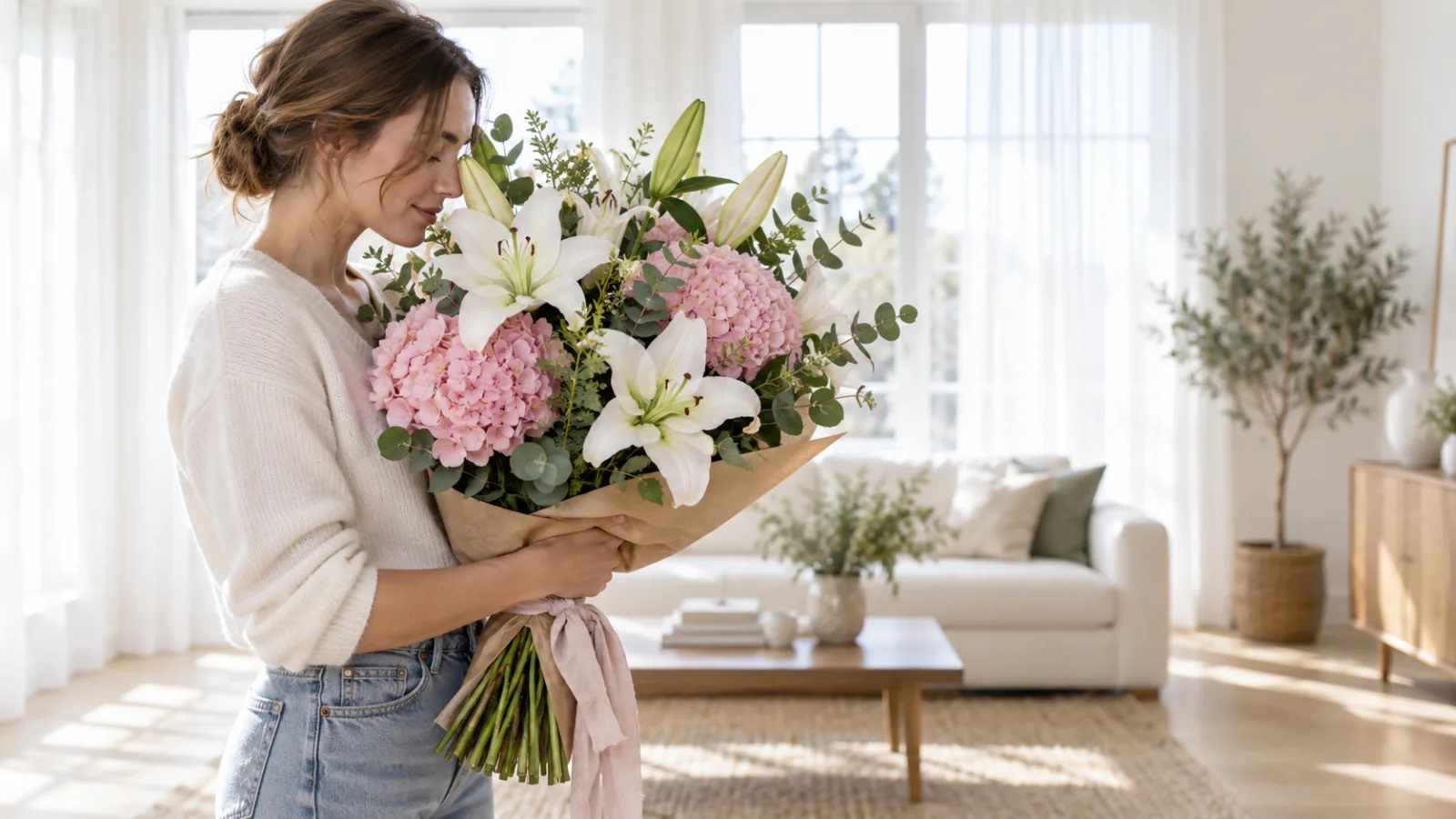
Every bouquet here is made to order: florists buy the flowers only after payment goes through. A photo of the finished bouquet reaches the sender before the courier leaves, and changes are still possible then; an unavailable rose or lily is swapped for something close in shade and price, and the swap shows in the same photo.
Giant bouquet delivery in Tashkent depends on the address. At a hotel, the bouquet is handed up to the room or left at reception, following that hotel's own rules; the order needs the guest's surname and, where known, the room number. At an office, the company name and floor take that place. A hospital needs more care, since many clinics do not allow live flowers on the wards, and the manager checks the department's rule beforehand.
Delivery to the centre is free, and every other zone carries a fixed charge shown before payment. Most orders reach the recipient the day they are placed, with exact timing shown on the bouquet's own page; a booking for a chosen date and time is accepted in any zone, and booking early leaves more slots open.
Looking after a large bouquet, basket or box
A hand-tied bouquet needs the ordinary routine: stems cut at an angle, any leaf that would sit under water stripped off, water changed every day or two, and the vase kept away from radiators, direct sun and fruit.
A basket or a box asks for something else, since there is no water to change directly:
- water the foam daily, in a thin stream over the whole surface, without tilting it;
- never let the foam dry out — dried foam barely takes water back;
- revive a drooping hydrangea by submerging the whole head in cool water for an hour or two;
- expect roses to last about a week, sometimes closer to ten days.
Choosing among giant bouquets in Tashkent starts with the address rather than the flower. For a table or a room that needs filling, the wider bouquet collection shows the full range of formats together. Where roses alone matter, roses by the stem count narrows things down by number. Anyone unsure a giant format is the right start can look through the full flower catalogue, with zones and charges set out on the delivery terms page.