March 8 in Antwerp: flowers for Women's Day and when to order them
International Women's Day was first held on 19 March 1911, in Austria-Hungary, Denmark, Germany and Switzerland. It settled on 8 March only after a demonstration by female textile workers in Petrograd in 1917: 23 February by the Julian calendar, 8 March by the Gregorian one. The date has not moved since, which matters to anyone sending flowers for March 8 in Antwerp. The day is known a year ahead, the flowers in season are known too, and the only thing a buyer decides late is how early to place the order.
How 8 March became a holiday, and where it still is one
The first celebration in 1911 drew more than a million people. After 1917 the Soviet Union took 8 March as its own date and made it a day off work in 1965, and the United Nations has marked it since 1975, International Women's Year. Today it is an official public holiday in more than twenty countries, among them Russia, Ukraine, Belarus, Kazakhstan, Georgia, Moldova, Mongolia, Cuba, Nepal and Uganda. Germany gives the day off only in Berlin and Mecklenburg-Vorpommern; in China women have had a half-day off since 2014; in Madagascar and Nepal the holiday is for women only. Vietnam, Romania, Bulgaria and Chile mark the day widely without a day off.
Italy is the odd one out. Since 8 March 1946, the first nationwide celebration after the war, Italian women have been handed sprigs of mimosa. Activists of the women's union UDI chose it because it was already in bloom across the country in early March and cost little; carnations belonged to May Day and orchids were too dear. For a sender abroad the practical question is where the recipient will be that morning: at home, if the day is a holiday where she lives, or at her desk, if it is not. Women's Day is also not Mother's Day: that one keeps its own calendar, the second Sunday of May in the United States and Germany, the last Sunday of November in Russia, and it deserves a bouquet of its own.
Tulips, mimosa and the other flowers in season in early March
Both flowers of the day are there because of the calendar. Mimosa, the silver wattle, flowers from January to March. Dutch tulips are cut from December to May: the bulbs are put through an artificial winter in a cooler and then forced in a greenhouse, so 8 March lands in the middle of the tulip season. Hyacinths, daffodils and ranunculus come from the same spring window.
Roses, chrysanthemums, gerberas and alstroemeria are grown in greenhouses all year round, so the date makes no difference to them. Many of the roses in the catalogue are French roses: not a variety but a florist's technique, the outer petals folded back by hand so the flower opens wide. Jumilia, a large-headed rose with a white base and a pink edge, lasts up to two weeks in a vase with care. The full cup of a peony in a month when real peonies are still months away comes from peony-style roses, mostly David Austin's English varieties and their relatives.

Women's Day is a date when many people send flowers to several women on the same morning: a mother, a wife, a daughter, colleagues, a child's teacher. The largest bouquet usually goes to the person closest to the sender. Colleagues are easier to please with identical small bouquets, so that none of them reads as a sign of special attention. For a teacher, a compact bouquet is easier to carry home along with a bag and the other bouquets of the day. A mother gets the flower she likes rather than the one in fashion, and if her vase is known, its size is worth a line in the order comment.
One cart covers the whole list: several bouquets can go to different addresses in one order, delivery is charged per address, and the courier hands each bouquet over in person with its card.
A few rules travel with the recipient. In Russia, Ukraine, Belarus and most of the former Soviet Union an odd number of stems is for the living and an even number is for the grave, so the count is worth writing in the order comment. Red says the most and suits a wife better than a colleague; for the office and for a mother, blush, peach, yellow and lilac read more calmly. In France, Italy, Spain and Poland a large chrysanthemum belongs to funerals, so it does not go to a recipient there even in a spring palette. Lilies carry a different warning: every part of the flower, pollen and vase water included, is poisonous to cats, so a home with a cat gets no lilies at all.
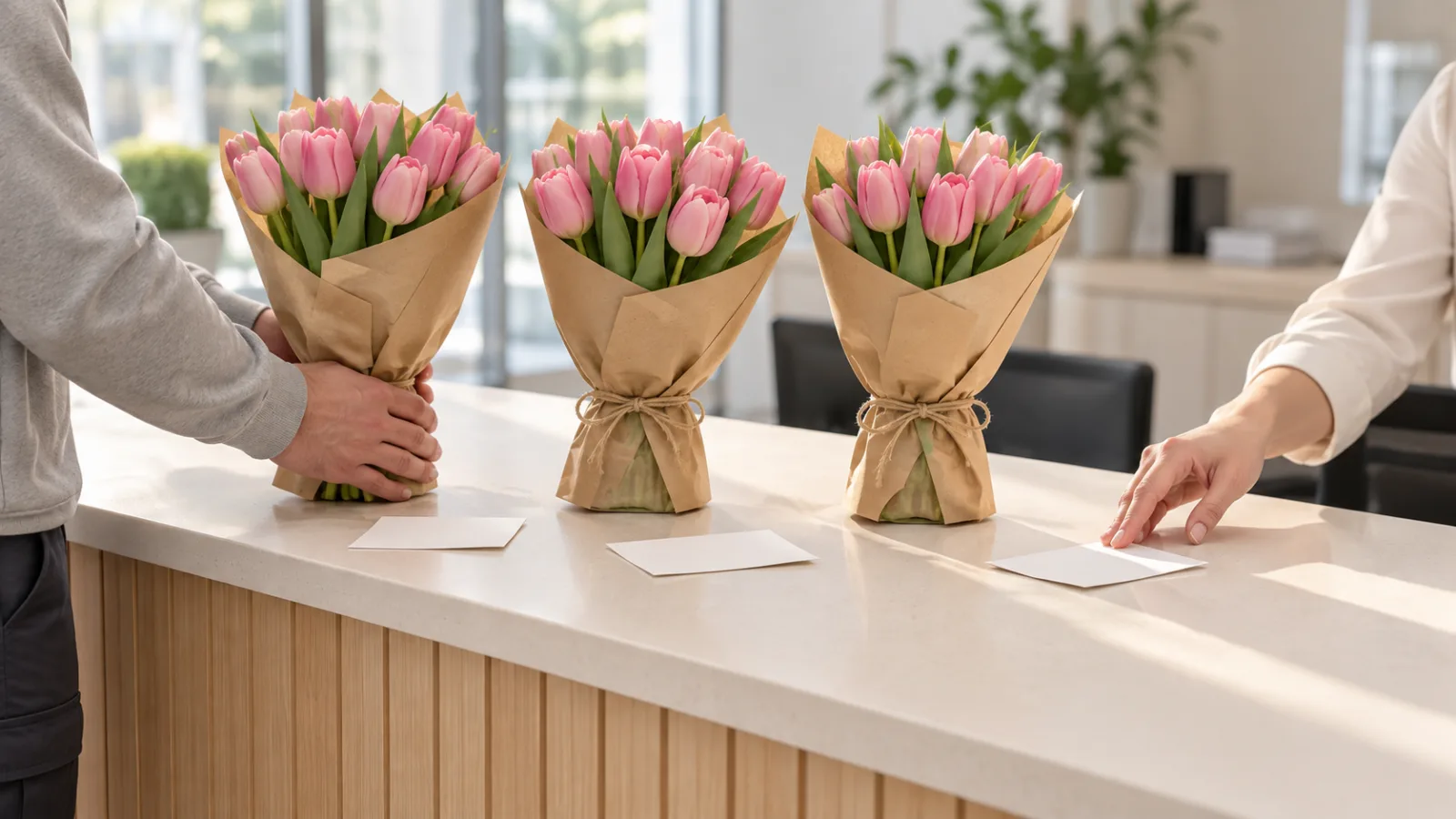
A hand-tied bouquet suits a handover in person with a vase waiting at home, and a mono bouquet of tulips or mimosa is the simplest thing to send there. An office may have no vase, so flowers in a box or a basket travel better: the stems stand in water-soaked floral foam, the arrangement needs nothing else and waits on a reception desk. An office order needs the company name and the floor; where the building has a pass system, the bouquet goes through reception and the sender is told who took it.
Add-ons follow the address too, and helium balloons are visible across an office. A cake or cupcakes cover the table if the day is celebrated at home, and a vase, chocolate or a soft toy go into the same cart. A card with a message is free, and on a row of identical bouquets for colleagues the card is the only personal thing, so it is worth writing a different one for each.
Women's Day flower delivery in Antwerp: book a slot, skip the call
Delivery on 8 March runs by the everyday rules with one difference. On 14 February, 8 March and Mother's Day orders come in at several times the usual volume, delivery slots are wider than on a weekday, and nobody promises an exact minute. Orders for a chosen date and time are accepted in every zone of the city, and the earlier the order, the more slots are still free, so flowers for March 8 in Antwerp are best ordered a few days ahead. Express delivery applies only to bouquets the florist already has in stock. The bouquet card shows the delivery time, and on the morning of the holiday that is not something to count on.
Delivery in the city centre is free; other districts have a flat rate for their zone, chosen at checkout and added to the total before payment. Nobody calls the recipient beforehand unless the sender asks, the exception being a gated building where the courier has to ring, and that call comes from the door. An address is optional: a phone number is enough, and the sender's details are never passed on. Before the courier leaves, the florist photographs the finished bouquet and sends the picture, so a ribbon or a shade can still be changed, and if a flower was unavailable that day the substitute is visible in the same photo. Payment goes through Visa or Mastercard on a secure page; the cart total is final, the courier is paid nothing, and orders are taken around the clock.
Keeping tulips upright: care after 8 March
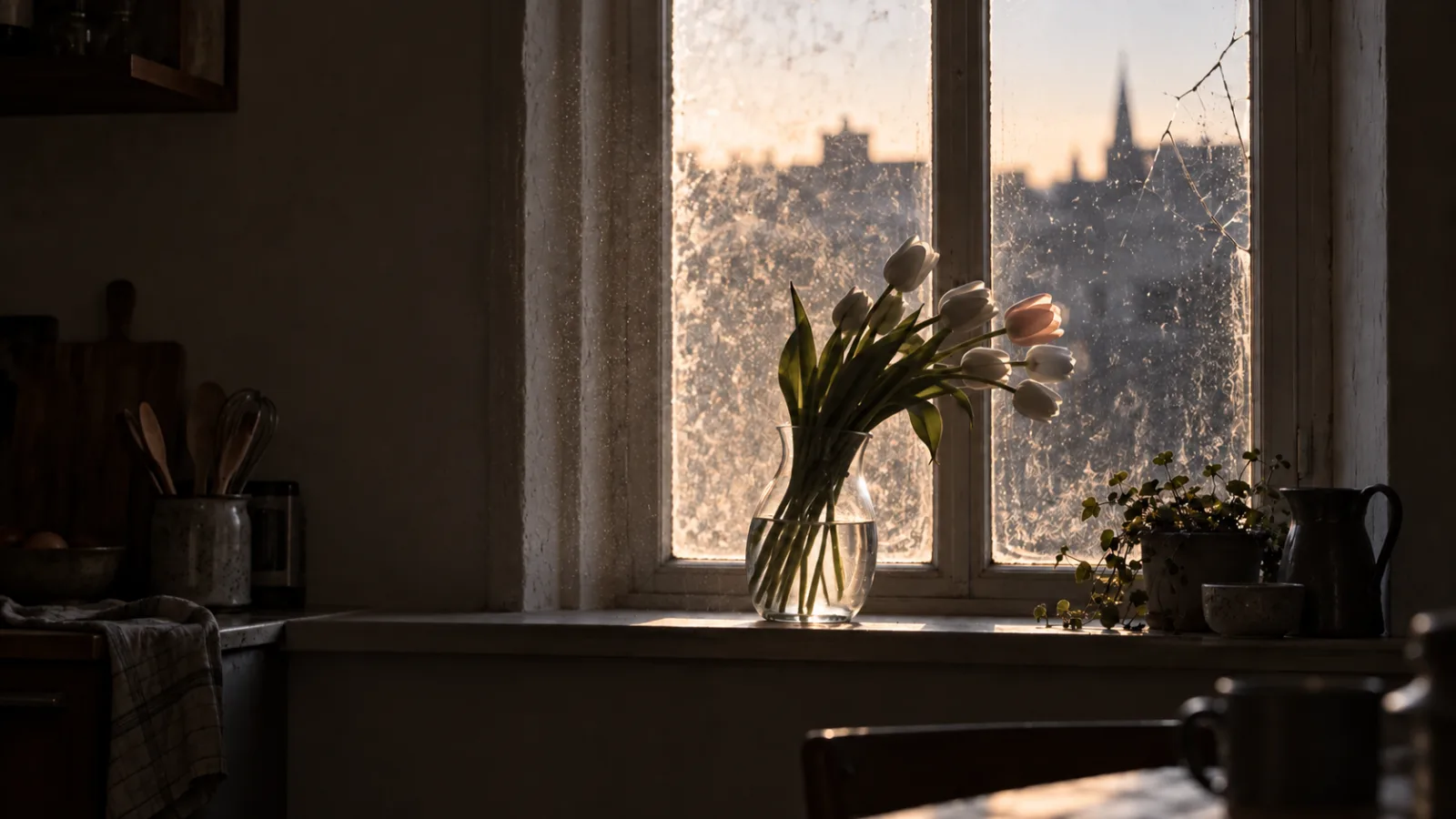
A cut tulip is still growing. In a vase it adds a centimetre or two a day and leans towards the light, so overnight the stems bend towards the window and the bouquet looks different in the morning. That is not damage.
Turn the vase once a day, use cold water and fill it only about a third of the way up: in deep warm water the stems soften and bend more. Daffodils are kept in their own water for about a day first, because a cut daffodil releases a slime that turns tulips yellow and makes roses wilt. After that they can join other flowers as long as the stems are not cut again.
The rest is the same for any bouquet: cut the stems at an angle with a sharp knife on arrival and strip the leaves that would sit under water. Change the water every day or two and keep the vase away from radiators, direct sun and the fruit bowl. A box or basket is watered daily in a thin stream over the whole surface of the foam and never tilted, since foam that has dried out barely takes water again. Roses last about a week this way, sometimes ten days; chrysanthemums and alstroemeria hold for two to three weeks.