


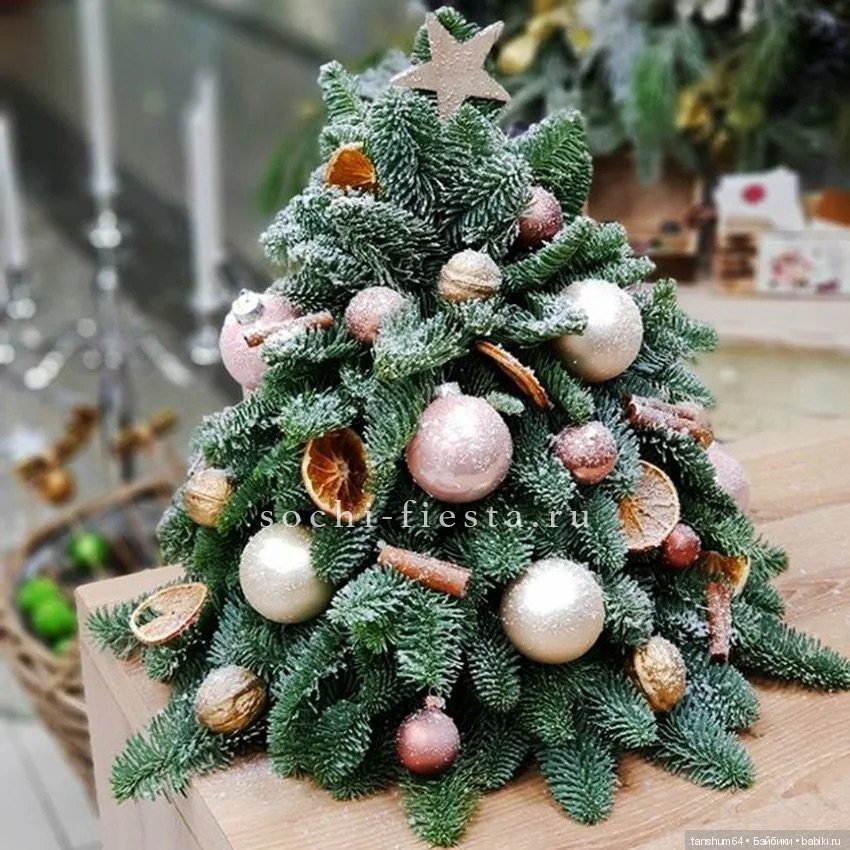




Christmas and New Year arrangements: an object that has to fit the room

A bouquet asks the room for a vase. An arrangement asks it for a surface, and that single difference decides most of what follows: where the piece can stand, how big it should be, and how long anyone will put up with it being there.
Measure the surface before ordering rather than after.
A hall console, a dining table and a reception counter want three different shapes. On a console the piece is seen from the front and from one side, so height is welcome and depth is wasted. On a dining table it sits between people and must stay below their eye line. On a counter it is walked past on both sides, so the back cannot be a flat wall of foam and offcuts, and a build meant for a wall position will look unfinished there within an hour of arriving.
How the piece is held together
The base is usually a block of florist foam soaked in water and cut to the pot. Conifer branches go in first and do the structural work, holding the outline and hiding the rim. Cones, dried pods and cinnamon sticks are mounted on wire legs and pushed into the same block, which is why they sit at angles instead of lying flat.
Nothing here is balanced. Everything is anchored, so the piece travels upright in one hand and is set down finished.
Two clocks running at once
Fresh spruce, fir and berried branches hold for weeks with almost no attention. Any fresh flowers in the same foam run on a shorter clock and will droop first, usually while the greenery still looks new. Pull those stems out one at a time as they go and close the gap with a cone or a short branch, and the piece carries on as an evergreen one.
The dried part outlives all of it.
Heat is the real problem
Indoor heating does more damage than anything the season throws at the piece outdoors. Warm dry air pulls moisture out of the needles, and once that starts the shedding does not stop: you sweep the table, and by evening there is a fresh scatter of needles on it. A pot standing above a radiator or in the draught of a fan heater dries out from below as well, and the foam goes from damp to crusty faster than most people expect. Top the water up through the rim every day or two until the block stops taking it. Keeping the piece away from the heat source buys more days than any amount of watering.

Candles need a rule of their own. Fresh greenery barely burns, but the same branches after a week in a heated room, together with dried cones and wood, catch from a nearby flame in seconds. Either leave a clear hand's width around the wick with no material in it, or switch to battery lights once the piece starts to feel dry to the touch.
When a bouquet is the better answer
Someone who enjoys arranging flowers will be mildly disappointed by a finished object, because there is nothing left to do with it. Someone in a small flat may find that a pot occupies the only clear surface they have. And if the recipient is likely to be moving the gift straight on to another address, wrapped stems travel better than a wet foam base.
Christmas and New Year arrangements suit the opposite case: an office, a rented flat, an older relative, anyone who will not want to hunt for a vase. A recipient in Auckland takes the pot from the courier, puts it where it belongs and adds water twice a week.

