


15 roses in Cape Town: why fifteen, which variety and how it arrives
15 roses in Cape Town is an odd number, and in Russia, Ukraine, Belarus and most other former Soviet countries odd counts go to the living, while even ones are set aside for remembrance. Once the count is settled, the choice comes down to variety, stem length and how the bouquet is wrapped.
Why fifteen: what an odd number of roses says
The odd-even rule runs through much of the former Soviet Union: a living person receives an odd number of flowers, and an even number is kept for graves and memorials. Outside that region the custom barely registers, and a dozen roses is the ordinary count for a gift instead. Fifteen works either way, odd where the tradition holds and close enough to a dozen where it does not. Anyone weighing up counts can compare the whole range under other rose counts.

Victorian flower dictionaries gave red roses the meaning of passionate love, pink a softer affection and white purity, though no single dictionary was ever agreed on and the meanings shift from one source to the next. Colour, in other words, is a hint rather than a rule.
Jumilia is one of the named varieties in the range: a bud that opens to about seven centimetres, with a white base and a pink edge along each petal, sold plain and as French Roses. French is not a variety at all but a technique, where the florist turns the outer petals back by hand to open the bloom, as in fifteen Jumilia French Roses. Peony-style roses, such as the Peony Lavender option, are usually David Austin varieties or similar breeds with the same dense, many-petalled shape, though the exact parentage of a given bunch is rarely stated. Misty Babyls and Pink X-Pression round out the named varieties in the roses section, each a cultivar name rather than a style.
Tall or classic: stem length and where the roses are grown
Ecuadorian farms sit in the Andes at around 2,800 to 3,000 metres, where the day holds close to twelve hours year-round because the country straddles the equator. That steady light produces some of the longest rose stems on the market, running from about seventy centimetres past a metre. Dutch greenhouses grow the classic varieties on shorter stems, usually forty to seventy centimetres, and Kenyan roses tend to run shorter again than the Ecuadorian ones. The catalogue keeps tall and classic stems side by side, fifteen Tall Red Roses next to fifteen Red Roses and fifteen Tall Cream Roses next to the Dutch Roses with Styling, and the length shows in both the name and the photograph.
Ribbon, box or purse: how fifteen roses are presented
A hand-tied bouquet under ribbon or coffee wrapping is built as a spiral: each stem goes in at a slight angle, all leaning the same way, so they meet at one point a hand's width below the heads. Built correctly, the bouquet stands on its own without support.
Fifteen Pink Roses with Eucalyptus pairs a mass flower with a filler: the roses give the bunch its weight and centre, and the eucalyptus closes the gaps between them rather than adding colour of its own. A box or a purse skips the vase altogether. Where the stems sit in floral foam, watering the whole exposed surface every day keeps it working, since foam that has dried out barely takes water again; kept damp this way, the arrangement lasts about as long as it would in a vase.
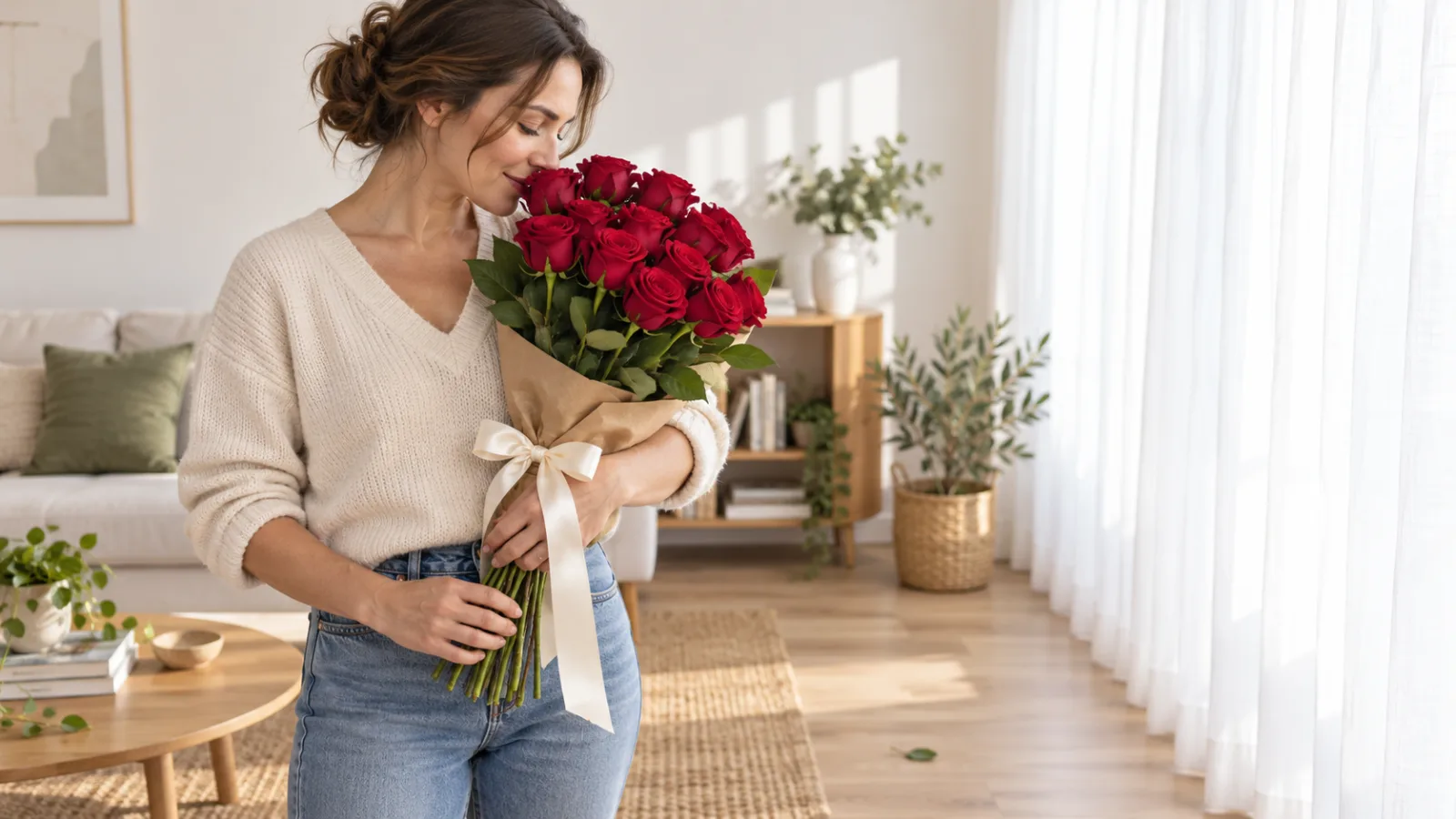
Each bouquet is made to order, and the roses are bought only once the order is paid. A photograph of the finished bouquet goes to the sender before the courier leaves, and any change can still be requested at that point. If a particular variety has sold out, the florist substitutes a rose close to it in shade and price, and the swap is visible on the same photo.
The card is free, and it can carry a signature or stay blank; the courier knows only the recipient's name and address, nothing about who sent the flowers. Most orders reach the recipient on the day they are placed, and the exact timing for a given bouquet is shown on its own page. Zones and rates are set out under delivery, and deliveries to the centre cost nothing extra.
A rose in water lasts about a week, sometimes closer to ten days, and Jumilia can hold for up to two weeks with attentive care. The routine is short: cut the stems at an angle, strip any leaf that would sit under water, and change the water every day or two. The vase itself is best kept away from radiators, direct sun and a bowl of ripe fruit nearby.
Choosing between counts starts with roses by quantity, where fifteen sits next to a dozen and larger bunches. For colours, varieties and flowers beyond roses, the full flowers catalogue covers the rest of the range.