


Designer giants in Kemer: how a florist builds a bouquet to be seen
Designer giants in Kemer trace their logic back to 1929, when Constance Spry dressed the Atkinsons perfumery window on Old Bond Street with hedgerow plants and drew crowds of London onlookers. A designer arrangement has been built to be seen from a distance ever since, and a giant works the same way: its size only pays off alongside the right construction, the right mix of flowers and the right address. Choosing one starts with where it will stand.
What makes a designer giant more than a big bouquet
A designer giant works because every flower in it has a job. Florists sort stems into roles: line flowers set the outline and the height, mass flowers such as roses, hydrangea or lily give the arrangement its weight and centre, filler flowers close the gaps between them, and foliage holds the transitions together. Get those roles right and even a very large bouquet reads as one shape rather than a pile of flowers.
Colour does similar work. A monochrome scheme keeps the whole arrangement in shades of one colour, while a complementary scheme sets opposite colours against each other for contrast. In the range, "Goddess", Wow Bouquet No. 1, Designer Box "Harmony" and the "Wow-3" Designer Cylinder each build on one of these schemes rather than mixing colours at random. Spry's own later signature was kale set beside roses, proof that an authored arrangement is often known by an unexpected neighbour, not by size alone.
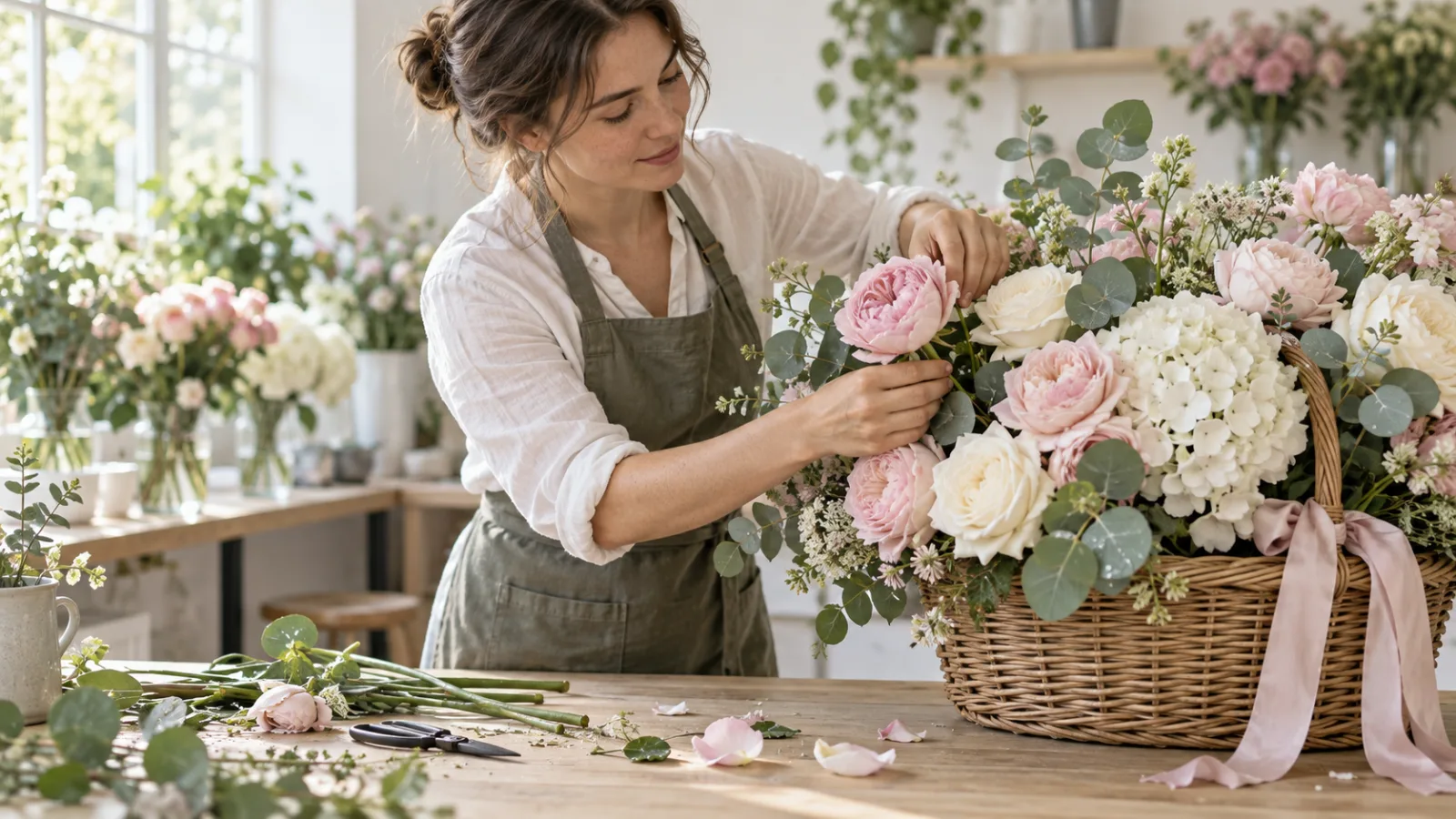
Size starts with the stems. The Ecuadorian rose used in 101 Ecuadorian Roses in a Basket grows in the Andes at around 2,800 to 3,000 metres. That altitude gives it a stem anywhere from 70 centimetres to a metre or longer, tall enough to carry a large arrangement on its own. In 201 French Red Roses, "French" describes a technique rather than a place: a florist bends the outer petals back by hand instead of using a particular variety or country of origin. The same reflexed shape turns up across the wider range of roses in the catalogue.
"Perfekte" pairs true peonies with peony-style roses, and a peony-style rose is most often one of the English David Austin varieties bred to open into the same dense, many-petalled cup as a peony. In Europe the peony season runs from late April to June; outside it, the florist replaces the flower with something close in shade, and the swap shows up in the photo sent before delivery. Hydrangea does the opposite job for less effort: its head is so large that a few stems already read as a finished bouquet.
Basket, box or cylinder: how giants hold water
A woven basket does not hold water on its own, so the florist lines it with a waterproof liner and fits a block of soaked floral foam inside before the flowers go in. Watered properly, that foam keeps an arrangement going for roughly as long as a vase would: pour a thin stream of water over the whole exposed surface every day, and never tilt the basket, box or cylinder once it is dressed. Foam that has been allowed to dry out barely takes water back, which is the one mistake worth avoiding.
An arrangement this size ages as a single unit, and its lifespan is set by whichever flower in it fades first, not by the sturdiest stem. Hydrangea is the exception worth knowing: if a head droops, it drinks through its petals as well as its stem, so submerging the whole flower head in cool water for an hour or two usually brings it back before anything else needs attention.
Where a giant lands best: hotel, office, restaurant
A hotel decides for itself whether a bouquet goes up to the room or waits at reception. The order needs the surname the guest checked in under, plus the room number if it is known, and the hotel's own rules set the last step. An office asks for different details: the company name and the floor are enough to get a courier past the lobby, and where a pass is needed, reception takes the delivery and the sender is told who signed for it.
A restaurant works on timing rather than an address. The delivery time is agreed with the venue's manager in advance, so the flowers arrive with dessert or just before a toast rather than sitting on a table through the meal. When none of these applies and the flowers are going straight to a person rather than a building, the recipient's phone number is enough to place the order. Full delivery rules for each address sit on the delivery page.

Every designer giant in Kemer is put together to order, and the florist buys the flowers only after the order is paid, which is why the arrangement can still be adjusted before it leaves the studio. A photo of the actual bouquet goes to the sender before the courier sets off, and anything that needs changing at that point is changed there and then, not after delivery. Ask in chat first and the manager sends back a few options with photos and prices before any payment is taken.
Orders for a set date and time are accepted into any delivery zone, and booking earlier simply leaves more time slots open closer to that date. How soon delivery can happen shows on each bouquet's own page rather than in this text, since it changes; most orders go out the same day they are placed. The card that travels with a designer giant in Kemer costs nothing extra and can be left unsigned if anonymity matters more than a signature.
A first designer giant in Kemer is easiest to choose from one of two directions. Where the flower variety matters most, compare stem lengths and colours across the full range of roses before settling on a basket or a box. Where getting the bouquet to the right hands matters more than the flowers themselves, start with the hotel and office rules above and check the zone list on the delivery page.