


Day of the Dead in Mexico City: red roses, stem counts and delivery
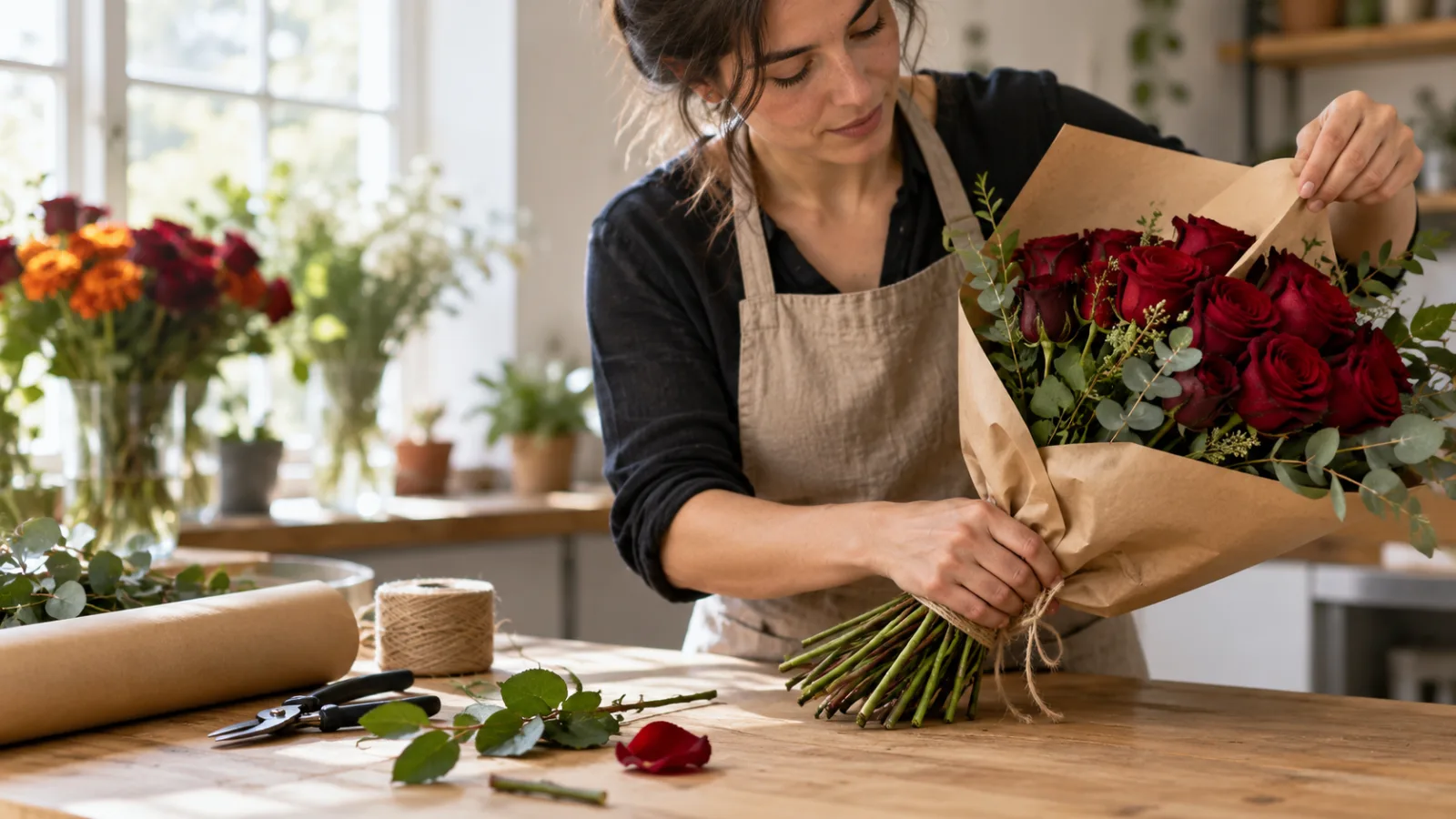
Day of the Dead in Mexico City is stocked almost entirely with one red rose, sold in kraft paper, in a cylinder, in a box and as a loose Bunch of 101 stems. Decide first where the flowers will stand and how many stems feel right, and the rest of the choice is already laid out in the grid above.
What the Day of the Dead grid holds: one rose, many presentations
Almost everything in this roses section is red, and colour changes only in a few names: 51 Red and White Roses, 55 Roses "Soft Mix", 55 Mixed Bush Roses, and two versions of "Carousel", with fifteen stems or a hundred and one in mixed shades.
Stem length and form vary more than colour does. Tall Red Roses stand higher than the regular stems in the kraft and box bouquets, and the Bunch of 101 Red Roses is sold loose, without wrapping. The 9 Red French Roses aren't a separate variety: a florist turns the outer petals back by hand, opening the head wider than usual.
Every number in this grid is odd: seven, nine, fifteen, nineteen, twenty-one, fifty-one, fifty-five, a hundred and one. In Russia, Ukraine, Belarus and most former Soviet countries, an odd number goes to someone living, an even one to a grave or in memory. Outside that custom a dozen is just as ordinary, so it helps to know which habit the recipient grew up with.
There are no chrysanthemums here. In France, Belgium, Italy, Spain, Poland, Hungary and Croatia a large chrysanthemum reads as a symbol of death and goes mainly to funerals and graves, while in the United States it's usually a cheerful flower. For anything the grid doesn't cover, describe the occasion and budget in chat, and a manager sends photos and prices before payment.
Box, cylinder or kraft bouquet: where the roses will stand
A kraft-wrapped bouquet goes into a vase, and a red rose there lasts about a week, sometimes closer to ten. Cut the stems at an angle, strip off any leaves that would sit under water, change the water every day or two, and keep the vase away from radiators, direct sun and ripe fruit.
Roses in a box stand in floral foam, invented in 1954 by the Ohio chemist Vernon Smithers. Water it daily in a thin stream over the whole surface: once it dries out it barely takes water back, so a skipped day shows sooner in flowers in boxes than in a vase. How the cylinder holds its roses is easiest to judge from the photo the florist sends before the courier leaves.
Day of the Dead flowers delivery in Mexico City: date, card and photo
An order for a set date and time is taken for any zone, and the earlier it goes in, the more slots stay open; the exact timing shows on each bouquet's own page. The card message costs nothing extra and can be signed or left anonymous: the courier only ever gets the recipient's name and address.
A photo of the finished bouquet is sent before the courier sets off, with time to change something up to that point. If a rose or colour isn't available, the florist substitutes one close in shade and price, and the swap is visible in the same photo. Delivery to the centre costs nothing extra, and Visa or Mastercard payment is taken online, so nothing further goes to the courier.
Kraft paper suits an address that already has a vase waiting; a box suits a desk or reception where nobody will find one. For a single flower without the extra shapes and mixes, the mono bouquets range holds a narrower version of the same choice, and the delivery page covers the centre rate and the rest of the zones.