


Mixed bouquets in Paris: which flowers lead and what the photo shows
Mixed bouquets in Paris are bought to order, and JFLOO buys the flowers only after you pay. So if a flower is unavailable that day, the florist swaps it for one close in colour and value, and the swap shows up in the photo sent before the courier leaves. What matters most in a mixed bouquet is which flower leads and which ones simply fill in around it, and that is where the choice starts.
Hydrangea or lily at the centre: a mix built on a few big heads
Big-headed flowers such as hydrangea and lily need only a handful of stems to read as a full bouquet, since one large head takes more visual space than a small flower. The exact stem count varies from one arrangement to the next, and a photograph gives a better sense of that than any number would.
Hydrangea drinks more water than most cut flowers and takes some of it in through the petals rather than the stem alone. If a cap starts to droop, standing the whole head in cool water for an hour or two usually brings it back; leave it no longer than four or five hours.
Lily pollen is the one thing to watch: it stains fabric and will not brush off. The anthers are removed once the flower has opened, and if fresh pollen does land on clothing, lifting it with sticky tape works far better than rubbing. Every part of a lily is toxic to cats, including the water left in the vase, so it is not the flower for a home with one.
Lily and gerbera are both greenhouse-grown and sit in the catalogue all year round, so a bouquet built around either does not depend on the month.

Roses with lisianthus, lilac, chamomile: a mix of many small flowers
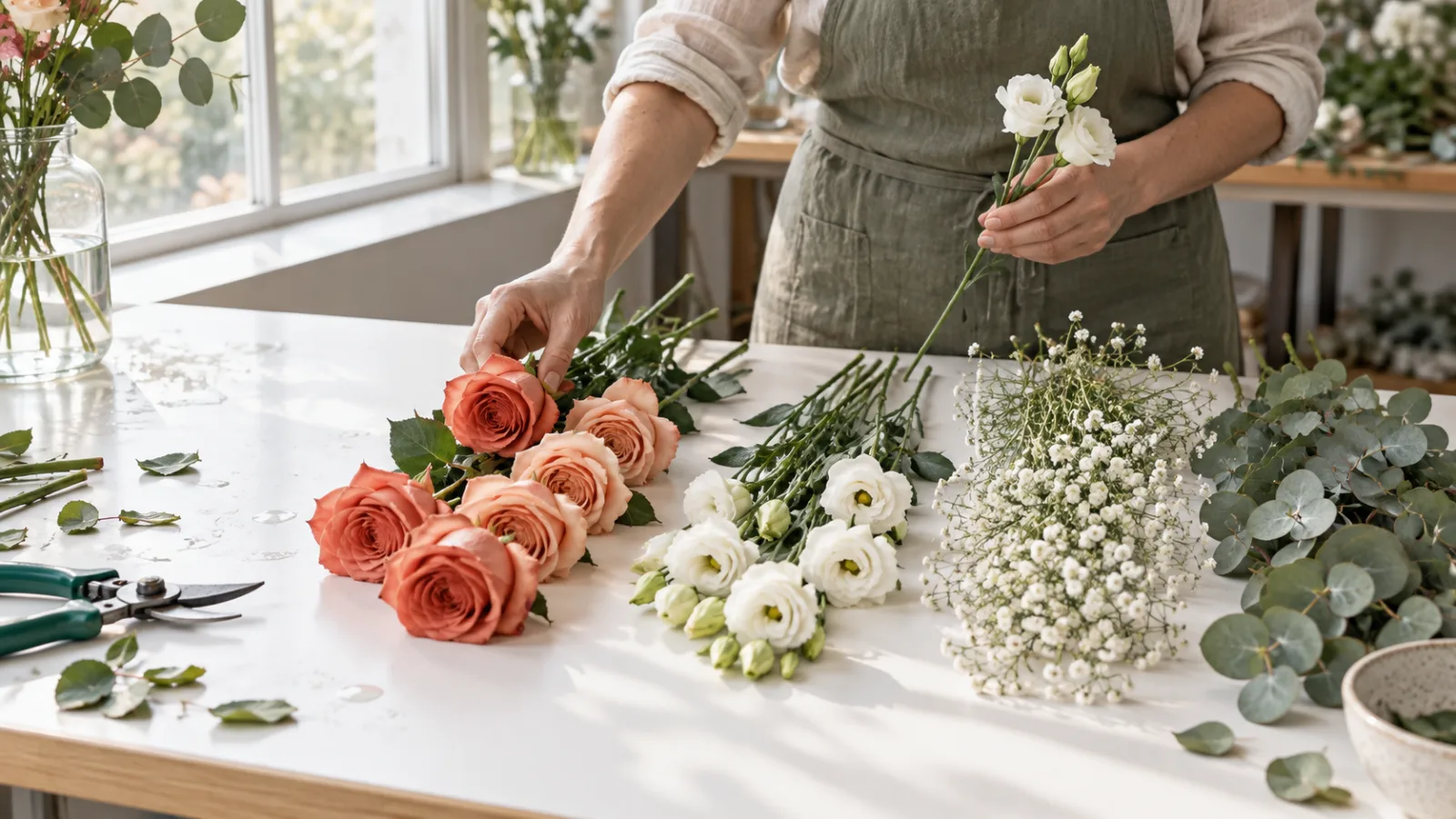
The second type works the other way round: many small flowers, where the stem count does the work that a few big heads do on their own. Roses with lisianthus and a bouquet with misty bubbles and chamomile both follow this pattern, though what actually sits inside each one is better read from the photo than guessed from the name.
Lisianthus is greenhouse-grown and available all year, which is part of why it pairs so easily with roses on almost any date. Lilac is different: French growers cut it in May, so a bouquet built around lilac only appears for that one month.
A rose kept in fresh water lasts around a week, sometimes closer to ten days, and that is a reasonable guide to how long a rose-led mixed bouquet will hold indoors.
One local habit worth knowing before you order: a French bouquet is traditionally put together with an odd number of stems rather than an even one.
Adding a French-grown peony or mimosa to a Paris mix
Around eighty per cent of the cut flowers sold in France are imported, which is why a French-grown stem only turns up in a mixed bouquet at its own time of year rather than on demand.
French peonies are cut from late April through June. In the months before that, Israel and Italy carry the gap, with France itself joining again from February, so peonies of one origin or another run from February into early summer. Mimosa has a narrower window still: French growers cut it from November to March, and it sits in the mono bouquets section on its own rather than mixed with other flowers.
To work either one into a mixed bouquet, the simplest route is to message the florist with the occasion and a budget. A few options come back with photos and prices attached, and nothing is paid until one of them is chosen.
Mixed bouquet delivery in Paris is free within the centre, and most orders go out the same day they are placed, with the exact timing shown on the bouquet's own page rather than promised in advance here. A handover at a hotel or an office simply follows whatever rules that particular address sets.
Roses, peonies and mono bouquets are a reasonable place to start if you are choosing between a mix built on one lead flower and one built from several, and the delivery page covers how a bouquet actually gets to its address.