

14 February in Porto: order the roses early, then choose what to send
Each January the United States alone imports about 11 million roses a day, and roughly half of the country's rose deliveries for the year arrive in two short bursts: the weeks before 14 February and the weeks before Mother's Day. The crop behind those numbers went into the ground months earlier, so by the time the holiday is close the only thing a buyer still controls is the date of the order. That is why a sensible guide to flowers for 14 February in Porto starts with the calendar and only then gets to the colour of the roses.
Why Valentine's roses are ordered a week early, not on the day
Growers begin the Valentine's crop about a year ahead, and the numbers are large: by the count of the Society of American Florists, more than 250 million roses are grown for the holiday. Colombia ships about one and a half billion stems a year, Ecuador about a billion, and Kenya grows its roses around Lake Naivasha. Ecuadorian plantations sit at around 3,000 metres in the Andes, where daylight lasts almost exactly twelve hours all year round, which is why those roses carry the longest stems. The stems fly in refrigerated aircraft and stay at one to two degrees above freezing all the way to the wholesaler.
What this means for a buyer in Porto is simple. The specific things sell first: a peony-style rose in one particular shade, a Jumilia with its pink edge. Ordering those a few days ahead, while the florist still has them, is the simplest way to get what was chosen, and wholesalers send their own lists to the growers as early as mid-January for the same reason. On 14 February, 8 March and Mother's Day orders run at several times the usual volume, delivery slots are wider than on an ordinary day, and nobody promises an exact minute, so the convenient time is worth booking early too.
Red roses, chocolate and the countries that celebrate on another day
The first known link between 14 February and lovers is a poem: Geoffrey Chaucer's Parliament of Fowls, written in 1382, in which birds gather on Saint Valentine's day to choose their mates. The red rose came much later: nineteenth-century Britain and America produced dozens of flower dictionaries, and a bouquet was composed like a letter. The dictionaries disagreed on most flowers, but on the red rose they mostly agreed: passionate love, with pink for a gentler affection, white for virtue and yellow for friendship.
The code still runs. In 2022, according to the Society of American Florists, 83 % of the flowers bought for Valentine's Day in the United States were roses, and 65 % of those roses were red. Plain red roses are the one gift that needs no note to explain it, and that is both their strength and their limit: they speak about the date more than about the person. For a bouquet that says something more particular, the rest of the roses section runs from blush and cream to coral and spray varieties.
JFLOO delivers in 113 cities, and a few of them read 14 February differently. In Japan it is the women who give chocolate: an "obligation" box to colleagues and a serious one to the person they mean it for. Men answer a month later, on 14 March, with White Day, invented by a confectionery association in 1978. Brazil keeps its lovers' day on 12 June, the eve of Saint Anthony's day, the saint who looks after marriages. Wales has Saint Dwynwen's Day on 25 January, and in Finland and Estonia 14 February is Friends' Day. A bouquet is welcome in all of them; a line in the card explaining the occasion helps.

Not every Valentine's bouquet in the catalogue is red, and the alternatives are not compromises. A bouquet of white French roses, with the outer petals folded back by hand so each flower opens wide, reads as a formal, almost bridal gesture; the same technique in blush or cream turns the volume down without changing the message. Jumilia, a large-headed rose with a white base and a pink edge, does the work of two colours in one stem and holds in a vase for up to two weeks with care. Spray roses, several small heads to a stem, fill a bouquet without making it tall, which matters when it has to sit on a restaurant table.
Mid-February also falls in the middle of the Dutch tulip season. The bulbs are put through an artificial winter in a cooler, and the cut flowers run from December to May. Fresh tulips next to roses take some of the ceremony out of a bouquet. On their own they keep changing: a cut tulip grows roughly a centimetre or two a day and leans towards the light, so the shape of the bouquet shifts within a day or two. Peony-style roses, most of them David Austin's English varieties and their relatives, give the full many-petalled cup of a peony at a time of year when there are no peonies: the real ones peak in late spring.
One rose, a dozen or 101: how many stems to send
The number of stems matters on this date at least as much as the colour, and the answer depends on where the recipient grew up. In Russia, Ukraine, Belarus and most of the former Soviet Union an odd number of flowers is for the living and an even number is for the grave. A dozen roses, ordinary almost everywhere else, lands there as a mistake. When the recipient comes from that tradition and the sender does not, a note in the order comment with the preferred count settles it.
A single long-stemmed rose is a precise gesture rather than a small one. It works on a first date and in a restaurant, where a large bouquet has nowhere to stand. Sending a bouquet of 101 roses is the opposite gesture. It makes its impression at the moment of handing over; after that it needs a vase the size of a bucket and a table it will not cover entirely. The sensible size is set by where the flowers will spend the following week: a hundred heads in a small flat rarely find both a vase and a place to stand.
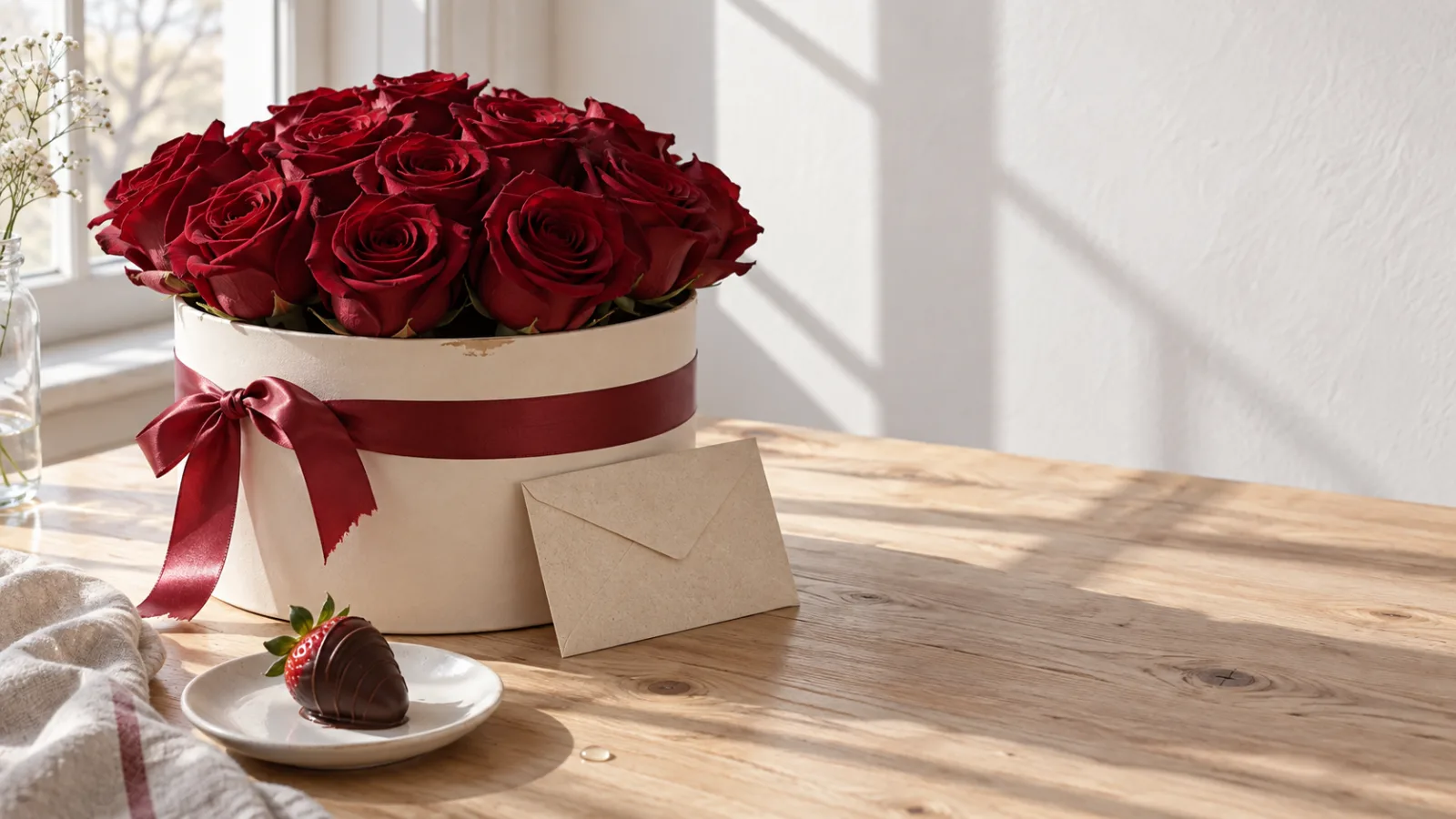
Many Valentine's bouquets go to places without a vase: a restaurant table, a hotel room, an office desk. A hand-tied bouquet suits a handover in person with a vase waiting at home. For a restaurant or a hotel, flowers in a box travel better: the stems stand in water-soaked floral foam, the arrangement needs no vase and waits on a reception desk or a restaurant table. Flowers sent to an office make the gift public, and only the sender knows whether that is the point or the problem.
Forever roses, preserved stems that need no water and sit on a shelf for months, suit anyone who wants the gift to outlast February. In the cart, a bouquet can be joined by chocolate-dipped strawberries, helium balloons, sweets or a vase, and a card with a message goes in free. The card can carry a name or none at all: the courier knows only the recipient's name and the address, and the sender's details are never passed on.
Delivery on 14 February follows the same rules as on any other day, with one difference: the volume. Orders for a chosen date and time slot are accepted in every zone of the city, delivery in the centre is free, and other districts have a flat rate that shows before payment. Express delivery applies to bouquets the florist already has in stock; the bouquet card shows the delivery time, and on a peak day a booked slot is a safer plan than hoping for express.
Dinner in a restaurant is arranged with the venue: the manager agrees the timing with the staff and the flowers come out for dessert or for the toast rather than at the start of the evening. A hotel order needs the surname the guest is registered under and, if known, the room number; whether the bouquet goes up to the room or waits at reception depends on the hotel's rules. Nobody calls the recipient beforehand unless the sender asks for it, since a surprise is part of the gift on this date; the exception is a gated building where the courier has to ring, and that call comes from the door.
An address is optional as well. With only a phone number, the manager works out where to deliver and mentions neither the sender nor the occasion. The finished bouquet is photographed before the courier leaves, so a ribbon, a shade or a substitute for an out-of-stock flower (close in colour and value) can be seen and corrected before dispatch. Payment goes through Visa or Mastercard on a secure page; the cart total is final and nothing is paid to the courier. Most orders are delivered on the day they are placed, but for 14 February in Porto the order should go in a few days early.
Making the roses last past the weekend
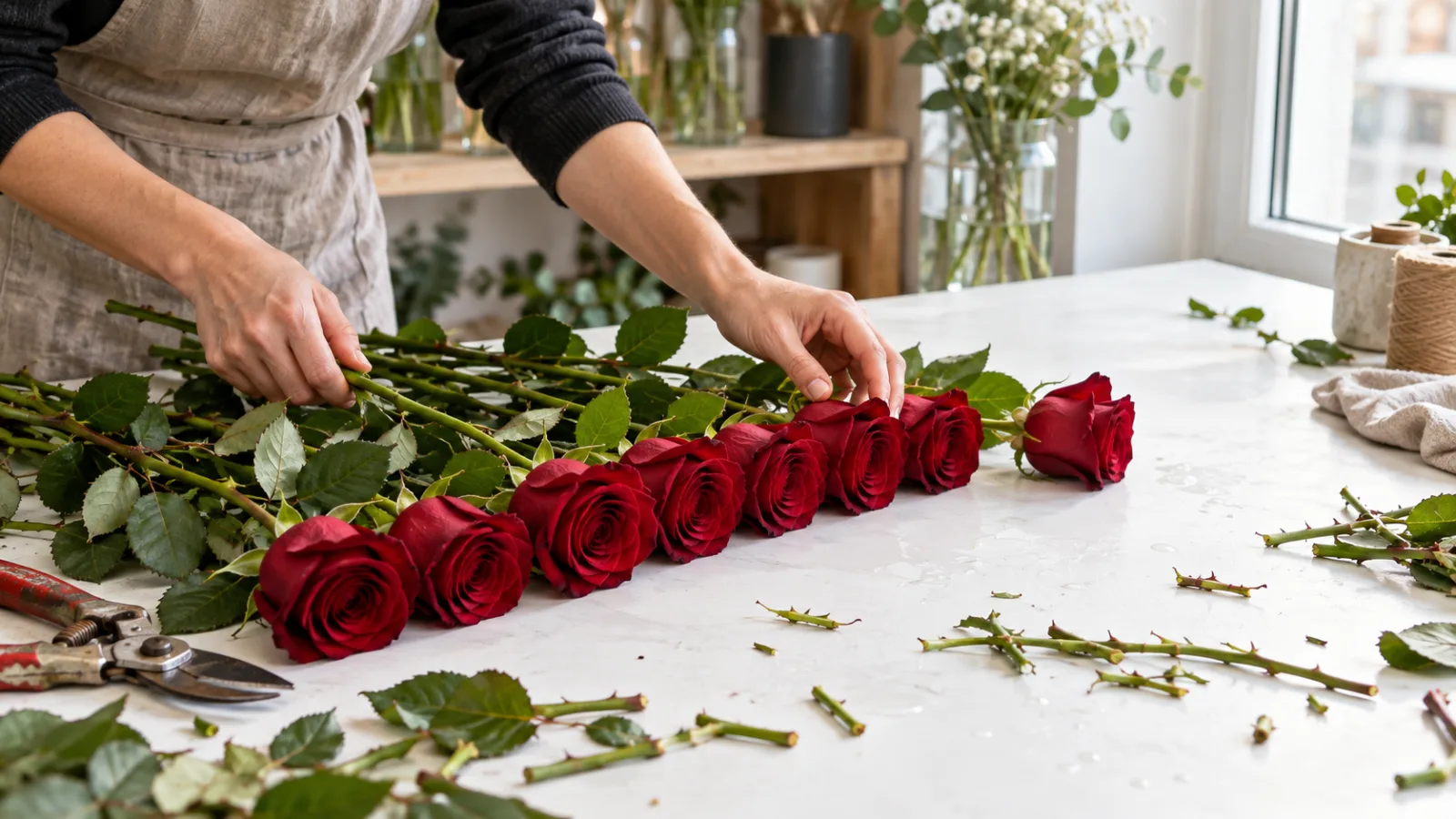
A rose lasts about a week in a vase, sometimes ten days, with a little care. Cut the stems at an angle with a sharp knife or secateurs and strip any leaves that would sit under water. Keep the vase away from radiators, direct sun and the fruit bowl, because ripe fruit gives off ethylene, which ages petals faster, and change the water every day or two. A box arrangement is watered daily in a thin stream over the whole open surface of the foam and never tilted, because foam that has dried out barely takes water again. Preserved roses need nothing at all.
Choosing flowers for 14 February in Porto is easier from the address and the hour than from a list of varieties. A box or a single long rose suits a restaurant, a bouquet with a vase suits home, and delivery by phone number reaches someone far away. If 14 February feels too loud a date, the same gesture can be made more quietly in Confession of Love, and the rest of the year's dates are gathered on the Occasions page. A florist can also be messaged: they will suggest a bouquet for the budget and send a photo and price before payment.