

Bouquets in Seoul: how a hand-tied bouquet is built and how to choose one
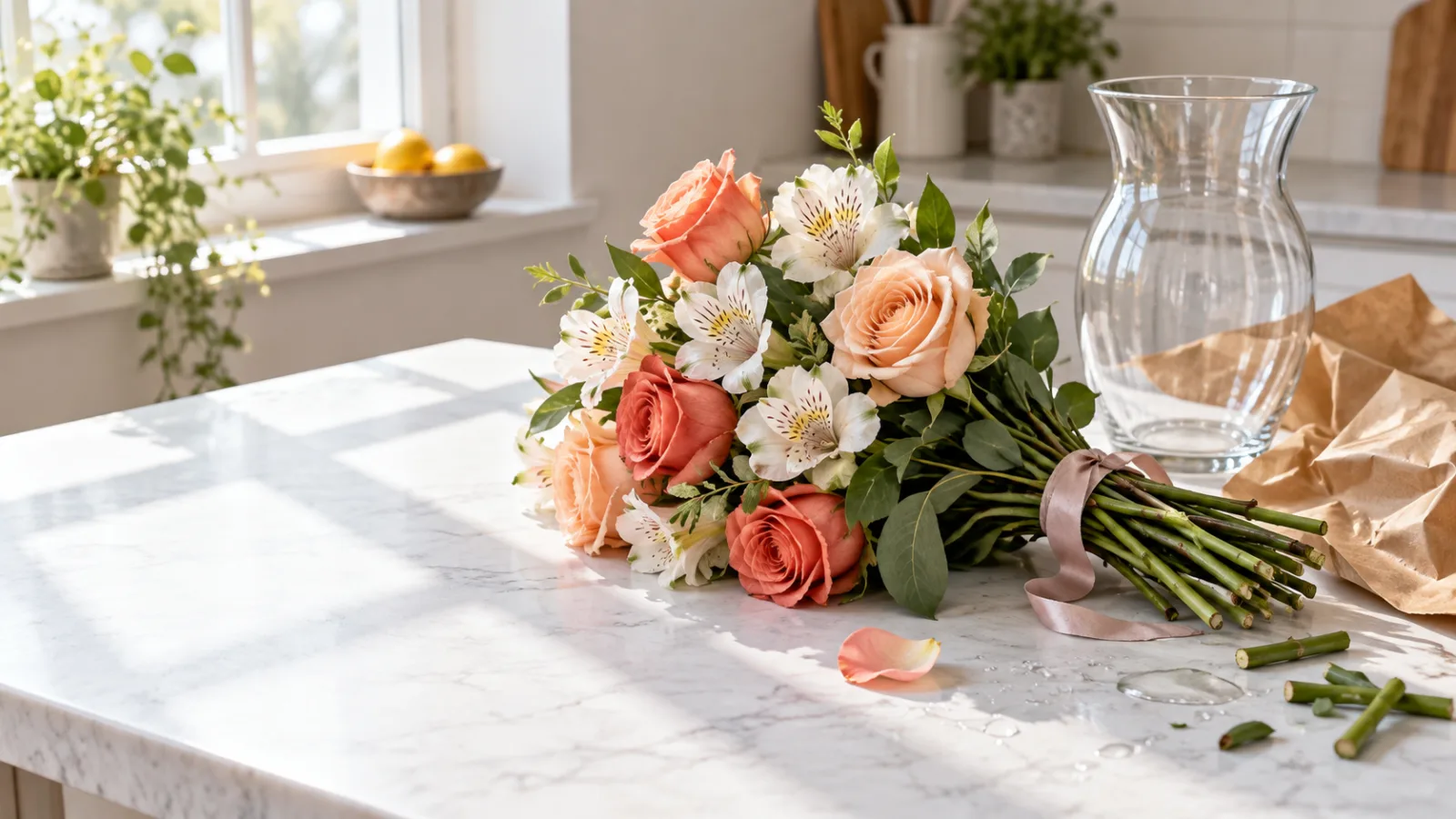
A well-made bouquet passes a simple test: set it down on a table and it stands up on its own, with no vase and no hand holding it. That balance comes from the way the stems are laid, and it is the first thing worth understanding about bouquets in Seoul: the same technique decides whether a bouquet survives the journey and keeps its shape in a vase. The catalogue splits bouquets into some twenty subsections; this page explains what separates them and which one fits the occasion and the address.
What holds a hand-tied bouquet together: the spiral
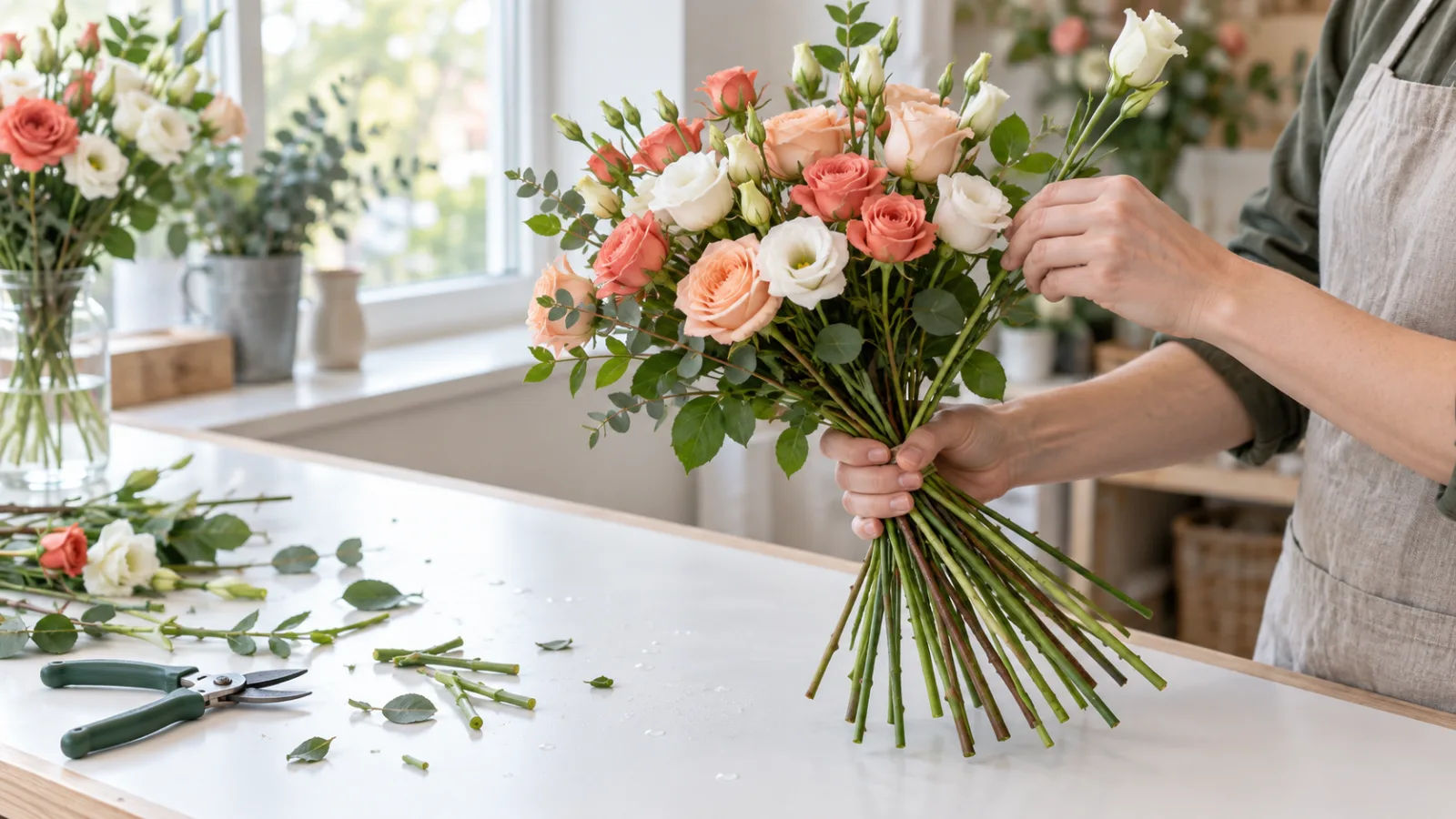
Nearly every wrapped or ribbon-tied bouquet starts with one stem held upright in the florist's hand. Each stem that follows goes in at a slight angle to the previous one, always in the same direction, and the florist turns the bunch a little with every addition. All of the stems cross at a single binding point roughly a hand's width below the flower heads, and below that point they fan out into a spiral. The bouquet is tied there with ribbon or twine, and that one knot carries the whole structure.
The spiral does real work. Because the stems lean on each other instead of pressing down on the ones underneath, the bouquet keeps its structure in transit. The heads spread into an even dome, each bloom facing slightly outwards, and the finished bouquet drops into a vase without being taken apart. That is also why a properly built bouquet stands on a flat surface by itself: the base of the spiral is wide enough to hold it up.
JFLOO makes every bouquet to order. Flowers are bought after payment, the florist builds the bouquet and photographs it, and the picture reaches the sender before the courier leaves. If something in the picture needs changing, that is the moment to say so: it is fixed before the courier leaves.
The largest subsection is bouquets with flowers, sorted by the main flower, from roses and peonies to lilies. A single-flower bouquet reads instantly and needs no explanation, which makes it the safe choice for someone you do not know well. A mixed bouquet of three or four kinds in one palette adds volume and texture, and a designer bouquet built around the recipient's character gives the florist the most freedom with varieties.
The other way in is colour. Bouquets by colour gather white, red, pink, yellow, lilac and mixed bouquets, and for many buyers this filter beats the botanical one. Many buyers find a colour easier to choose than a variety name. Red is the usual pick for a declaration, white for respect or sympathy, pastels for a softer gesture, and a bright mix for a loud party.
The season changes both the contents and the price. Roses, chrysanthemums, carnations and alstroemeria are available all year. Peonies, tulips, lily of the valley and lilac appear for a few weeks or months. A bouquet built around them is easier to source, and usually cheaper, inside that window than out of season, when the flowers have to be imported from far away. The seasonal bouquets subsection shows what florists are working with right now; if a particular variety matters, confirm it before ordering.
From a compliment to a giant: choosing the size
Size depends as much on the scene of the handover as on the budget, and bouquets in Seoul run from a few stems to an armful. A compliment bouquet is an everyday gesture: a thank-you, a get-well, a housewarming. A medium bouquet is the classic for a birthday or a date, while a large one of several dozen stems is visible from across the room and suits an anniversary.
Giant bouquets are a genre of their own, counted in impact rather than stems: a hundred and one roses, an armful of peonies, a basket of lilies. A giant is built for the moment of presentation and ordered for an event with an audience, an anniversary, a premiere, an airport arrival. After the handover it needs a place to stand and a person to carry it to the car, and if the recipient then has to cross the city with it, a medium bouquet is easier to carry.
Business occasions ask for their own size and palette. Business bouquets are built in restrained tones, white, cream and green, so the bouquet reads from a distance and does not argue with a stage backdrop or a meeting room. For a corporate handover neutral colours are safer than red, which risks reading as a romantic hint.
Kraft paper, ribbon, bag or planter: wrapping for the address
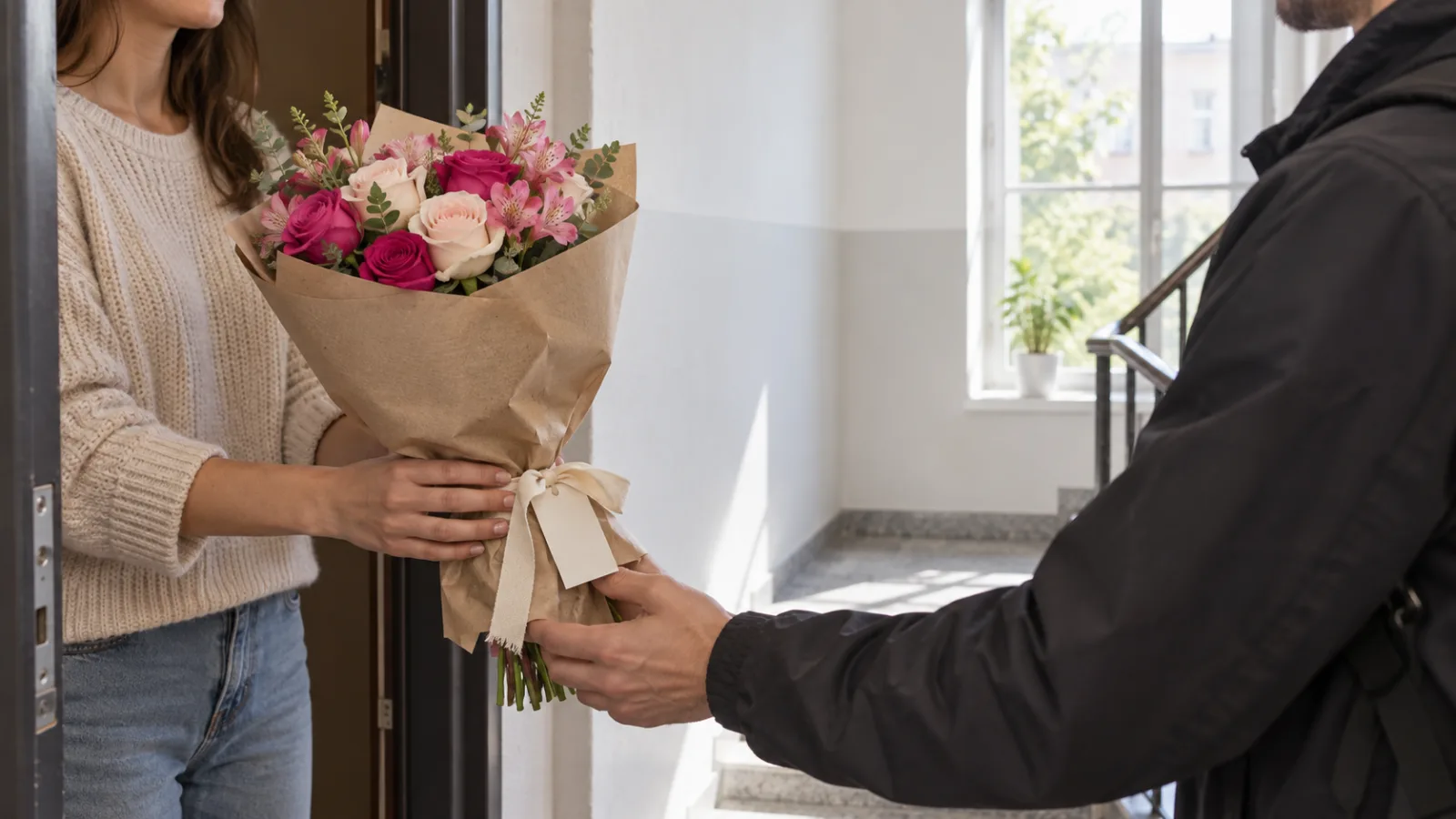
Wrapping shapes both the look of bouquets in Seoul and how they cope with the trip. The quietest option is bouquets in kraft paper: unbleached matte paper does not shine or compete with the flowers, so the eye goes to the bouquet first and the wrapping second. It suits a colleague's birthday, a hospital discharge or a first date, where glossy paper and bows would say more than intended.
Going without paper altogether, ribbon-tied bouquets show the stems in their spiral, a ribbon at the binding point and the cut ends in plain view. The format leaves stem length and the cut ends visible, so florists use it for flowers with a straight, sturdy stem: roses, lilies, gladioli and peonies.
Two formats skip the vase entirely. Bouquets in planters and bouquets in bags sit in floral foam soaked with water, so the arrangement can be set on a table and left alone. For a hotel, an office or any address where the flowers will wait a few hours for the recipient, that is more practical than a hand-tied bouquet: a hotel room or a reception desk may have no vase at all. A wrapped bouquet, on the other hand, belongs where it will be handed over in person and put in water straight away, at home or at a party.
A reference photograph is the other way to order, and the bouquet from your photo subsection exists for it. Send a reference picture or describe the mood, colours and budget, and the florist replies with similar pieces of their own work and prices, builds the bouquet and sends a photo before dispatch. Shape, size and palette can be matched closely; the exact varieties depend on what is in supply, because a flower in the reference may be seasonal or rare in your city. If a flower is unavailable, the florist swaps it for one close in colour and value, and the swap shows up in the photo before the courier leaves.
Edible bouquets are built from sweets, marshmallows, chocolate and strawberries, plus a few vegetable sets. Such a bouquet is taken apart and eaten rather than put in water, so it works where fresh flowers would feel too solemn: colleagues at the office, a child at the end of the school year, a housewarming. Nut allergies and diets deserve a thought before ordering; fresh flowers raise different questions, such as scent or pollen.
Bouquet delivery in Seoul: timing, privacy and payment
Bouquet delivery in Seoul works the same way for every format on this page. Delivery to the city centre is free, other districts carry a flat fee shown in the cart before payment, and most orders are handed over on the day they are placed. If the bouquet is already in the florist's studio, express delivery is available after confirmation, and the bouquet card shows the exact time. Orders for a set date and time slot are accepted for any zone, and around 14 February, 8 March and Mother's Day the convenient slots go days in advance. Zones and rates sit on the delivery page.
The recipient is not called ahead unless the sender asks; the one exception is a building or gated area that cannot be entered without a call, and then the courier calls from the door. The courier knows only a name and an address. Who sent the flowers is revealed only by a signed card, which comes free, and if there is no address at all, the recipient's phone number is enough.
In a hotel the bouquet goes to the room or waits at reception, whichever the hotel allows. In an office with access control it passes through reception, and in a clinic the florist checks first whether flowers are allowed on the ward. Payment is by Visa or Mastercard on a secure page, the cart total is final, and nothing is paid to the courier. Orders are taken around the clock.
Keeping a bouquet fresh after the handover
A wrapped bouquet is unwrapped as soon as it arrives: paper and film protect it on the road and only get in the way in a vase. Cut the stems at an angle with a sharp knife or secateurs, strip any leaves that would sit under water and put the flowers into clean water. From there, a few rules apply to any bouquet:
- change the water every day or two and refresh the cut each time;
- keep the vase away from radiators, direct sun and a bowl of ripe fruit, since apples and bananas give off ethylene, which ages petals faster;
- water an arrangement in a planter or bag daily, in a thin stream across the whole surface of the foam, and never tilt it;
- remove a wilted bloom straight away, so decay does not spread to the rest.
With that care roses last about a week, sometimes ten days, and chrysanthemums and carnations two to three weeks. The ribbon at the binding point can stay on: the spiral under it keeps holding the shape, so the bouquet does not slump in the vase.