




Tulips with delivery in Tokyo: varieties, the Japanese spring, and graduation season
In Tokyo the tulip is the flower of spring and new beginnings. It goes to graduations in March and entrance ceremonies in April, when the cherry blossom opens along the Meguro river and in Ueno Park. In the language of flowers the tulip stands for care and sincerity, which makes it an easy gift where a rose might feel too direct. By spring the shop windows of Shibuya and Ginza fill with bright armfuls. Here the tulip is a sign that winter has let go.
The category covers single-colour bouquets from 11 to 50 stems, mixed spring arrangements, and gift boxes with tulips and companion flowers — narcissi, ranunculus, anemones. The Japanese spring warms quickly, and the tulip season is concentrated — from late winter through April — so timing matters.

Which varieties to choose
Tulips in the catalogue are Japanese and Dutch. Japan grows cut tulips in Toyama prefecture (the Tonami plain) and in Niigata — well-known tulip-growing centres from which the flower travels across the country. We select varieties with a sturdy stem, a long vase life, and an interesting colour.
- Strong Gold — golden-yellow, a classic tulip on a tall, even stem. A graduation-season hit, it pairs well with white and green-spring arrangements.
- Red Impression — deep red, a large bud, a very sturdy stem. Suited to large single-colour bouquets of 25 stems and up.
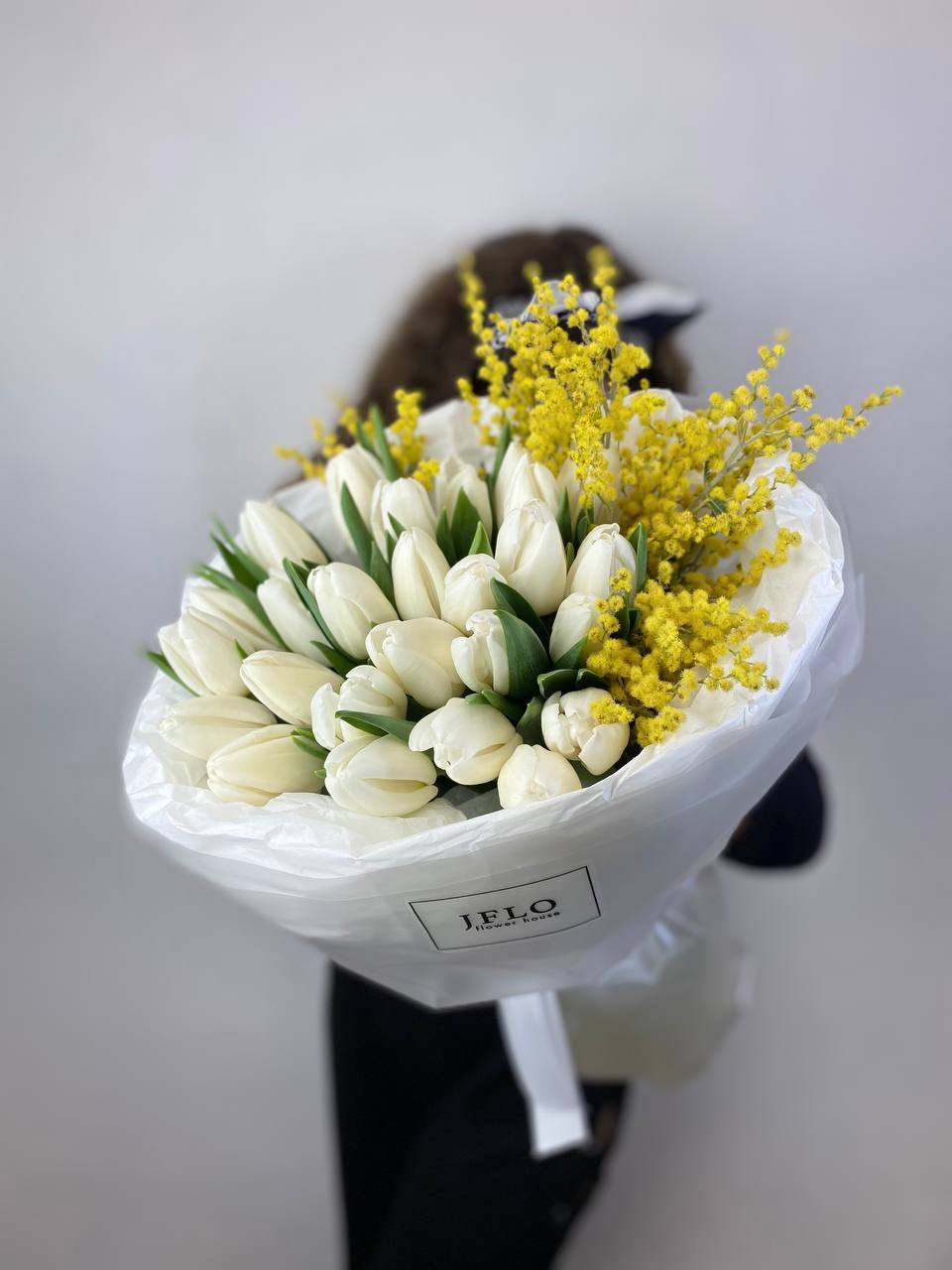
- White Dreamland — pure white, slightly matte. Neutral and elegant, good in mixed spring bouquets.
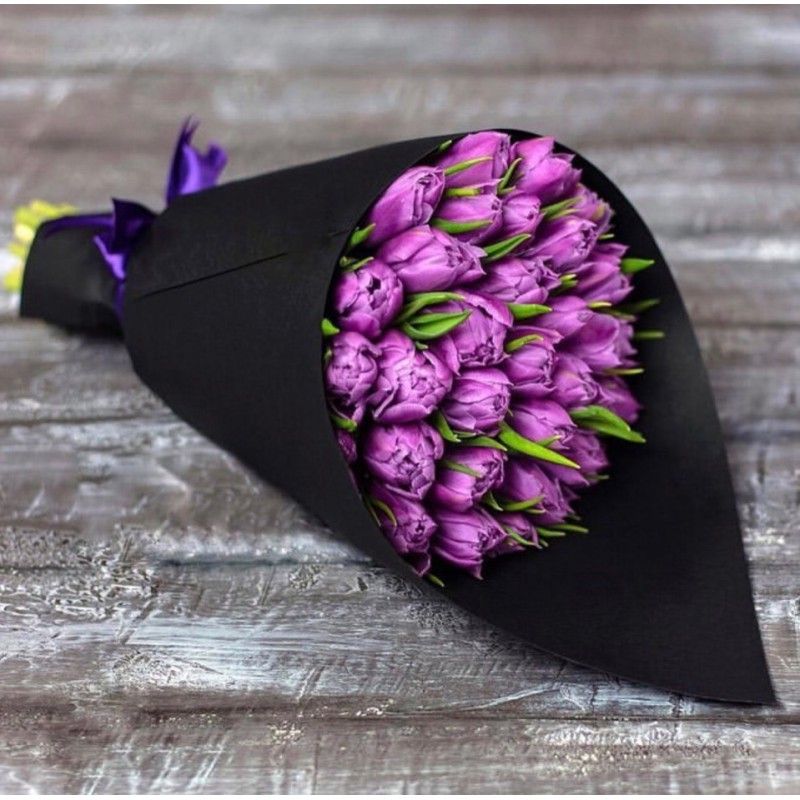
- Purple Flag — rich purple. A popular choice for those looking beyond the red-yellow-white palette.
- Japanese tulips from Toyama — local cut stems with a short delivery leg. Freshness and a firm stem are the main advantage in spring.
- Black Hero — deep dark-purple, almost black, a double tulip. An unconventional choice for modern interiors in the centre.
Occasions and seasonality
The tulip is the flower of the Japanese spring. Its main occasions are graduations (sotsugyō, March) and entrance ceremonies (nyūgaku, April): the tulip is seen as a fitting, restrained gift for teachers, graduates, and first-year pupils. White Day (14 March) and spring corporate occasions add to that. For offices in Marunouchi and Shibuya, tulips in vases are a regular fixture from February through April.
Tulips are given by the stem less often than roses — formats of 15, 25, and 50 are more typical. As with the other flowers, bouquets avoid counts of 4 and 9. For graduations, multi-colour armfuls are especially popular: several shades in one bouquet read more vividly than a single colour.
Freshness and logistics
Japanese tulips from Toyama and Niigata travel a short leg and arrive fresh within a day or two. Dutch cut stems fly in through Narita Airport (NRT) and are then distributed to florists through the Ōta Market — Japan's largest wholesale flower market. Tulips arrive in closed buds under deep chilling; they mature at the recipient's home — standard practice that extends freshness.
An important point for the Tokyo climate: on warm, sunny spring days tulips open noticeably faster. For a large event, take delivery the evening before rather than the morning of the day, especially when warm weather is forecast.
"The tulip is the most temperature-sensitive flower we work with. In Tokyo the spring warms in fits and starts: cool in the morning, sunny by midday, and the buds open before your eyes. For large orders I recommend delivery the day before the event, not the day of. And before graduations, order ahead — March is the peak of tulip demand."
— Aoi Nakamura, florist, Tokyo, 11 years in the trade
Delivery specifics in Tokyo
Tokyo sits on the Kanto plain by Tokyo Bay, with a humid subtropical climate. Winters are mild and dry, +5–10°C, and snow is rare. Spring warms quickly, and sunny spells can speed tulip opening. Summers are hot and muggy, +33–35°C, with the tsuyu rainy season and typhoons — but by then the tulip season is over. The most comfortable time for the tulip here is March and April.
We deliver across Tokyo: Ginza, Marunouchi and Nihonbashi, Shibuya, Shinjuku, Ikebukuro, Roppongi and Akasaka, Omotesando and Aoyama, Daikanyama, Ebisu, Meguro, Setagaya, Asakusa and Ueno, Shinagawa, the bay area and Odaiba. We take corporate orders for offices, restaurants, and hotels throughout the season. Payment is in yen (¥, JPY). For graduations and White Day, book 3–5 days ahead — demand for tulips rises sharply on peak days.
Care at home
Tulips keep growing in the vase — that's their quirk: the stems lengthen by 3–5 cm after they go into water. Cut at a 45° angle, remove the lower leaves, and change the water daily or every other day — tulips are very sensitive to bacteria in the water. A cool room of +15–18°C extends their life to 8–10 days.
Don't add anything extra to the water — clean cool water, changed regularly, works better than home remedies. On warm sunny days, keep tulips in the coolest room and move them to the refrigerator overnight to slow the buds. Message our manager and we'll help match the colour and stem count to the occasion and budget.

