

Flowers in boxes in Tokyo: cut stems under a lid, never roots
In Japan nobody brings a potted plant to a hospital patient: the plant visibly takes root, nezuku, and that reads as a wish for the stay to go on and on, so cut flowers go instead. Flowers in boxes in Tokyo are cut stems for exactly that reason, already arranged in wet foam rather than waiting for a vase, which leaves only one real choice: which shape suits the person who will carry it away. Many Tokyo clinics will not accept live flowers at all, and the rules for a particular ward are worth checking before you order, on sending flowers to a ward.
Into Ginza, home or onto a shelf: picking the shape of the box
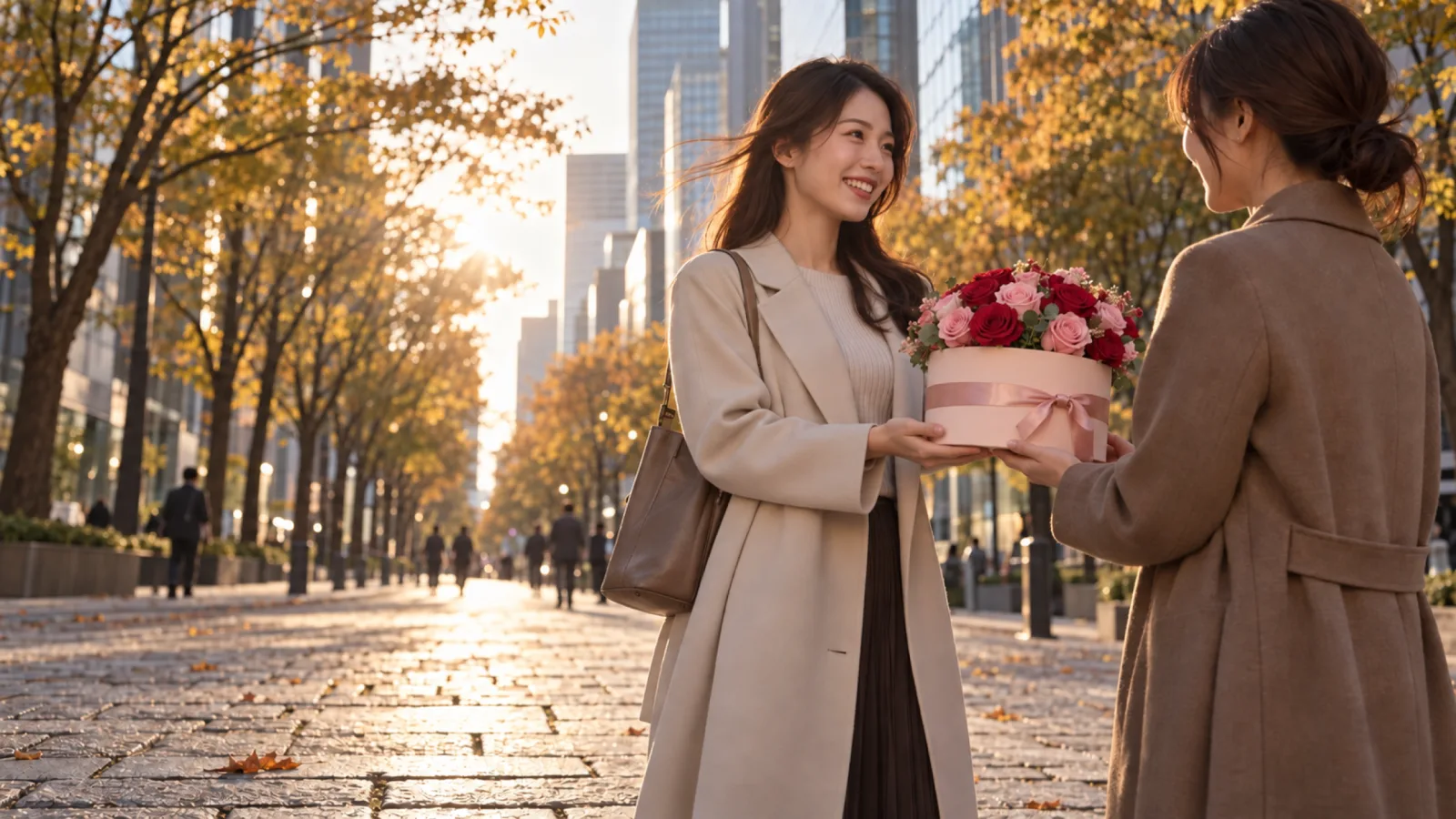
A flower handbag is built to go further than the doorstep. Its handles sit in one hand, so if the person collecting it is heading straight on to dinner in Ginza, Tokyo's shopping and restaurant district, the handbag travels with them without the trouble of carrying a stiff box through the city.
A hat box is built for the opposite trip: it gets carried home first, set down, and only then opened, the lid lifted off once there is room to actually look at what is inside.
A jute pot, a crate or a hanging basket stay exactly where they are put down. The container is handed over once and left with the recipient. They either stand it on a shelf or hang it from a hook, and it never needs to travel on anywhere; see crates and hanging baskets for the standing and hanging versions side by side.
Ecuadorian stems, reflexed jumilia or lisianthus inside a Tokyo box
A French rose is not a variety but a technique: a florist peels the outer petals back by hand until the bloom opens into a wide, slightly ruffled cup instead of the tight spiral it started as.
Jumilia is easier to place by size alone: the bud opens to around seven centimetres, white at the base and edged in pink, and with regular water it holds for close to two weeks, longer than most roses manage.
A Tokyo box also draws on the wider catalogue: Ecuadorian roses with their long, straight stems, lisianthus with its papery double flowers, hydrangea for its colour, and lilac in season, all of them cut stems rather than anything rooted.
One number quietly stays off the card: four and nine are avoided in a Japanese gift, in a stem count as much as anywhere else, because they echo the words for death and suffering.

Flower box delivery in Tokyo with macarons for White Day
On the fourteenth of February in Japan it is women who give chocolate, and on the fourteenth of March, White Day, men return the gesture. Sweets are the usual reply, but flowers are named among White Day gifts too, and a box holding both lets one delivery cover the custom either way.
The same caution about numbers applies to macarons as to stems: four and nine are avoided in the count, though exactly how many sit in any particular box is a detail for the product page rather than this one.
Every flower box in Tokyo is put together once the order is paid, and the sender gets a photo of it before the courier leaves. Delivery within the centre is free, most orders are delivered on the day they are placed, and the exact slot shows on the product page itself; see how delivery works across Tokyo for the rest.
First-time buyers of flowers in boxes in Tokyo usually start with a hat box, since it opens at home with nothing more than a lid to lift. For someone heading out straight after, a flower handbag travels better than anything with a lid. For a table rather than a doorway, macarons in boxes put something sweet next to the stems.