


Graduation in Tokyo: a bouquet for the March sotsugyoshiki
Japan's school year ends in March, and from mid-month to its last days, graduation in Tokyo means sotsugyoshiki, the formal ceremony after which graduates are given bouquets. The flowers change hands in public, so their shape depends on what comes next: a graduate's hands, a photograph, or a table at home. The same weeks fill the city with cherry blossom.
A sotsugyoshiki bouquet small enough to carry out of the hall
Sotsugyoshiki runs in every school in Tokyo, from primary schools to universities, as a formal event rather than a private family moment. A graduate walks out of the hall holding the bouquet, so a compact shape that fits in one hand works better than an armful.
Lavender spray roses meet that brief: several small heads on one stem already read as a full bouquet. Start with 11 Lavender Spray Roses. For a younger sibling or classmate, a mini bouquet built on the same small scale is just as easy to carry.
One number is worth avoiding regardless of the flower: Japanese gift-giving skips four and nine, a detail covered along with counting stems and sending from abroad.
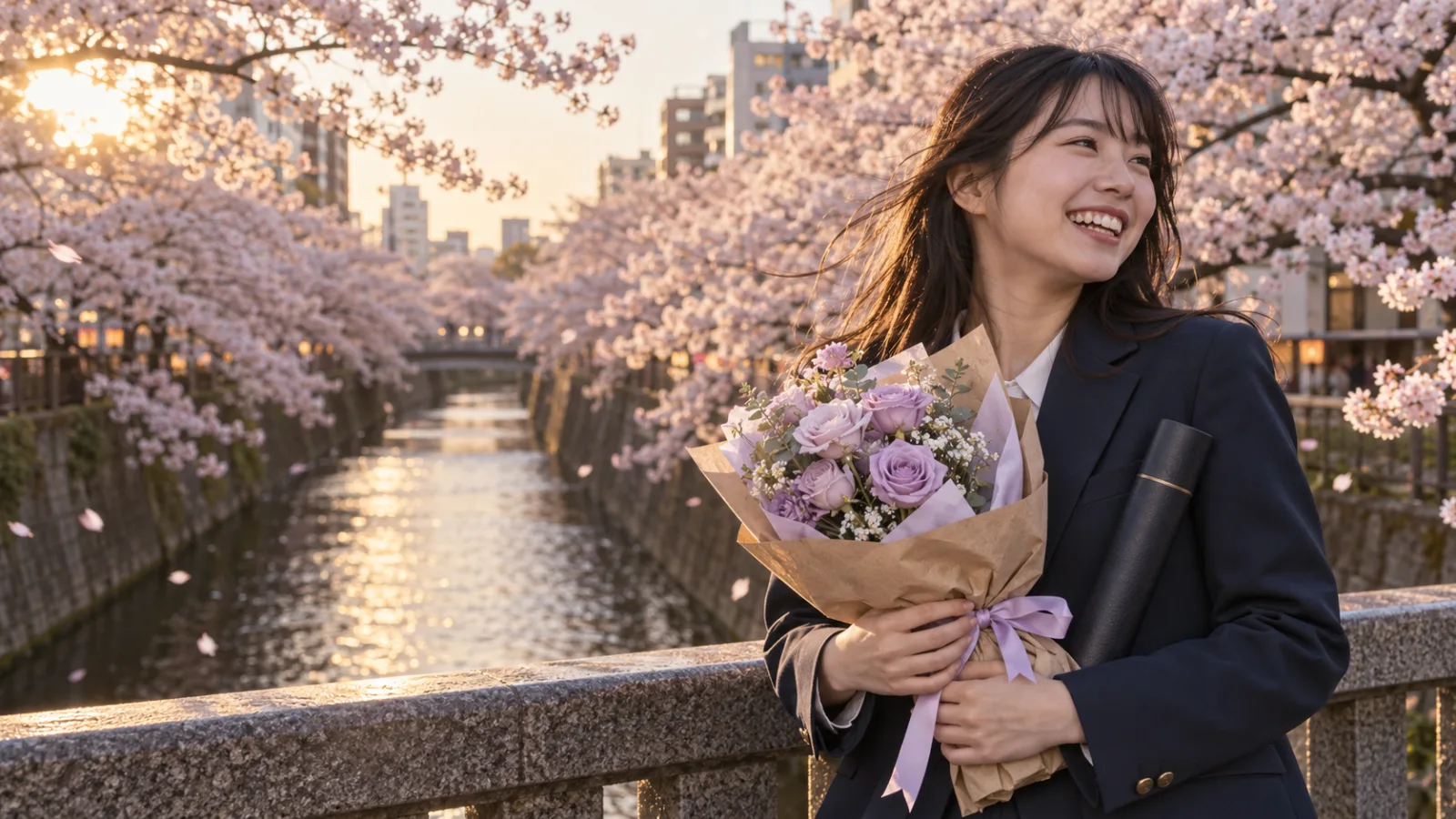
Graduation in Tokyo sits close to another date: nyugakushiki, the entrance ceremonies that open the new school year in April. A bouquet from sotsugyoshiki has to survive the weeks between the two.
Jumilia is built for that stretch: each bud reaches up to seven centimetres, white at the base and edged in pink, and with care it holds for up to two weeks, as in 51 Jumilia in Airy Wrapping.
Roses last about a week, sometimes ten days, so where the goal is simply reaching April, a mono bouquet of one flower built on a single long-lasting kind is steadier. Either way, cutting the stems at an angle and changing the water buys extra days.

Lilies, chrysanthemums and the one white to leave out
White chrysanthemums carry a funeral meaning in Japan and are not given to the living; other shades sit comfortably inside a mixed bouquet, since the restriction is specific to white.
Lilies add colour to a mixed bouquet. Once open, their anthers are removed, since fresh pollen stains fabric and is hard to lift; it comes off with sticky tape pressed on and peeled away, never rubbed. Where the family keeps a cat, lilies are worth leaving out, since every part of the plant is toxic to cats.
White is not off-limits in itself: white roses and peonies are fine; only the white chrysanthemum is.
A box or basket waiting at home after the ceremony
A gift that need not be carried through the ceremony can wait for the graduate at home, where a box or a basket earns its place over a hand-tied bouquet. A box or a flower basket holds its flowers in soaked floral foam and needs no vase. Either one is watered by running a thin stream over the whole surface of the foam every day.
Graduation flower delivery in Tokyo can go to the family's home, which suits a gift meant to wait there. Delivery to the city centre costs nothing, other districts carry a flat zone rate shown before payment, and any of them allows a chosen date and time slot. The florist sends a photo of the finished arrangement before the courier leaves. Zones and delivery terms cover the rest.
To order graduation flowers to Tokyo from outside Japan, the form needs only a name and a phone number for the graduate; no local address is required.
For the hall, start with lavender spray roses or a mono bouquet; for home, flowers in a box.