





Flowers in Singapore: what grows here, what is flown in and how to order
Singapore's national flower is an orchid bred in a Tanjong Pagar garden in 1893 and given the title in 1981 partly because it blooms all year round. Almost everything else in a bouquet here has travelled. Roses, peonies and tulips arrive by air through Changi or by road from Malaysia, and that route decides what flowers in Singapore cost this month and how long they last under the air conditioning.
Where the flowers sold in Singapore come from
Singapore imports nearly all of its cut flowers. In 2023 about a quarter of the value comes from Malaysia, another quarter from China and about a sixth from the Netherlands, with India, Thailand, Kenya and Ecuador sharing the rest. Malaysia is the short route: chrysanthemums, gerberas and tropical stems grown in the Cameron Highlands come south by road. The Dutch route brings tulips, lilies and delphinium, China sends roses, chrysanthemums and lisianthus, and roses fly in from Kenya and Ecuador, the Ecuadorian ones with the biggest heads and the longest stems.
The one flower with a Singapore history of its own is the orchid. In the 1960s and 1970s cut dendrobiums from the Mandai gardens went to Europe, North America and Japan. The gardens closed in 2010, and today the orchid lives on at the National Orchid Garden, with more than a thousand species, rather than on farms.
What matters at the vase is not the country on the label but the hours the stems spent warm on the way. Changi has a perishables terminal inside the airport for exactly that reason. At JFLOO the flowers are bought for your order after payment, and the florist sends a photo of the finished bouquet before the courier leaves.
The city has no spring or autumn, so the seasons in a Singapore bouquet are borrowed from the countries that grow it. Roses are grown under glass all year: the roses section alone holds more than five hundred bouquets.
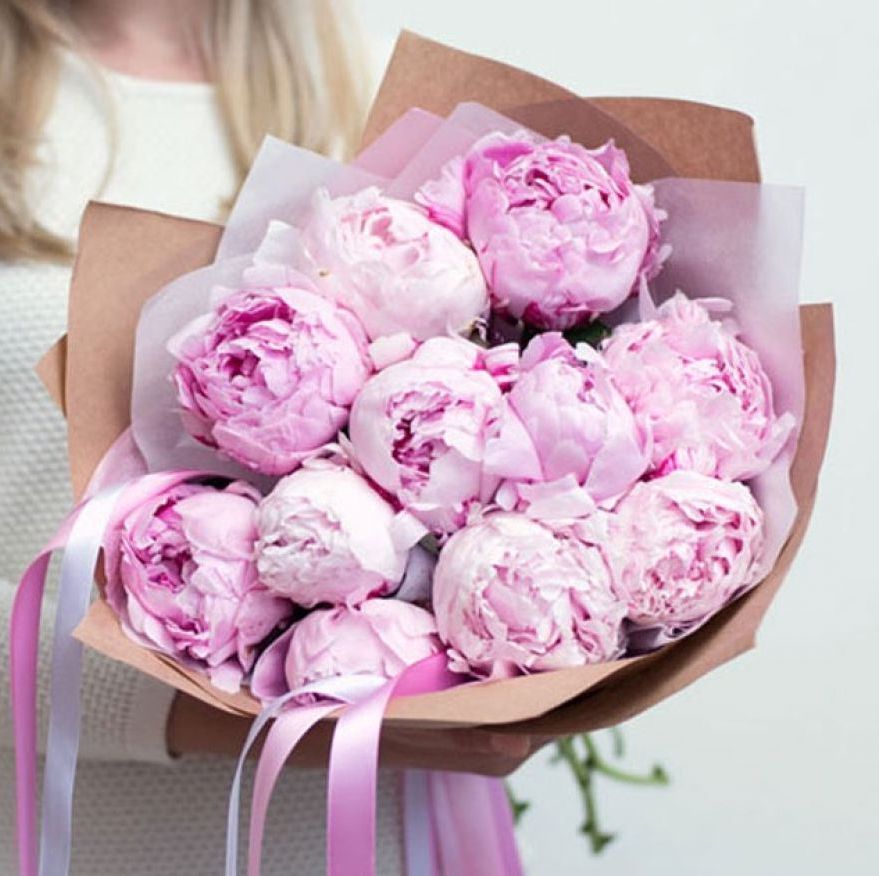
Peonies keep the strictest calendar: Europe cuts them from late April to the end of June, Chile, Australia and New Zealand from October to December, and in the months between peonies come from further away at a higher price. Chrysanthemums, gerberas, alstroemeria, lilies and lisianthus are grown all year, much of it a few hours up the road in Malaysia. That makes mono bouquets of one flower the safe choice when the date matters more than the variety, and designer bouquets the choice for a palette rather than a name.
Singapore does have one flower season of its own: Chinese New Year, a holiday whose date shifts every year. In the week or two before it, homes fill with pussy willow, whose Chinese name sounds like a wish for silver and property, potted kumquats for gold and plenty, and orchids, all bought as plants rather than cut stems.
Hand-tied bouquet, hat box or basket: choosing by Singapore address
More than three quarters of Singapore residents live in HDB flats, many others in condominiums behind a guardhouse, and the working day happens in the towers of Raffles Place, Marina Bay and Tanjong Pagar or the hotels along Orchard Road. A hand-tied bouquet in paper suits a flat where the recipient opens the door and a vase is waiting. At a condo gate, a reception desk or a hotel room the flowers may wait for hours without a vase. For those addresses there are flowers in boxes and flower baskets: the stems stand in floral foam soaked with water, so the arrangement needs no vase and tolerates the wait.
The order form asks for what each address needs: for a hotel, the surname the guest is registered under and the room number if you know it; for an office, the company name and the floor. At a gated estate that cannot be entered without a call, the courier calls from the gate. Hospitals are the strictest address in the city: intensive care and high dependency wards do not accept fresh flowers, general wards take small arrangements, and in public hospitals the delivery is left at reception or the nurses' station. The manager checks the ward's rules first. For a hall full of people there are armfuls and designer giants.
Colours and numbers that matter in Singapore
The rules for flowers follow the household, and Singapore has three main ones. In Chinese custom, white and yellow chrysanthemums are the flowers of funerals and condolence, so a bunch of white chrysanthemums is a poor birthday present. Red is the colour of celebration, weddings and luck, and it stays away from funerals. Numbers count too: four sounds like the word for death in Chinese, so four, fourteen or twenty-four stems are avoided in a gift, and one of the city's bus operators even skips some plate numbers ending in four.
Malay Muslim families are more likely to prefer a donation to flowers at a funeral, while Indian families use garlands of marigold and jasmine rather than standing arrangements. For a birthday, roses or sunflowers raise none of those questions, and flowers also go to teachers on the first Friday of September, Teachers' Day. Ready-made selections for birthdays and anniversaries are under occasions; a doubt about a colour or a count goes in the order comment.
What flowers cost in Singapore
Prices are in Singapore dollars and vary widely by category. Mono bouquets and roses sit at the lower end, flowers in boxes, mixed bouquets and peonies in the middle, armfuls and designer bouquets higher still, and designer giants at the top of the range. What is charged is the cart total, bouquet, extras and delivery included; a card in another currency is converted by your bank at its own rate, with no fee from the shop.
Two things move the price inside a category. Stem length: roses are sorted into 40, 50, 70 and 80 centimetre stems, and the longer the stem, the more each flower costs, so an Ecuadorian rose is dearer than a Kenyan one. The grower's season: a peony in May costs less than the same peony in November, and before Valentine's Day and Mother's Day, the second Sunday of May, wholesale prices follow demand. To buy flowers in Singapore at a sensible price, go with the season and let the florist swap a scarce variety for a close one.
Flower delivery in Singapore: zones, timing and ordering from abroad
Flower delivery in Singapore is free in the Downtown Core from 7 am to 11 pm; at checkout that zone covers Marina Bay, Raffles Place, Orchard and Clarke Quay. Most bouquets are delivered on the day they are ordered, and for express orders the bouquet card shows the delivery time. Every other district has a flat rate that is added in the cart before you pay:
- Outer districts: Tanjong Pagar and Chinatown, Bukit Merah and Tiong Bahru, Bukit Timah and Holland Village, Bedok and Tampines, Woodlands, Yishun and Sembawang;
- 11 pm to 7 am: any zone by prior arrangement, priced individually;
- the islands, gated communities and the airport: on request, with the price confirmed before payment.
Those rates are for express orders of a bouquet in stock; a chosen date and time slot is available in every zone. Around Valentine's Day, 8 March and Mother's Day the volume is several times the usual, the slots are wider and it pays to order a few days ahead. The recipient is not called in advance unless you ask; the exception is a building or a gated estate that cannot be entered without a call. Zones and rates are on the delivery page.
A bouquet indoors in Singapore: air conditioning and the afternoon sun
Singapore's weather is the same in every month: 31 to 33 degrees by day, 23 to 25 at night, humidity above 90 per cent before sunrise and around 60 on a dry afternoon. Rain falls on roughly every second day, heaviest from November to January and lightest in February. Indoors the enemy is the air conditioner: it dries the air and pulls water out of the petals faster than the stem can replace it. Get the flowers into water as soon as they arrive and keep to a few habits:
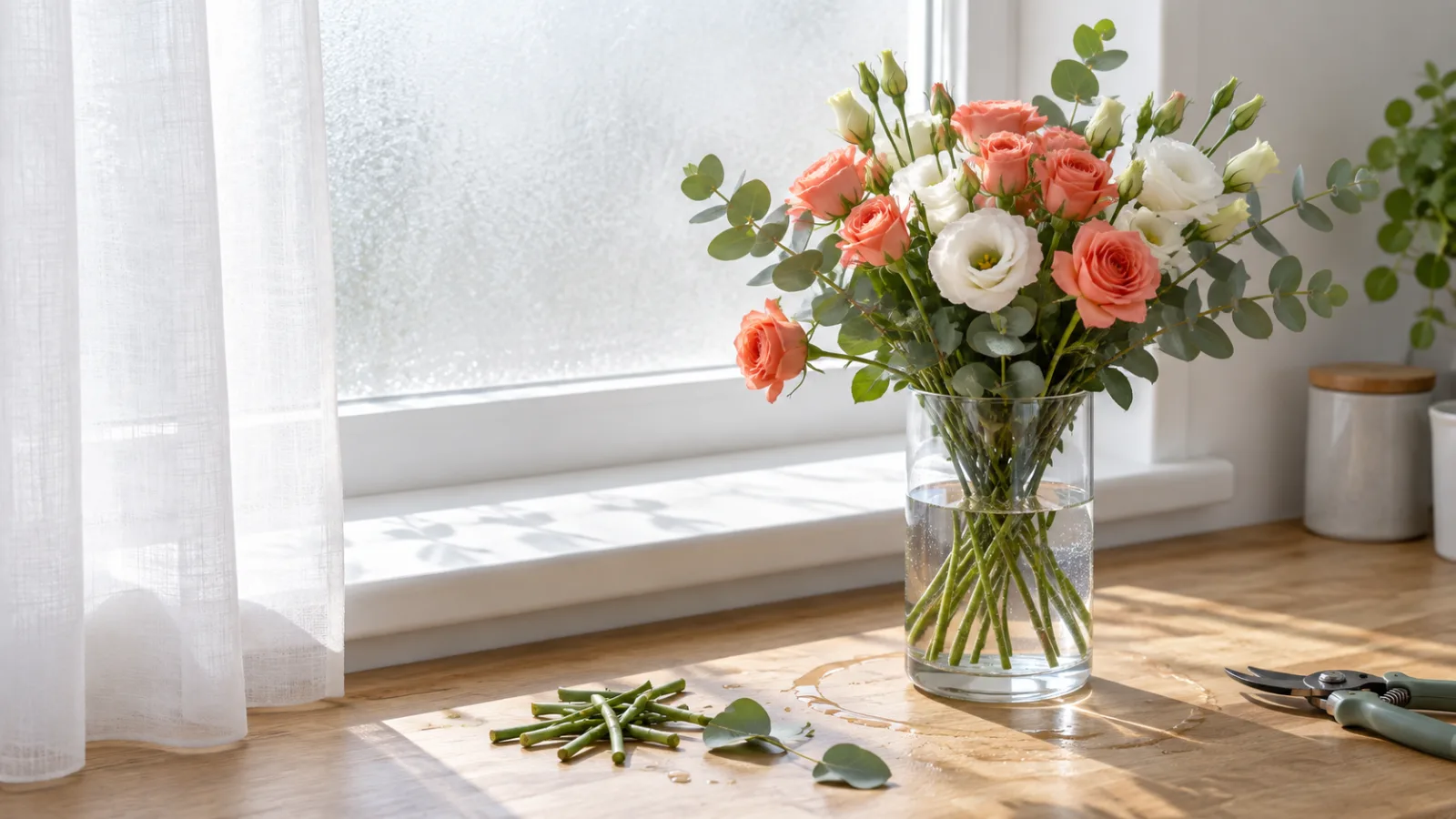
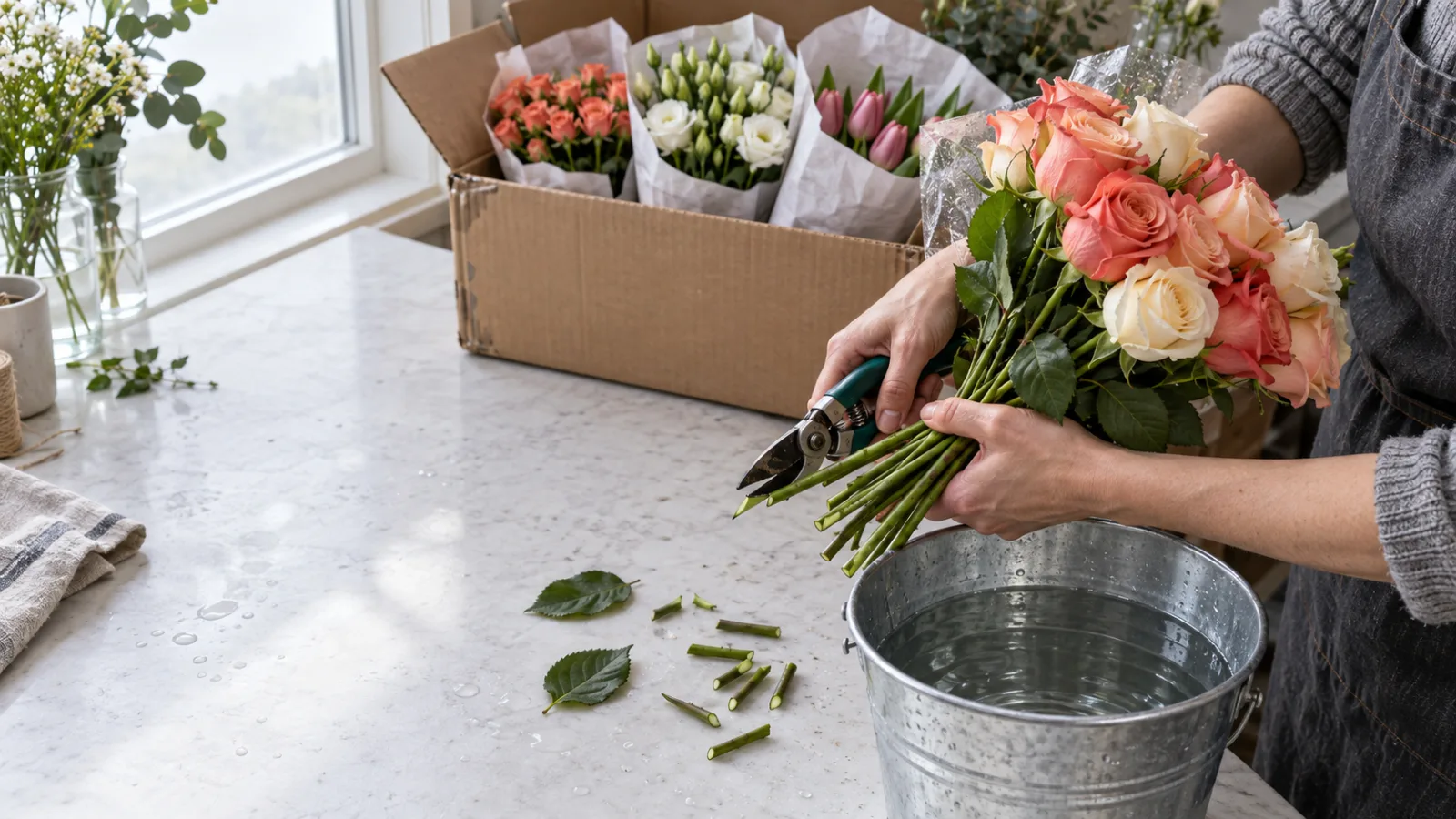
- recut the stems at an angle with a sharp knife or secateurs, taking off 1–2 cm, and strip any leaves that would sit below the waterline;
- keep the vase out of the direct draught of the air conditioner, away from the afternoon sun and the fruit bowl, since ripe fruit gives off ethylene;
- change the water every day, since warm water clouds faster than it looks;
- water a boxed or basket arrangement into the foam across its whole surface and never tilt it.
With that routine roses last about a week; chrysanthemums, carnations, alstroemeria and, fittingly for the national flower, cut orchids last two to three.