

Tulips: the leading flower of spring
The tulip is the symbol of spring and one of the most popular seasonal flowers. Its season runs from late January to mid-April, and demand peaks around International Women's Day on 8 March.
This category brings together tulips by stem count, colour, type (classic Triumph, Darwin hybrid, double peony-flowered, fringed, parrot) and presentation (bouquet, hatbox, basket, armful). Each subcategory has its own page.
The axes the category is divided by
The tulip has several independent classifications, and all of them matter when choosing.
- By count — 11, 15, 25, 35, 51 or 101 stems.
- By palette — white, yellow, pink, red, purple, red-and-white two-tone.
- By type — classic Triumph (medium-sized bloom, stem 35–45 cm), Darwin hybrid (long stem 45–55 cm, large bloom), double peony-flowered (a rounded, peony-like bloom), fringed (with a serrated edge), parrot (with wavy petals).
- By presentation format — a bouquet in paper, a hatbox, a woven basket, a large armful of 51 stems or more.
The main varieties in mass-market cut flowers
Strong Gold — the flagship of the yellow palette among classic Triumphs.
Yokohama — a lemon-yellow Triumph that blooms mid-season.
Pink Impression — a pink Darwin hybrid with a long stem.
Ile de France — a scarlet classic Triumph, the best-known red variety.
Red Power — a scarlet Darwin hybrid with a large bloom.
White Dream — a white classic Triumph.
Negrita — a rich purple Triumph, the best-known purple variety.
Foxtrot — a soft-pink double peony-flowered tulip, a benchmark of the premium range.
Mount Tacoma — a white double peony-flowered tulip, a favourite for wedding floristry.
Leen van der Mark — a two-tone red-and-white “flame” tulip, the best-known variety of the two-tone palette.
When this flower is a good fit
Good for: International Women's Day on 8 March (gifts for mothers, grandmothers, colleagues and teachers), spring holidays and birthdays from February to April, welcoming a newborn girl home, thanking a teacher, corporate gifts for 8 March, affordable gifts in season (one of the most budget-friendly seasonal flowers), and wedding floristry from February to April as an alternative to expensive out-of-season peonies (especially the double peony-flowered varieties).
When another flower is a better choice: an engagement or a silver wedding anniversary (the rose is more precise in its symbolism), grand public gestures, formal business gifts, the autumn–winter period (out-of-season tulips cost more and the choice of varieties narrows), Valentine's Day and romantic dates (the rose is more expressive), and large events with a lot of flowers in the autumn–winter months.
«The tulip is the seasonal king of floristry. From late January to mid-April it dominates every counter. I often tell clients: if you want a beautiful bouquet in season at an affordable price — take this flower. The quality, stem length and bud density are at their peak, and yet the price is 2–3 times lower than an equivalent rose arrangement. It is the best value for money on the spring market.»
— Yulia Gavrilenko, florist at the Tsvetochka chain, 12 years of experience
Combinations and arrangements
The tulip is a gentle partner in arrangements. The main rule is not to overload the bouquet with competing bright elements, especially in a single-variety bouquet.
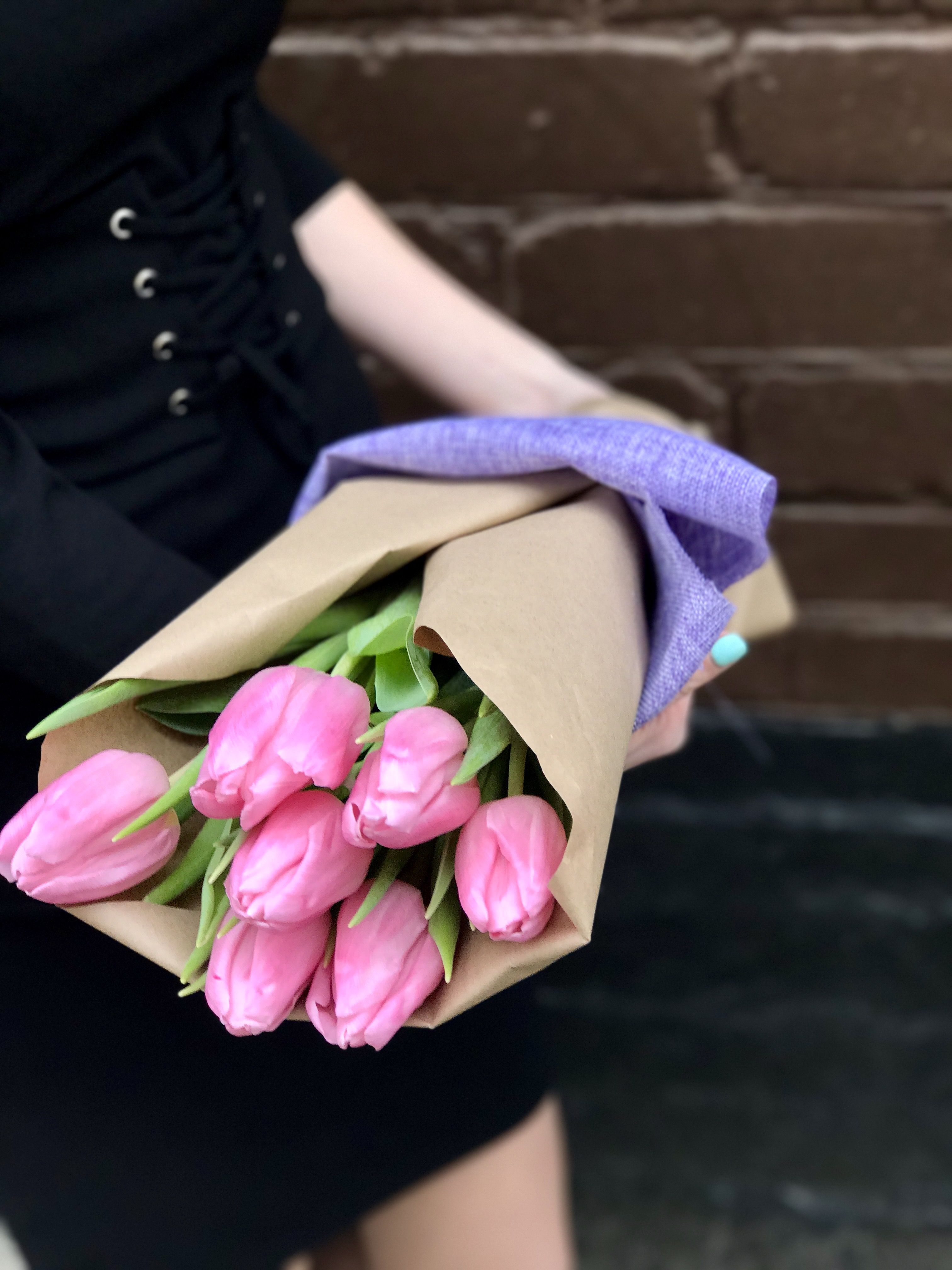
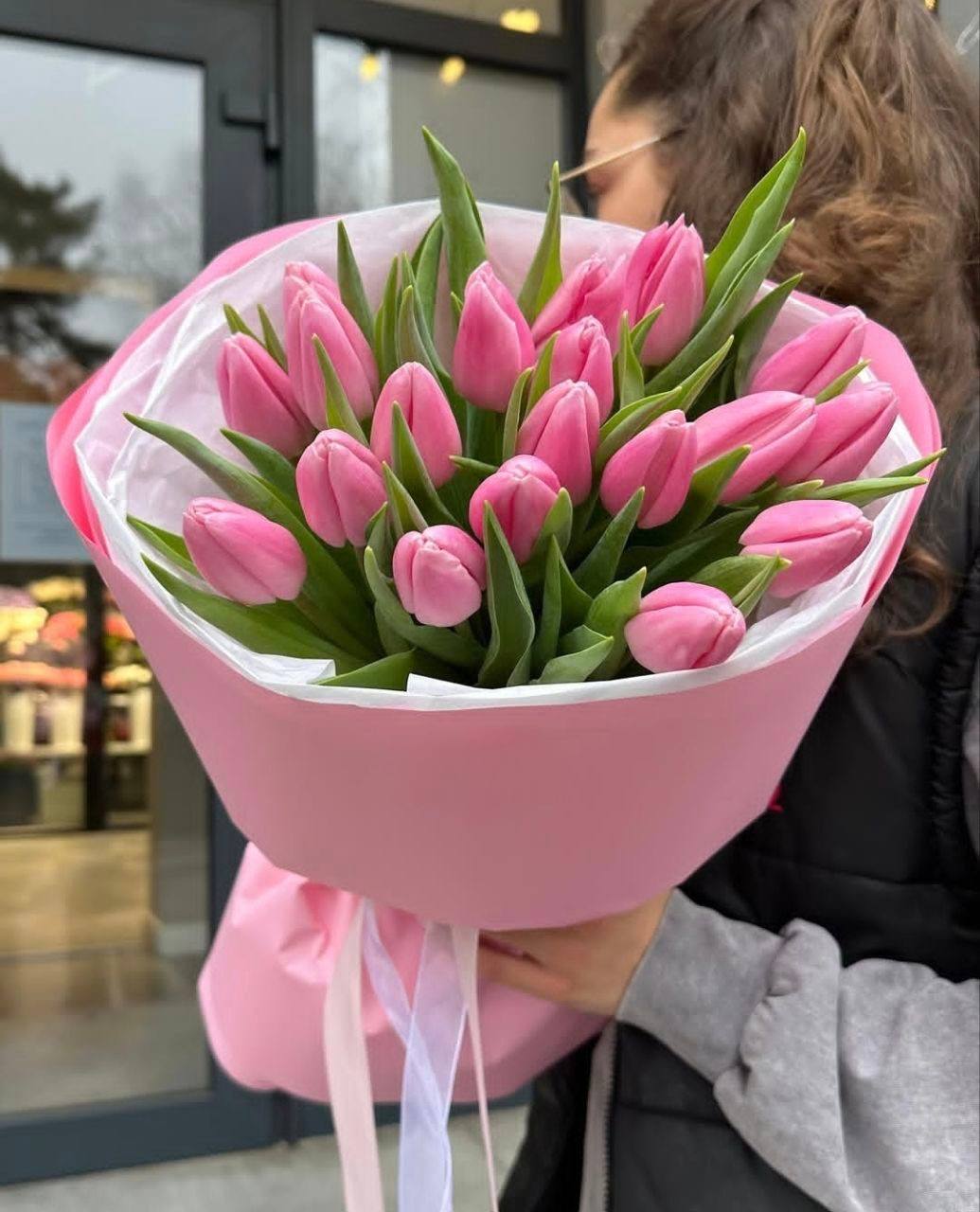
One colour — the classic. 11, 15, 25 or 51 stems of a single colour in kraft paper, linen felt or clear wrapping, with a neutral or matching ribbon.
With irises — the classic spring bouquet. 9 yellow tulips + 9 blue irises is a spring favourite for 8 March.
With roses — a modern designer arrangement. 11 Foxtrot tulips + 11 Quicksand roses + eucalyptus makes a premium wedding arrangement for February–April.
With mimosa and eucalyptus — a classic for 8 March. 15 yellow tulips + mimosa branches + eucalyptus.
With greenery — the standard. Eucalyptus cinerea, pistache leaves, pittosporum. Dark, dense greenery sets off the brightness of the tulip.
Combinations to avoid: tulips with large tropical flowers (anthurium, heliconia), where the scales clash; tulips with cymbidium orchids, where the premium look is lost; and tulips of 5 different varieties in one bouquet, which looks cluttered.
Season and availability
The tulip season runs from late January to mid-April, peaking in the first half of March. During this period all varieties are available in full volume and prices are at their best.
Greenhouse-grown tulips supplement the supply year-round, but from May to October the choice narrows to a basic five (Strong Gold, Yokohama, Ile de France, Pink Impression, White Dream). Double peony-flowered varieties (Foxtrot, Mount Tacoma, Black Hero) and purple ones are rare out of season and are available only by pre-order 7–14 days in advance.
Around 8 March prices rise, especially in the last 2–3 days before the holiday. The best varieties (Foxtrot, Mount Tacoma, Leen van der Mark) sell out 5–10 days before the date.
What unites all the subcategories
Care is standard for any variety. Renew the cut at 45° with a sharp knife (remove 1 cm), strip the leaves below the water line, place in clean cold water at 4–8 °C. Change the water every 1–2 days, renewing the cut by 0.5 cm at each change. Vase life 5–8 days — shorter than for the rose and chrysanthemum, but within the norm for a seasonal flower.
The tulip keeps growing in the vase, lengthening by 2–4 cm over the first 3–5 days. The flowers open and close with the day and night cycle — this is not a defect but the natural behaviour of the flower. To keep the stems from stretching excessively, add a drop of bleach or an aspirin tablet to the water. This slightly slows the growth and extends the bouquet's life by 1–2 days.
Cold water is essential — 4–8 °C. Warm water speeds up opening and halves the bouquet's lifespan. Unlike the rose, which needs water at 8–12 °C, the tulip does best in cold water.
Tulips are available in Hangzhou year-round, with the widest choice in season (February–April), including premium double peony-flowered and rare two-tone varieties. For 8 March, order 5–10 days ahead.
The tulip is the all-rounder of spring. It is not for grand gestures or premium presentations year-round, but for those moments between February and April when the season itself supports the choice, and it suits any gift — from an everyday one to a serious anniversary.

