Iris blooms three weeks a year, but during that time each scape produces up to 12 buds. Humans have known this plant for 4,000 years: painted on Cretan frescoes, added to Medici perfumes, planted in Monet's garden. Here's a full guide to the groups, varieties, care, and use of iris in bouquets and the garden.
Botanical description
Iris is a genus of perennial rhizomatous and bulbous plants in the Iridaceae family. About 800 species; native range covers the temperate Northern Hemisphere: Japan to Portugal, Siberia to North Africa.
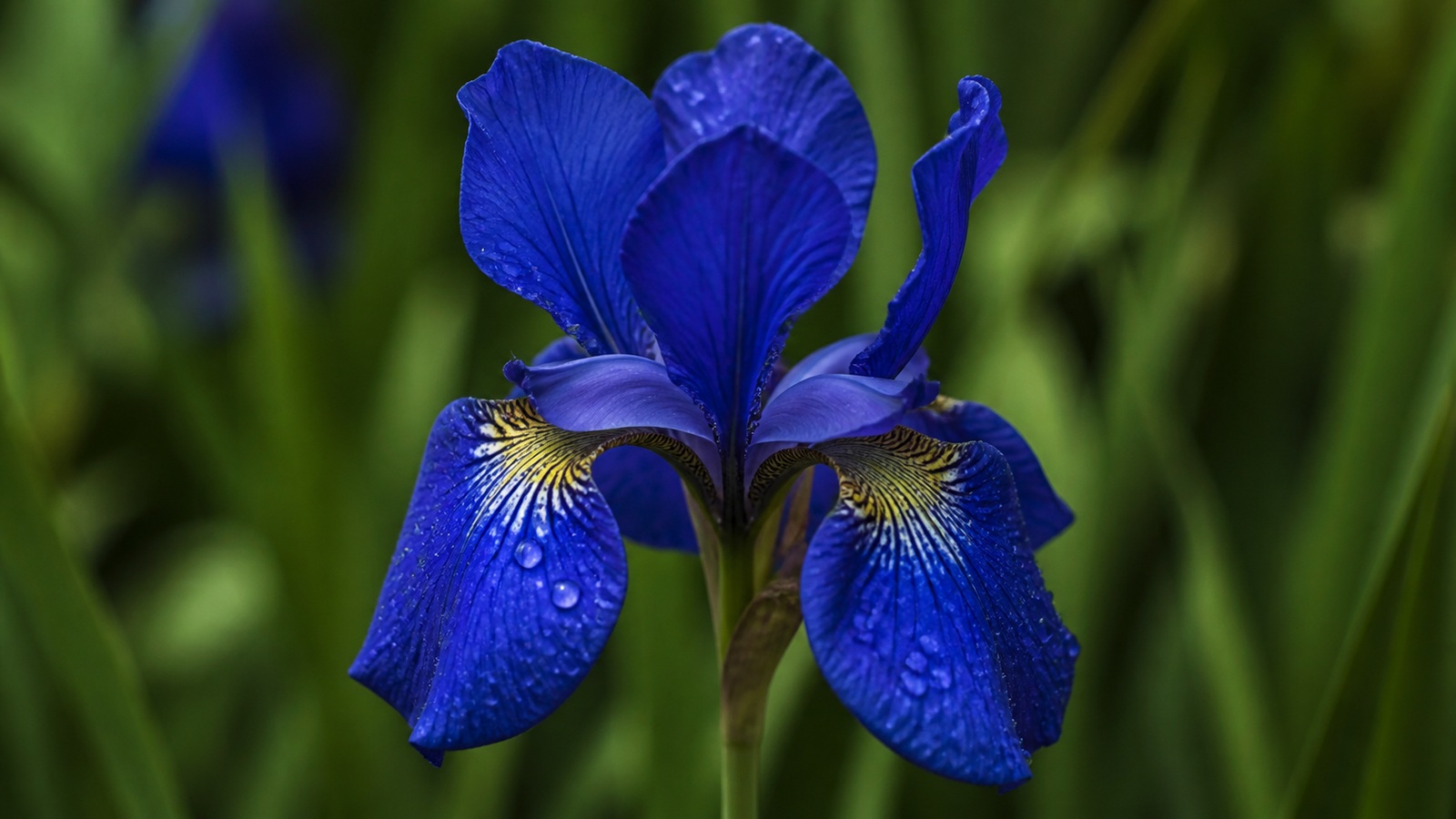
The iris flower is unusually built. Three outer segments ("falls") arch downward, and three inner ones ("standards") stand upright. Three petal-like styles hide within, with stamens beneath — an adaptation for pollinators: a bumblebee lands on a fall as a runway and crawls inward.
Scape height ranges from 15 cm in dwarf forms to 120 cm in Japanese iris. Leaves in most species are sword-shaped, dense, gray-green. After bloom they stay decorative through autumn as a backdrop for other perennials.
Difference from similar plants
- Gladiolus — a corm, flowers on a single vertical spike opening bottom-up. Blooms July–September.
- Daylily (Hemerocallis) — a rhizome with thickened roots; each flower lives one day, six equal petals. Blooms June–August.
- Iris — rhizome or bulb, up to 12 buds per scape, uneven perianth (three falls + three standards). Blooms May–June.
Groups and species
Horticulture uses six main groups, each with its own agronomy.
Bearded (Iris germanica)
The most common in gardens. A rhizomatous perennial 30–90 cm tall. On the falls — a "beard" of colorful hairs (hence the name). Bloom late May–early June, 2–3 weeks per bush.
Sub-groups:
- Tall Bearded (TB) — 70+ cm, most cultivars
- Intermediate Bearded (IB) — 40–70 cm
- Standard Dwarf Bearded (SDB) — 20–40 cm
- Miniature Dwarf Bearded (MDB) — under 20 cm
Best-selling varieties: Sapphire Hills (pure blue), Beverly Sills (rose-pink), Superstition (near-black purple), Batik (white with purple stripes).
Siberian (Iris sibirica)
Grass-like leaves, slender scapes 60–100 cm, 3–5 flowers per scape. Blooms mid-June. Winter-hardy to −40 °C, needs no cover. Prefers moist soil at pond edges.
Varieties: Butter and Sugar (yellow-white), Caesar's Brother (deep purple), Shirley Pope (violet).
Japanese (Iris ensata)
The largest group by flower size — up to 25 cm across. Height 80–120 cm. Blooms late June to mid-July. Loves acidic wet soil, blooms only at water's edge or in bog gardens.
Louisiana
American water iris species. Grows in shallow water 5–15 cm deep. Cold-hardy only to −20 °C.
Bulbous (Dutch Iris — I. × hollandica)
Bulb, height 40–60 cm. Blooms May. Best group for cut floristry — 90% of "florist irises" you'll see. Colors: pure blue, purple, yellow, white, bicolor.
Reticulata (Iris reticulata)
Dwarf bulbous, 10–15 cm tall. Blooms March–April with the first snowdrops. For rock gardens.
Popular varieties for the florist
Dutch iris varieties for cut floristry:
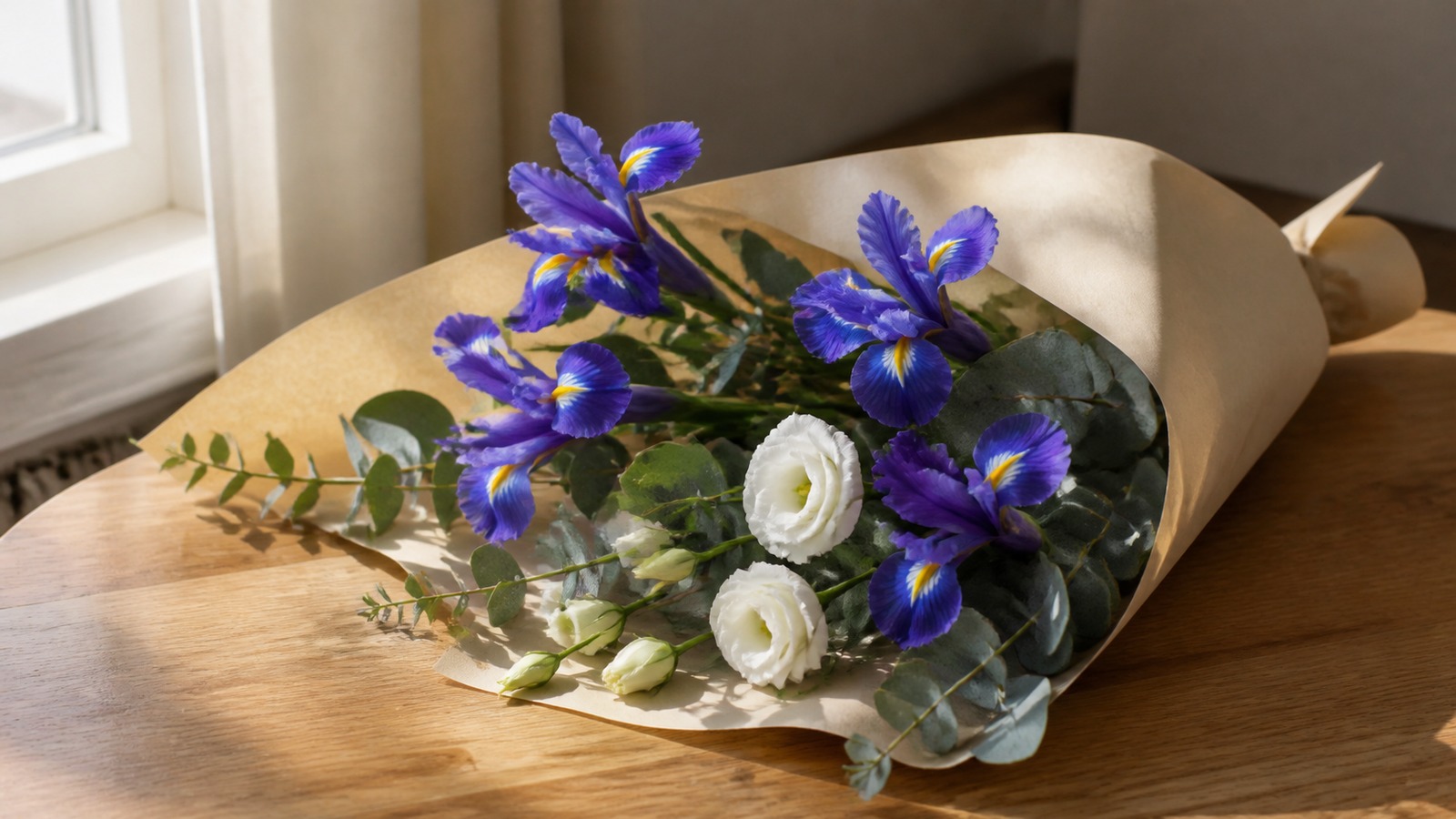
- Blue Magic — deep blue, market standard
- Blue Diamond — sky-blue, wedding classic
- Discovery — pure white
- Golden Beauty — bright yellow
- Telstar — cobalt blue
- Purple Sensation — dark purple
Vase price per stem: $2–4. Availability year-round through Dutch imports.
Planting and location
Bearded iris — sunny position, drained soil. Rhizome is planted horizontally, half above ground — the crown must "sunbathe" to bloom.
Siberian iris — sun to partial shade, moist soil.
Japanese iris — wet acidic soil, near water.
Dutch iris (bulbous) — planted in autumn 8 cm deep, spacing 8–10 cm. Lift after bloom or leave in the ground.
Common mistake: planting a bearded iris rhizome too deep. If planted below the soil surface, it will only produce leaves; won't bloom. Uncover the top of the rhizome.
Season care
- Spring: remove old dead leaves, apply nitrogen fertilizer (30 g/m² ammonium nitrate)
- Bud stage: N-P-K balanced (25 g/m²)
- After bloom: phosphorus-potassium mix (superphosphate 40 g/m² + potassium sulfate 25 g/m²)
- Watering: moderate, no waterlogging on rhizomes
- Division: bearded iris every 4–5 years; Siberian every 8–10; Japanese every 3–4
- Winter cover: bearded — needs pine branches or straw; Siberian, Japanese — no cover in temperate zones
Diseases: rhizome rot (Fusarium), leaf spot (Heterosporium). Prevention: don't overwater, don't cover the rhizome, remove old foliage in spring.
Iris in bouquets and floristry
Iris is graphic and vertical — a bouquet's "architectural" element. Works well in:
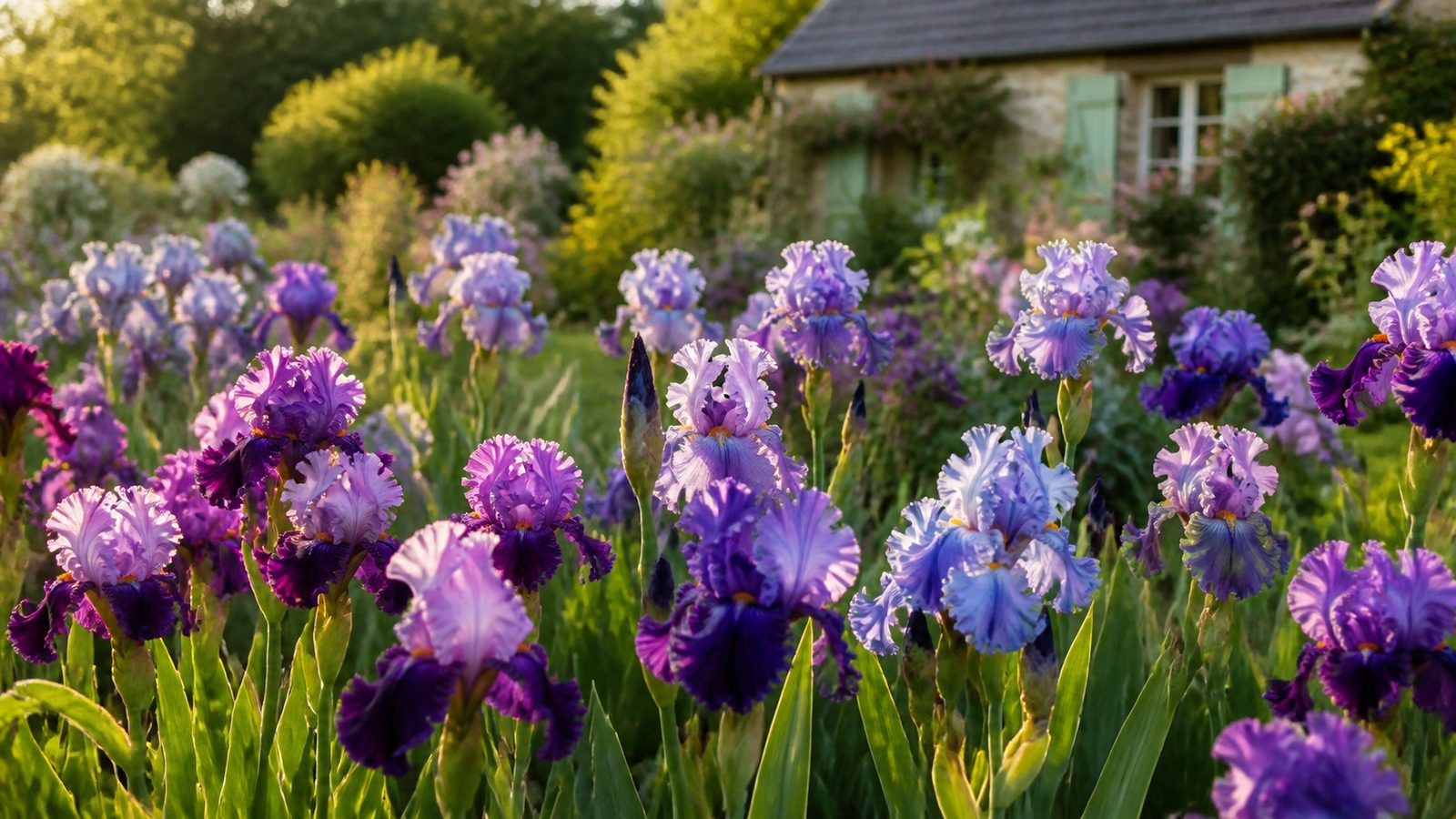
- Vertical mono-bouquets — 7 blue irises in kraft = the classic "gentleman's" bouquet
- "Aquarius" compositions — iris + eryngium + Baby Blue eucalyptus (see Aquarius zodiac flower)
- Impressionist palette — blue iris + yellow narcissi + tulips (Monet's garden style)
- Wedding boutonnieres — one iris flower + eucalyptus (a groom's non-standard boutonniere)
Working combinations
- Iris + eucalyptus + eryngium (cool blue palette)
- Iris + narcissus + tulip (spring bouquet)
- Iris + white lisianthus + hydrangea (elegant wedding composition)
- Iris + snapdragon + delphinium (English cottage garden)
Combinations that don't work
- Iris + rose (silhouette mismatch)
- Iris + gerbera (color palette clash)
- Iris + carnation (aesthetic mismatch)
Cut care
- Trim at 45° under water
- Cool water, medium vase
- Bud opening: iris opens sequentially — one bud at a time, over 3–5 days per stem
- Remove faded flowers — the upper buds keep opening
Vase life: 5–7 days per stem, total inflorescence life 8–10 days.
Symbolism and meaning
The iris is the flower of the Greek goddess Iris — messenger between gods and mortals, personifying the rainbow. Hence the flower's name and the wealth of colors.
In heraldry: the fleur-de-lys — the stylized iris — is the symbol of French royalty. First used in 1179 in the seal of Louis VII. Still on the flag of Quebec and the coat of arms of Florence.
In perfumery: iris root (orris root) is the most expensive raw material in perfumery — up to $6,000 per kilogram. Used in Chanel N°19, Hermès Iris des Champs, Serge Lutens Iris Silver Mist.
Color code:
- Blue — hope, faith, trust
- Purple — wisdom, dignity, courage
- Yellow — passion, hot affection
- White — purity, innocence, "you understand me"
- Bicolor — the complexity of the relationship
In Japan, iris (shobu, 菖蒲) is a masculine flower symbolizing courage. Children's Day (Kodomo no Hi, May 5) features iris in every home to guard boys from evil.
Facts and history
- Frescoes on Crete — the earliest iris depiction, palace of Knossos, 2100 BC
- Fleur-de-lys — the stylized iris on the French royal shield; more than 800 years of heraldry
- The most expensive perfumery raw material — orris root; the price reaches $6,000/kg
- Monet's garden — Claude Monet planted 150 iris varieties in Giverny; painted them in over 20 canvases
- Iris on the U.S. state flag — Tennessee (bearded iris, adopted 1933)
- World record — the largest iris was bred in 1998 in New Zealand: the flower head reached 30 cm across
FAQ
What's the difference between garden and Dutch (florist) iris? Dutch iris is bulbous, blooms May; garden bearded iris is rhizomatous, blooms May–June. Florists mostly use Dutch — hardier as cuts.
Why doesn't my iris bloom? 90% of cases — planted too deep. The rhizome must sit half above ground. Alternatively — insufficient light (needs 6+ hours of sun).
When do irises bloom in the garden? Bearded — late May, early June. Siberian — mid-June. Japanese — late June to mid-July. Dutch iris — early to mid-May.
Can I plant iris in a pot at home? Only dwarf Reticulata forms in cool sunrooms. Standard iris needs open ground.
How long does a cut iris last? 5–7 days per stem. Total inflorescence life (with sequential opening) — 8–10 days.
Is iris safe for pets? No, iris rhizomes and leaves are toxic to cats and dogs. Keep out of reach.
Want a bouquet with iris? Browse the catalogue — year-round supply, mono-bouquets from $30.
Summary: iris is a florist's architectural tool. Graphic silhouette, cool palette, sequential blooming. Works especially well in "Aquarius" bouquets and spring compositions with narcissus and tulip. Key rule: don't bury the rhizome deep — leave it exposed to bloom next year.
— Sofia Bell