Gemini runs May 21 to June 20, an air sign ruled by Mercury and the mutable sign of the air triad. Tradition hands it lavender, lily of the valley, and ranunculus; older lists add orchid, chrysanthemum, and jasmine. The palette is yellow, light green, sky blue, and white, usually several at once. This is the one sign where a mixed bouquet beats a mono-bouquet outright, and where a small gift on an ordinary Tuesday beats a large one on the date in the calendar.
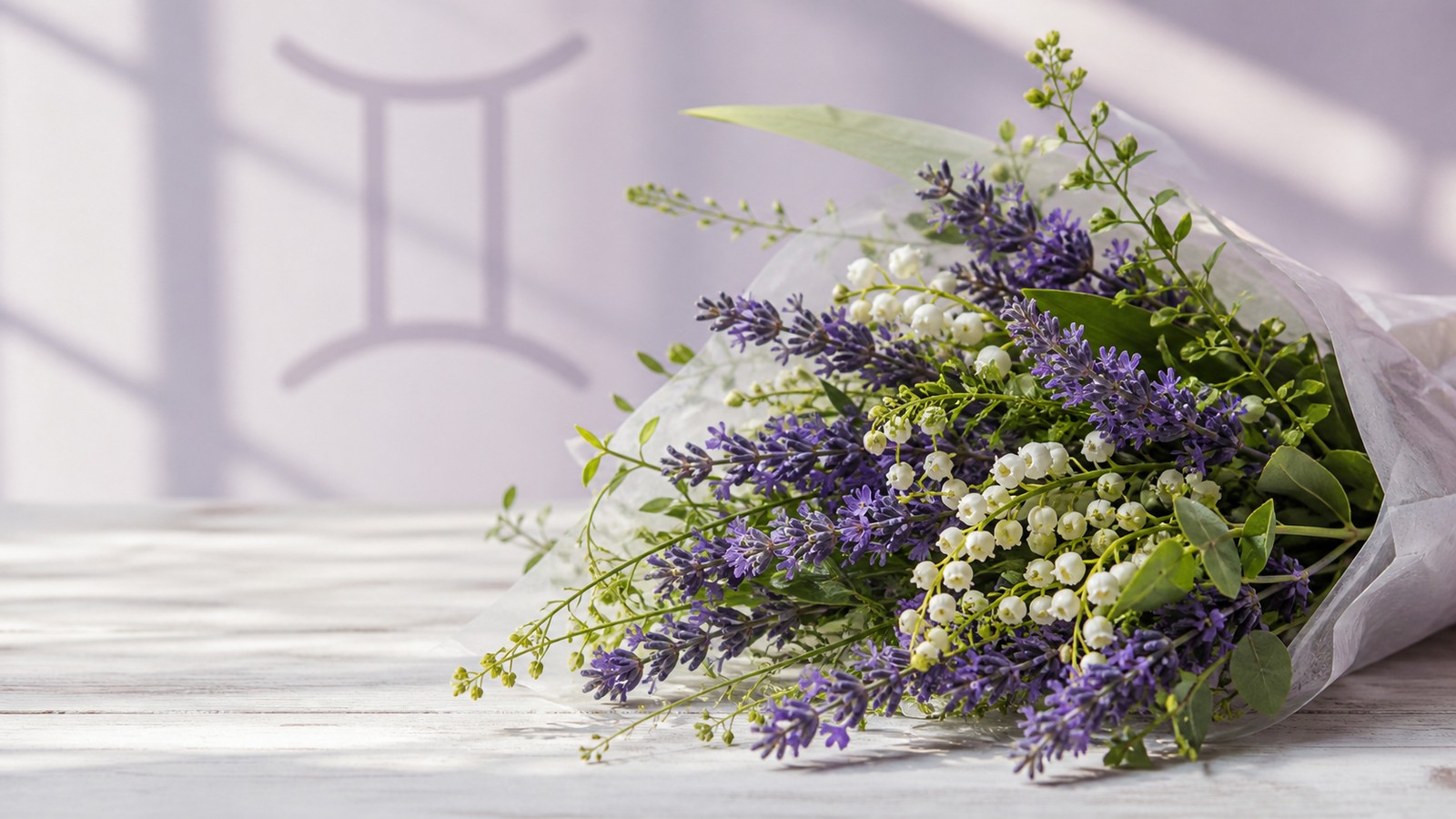
Gemini shares the air triad with Libra and Aquarius, and the three do different work. Libra weighs things and looks for the balanced version. Aquarius takes a position and holds it whatever the room thinks. Gemini moves, and as the mutable sign it closes spring and hands the year over to summer. That changes the test a bouquet has to pass: not whether it impresses on arrival, but whether there is still something to notice on day three.
Mercury rules two signs and works differently in each: in Virgo it sorts and corrects, in Gemini it talks. Messages, exchange, speed, the pleasure of an unfamiliar thing to look at. Which is why the safe bouquet, the one nobody could object to, is the wrong answer here. Being puzzled by a gift is fine for this sign. Being bored by one is the failure.
Table of contents
- The Gemini character
- Main flowers of the sign
- Why tradition picked these flowers
- Bouquet palette
- Bouquets for a Gemini woman
- Bouquets for a Gemini man
- What not to give
- Birthdays inside the Gemini window
- Florist tips
The Gemini character
Curiosity comes first, and it is the practical kind. A Gemini wants to know what the flower is called, where it grew, whether the blue one is dyed. Florists field more questions from this sign than from any other, and the answers are part of the gift.
Speed comes second, and it works differently than it does for Aries. Gemini reads a bouquet in two seconds and reacts at once, but that first reaction is not the verdict. The thing gets a second look an hour later and a third the next morning in better light, which rewards detail that does not show up at a glance. Flowers also turn into conversation here, something to mention, describe, photograph.
Then the trait that decides everything else on this page. Gemini gets bored, not with the person and not with flowers, but with sameness. Twenty-five identical heads in one color, or the same bouquet every year on the same date, will be received warmly and forgotten by the weekend.
Main flowers of the sign
The list is light, scented, and mixed. Nothing on it is heavy, and several of the plants move in a draught from an open window.
- Lavender: the sign's herb, and the one flower here that keeps working after it dries
- Lily of the valley: small, white, out of all proportion to its size in smell
- Ranunculus: dozens of tissue-thin petals, curving stems, the whole pale palette
- Iris: the messenger flower, blue and quick
- Sweet pea: papery, fragrant, with tendrils that go their own way
- Bellflower (campanula): sky blue and white, open and easy
- Freesia: several buds on one stem that open in sequence
- Orchid: the unusual entry, and the one that lasts longest
- Chrysanthemum, spray: the archive name, redeemed by its range of forms
- Jasmine: a climber and a scent rather than a cut stem
Lavender is not a florist's cut flower in most shops and does not need to be. It comes in bunches in season, costs little, and dries better than anything else here: the color fades, the smell stays for months. Lily of the valley catches only the first days of the window, and only in markets that still have it. Expensive for its size, poisonous if eaten, and irreplaceable, so ask early rather than on the day.
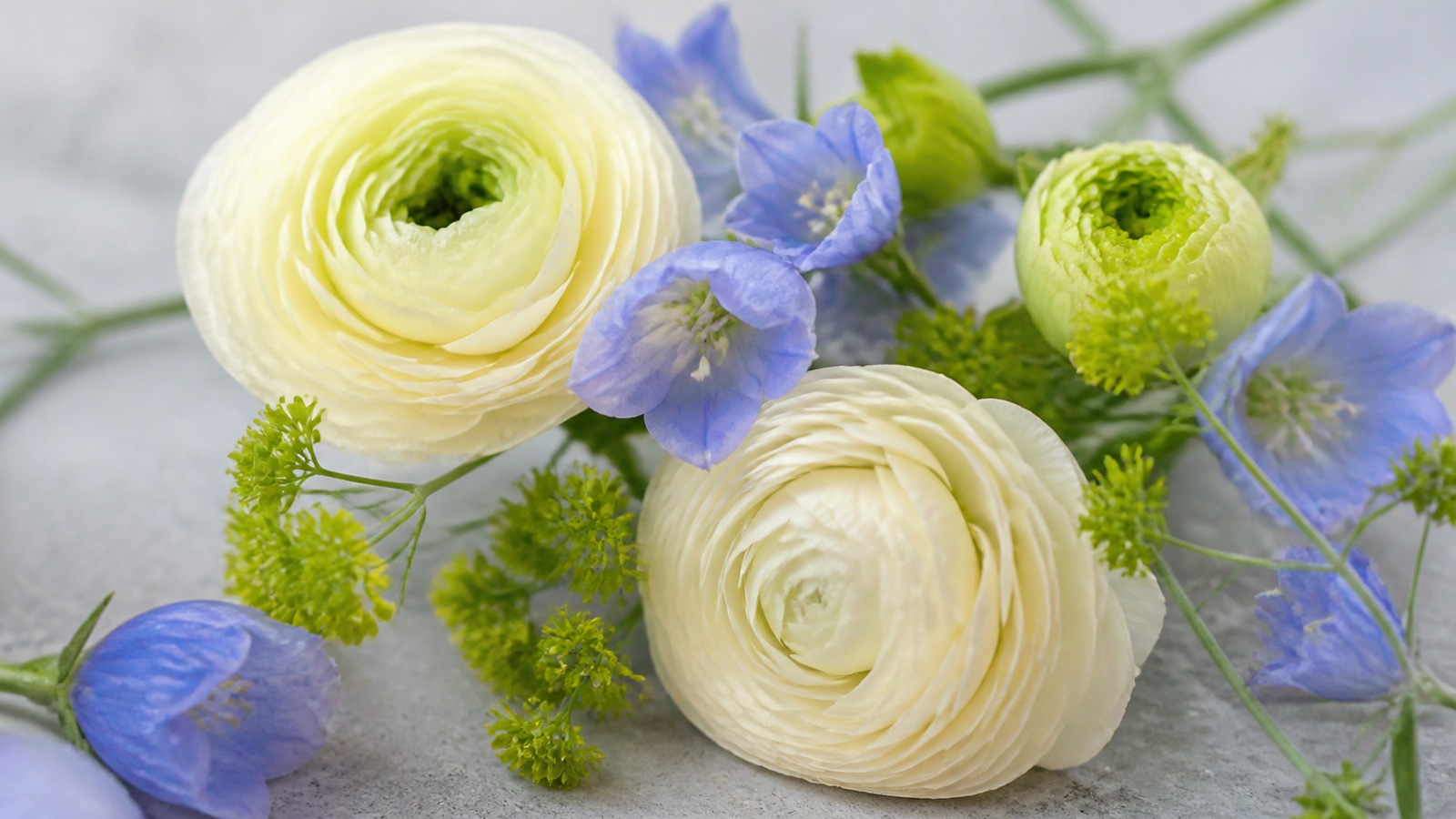
Ranunculus is the practical center of the list. A head the size of a walnut holds dozens of petals as thin as cigarette paper, the stems curve and keep adjusting in the vase, and the range covers cream, lemon, white, apricot, and pale green. It has almost no scent, which for once is useful: it mixes with the fragrant material without a fight. Its season runs from winter through spring, so a Gemini born in late May gets the good end of it and one born in mid-June does not.
Iris is on the older lists partly through its name: in Greek myth Iris carried messages between the gods, and messages are Mercury's department in the Roman version. In the vase it is fast, so buy it in tight bud with a line of color showing. Sweet pea brings papery texture, scent, and tendrils that refuse to sit where the florist put them, and campanula supplies the sky blue this palette otherwise struggles to find without dye. Freesia earns its place through behavior: the buds on each stem open one after another over several days, so the arrangement is never the same twice.
Of the older names, orchid is there because it is strange, and a phalaenopsis in a pot flowers for months, which suits somebody who wants a gift to keep doing something. Chrysanthemum looks like a mistake next to lavender until you see the range: spider, spray, pompon, single-head, green, rust, dusty pink. Jasmine is a climber rather than a cut stem, so in practice it means a potted plant on a windowsill.
Why tradition picked these flowers
The lists were built by matching a plant against three things at once: the element, the ruling planet, and the portrait of the person. Air asks for lightness, so the flowers are small-headed, thin-stemmed, and often scented. Mercury asks for variety, which is how a herb, a bulb, and a hothouse orchid end up on one list. The portrait asks for change, so plants that alter over a week score better than plants identical on day one and day six.
There is a fourth filter nobody names: whatever the market happened to be selling. Late May into June is the handover between the last spring bulbs and the first summer garden flowers, the least settled range of the year, so a tradition assembled in temperate Europe gave this sign the weeks when the shops cannot decide what they are either.
Worth saying once, plainly: none of this is fact. It is tradition, and on Gemini the tradition contradicts itself more than usual. Some sources lead with lavender, some with lily of the valley, some with iris. No plant is bound to a date of birth. What the tradition does well is describe a type of person and hand you a palette to match, which helps when you are choosing for somebody whose taste you only half know.
Bouquet palette
Yellow, light green, sky blue, white, and none of them at full strength: lemon rather than gold, sky rather than navy. Everything reads light, and light is the requirement.
Then the rule that applies to no other sign this way: here the mixture is the point. On a Taurus bouquet a second color is a decision to justify; on a Gemini bouquet a single color is the thing that needs justifying. Texture carries as much as color, so vary the size of the heads, put something papery beside something glossy, leave gaps instead of packing the shape solid, and include at least one stem that moves: a sweet pea tendril, a curved ranunculus, a grass.
| Palette |
Suits Gemini |
Main flowers |
| Yellow + white |
Ideal |
Ranunculus, freesia, spray chrysanthemum |
| Light green + white |
Ideal |
Lisianthus, ranunculus, bupleurum |
| Multicolored pastel mix |
Ideal, the sign's own |
Five or six species together |
| Sky blue + white |
Very good |
Iris, campanula, nigella |
| Lavender + white + green |
Very good |
Lavender, sweet pea, grasses |
| Single deep tone, mono |
Not for Gemini |
25 red roses, one color |
| Dark burgundy, heavy |
Not for Gemini |
Dark dahlias, deep foliage |
Bouquets for a Gemini woman
Build a mix and build it properly. Five or six species in the light palette land better than the most expensive single-flower armful in the shop, provided the mix has real variation rather than one flower plus filler. One unfamiliar stem in an otherwise readable bouquet does more than any amount of scale, and its name belongs on the card.
- A loose mix of ranunculus, campanula, and sweet peas in lemon, white, and blue
- Ranunculus in four pale tones together: cream, lemon, apricot, soft green
- White and green, airy rather than dense: lisianthus, bupleurum, spray chrysanthemum
- A garden-style bouquet with nigella, astrantia, and grasses that moves when you walk past
- Blue irises with white campanula, bought in tight bud so they open at home
- Freesia with ranunculus, chosen because it changes shape every day for a week
- A small bunch of lily of the valley in the last days of May, nothing added
- A wedding bouquet of lisianthus and sweet peas, loose and asymmetric with trailing stems
Bouquets for a Gemini man
The mistake here is not sweetness so much as ceremony: a dense symmetrical bouquet reads as an official presentation. Keep the palette cool, the structure loose, and put something in it he can ask about.

- Blue iris with bupleurum and grasses, tall and unarranged, in plain paper
- A bunch of fresh lavender tied with twine, for a desk or a car
- Spray chrysanthemum in green and white, several forms in one bouquet
- A potted phalaenopsis for a work surface, since it flowers for months and asks for little
- Dried lavender with grasses, for someone who forgets to change vase water
- A herb plant on the windowsill for a man who says he does not like flowers
Keep the container plain. Clear glass or a straight ceramic cylinder suits a loose mix better than anything decorative, because the bouquet is already doing the visual work.
What not to give
- Twenty-five roses in one color. The standard premium gift in every shop, and the one that underperforms here. It says a great deal about the budget and nothing about the person.
- The calendar-only bouquet. Flowers once a year, on the date, because the date arrived. A cheaper bouquet on an unmarked Wednesday beats it.
- Last year's bouquet again. Repeating a gift that worked is a compliment to most signs. In this one it makes a good bouquet invisible.
- Heavy dark arrangements. Burgundy, deep purple, dense foliage packed tight. A beautiful register that belongs to the autumn signs; here it reads as somebody else's bouquet delivered to the wrong flat.
- A composition with a maintenance protocol. If it needs recutting every second day to survive, it will not survive. Choose sturdier material, or say the instructions out loud and expect half of them to stick.
Birthdays inside the Gemini window
The month sits on the join between two seasons, and the market moves underneath it. The same bouquet is neither available nor advisable on May 22 and June 18.
May 21-31. The last good stretch of the spring range. Ranunculus is still excellent, lily of the valley is finishing, lilac faster still, and the first garden flowers are arriving. The best window of the year for a wide mix, with two seasons on the shelves at once.
June 1-10. Early summer supply. Sweet peas appear in some markets, campanula and lisianthus are reliable, roses are at a good point of the year. Ranunculus thins out and turns uneven, so check the heads rather than ordering blind.
June 11-20. Full summer range with the spring flowers gone. Lisianthus, spray chrysanthemum, campanula, and garden material carry the bouquet, and lavender starts in warmer regions. If the sign's traditional flowers have run out by now, substitute freely and keep the palette light. This is the last sign that would insist on a specific plant.
Florist tips
Mix on purpose, not by accident. Five species thrown together look like a supermarket bunch; the same five with variation in head size, height, and texture look considered. Pick one flower to lead, one to contrast with it in shape, and one to move.
Buy at different stages: some heads open, some in bud, some tight. The bouquet then rearranges itself across the week, and this is the sign that will notice on Thursday that the freesia has done something new. Say so when you hand it over, with the name of whatever is unfamiliar in it.
And change the timing rather than the budget. Two modest bouquets a few months apart, neither owed to any occasion, are worth more here than one large delivery on the correct date. If both are possible, keep the birthday bouquet and add the unannounced one. The second gets talked about.
Bouquet for a Gemini, a light mix of ranunculus, campanula, and sweet peas? Browse the catalogue and build something with more than one thing to look at.
Summary: Gemini wants lightness, variety, and something to ask about. Lavender, lily of the valley, and ranunculus lead the traditional list; iris, sweet pea, campanula, and freesia do the work in practice. Keep the palette light, mix several species instead of massing one, and give flowers when nobody is expecting them.
The JFLOO team