Ten years ago gypsophila was "filler." It was added to rose bouquets "for volume," and it belonged to the "cheap" category. Florists had shorthand for it: "throw some baby's breath at those roses so they don't look bare."

By 2026, everything flipped. Gypsophila is now a standalone star. Mono-bouquets sell for $50–75. Design studios build gypsophila arches for weddings at $1,000+. What happened?
Here's the rise of baby's breath and how to use it right in 2026.
What gypsophila is
Gypsophila paniculata (from Latin, "lime-loving," after the soil it favors) is a perennial in the pink family. In the wild it grows in the steppes and mountains of Eurasia and loves dry chalky soil.
It blooms in tiny, numerous inflorescences forming a "cloud" of small five-petaled florets 3–5 mm across. A single branch carries 200–300 tiny flowers.
Main floristry cultivar: Gypsophila paniculata 'Bristol Fairy' — white, doubled florets, 60–80 cm branches.
Its floristry history
1980–2010: "filler"
Gypsophila entered wide floristry use in the '80s as a cheap workhorse. It was used as background: to keep a rose bouquet from looking bare. On its own it wasn't a gift.
2010–2018: "the country cousin"
In this period, gypsophila was associated with "grandma's bouquet" and premium studios avoided it. Designer shops said, "we don't do baby's breath."
2018–2022: "eco revival"
Around 2018, Instagram floristry produced the first wave of minimalist "eco-bouquets": gypsophila + ribbon, no other flowers. It was a shock — a flower considered "cheap" became visually expensive.
2022–2026: "standalone star"
In 2026 gypsophila is its own premium category:
- Mono-bouquets of gypsophila — $50–75
- Wedding gypsophila arches — $1,000–1,500
- "Gypsophila rain" installations for interiors and photo backdrops — $180–400
- Dried gypsophila sits on shelves for years
Varieties
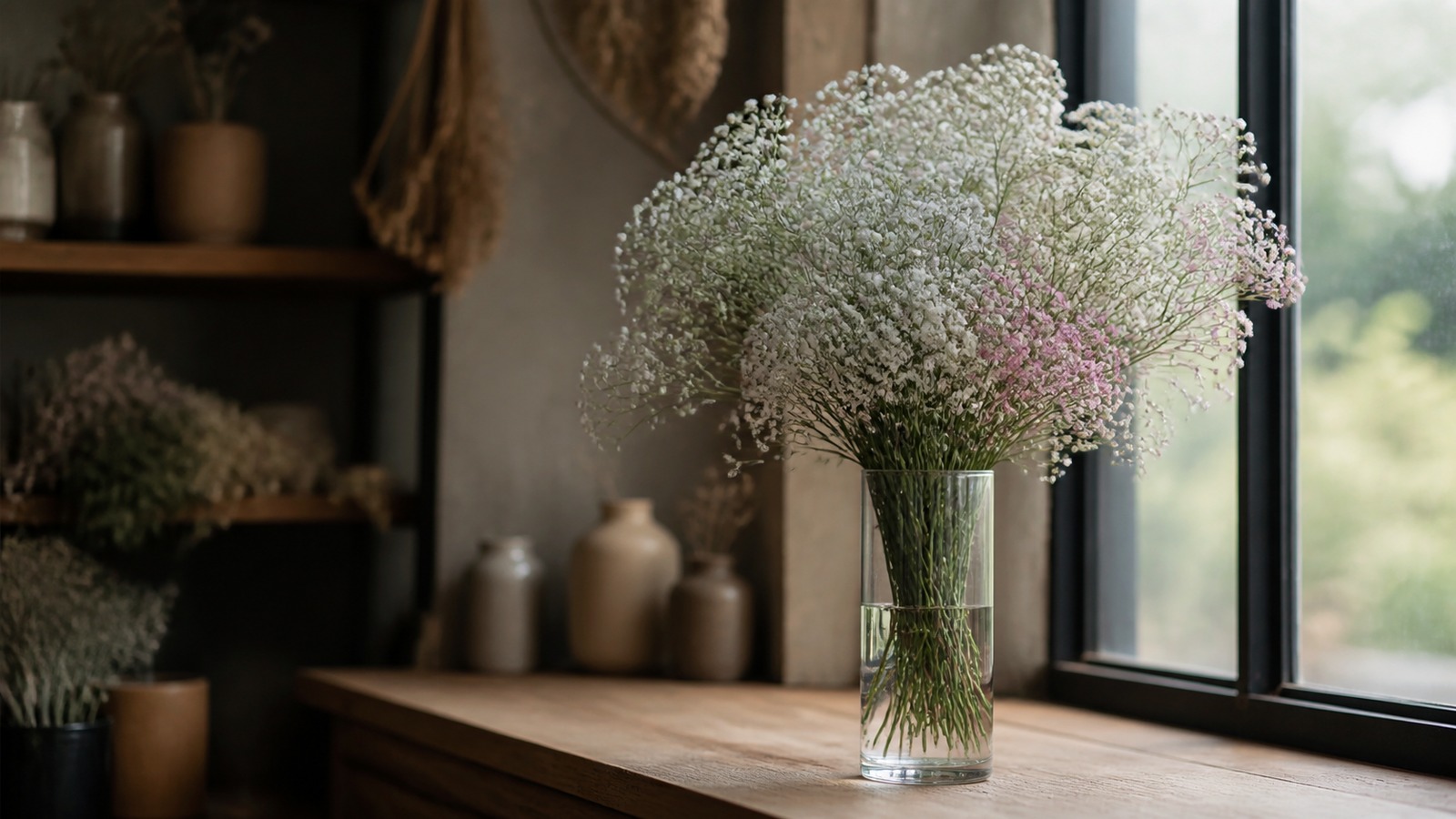
Fresh gypsophila
- Bristol Fairy — the main cultivar, white doubled florets, 60–80 cm branches. The most versatile.
- Pink Fairy — soft pink, for the 2026 pastel palette.
- Compact Plena — smaller, for small bouquets.
Dyed gypsophila
Appeared around 2020 as "an Instagram experiment." Gypsophila is dyed any color through the stem:
- Pink, blue, yellow
- Glitter (silver / gold shimmer)
- Black
Dyed baby's breath costs more and is used as an accent only, not a base.
Dried gypsophila
Gypsophila dries exceptionally well. It barely loses shape after drying and stores for years. Dried baby's breath is the backbone of every "winter" interior arrangement.
Symbolism
In the classic "language of flowers":
- Purity, innocence (hence white baby's breath in bridal bouquets)
- Ethereal, airy ("cloud")
- Constancy (perennial, blooms every year)
- Modesty
Modern floristry added:
- Eco, natural
- Minimalism, considered
How to use gypsophila in 2026
1. Mono-bouquet of gypsophila
The most on-trend format. 5–7 branches of gypsophila (roughly 80 cm long) in kraft wrap with a dense ribbon.
Suits:
- A friend's birthday (minimalist)
- A "thank you" to a teacher
- Mom for a milestone (especially a design-minded mom)
- A boho bride
- Apartment interior (holds 2 weeks in a vase)
Price: $50–75.
2. Gypsophila as an accent in a bouquet
In a modern bouquet, gypsophila works not as "background" but as a deliberate accent:
- 2–3 sprigs in a bouquet of pink peonies
- A cloud of gypsophila at the top of a rose bouquet
- A "ball" of baby's breath around one focal flower (anthurium, for example)
No longer a "cheap substitute" — a designer choice.
3. Wedding arches and photo backdrops
Gypsophila is the flagship material for 2026 wedding arches. Reasons:
- Light — doesn't overload the frame
- Creates a "cloud" — highly photogenic
- Cheaper than a peony or rose arch
- Doesn't drop fast (fresh stems hold 12 hours without water)
Gypsophila wedding arch: $1,000–1,500 (half the price of a peony arch).
4. Gypsophila "rain" installations
A "gypsophila rain" is a hanging installation with many stems descending from the ceiling at a café, boutique, or wedding photo backdrop. Very popular in 2026.
5. Dried compositions
Dried gypsophila is the base of every "winter" interior composition:
- In a vase as an accent
- In a frame (a floral "herbarium")
- In wreaths and sachets
Lasts years.
How long gypsophila lives
Fresh:
- In a vase with water and flower food: 14–21 days (one of the hardiest cut flowers)
- Without water (in a wrapped bouquet, no vase): 3–4 days before wilting
- As an accent in a bouquet: masks the aging of the focal blooms
Dried:
- At room temperature in a dry place: 2–3 years
- Under dust protection: 5+ years
Care for fresh gypsophila
- Fresh cut under water
- Water in the vase with flower food
- Change the water every 3–4 days (gypsophila doesn't like frequent changes)
- Do not mist — the tiny florets stick together and yellow with water
- Keep away from fruit (ethylene)
Pricing
| Format |
Price |
| 1 fresh gypsophila branch |
$1.20–2.50 |
| Mono-bouquet (5–7 branches) |
$50–75 |
| Gypsophila as a bouquet accent |
+$3–6 to the bouquet price |
| Wedding arch |
$1,000–1,500 |
| Gypsophila "rain" (1×1 m) |
$65–100 |
| Dried gypsophila (bundle) |
$5–8 |

Combinations that work in 2026
- Gypsophila + dusty pink lisianthus — the 2026 palette
- Gypsophila + one focal flower (anthurium, protea)
- Gypsophila + cotton + lagurus — dried composition
- Gypsophila + lavender — Provence style
Combinations that DON'T work
- Gypsophila + 51 red roses — dated, "banquet hall" vibe
- Pink gypsophila in a bridal bouquet — reads "artificial," go white
- Black gypsophila — reads "lab experiment," inappropriate in most contexts
"Using gypsophila in a bouquet" checklist
- Treat it as a base, not a "cheap filler"
- Variety: white Bristol Fairy (classic) or Pink Fairy (2026 palette)
- Don't pair with 51 red roses (dated)
- For a bouquet — accent or mono-bouquet
- For interiors — dried or "rain" installation
- Care: water with flower food, no misting, no fruit nearby
If you need a bouquet with gypsophila
Bouquets with gypsophila and mono-bouquets — a dedicated category. From a $50 mono-bouquet to wedding compositions.
— Sofia Bell
Author
Sofia Bell
Florist and blog editor