We hear the same line every week: "The bouquet was gifted yesterday and half of it looks sad today. Why?" Every time we explain the same thing — because most people know very little about bouquet care, and what they "know" is mostly myths.

Here's the honest version. No hard science, no esoterica — just what actually works. Seven techniques we use ourselves and have verified on hundreds of bouquets.
Before you read
Important upfront: most "grandmother's tips" don't work.
- Aspirin in water — myth (separate article)
- Sugar in water — myth
- Vodka / alcohol in water — partly myth, partly harm
- A coin at the bottom of the vase — myth
- Angled cut with a knife — not a myth, actually works
If you believed in aspirin for years — don't feel bad. We did too, until we studied floristry.
Now to the techniques.
Secret 1. Re-cut stems immediately on arrival
The main rule 9 out of 10 people ignore.
When a cut flower is removed from the plant, its vascular system keeps working — trying to draw water. Within 5–10 minutes an air lock forms at the cut, a bubble that seals the capillaries. After that the flower physically can't drink, no matter how much water sits in the vase.
What to do:
- As soon as the bouquet arrives, remove the wrap
- Re-cut each stem at a 45° angle (angled cut = larger absorption area)
- Under a running tap, not on a dry table — so air doesn't seal the cut again
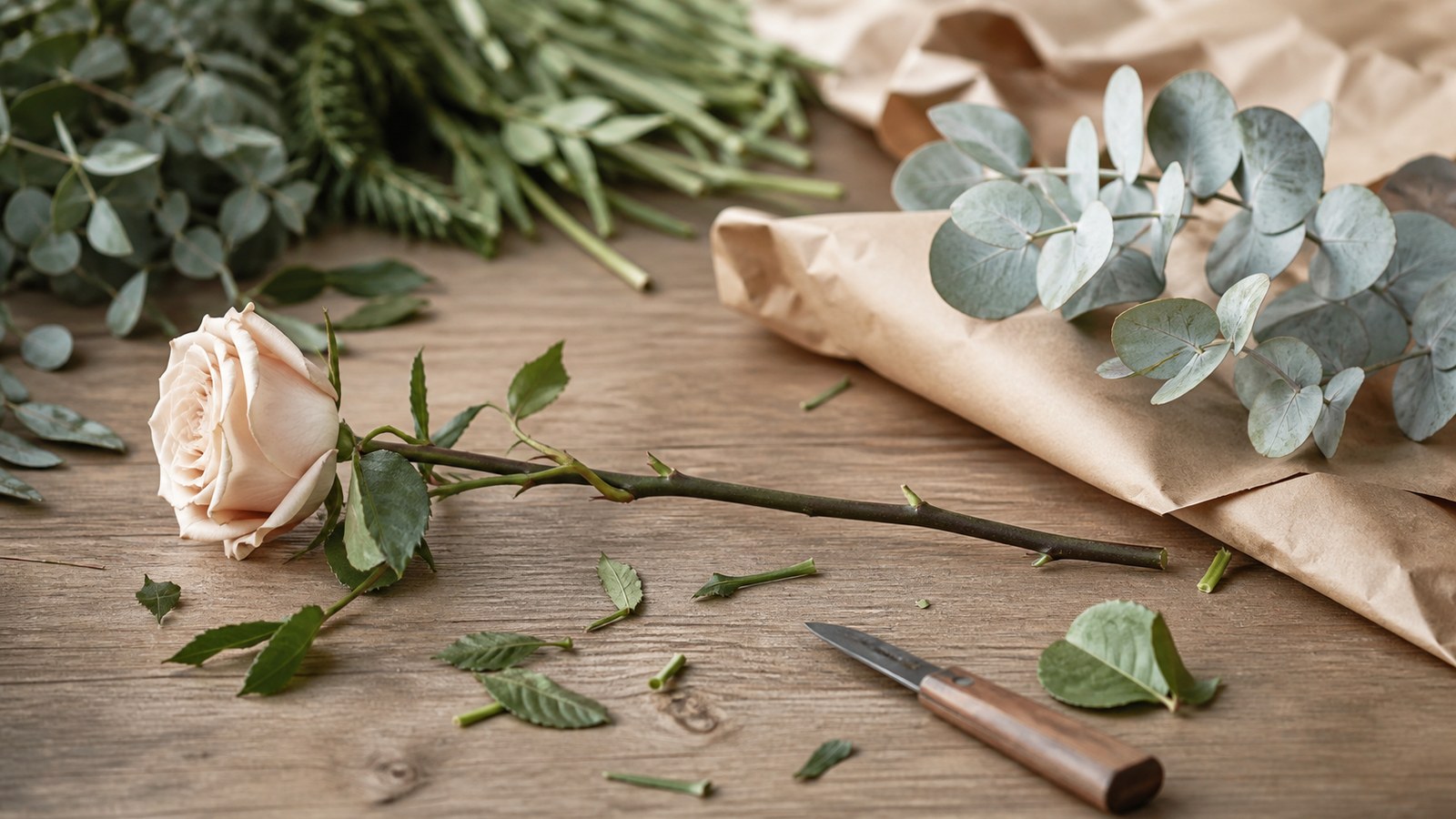
- Use a sharp knife, not shears (shears crush capillaries)
- Cut 2–3 cm, not "refresh the tip"
Repeat every 2–3 days, otherwise the cut re-seals. Roses tolerate a daily re-cut and only benefit from it.
Secret 2. Strip leaves below the waterline
The second most important rule, and almost nobody follows it.
Any leaf below the waterline starts rotting within 24 hours. Bacteria multiply, water clouds, bacteria clog the stem's capillaries — and the bouquet dies 2–3× faster than it should.
What to do:
- Before placing in the vase, strip every lower leaf that would sit in water
- Don't tear by hand — ragged edges rot faster. Use a knife or a leaf-stripping tool
- Especially important for roses and lisianthus — soft leaves that rot quickly
If the vase water clouds or smells within 2 days, you missed a leaf. Change the water and re-check.
Secret 3. Change water every 2 days
Vase water is not "self-cleaning." Bacteria multiply in any standing water; within 2–3 days the concentration is dangerous for the flowers.
What to do:
- Every 2 days, fully change the water
- At each change, wash the vase itself with mild soap or baking soda
- Water should be cool, not room temperature (12–15 °C ideal; colder in heat)
- In summer heat (+25 °C and above) — change daily
Don't "top up" — that's useless. Replace.
Secret 4. Use flower food
The sachet included with every bouquet. Most people throw it away, not understanding what it is.
Flower food is a mix of:
- Nutrition for the flower (sugar or glucose)
- Antibacterial (keeps water clean)
- Acid regulator (helps water pass through the stem)
It works 10× better than "sugar in water" (which without antibacterial just feeds bacteria) or "aspirin" (which does nothing).
What to do:
- Use the flower-food sachet the florist provided
- Out of sachets — buy separately. $1–2 for 5–10 sachets, lasts a long time
- Dose per instructions (usually one sachet per 0.5 L water)
Secret 5. The right spot for the vase
Placement is critical. We've seen a bouquet live 10 days, then "move" to a windowsill — and turn into a herbarium overnight.
What not to do:
- Not on a sunny windowsill — sun accelerates transpiration, flowers droop in a day
- Not near a radiator or heater — too dry
- Not on the kitchen counter near stove or fruit — fruit releases ethylene (especially bananas and apples), a gas that causes wilt
- Not in a draft — between window and door
- Not under an AC vent — cold flow parches
What to do:
- Cool spot in the room — far wall from the window
- On a table or dresser, away from radiators
- In summer heat (+30 °C) — on the bathroom floor overnight, it's cooler
- Away from fruit — even a bowl of apples on the same table accelerates decline
Secret 6. Warm or cold water
A nuance many don't know.

For most flowers, cool water (12–15 °C) is best. Cool water slows metabolism, extends life.
Exceptions:
- Tulips — love very cold water; you can add ice
- Roses — neutral, cool or room temperature
- Orchids on stem in bouquets — room temperature, closer to warm
- Anthuriums — room temperature
In summer we add 2–3 ice cubes to the water each morning — the bouquet stays "fresher" longer.
Secret 7. Reviving a drooping bouquet
If the bouquet is already "sad," don't discard immediately. In 60% of cases it can be brought back.
Revival algorithm (for most flowers):
- Take it out of the vase, dump the water
- Re-cut each stem under water, at least 3–4 cm off
- Fully submerge the bouquet in a bathtub of cool water for 30–40 minutes (only flowers and stems — remove the ribbon)
- Remove, let water drain
- Place in a clean vase with cool water and flower food
- If possible, leave for an hour in the bathroom (cool and humid)
For roses, you can additionally "refresh" the buds by trimming the outer "guard petals" and misting the bud with cool water.
What DOESN'T help:
- Aspirin in the new water
- Sugar
- Hanging the bouquet upside-down overnight (yes, that's a myth too)
Per-flower quick reference
Roses
- Thick stem, thick petal skin — the hardiest
- 8–12 days with proper care
- Daily re-cut is fine
Peonies
- Very delicate, 3–5 days in a vase
- Love cool
- Don't like the bud being touched — will dry out
Tulips
- Keep growing in the vase, reach for light
- 4–7 days
- Very cold water — ice
Chrysanthemums
- The hardiest — 2–3 weeks
- Like more frequent water changes than roses
- Like plenty of space in the vase
Lisianthus
- Delicate looking, actually very hardy — 10–14 days
- Loves cool water
- Great "second life" — closed buds open in the vase
Wildflowers (daisies, cornflowers, lavender)
- Shortest-lived — 2–4 days
- Don't like heat
- Often added for aesthetics but leave first
Maximum-life checklist
Before placing the bouquet in the vase:
- Re-cut each stem at 45° under water
- Strip all lower leaves
- Cool water with a flower-food sachet
- Cool spot, no sun, no fruit
- Change water every 2 days, wash the vase
- Mist daily for delicate flowers (hydrangeas, peonies)
- First signs of wilt — bath revival
Do all this, and a rose bouquet lives 10–14 days instead of the usual "4–5."
Short takeaway
Bouquet care is not magic — it's concrete simple steps:
- Underwater re-cut with a sharp knife
- Strip leaves below the waterline
- Change water every 2 days
- Use flower food (not aspirin!)
- Cool spot, no sun, no fruit
- Cool water (ice for tulips)
- Bathtub revival if it droops
Enough to double or triple bouquet life.
Our catalogue carries fresh bouquets with delivery — built for maximum vase life. Every bouquet ships with a flower-food sachet and a short care card.
Coming up: "how to keep peonies," "reviving roses," "care for a bridal bouquet at home."
— Sofia Bell
Author
Sofia Bell
Florist and blog editor