Hyacinth is the only spring bulb whose scent arrives before the picture: you smell it three meters before you notice the flower itself. A short dense raceme fits up to 60 little bells; shades run from ink-purple to translucent apricot; and forced in a pot on a windowsill, it blooms for March 8 with proper timing. This guide covers the botany, varieties, garden and home care, bouquet use, symbolism, and the ancient Greek myth that gave the flower its name.
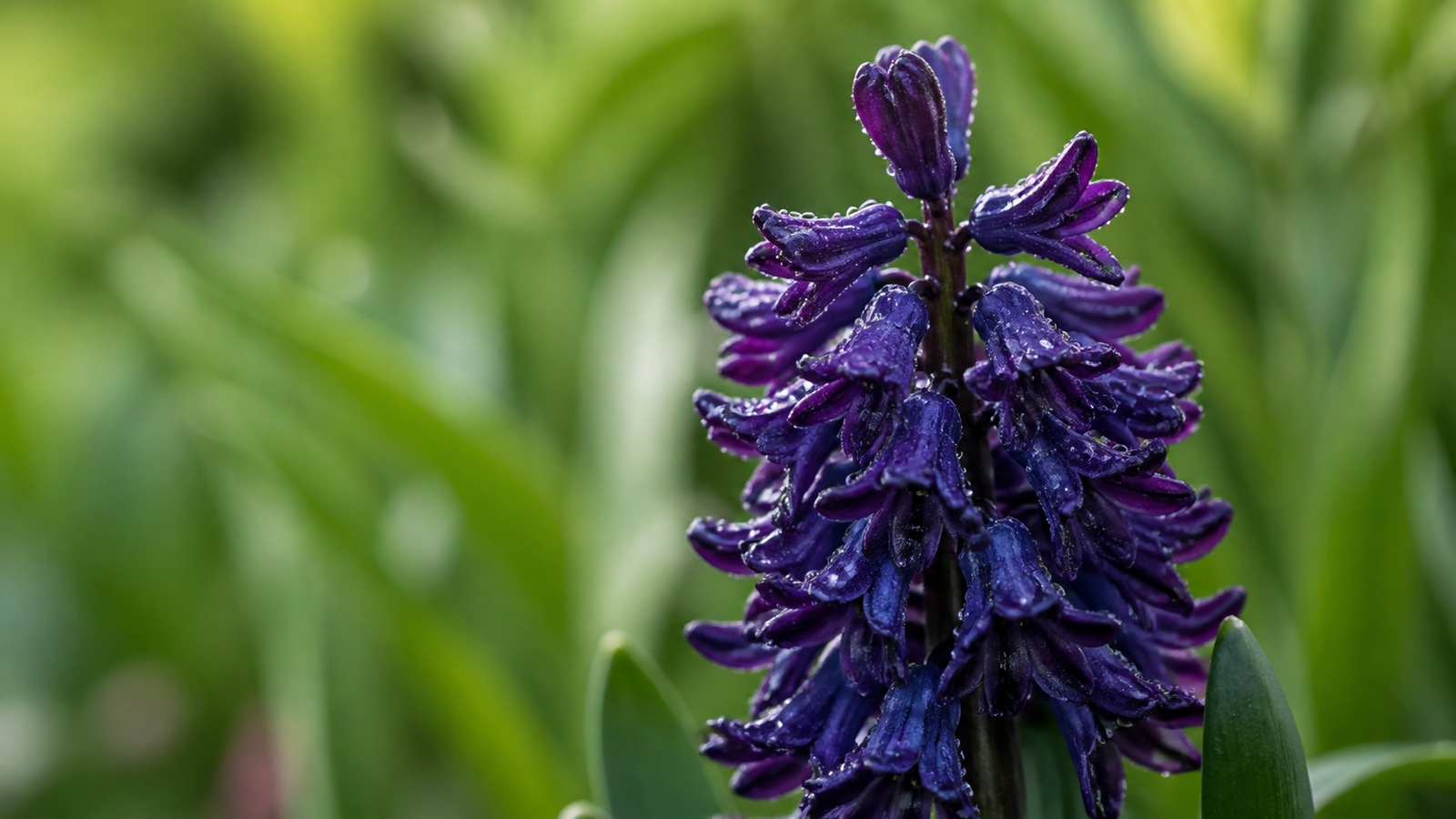
Botanical description and origin
The oriental hyacinth (Hyacinthus orientalis) is a perennial bulb in the family Asparagaceae. Native to the mountain slopes of Asia Minor, Syria, Lebanon, and northern Iran, where the wild ancestor blooms at 800–2,600 m elevation. Bulbs reached Europe through the Ottoman Empire in the 16th century; the first industrial nursery was founded by the Dutch in Haarlem around 1690. By the early 19th century, Dutch breeders had 1,500 varieties.
The bulb is dense, egg-shaped, 4–6 cm across in adults, covered in dry scales in gray-purple or cream. Scale color hints at the future bloom: reddish — pink cultivars; dark purple — blue; light — white and yellow. Both next year's leaves and flower stalk are pre-formed inside — that's why gardeners love bulbs for predictability.
The above-ground part has 4–8 strap-shaped leaves 15–22 cm long and a single leafless scape 20–30 cm tall. On top forms a raceme of 25–60 bell-shaped florets. The botanical species has a simple 6-petal corolla with reflexed lobes; garden cultivars include double forms with 12–18 petals resembling miniature roses.
The scent is the defining trait. Perfumers isolate notes of green stem, honey, orange zest, and a whisper of narcissus. One blooming pot noticeably scents a 12–15 m² room, which is why bedrooms usually don't host it. Commercial perfumery uses synthetic bases like IFF's Hyacinth Body, not natural extract (which runs ~€18,000 per kg of absolute).
Hyacinth (Hyacinthus orientalis) Bulb perennial 20–30 cm tall. Blooms 10–18 days in the open ground, 7–10 days as a cut, 14–21 days potted when forced. Cold-hardy to −25 °C with 10 cm mulch cover. Propagated by offsets, scaling, and basal scoring.
Varieties by color and timing
Blue and purple
- Delft Blue — sky blue, wedding classic
- Blue Jacket — dark blue with a white base, dense
- Peter Stuyvesant — deep purple, dramatic
- Woodstock — ink purple, near-black
- Aida — cobalt blue, single form
Pink
- Pink Pearl — rich pink, the classic
- Fondant — soft pink pastel
- Anna Marie — pale rose with cream tips
- Jan Bos — bright crimson-pink
White
- White Pearl — pure white, universal
- Carnegie — snow white, market standard
- Innocence — cream white
- L'Innocence — pale ivory
Yellow and orange
- Yellow Queen — pale yellow
- City of Haarlem — buttery yellow
- Gipsy Queen — apricot-orange, warm palette
- Orange Boven — bright orange, rare
Double forms
- Hollyhock — doubled crimson-red
- Isabelle — doubled soft pink
- Snow Crystal — doubled white
Planting in the open ground
Timing: September to first ten days of October, when soil at 10 cm depth cools to +8…+10 °C. Earlier — the bulb sprouts and freezes; later — it doesn't root before frost.
Depth: 3× the bulb height — for a 5 cm bulb, plant 15 cm deep. Spacing: 15 cm apart.
Soil: light, drained, pH 6.5–7.0. Add sand to heavy clay. On the bottom of the planting hole — a 3 cm sand layer as drainage.
Feeding at planting: 30 g superphosphate + 20 g potassium sulfate per m².
Season care in the garden and home
Spring: on shoot emergence, apply 20 g ammonium nitrate per m² and 15 g potassium sulfate. During bloom — water moderately.
After bloom: leave foliage until it yellows fully — this recharges the bulb for next year.
Bulb lifting: July, when leaves have completely died down. Dry the bulbs for 2 weeks at +20 °C, then store at +17 °C until autumn planting.
Diseases: Fusarium (prevent with fungicide treatment before planting), soft rot (avoid overwatering).
Forcing for March 8 and Christmas
Hyacinth's magic — it can be timed to any date if the cold-treatment window is correct.
For March 8 (bloom):
- Plant bulbs in a pot in early November
- Water once thoroughly, cover with dry leaves
- Store at +5…+9 °C for 10–12 weeks (cellar, fridge)
- Move to warmth (+16 °C, bright light) on Feb 20
- Bloom 12–14 days after moving to warmth
For Christmas (December 25):
- Plant in late September
- 8–10 weeks in cold
- Move to warmth Dec 5
- Bloom Dec 20–25
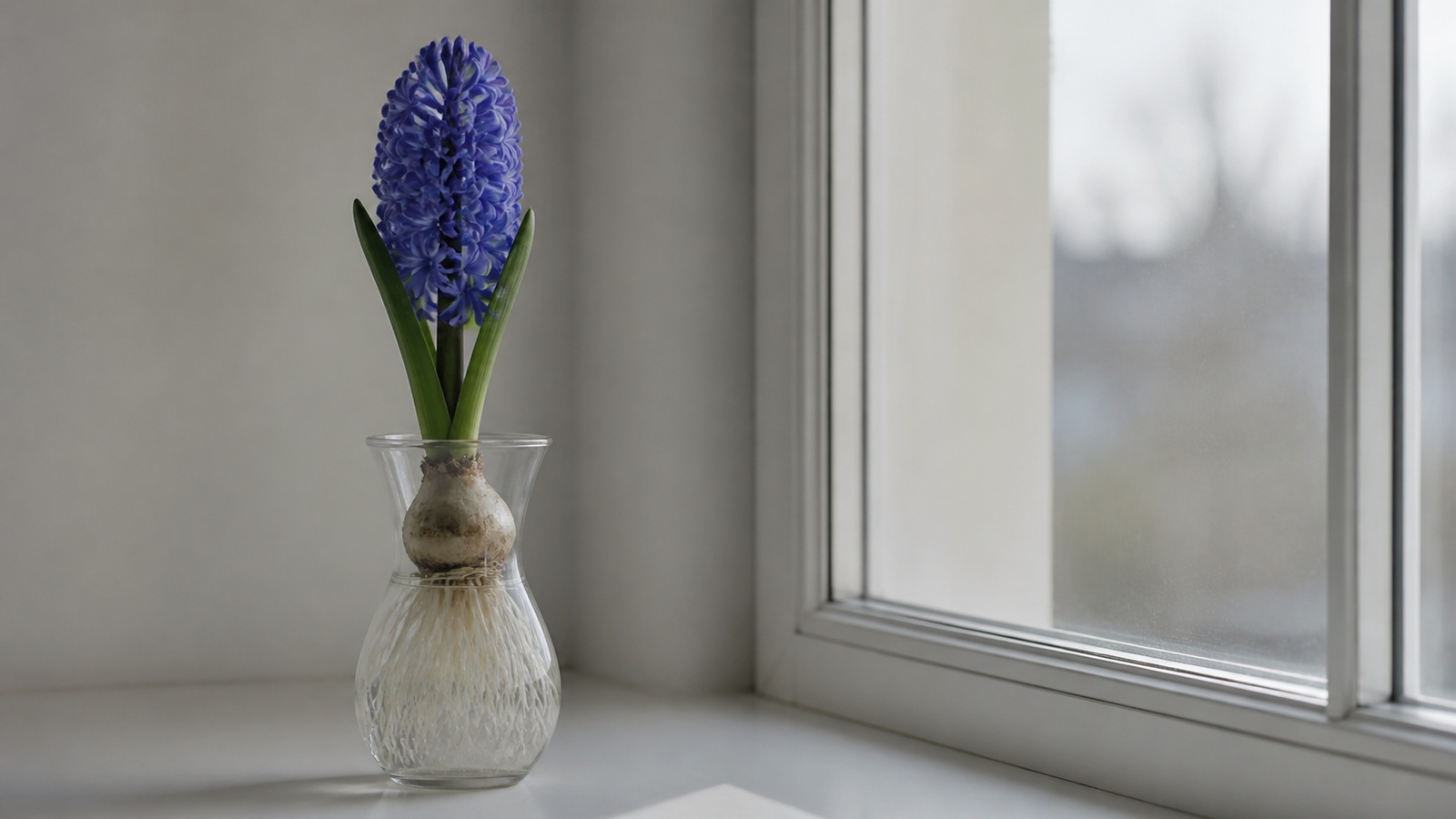
For water forcing (a "hyacinth in water"), you need a specialized vase with a narrow neck holding just the bulb's base, and water 1 cm below the base. The bulb releases roots into the water; the flower blooms above. A visual highlight of the winter interior.
Hyacinth in bouquets and compositions
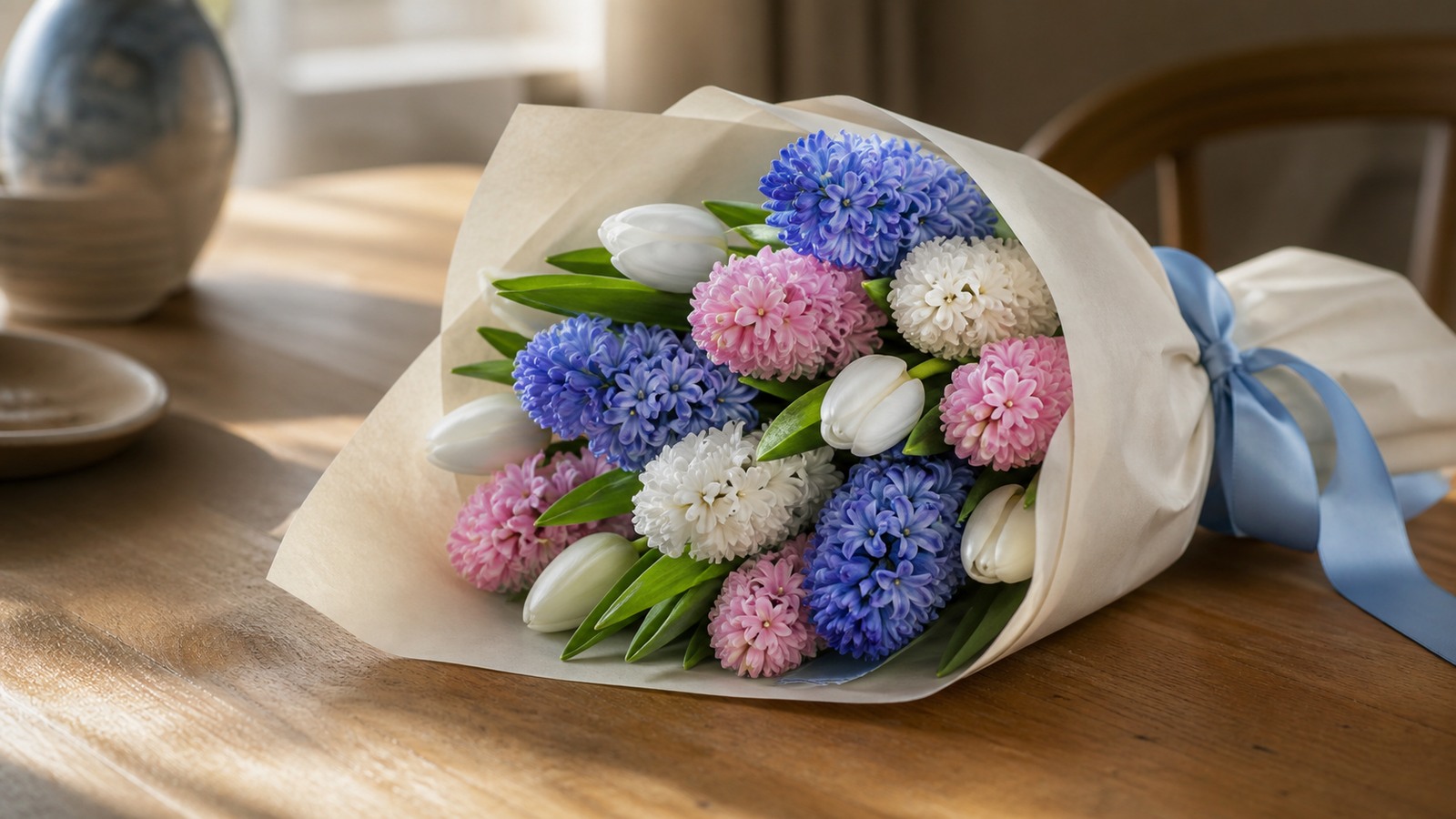
Hyacinth is a spring bouquet staple. Working combinations:
- Hyacinth + tulip + narcissus (spring classic)
- Blue Delft Blue + white lisianthus (dusty blue palette)
- Pink Pink Pearl + peony + eucalyptus (early wedding bouquet)
- Woodstock + iris + eryngium (Aquarius composition)
Combinations that don't work
- Hyacinth + lily (scent clash)
- Hyacinth + freesia (competing scents)
- Hyacinth + carnation (aesthetic mismatch)
Cut care
- Cut at 45° at the intake
- Cool water, medium vase depth
- The stem contains a viscous slime — rinse the cut end under water before placing in the vase
- Add flower food
- No fruit nearby (ethylene sensitivity)
Vase life: 7–10 days. In heat — 5 days.
Important: hyacinth sap can irritate skin. Handle with gloves; wash hands after arranging.
Symbolism, the Apollo myth, and the language of flowers
The hyacinth's name comes from Greek mythology. Hyakinthos was a beautiful Spartan youth loved by Apollo. During a discus contest, the wind god Zephyr, jealous of the friendship, deflected Apollo's discus and it struck Hyakinthos, killing him. From the youth's blood grew a flower — the hyacinth. Apollo inscribed the Greek letters "AIAI" (an exclamation of grief) on the petals.
Meaning by color:
- Blue — constancy, sincerity
- Purple — sorrow, request for forgiveness (from the Apollo myth)
- Pink — playfulness, tender affection
- White — modesty, unspoken love
- Yellow — jealousy (a Victorian meaning that faded in modern floriography)
- Red — passion
In Middle Eastern culture, the hyacinth is a symbol of the arrival of spring — Persian Nowruz cannot happen without a hyacinth on the haft-seen table (one of the seven traditional items).
In Christian symbolism, the hyacinth is a symbol of prudence and remembrance.
Facts and FAQ
- The Ottoman Empire had a "tulip vizier" and a "hyacinth vizier." In the 18th century, the palace hierarchy included dedicated positions for the sultan's floral collections.
- The hyacinth is the January birth-flower. In American florist tradition, hyacinth is the second January flower (alongside the carnation).
- The world's most expensive absolute of hyacinth — €22,000 per kg (Netherlands, 2023). One kilogram absolute requires 4 tons of fresh flowers.
- The Great Fire of Haarlem, 1738 — hyacinth bulb storage caught fire; the loss was estimated at 12 million guilders (a colossal sum at the time). Since then Dutch nurseries fireproof the bulb storerooms.
- Hyacinth in Monet's palette. The artist planted purple Woodstock hyacinths in his Giverny garden; they appear on 12 canvases.
FAQ
How long does a hyacinth live in a pot? After forcing, 14–21 days. Then the plant can be moved to the garden — it'll bloom outdoors next spring.
Can I regift a forced hyacinth? Yes, the pot works as a live gift. Add a small note with care instructions.
Are hyacinth bulbs poisonous? Yes, all parts of the plant contain alkaloids toxic to cats and dogs, and the sap can irritate human skin. Keep out of reach; wear gloves.
Which hyacinth to gift on Valentine's Day? Pink Pink Pearl or red Jan Bos in a pot — a fragrant living gift.
Bouquet with hyacinth for a wedding? Yes, especially in a spring wedding. Blue Delft Blue + white tulips + Sweet Avalanche = a spring bridal bouquet.
Budget? Cut hyacinth: $2–4 per stem. Potted forced hyacinth: $12–24 per pot. Wedding composition with hyacinth: $80–160.
Want a bouquet with hyacinth or a forced potted hyacinth? Browse the catalogue — available from November through April.
Summary: hyacinth is a florist's fragrant spring magic. Long vase life, huge palette, can be forced for any date. Great as a solo pot gift, in a spring bridal bouquet, or as an accent in a "spring" composition. Key rule: handle with gloves — the sap irritates skin.
— Sofia Bell