



Flowers in Dubai: where they come from and how to choose a bouquet for delivery
Dubai International Airport has a cargo terminal built for flowers. The Dubai Flower Centre opened its first phase in 2004 with 34,000 square metres of bonded cold storage, and in 2024 Kenya alone sent close to seven million kilograms of cut flowers to the Emirates, more than any other country. The flowers in Dubai fly in: summers run above forty degrees and nearly all the drinking water is desalinated seawater. So the useful questions about a bouquet here concern its route, the month and the address, in that order.
Where the flowers sold in Dubai come from
Cut flowers reach the Gulf by air, and Dubai has been the region's transfer point for them for two decades: part of what lands at the Flower Centre stays in the Emirates, part flies on to neighbouring countries.
The suppliers divide the work between them. Kenya, the largest of them by weight, sends roses from farms around Lake Naivasha, on shorter stems than Ecuador's. The Netherlands sends tulips, hydrangea and ranunculus through the Aalsmeer auction. Ecuador grows the roses with the largest heads and the longest stems at around 3,000 metres in the Andes, and Colombia sends alstroemeria and carnations.
Freshness therefore depends less on the country of origin than on whether the cold chain broke on the way: the stems cross the world at about two degrees, and each warm hour after that is subtracted from their time in the vase. At JFLOO the order is paid first, the flowers are bought for it afterwards, and the finished bouquet is photographed for the sender before the courier sets off.
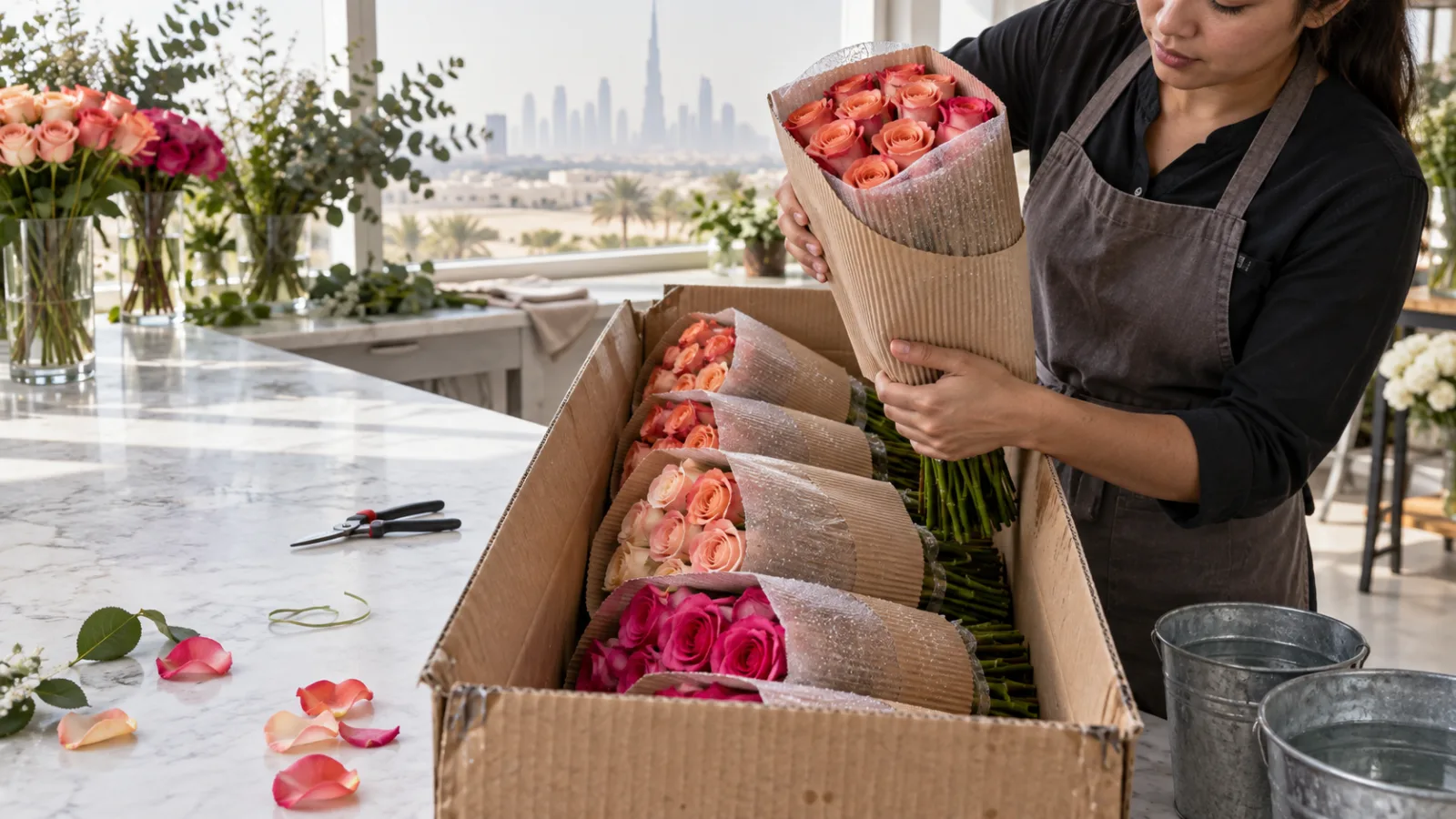
Roses are the largest single-flower section: roses alone number more than five hundred bouquets. Spray roses carry several small heads on one stem, garden roses open into a dense many-petalled cup, and French roses are an ordinary rose whose outer petals the florist turns back by hand. The tallest stems reach two metres.
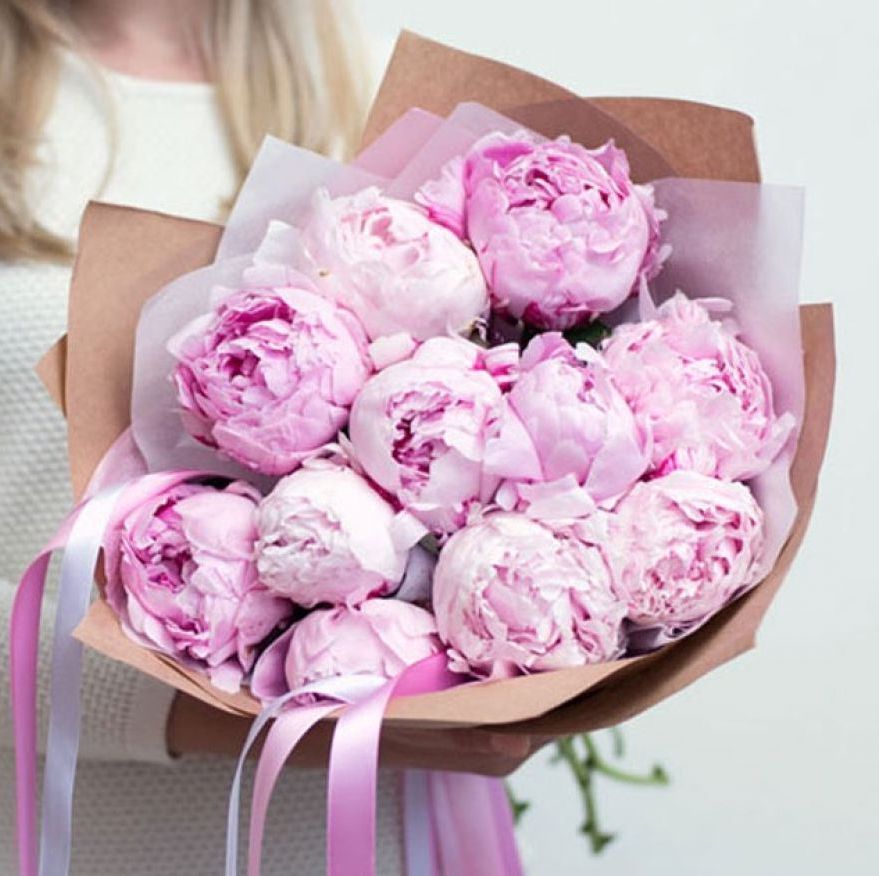
Peonies are seasonal, and in Dubai the price shows it. The main wave comes in late spring and early summer, when European farms are cutting and peonies are large, bright and noticeably cheaper. In other months they are flown in from the southern hemisphere and cost more. Dutch greenhouse tulips are cut from December to May, which overlaps with Dubai's cooler months, when a January day is around twenty-four degrees.
Chrysanthemums, carnations, alstroemeria, lilies, lisianthus and gerberas come from greenhouses and are in the catalogue every month of the year. For a fixed date that is where mono bouquets of a single kind earn their place: the flower will be there whatever the season. Where the palette matters more than the botany, designer bouquets bring several kinds together in one colour range.
Hat box, basket or hand-tied bouquet: choosing by Dubai address
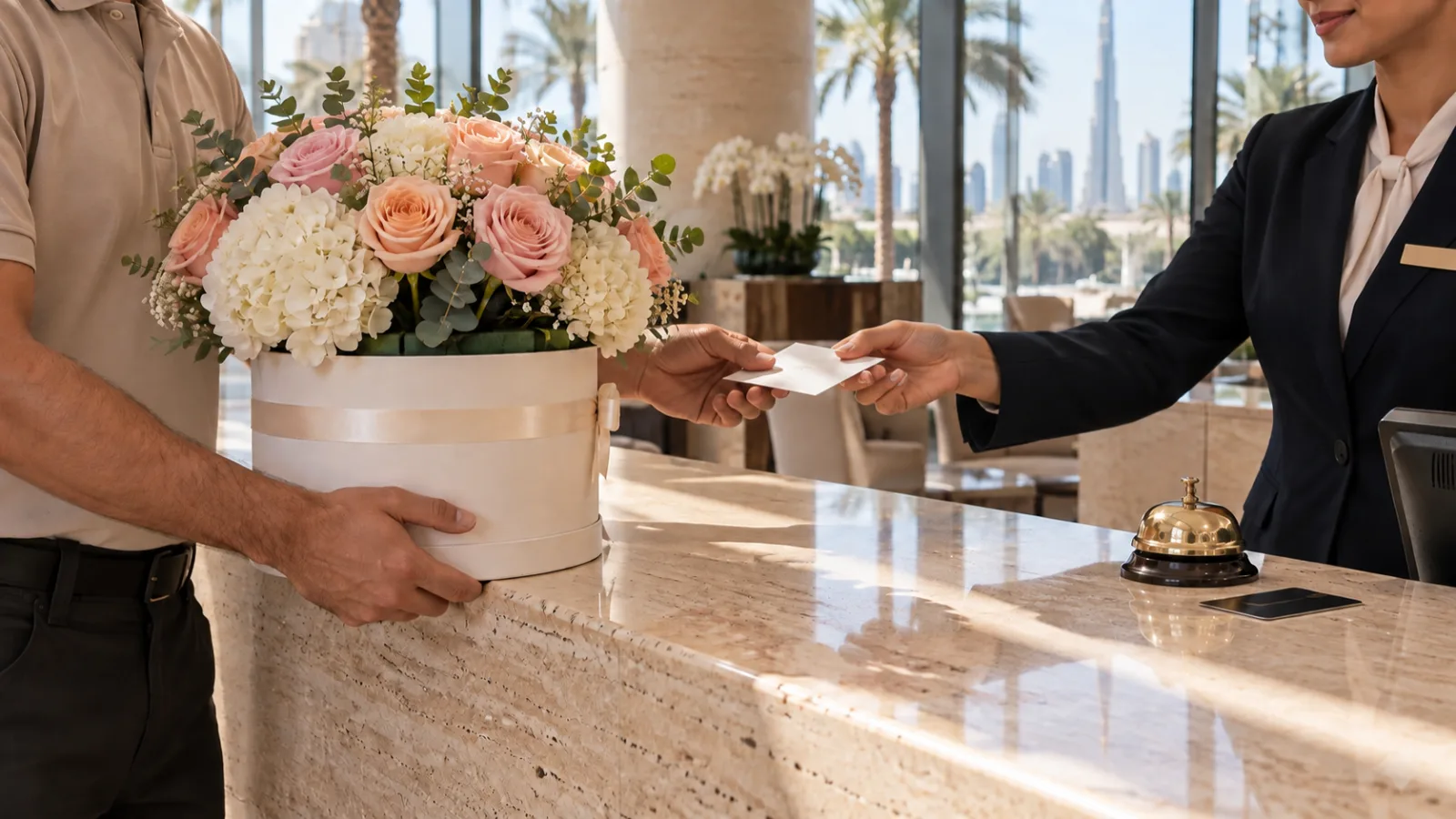
In Dubai the first question about a bouquet is where it is going. The city ended 2025 with more than 150 thousand hotel rooms in over eight hundred hotels, and almost twenty million international visitors came through that year. Two Dubai addresses are therefore worth thinking about first: a hotel in Downtown, on the Marina, at JBR or on the Palm, and an office tower in DIFC or Business Bay. Neither place is certain to have a vase, and a bouquet may wait at reception for hours before the recipient comes down. Paper-wrapped stems do not like that wait; flowers in boxes and flower baskets do, because their stems are pushed into floral foam soaked with water and drink from it until someone takes them upstairs.
What the courier needs depends on the building. For a hotel, the surname under which the guest checked in and, if known, the room number; the hotel itself decides whether the box goes up or stays at reception. For an office, the company name and the floor; where a pass is needed to get past the lobby, reception takes the box and the sender is told who accepted it.
A hospital is the one address the manager clears in advance. Many clinics in Dubai keep fresh flowers off the wards, and intensive care units as a rule refuse them, so if the ward says no, the handover moves to the nurses' station or to the day of discharge. Where the audience is a whole room rather than one person, armfuls fill a table without any container.
Prices are in dirhams. Mono bouquets and roses sit at the lower end, flowers in boxes, mixed bouquets and peonies cost more, and armfuls, designer bouquets and designer giants are priced highest. The site header can show the same figures in dollars, euros or roubles, but that is a reading aid. The dirham total in the cart, bouquet plus extras plus delivery, is what the bank sees; a card issued in another currency is converted at that bank's rate, and JFLOO adds nothing on top.
What moves the price is not the stem count alone. A long, straight Ecuadorian stem costs more than a Kenyan one of the same colour, and a two-metre rose is priced accordingly. A May peony costs less than a November one, because in May it arrives from Europe in season and in November from the far side of the equator. Before Valentine's Day, 8 March and Mother's Day wholesale prices climb with demand, and a box or a basket carries the cost of the container and the foam on top of the flowers. A sensible way to keep the price down when you buy flowers in Dubai is to take what is in season and let the florist replace a scarce variety with a near one; the replacement appears on the photo before the courier leaves.
Flower delivery in Dubai: free in the centre, flat rates elsewhere
The city is priced in three rings. In the centre, meaning Downtown, Business Bay, DIFC, Jumeirah 1 and City Walk, flower delivery in Dubai is free between 7 am and 11 pm, and a bouquet the florist has in stock can be on its way from 45 minutes after confirmation. The inner ring carries a flat delivery fee; the bouquet card shows the delivery time: Bur Dubai and Deira, Al Satwa and Al Quoz, Al Barsha and JLT, the Marina and JBR, Palm Jumeirah, Al Nahda and Mirdif.
The outer ring carries a higher flat fee and takes from two hours: Dubai Silicon Oasis and Dubailand, Jumeirah Village and Dubai Sports City, Dubai Investments Park and Jebel Ali, Al Awir and Hatta. Between 11 pm and 7 am any zone is served by prior arrangement at a price quoted separately; the zone fee is picked at checkout and added to the total.
Those timings are for express orders; for a chosen date and time slot every zone is open, and most orders are delivered on the day they are placed. Besides Valentine's Day there is 8 March, which the Russian-speaking community keeps although it is not a UAE holiday. Then comes Mother's Day, which the Arab world marks on 21 March, the first day of spring, a date Egypt set in 1956. It sometimes falls close to Eid al-Fitr, a moving holiday whose date shifts every year, and Eid visits bring bouquets of their own. Around those dates the convenient slots go days ahead.
Unless the sender asks for a call, the recipient hears nothing in advance; the courier rings from the door only when a tower or a gated community cannot be entered otherwise. Zones and rates are on the delivery page.
Sending flowers to Dubai from abroad
Roughly nine in ten residents of Dubai are expatriates, and the order form makes no distinction between a sender in Deira and one on another continent. It wants two things about the recipient, a name and a phone number; the address is welcome but not required, since the manager can ring the recipient, settle the where and say nothing about the who or the why. Anonymity is set by the card: left unsigned, it leaves the recipient guessing, because the courier carries nothing but the recipient's name and address. Payment is taken before the florist goes shopping, on a secure page, by Visa or Mastercard, and the courier arrives with flowers, not a card terminal.
What comes back to the sender is a photo of the finished bouquet, sent to the phone number given at checkout, and later a message that the flowers have been handed over; no account is created for any of this. Until the bouquet leaves, and up to six hours before delivery, the date, the slot, the address and the card text stay open to change. Orders are taken day and night on the site, on Telegram and on WhatsApp, and an address beyond the listed zones is priced before payment, not after.
Keeping a bouquet alive in Dubai heat
From June to September Dubai runs above forty degrees by day and stays around thirty at night, and on the coast, on the Marina, at JBR and on the Palm, the humidity can pass ninety per cent. A cut flower suffers less from the temperature itself than from the swings: from the cold of the aircraft hold into the street, and from the street into a flat where the air conditioning dries the air. The two places a bouquet should never wait are a parked car and a sunny windowsill.
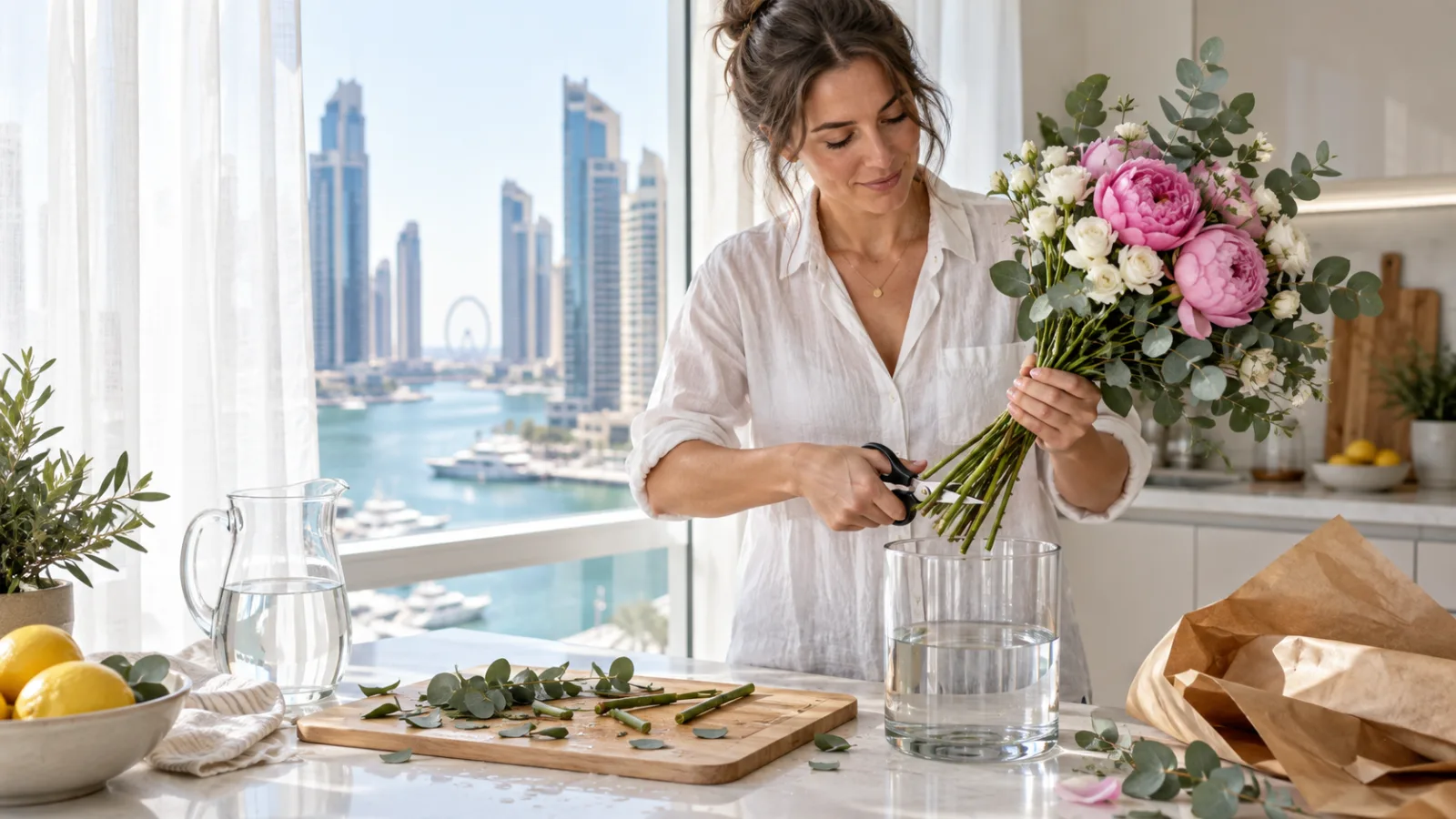
Indoors the routine is short. The stems are recut at an angle, a centimetre or two off with a sharp knife, and any leaf that would sit under water comes off. The vase stands in the shade, out of the air-conditioning draught and away from the floor-to-ceiling glass on the sunny side; the water is changed daily, since in this heat it clouds within a day.
A box or a basket is watered into the foam over its whole surface and never tilted. A hydrangea that has wilted is the exception to the drink-through-the-stem rule: hydrangea takes water through its petals as well, so the whole head goes under cool water for an hour or two and comes back. Kept this way, a rose has about a week in it, while chrysanthemums, carnations and alstroemeria stretch to two or three weeks.