"The bouquet delivered at lunch had drooped by evening. Can I save it?"
 We get messages like this at least 3 times a week. Especially in summer, when the courier hit traffic or the client didn't put the flowers in water right away.
Good news: a drooping bouquet isn't a death sentence. In 70% of cases it can be brought back.
Bad news: in 30% of cases it can't. Here's how to tell the difference and what to do.
What "drooping" actually means
Before saving, understand the cause. "Drooping" isn't a diagnosis — it's a symptom with several possible causes and different treatments.
4 reasons a bouquet droops
Cause 1: Air lock in the stem
The most common. When the stem sits without water for some time (in a courier box, in heat, after delivery), air enters the capillaries. Water no longer travels up, the flower head doesn't get moisture and bends.
Treatable: 80% of the time.
Cause 2: Stem rot
If the bouquet sat in dirty water for 3+ days, or you didn't re-cut it on arrival, the lower stem starts to rot. Bacteria clog the capillaries — the flower "starves."
Treatable: 50% of the time (depends on stage).
Cause 3: Natural aging
The flower has simply lived out its lifespan. If the bouquet is already 10 days old and gradually "settling" — it doesn't need revival, it needs acceptance.
Not treatable. You might add +1 day, no more.
Cause 4: Physical damage
Stem is broken, kinked, or the flower was frozen in a fridge.
Not treatable in most cases.
How to tell if the bouquet can be saved
5 signs of a "reviveable" bouquet:
- Stem firm to a squeeze (not watery, not soft)
- Cut on the lower end is light (not dark, not brown)
- Petals don't yet fall from a light touch
- Bouquet is under 5 days old (from delivery)
- No rot smell from the vase
5 signs revival is pointless:
- Stem soft, watery, bends easily
- Cut is dark, brown, smells
- Petals fall on their own when touched
- Bouquet is over 10 days old
- Strong rot smell from the vase
7 revival techniques
Technique 1. Fresh underwater re-cut (the gold standard)
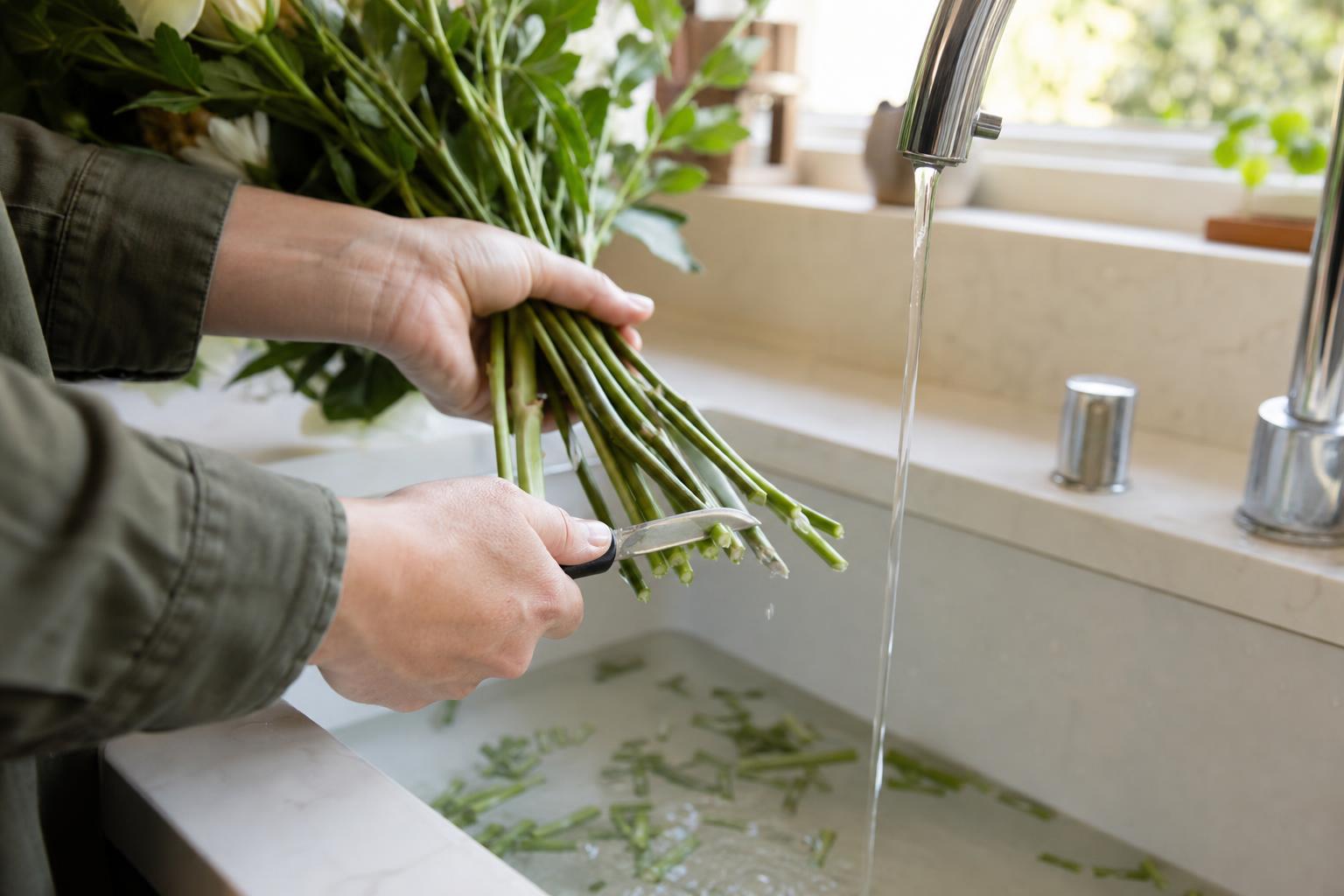 The most basic and the most effective move.
What to do:
- Fill the sink with water
- Submerge the bottom 5 cm of the stems in the water
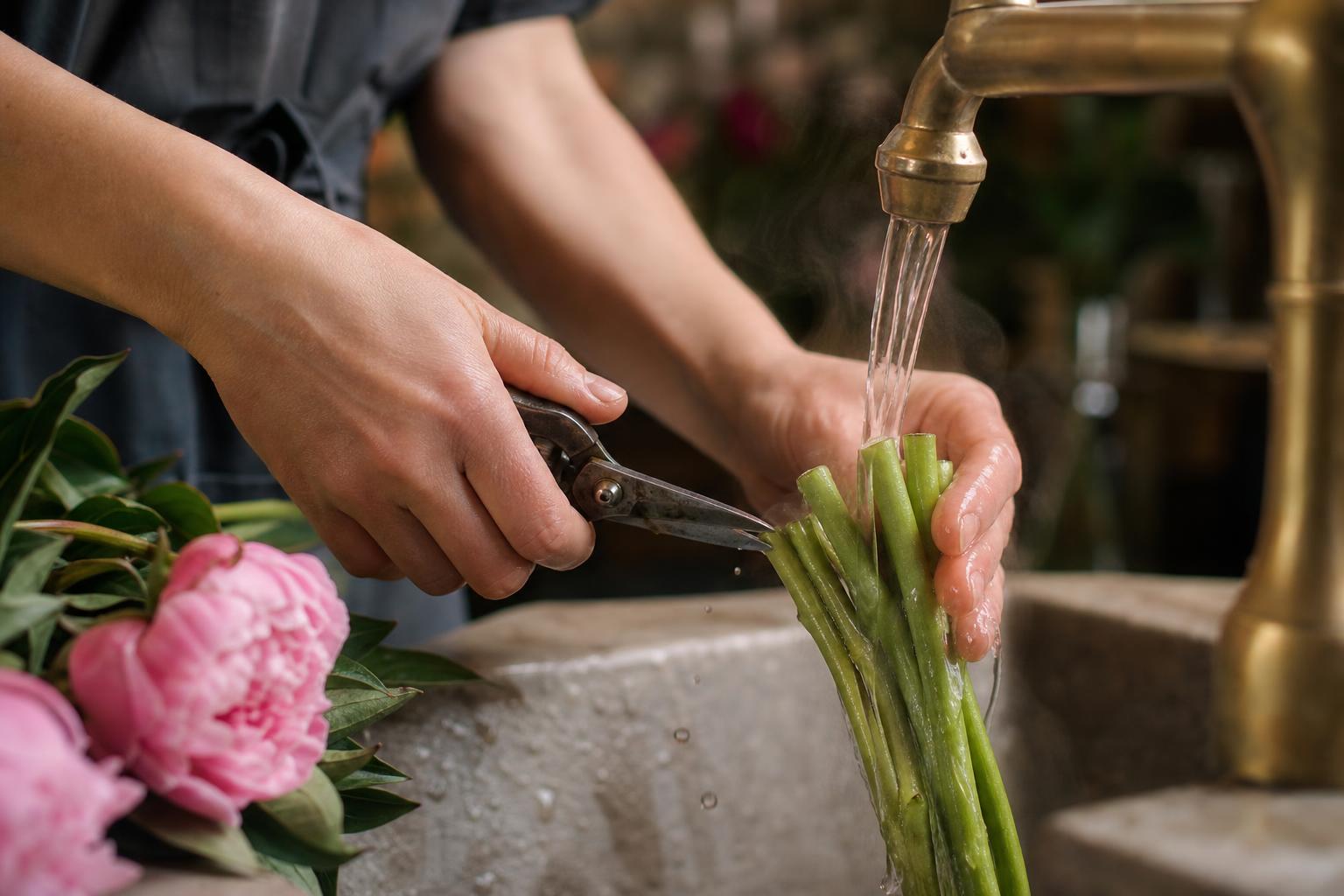
- With a sharp knife (NOT scissors!) cut 3–4 cm off each stem at a 45° angle under the water
- Without removing from the water, inspect the fresh cut — should be greenish, not brown
- Move to a vase with fresh cold water + flower food
This technique flushes the air lock from the capillaries. Helps in 80% of cases of drooping flowers.
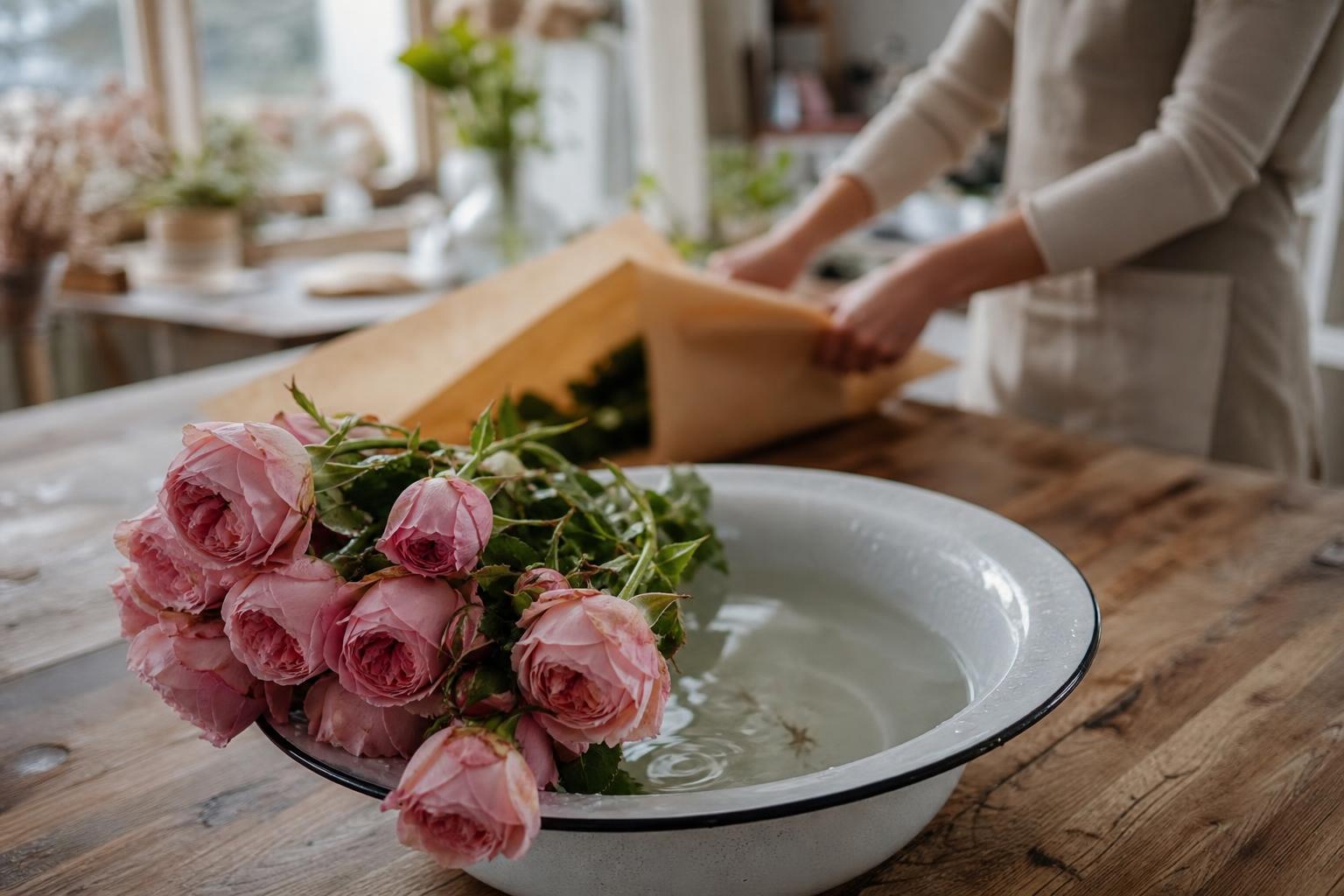
Technique 2. "Pencil wrap" for roses
Specifically for roses and other long-stem flowers.
What to do:
- Fresh underwater re-cut (see Technique 1)
- Wrap the bouquet vertically in stiff paper (kraft or cardboard), stems sticking out at the bottom
- The paper should hold the bouquet tightly, like pencils in a case
- Submerge the bottom 10 cm of stems in cold water (ice cubes optional)
- Leave for 3–4 hours in a cool spot
The paper "straightens" the heads and cold water restores the capillaries. Often fully revives in 4 hours.
Technique 3. Warm water for peonies
Peonies are a special case. Cold water doesn't help, they need warm.
What to do:
- Fresh underwater re-cut
- Place in water at +30…+35 °C (like slightly cooled tea)
- Hold for 30–45 minutes
- Move to normal cool water with flower food
Warm water opens the peony capillaries so they drink again.
Technique 4. Misting / submerging for hydrangeas
Hydrangeas are the only flower that drinks water through its petals.
What to do:
- If a hydrangea head is dropping, submerge the flower head entirely in cold water for 30 minutes
- Or mist heavily with a spray bottle
- The hydrangea absorbs water directly through the petals and recovers
Works 90% of the time.
Technique 5. "Shock" flower-food dose
If the bouquet is "starving," you can try a doubled flower-food dose.
What to do:
- Fresh water (1 liter)
- 2 flower-food sachets instead of one
- Underwater re-cut
- Place in the water for 6 hours in a fridge (if the vase fits) or in the coolest spot in the home
After 6 hours the bouquet gets a "double feeding" and often revives.
Technique 6. "Drip watering" (for slightly rotting stems)
If the stem is slightly rotting at the bottom (1–2 cm) but the flower is still "alive," you can try trimming the rot and gradually re-hydrating.
What to do:
- Trim 5 cm off the rotted end under water
- Rinse the stem with warm water
- Place in a very small amount of water (1–2 cm in the vase)
- Every 2 hours, add 1 cm of fresh water
- Over the course of 12 hours
The flower gradually "gets used to" water without shock.
Technique 7. Split the bouquet
Sometimes part of the bouquet can be saved, part can't. Don't try to revive the whole armful uniformly — break it apart.
What to do:
- Take the bouquet apart into individual stems
- Inspect each stem — firm? cut light? petals intact?
- Normal stems — into one vase with proper care
- Borderline stems — into a small vase with warm water and flower food (separately)
- Hopeless stems — discard
That way you save 50–70% of the bouquet instead of losing 100%.
Specific cases
Case 1: Roses "dropped their heads" (the day after purchase)
Best technique: #2 (pencil wrap) + cold water. After 4 hours in tight paper, the heads recover in 85% of cases.
Case 2: Peonies "won't open" after 3 days
Best technique: #3 (warm water). Bonus: massage the petals with your thumb at the base of the bud.
Case 3: Hydrangeas "hanging"
Best technique: #4 (misting + submerging the heads).
Case 4: Tulips stretched and fell
Unfortunately, tulips don't revive in 95% of cases. They "keep growing" in the vase and beyond a certain bend they won't straighten.
Prevention: a deep narrow vase from the start.
Case 5: Bouquet arrived "tired" from the courier
All 5 techniques at once: split, inspect, fresh underwater re-cut, pencil wrap for roses, warm water for peonies, misting for hydrangeas.
That's 30 minutes of work, and the bouquet can be recovered ~70%.
When it's really over
If after all 7 techniques, 6 hours later the bouquet hasn't recovered — it's the end.
 Don't throw it out immediately. You can:
- Dry it for an interior composition (works especially with chrysanthemum, hydrangea, lavender)
- Make sachets from the petals
- Scatter the petals in a bath for a last "goodbye"
Don't throw it out immediately. You can:
- Dry it for an interior composition (works especially with chrysanthemum, hydrangea, lavender)
- Make sachets from the petals
- Scatter the petals in a bath for a last "goodbye"
Revival checklist
- Identified the cause (air lock / rot / aging / damage)
- Bouquet is young (under 5–7 days)
- Stem firm, cut light
- Did a fresh underwater re-cut
- Applied the right technique for the variety (pencil for roses, warm for peonies, misting for hydrangeas)
- Placed in fresh water with flower food
- Waited 4–6 hours in a cool spot
The main point
If a shop sold you a bouquet that drooped within 24 hours — that's a complaint against the florist, not against your care. Go back and demand an exchange. A good shop replaces without questions in the first 24 hours.
If you want a bouquet with a freshness guarantee
Bouquets with delivery — 24-hour freshness guarantee. If it arrives tired, we exchange without questions. Every bouquet includes a care card.
— Sofia Bell