"Is it true that if I drop aspirin in the vase, the bouquet lasts longer?" We hear this at least once a week. And each time we say honestly: no, it doesn't work.
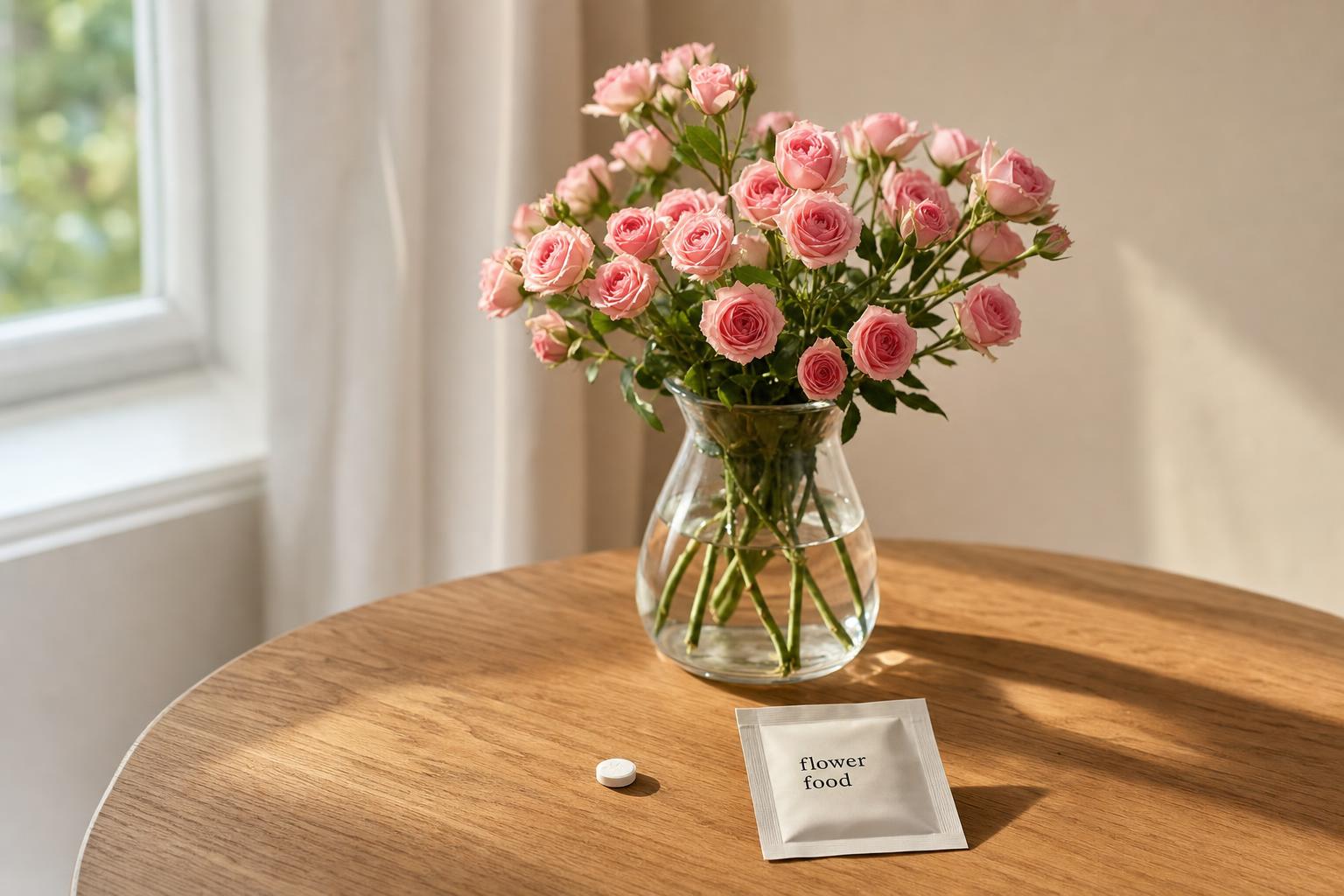 But we see the doubt in the client's eyes: "but my mother did that her whole life." And we understand — this isn't a science question, it's a family tradition question. Let's break the aspirin myth down properly, along with the rest of the "grandmother's tips." What works, what doesn't, and what to use instead.
Where the myth came from
Dig in and the aspirin myth isn't groundless. It rests on a real observation:
Aspirin is acetylsalicylic acid. Acid lowers water pH. And in acidic conditions:
- Water moves better through the stem's capillaries
- Bacteria multiply more slowly
So the idea is right. But there's a problem.
Why aspirin doesn't work
Aspirin is a very weak acid. One tablet in a standard 1-liter vase drops the pH from 7 to about 6.5–6.7. For a real effect on flower stems, pH should be 5.0–5.5. That means you'd need about 10× more acid.
To actually acidify a vase with aspirin you'd need to drop in 10–15 tablets. Then:
- The flower gets the right pH
- But it also gets a soup of inert tablet fillers — talc, cellulose, binders
- Those clog the stem's capillaries
The bouquet dies not from bad pH but from a "tablet soup" in the water.
Tested across hundreds of bouquets in the shop. The difference between "bouquet in plain water" and "bouquet with aspirin" is statistically nothing. Sometimes the aspirin bouquet does worse, because tablets dissolve into a cloudy residue.
Other "grandmother's tips" — a short breakdown
Sugar in the water
 Idea: feed the flower. Sugar = glucose, an energy source.
Reality: the idea is right, but pure sugar feeds more than the flower. Bacteria in the water feed too — and multiply ten times faster. Within 2 days the water smells sour. The bouquet dies not from starvation but from bacterial infection.
Sugar only works combined with an antibacterial component. That's what floral preservative is — more on it below.
Vodka / alcohol in the water
Idea: alcohol disinfects the water.
Reality: partially works, but:
- The dose needs to be big — 2–3 tablespoons per liter
- At that dose alcohol burns the stem's capillaries — the flower can't drink
- Alcohol evaporates fast; after 24 hours there's no effect
Net: more harm than good.
A coin at the bottom of the vase
Idea: copper (Cu²⁺) kills bacteria.
Reality: in theory yes, in practice no. Modern coins are alloys, not pure copper. Copper leaches out very slowly and in microscopic amounts. Effect: zero.
If you have a pure copper coin or copper wire (some pre-1958 coins, some hobby copper), it would work. But who has those on hand in 2026?
Bleach
Idea: kill bacteria with chlorine.
Reality: works, but in a very small dose. A full drop of bleach per liter is already excess that burns the stem. In home conditions the right dose is hard to hit. Better to use professional flower food, where the dosage is pre-calculated.
Lemon juice
Idea: acidify the water with citric acid.
Reality: works better than aspirin. Citric acid is a real acid without tablet fillers. But bacteria still multiply because there's no antibacterial component. Life extension is small — 1–2 days at most.
What actually works
After the myths — the short list of what actually extends bouquet life.
1. Professional flower food
The little sachet included with every bouquet. It's a mix of three components:
- Nutrition (sugar or glucose) — flower food
- Antibacterial component (usually a silver salt or specialized biocides) — keeps water from turning
- Acidity regulator — lowers pH to 5.0–5.5
This is a professional product, sold at any flower shop, $1–2 per pack of 10 sachets. Enough for six months.
Never toss the sachet from your bouquet. And buy spares. It's 10× more effective than any "grandmother's recipe."
2. Underwater re-cut
Genuinely works. Within 5–10 minutes of cutting, an air lock forms in the stem. The flower can't drink water no matter how you "improve" it.
Solution: cut each stem at a 45° angle under running water, with a sharp knife, not shears. Remove 2–3 cm.
Repeat every 2–3 days.
3. Strip leaves below the waterline
Any leaf underwater rots within 24 hours. Bacteria spread from a rotting leaf faster than from water alone.
Strip with a knife, don't tear by hand (ragged edges rot faster).
4. Cool spot, cool water
Flowers are biological. Cold slows metabolism.
- Cool water (12–15 °C)
- Cool spot in the room
- Not near a radiator, sun, or fruit
5. Regular water changes
Every 2 days, fully replace the water and wash the vase. Not "top up" — replace.
What if you don't have flower food
Sachet tossed, shop trip skipped. What to do in the moment. Here's the home recipe that runs at about 70–80% of professional flower food:
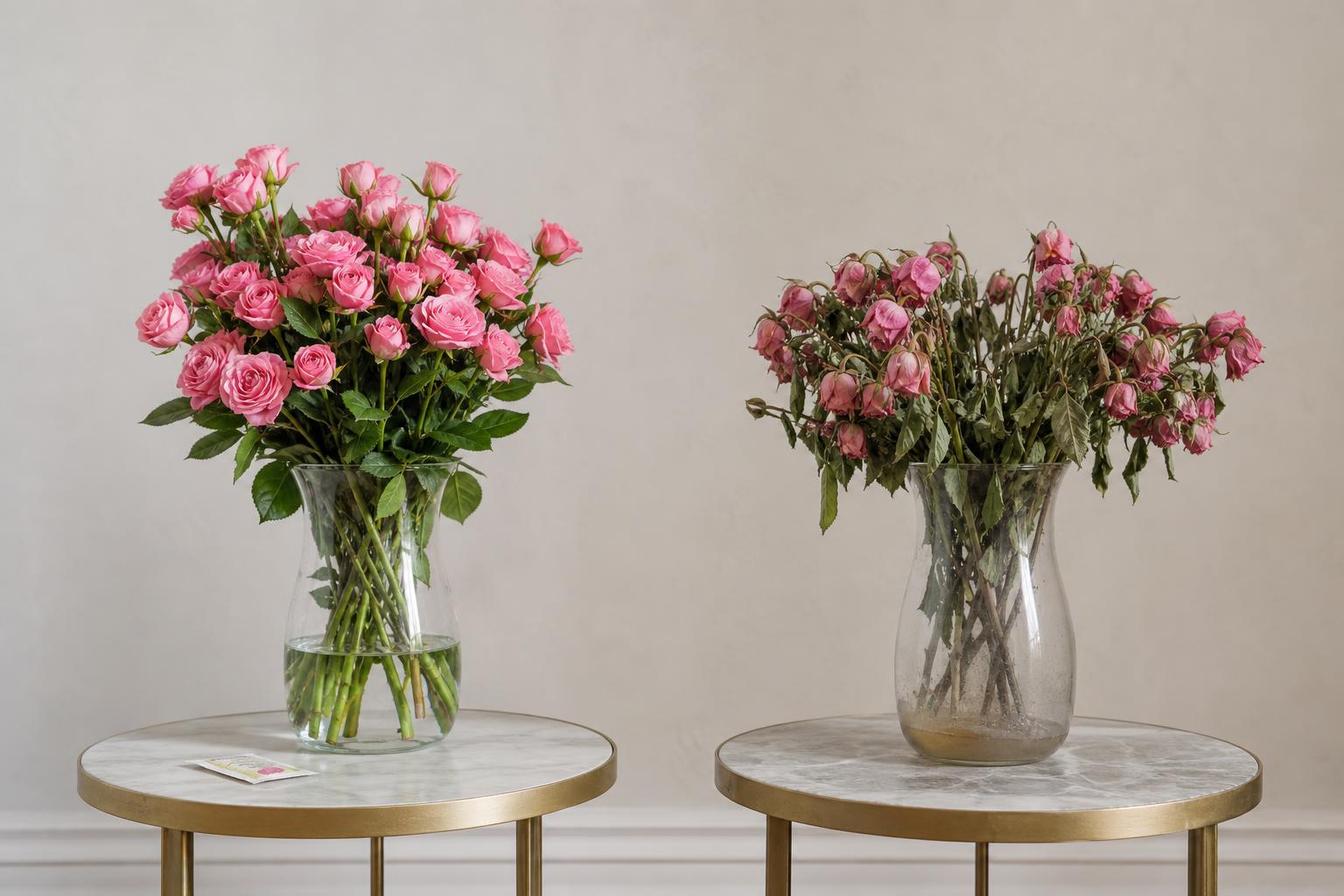 Per 1 liter of water:
- 1 tsp sugar (nutrition)
- 1 tsp lemon juice (acidifier)
- 2–3 drops of bleach (antibacterial)
Stir, place the bouquet, check daily.
This isn't a myth — it works because it hits the "three components" principle. But buying proper flower food is still simpler and cheaper.
The most common question: why did mom's bouquets with aspirin last
We hear it constantly. Honest answer:
Most likely, the bouquet lasted despite the aspirin, not because of it. Mom probably:
- Re-cut the stems (right)
- Changed the water every 2 days (right)
- Kept the bouquet in a cool room (right)
- Stripped lower leaves (right)
And the aspirin was a "ritual" that didn't harm (one tablet does nothing, plus or minus). So it looked like "it helps."
That's not bad. It's a family tradition and it has its own value. It just doesn't "work" in a scientific sense.
"Real care, no myths" checklist
- Re-cut each stem under water with a sharp knife, 45°
- Strip lower leaves
- Cool water with a flower food sachet (not aspirin!)
- Cool spot, not near sun, not near fruit
- Change water every 2 days, wash the vase
- If a bouquet wilts — revive it in the bathtub (separate article)
Short takeaway
- Aspirin — myth, concentration too low
- Sugar alone — feeds bacteria, harmful
- Vodka / alcohol — burns stem capillaries, mostly harmful
- Coins — modern alloys, zero effect
- Lemon juice — weak, no biocide
- Professional flower food — works, 10× more effective than everything above
If you have aspirin in the cabinet "for the flowers" — use it for its intended purpose. Buy your flowers proper food for $1.50.
Our fresh bouquets with delivery each ship with a flower food sachet and a short "how to keep them longer" card.
Coming up: "can you revive a wilted bouquet," "do you need distilled water," "do roses actually like sugar."
— Sofia Bell