Long stem roses: what 50, 60, 70 and 80 cm mean, and when length is worth it
What do the 50, 60, 70 and 80 cm next to the roses on an order form actually mean? Each number is the length of the shortest stem in the batch, measured from the cut end to the top of the bud. It is a trade grade set by auctions and exporters, not a promise of a better flower, and a longer stem is worth the money only when the bouquet will be shown tall.
The fact that saves the most money is also the one mentioned least. A long stem is often cut down. A florist building a round hand-tied bouquet shortens the stems to suit its proportions. The recipient unwraps it at home and trims them again so they fit whatever vase is in the cupboard. Twenty paid-for centimeters can end up in the kitchen trash before anyone has admired them.
So the useful question is less how long the stems are than where that length will be seen. The answers below follow roughly the order in which people ask, usually with the order form already open in another tab.
What do 50, 60, 70 and 80 cm on a rose order actually measure?
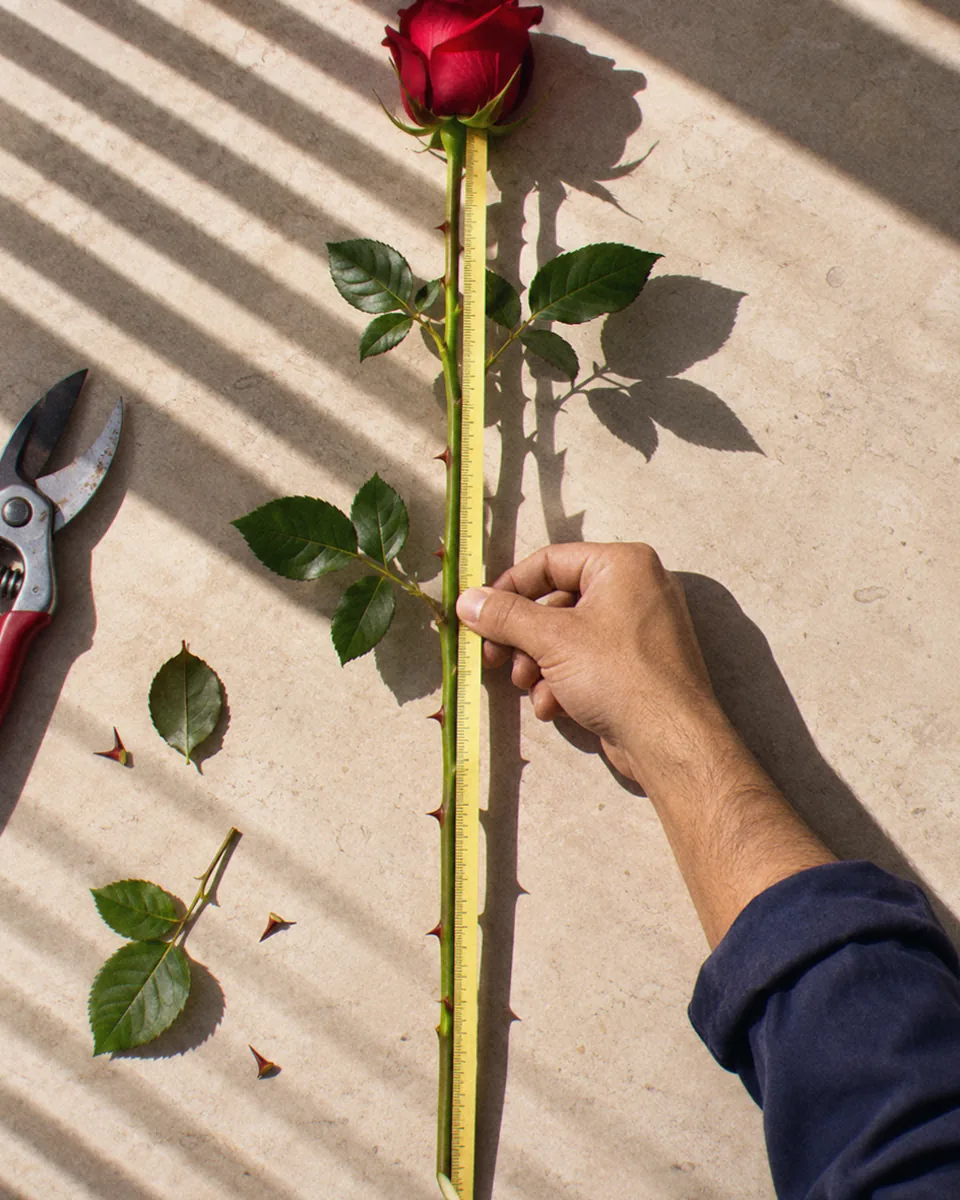
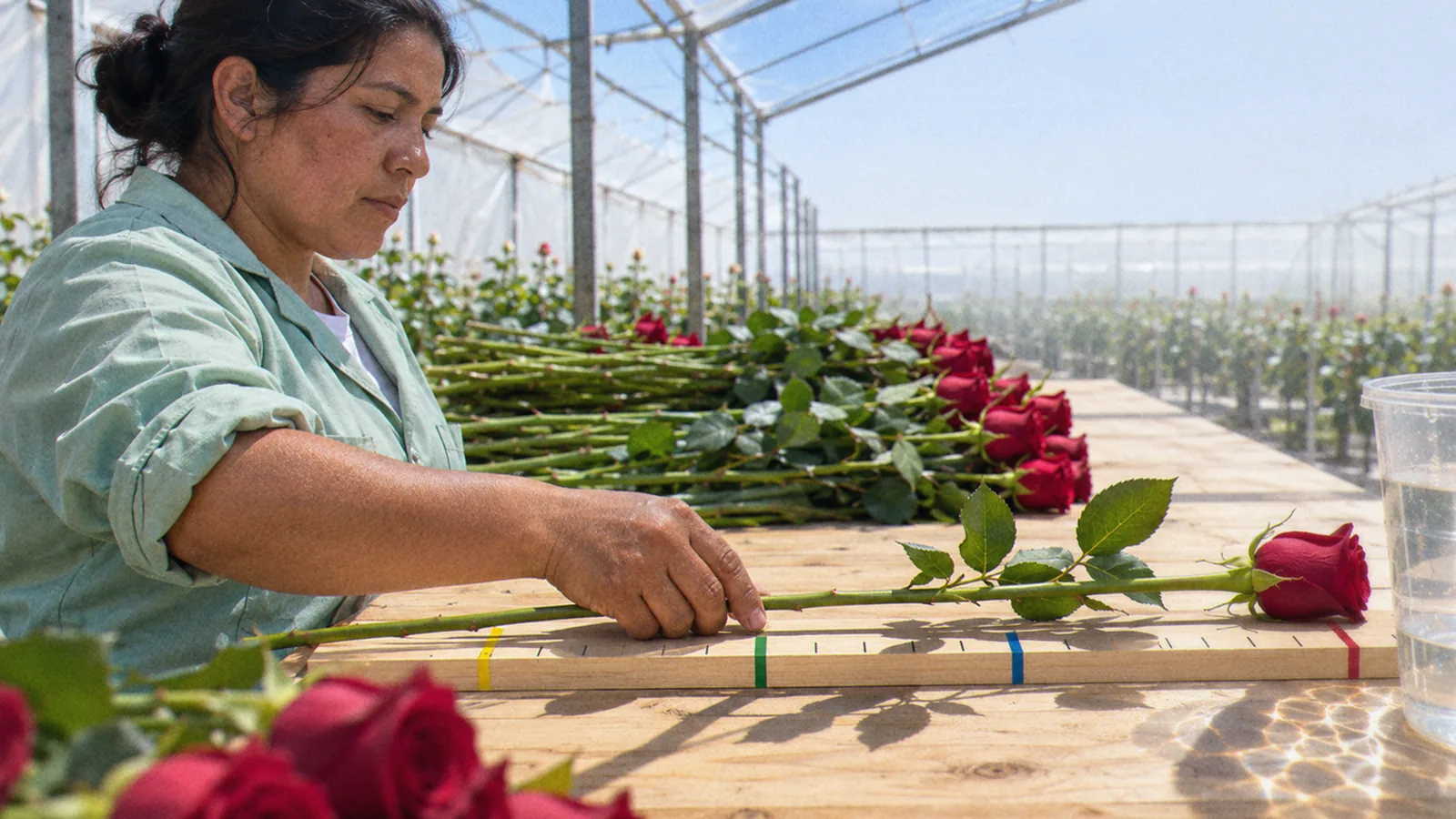
The number is the stem’s length in centimeters, from the cut end to the tip of the bud, with the bud included. Under the convention used at the Dutch flower auctions, it is also the length of the shortest stem in the lot, rounded down.
Two things follow from that. A “70” rose is not seventy centimeters of stem with a flower perched on top, because the head is counted inside the figure. And the grade is a floor, not an average. A bunch labeled 60 may hold stems that run longer, but none that run shorter. That is the only guarantee the number makes.
Nor is it a legal standard, at least not anymore. Europe did once write cut-flower quality into law: a 1968 regulation set standards for fresh cut flowers, including a sizing scale by stem length. It was repealed in 2008. No law stands behind the figure today. Grades are trade specifications, agreed between the growers, the exporters and the auctions that sell their flowers.
That makes the label a useful piece of information with a narrow job. It tells you how tall the rose is. It tells you nothing about whether the rose is any good.
Rose stem length grades: is every “70” the same?
No. The steps differ depending on who grades the roses, so two bunches both labeled 70 can differ by several centimeters.
The Dutch auctions work under specifications from Royal FloraHolland and its trade association, the same rulebook that sorts flowers into quality groups such as A1 and A2. Under the general Dutch cut-flower rules, length classes are 5 cm and stems in a bunch differ by no more than 3 cm; for roses, a “70” may fall between 70 and 74. Exporters in Colombia and Ecuador often use 10 cm steps (40, 50, 60 and on up to 100). In this exporter practice, a “70” means at least seventy and usually just under eighty, as a longer stem may be sold as the next grade. International voluntary standards also exist, but they are not law.
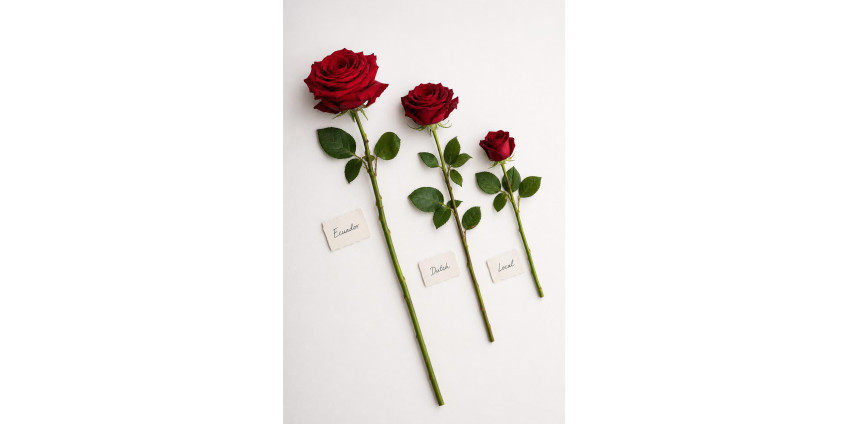
Where a rose grew changes more than its label, and our comparison of Ecuadorian, Dutch and local roses covers that side of the question.
Does a longer stem mean a bigger bud?
Only loosely. Within one variety, longer grades often come with somewhat larger heads, but the link is weak, which is why the trade grades head size separately. Bud size is its own specification, measured in centimeters, and some buyers in southern Europe sort bud height in 1 cm classes.
Variety decides head size far more than length does. One breeder’s catalog lists a single variety with the same 5.5–6 cm head across stems from 50 to 80 cm. The cheerful claim on some retail sites that a 60 cm rose has a head twice the size of a 40 cm one has nothing reliable behind it.
If the size of the flower is what matters to you, ask about the flower.
Why does every extra 10 cm cost more?
Long stems are scarce, and they take up more room on the way to the florist.
Cut roses are graded and sold by length, so length is how the market prices them, and growers go to some trouble to tilt a crop toward the top grades. They bend shoots over to reshape the canopy. They warm the root zone, which research has shown increases the proportion of long-stemmed roses. They fight heat, because high temperatures shorten the stretches between leaves and, with them, the whole stem. Even so, the long grades remain a fraction of each harvest. A grower can push that fraction up but cannot set it for every stem.
Altitude helps. Ecuador’s rose farms sit at 2,750–3,200 meters, and the country’s growers’ association credits the light and height there for its longer, straighter stems.
Then there is the box. Fewer long stems fit in one, and air freight is charged by volume and weight, so every extra ten centimeters has already cost more by the time a wholesaler cuts the strapping.
Do long stem roses last longer in the vase?
No. Stem length does not extend vase life, and the one controlled study on the question points, if anything, the other way.
Researchers working with a white variety, ‘Bingo White’, found that stems cut to 25 cm lasted 17 days, while stems cut to 55 cm lasted 10, and the shorter stems kept a better water balance. One variety tested in a laboratory doesn’t prove that short is better, so there is no need to start ordering stubs. It does settle the narrower point: centimeters don’t buy you extra days.
Variety counts for far more. A comparison of 25 cultivars found large differences in vase life, and some cultivars barely responded to treatments at all. After variety comes care: recut the stems under water to clear air from them, use clean water and flower food, and keep the roses cool. Our guide to making cut flowers last covers the rest.
Which kind of bouquet actually shows the length?
A tall bouquet shows the length most clearly. In a round hand-tied bouquet or a box, stems are cut to suit the form, so extra length may be lost before delivery.
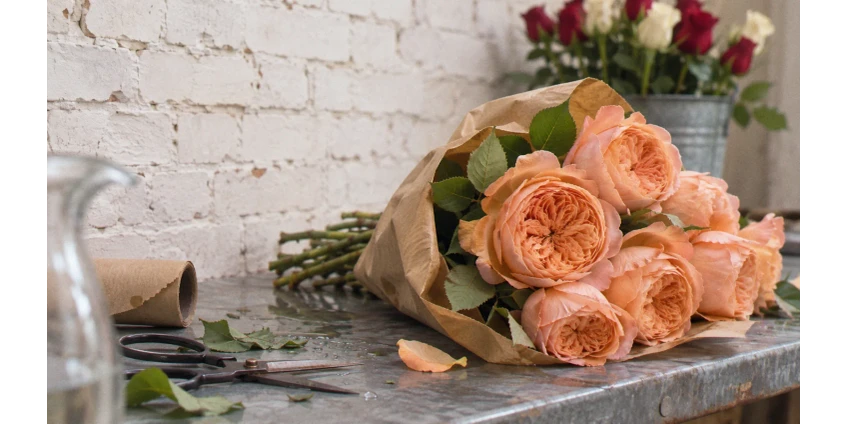
A round hand-tied bouquet is built to its proportions, so the florist cuts the stems to suit, and much of an extra-long grade can end up among the offcuts on the workbench. The label on the stems says very little about how tall the finished bouquet will stand.
In a box or hatbox, stems are cut short to fit, so the grade stops mattering the moment the lid goes on. If you are choosing between the two forms, our piece on the French bouquet versus the hatbox arrangement sets them side by side.
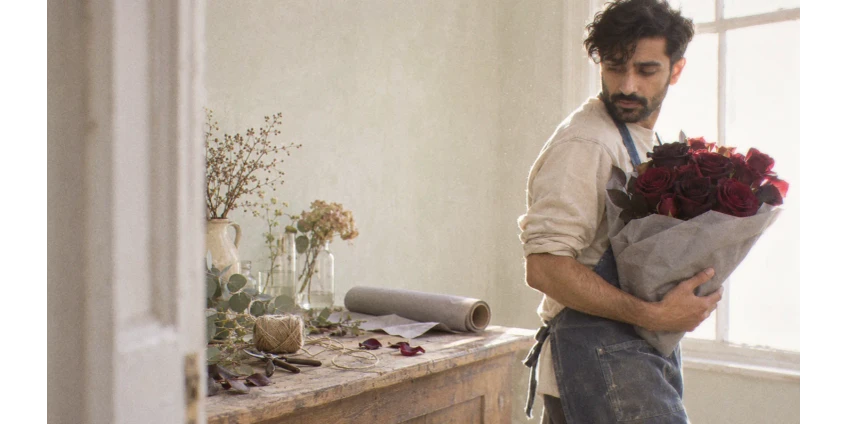
The tall bouquet of a single variety is where length earns its keep: straight stems, lightly bound, held in the crook of an arm rather than in one hand. Here the stems are half the picture.
What vase height do long stem roses need?
A vase about one-third to one-half of the bouquet’s height is a florist’s rule of thumb. An 80 cm rose wants a vase of about 27–40 cm, and a 50–60 cm rose sits comfortably in one of 17–30 cm.
The catch is the recipient’s cupboard. If the tallest thing in it is a water jug, someone handed 80 cm stems will do the sensible thing and recut them to fit. That is good care, since a fresh cut helps a rose drink, and it also undoes your upgrade in one stroke.
So before you pay for the long grade, find out about the vase. If asking the recipient would spoil the surprise, ask the florist instead: whether a vase comes with the bouquet, and how tall it is.
Are meter-long roses real?
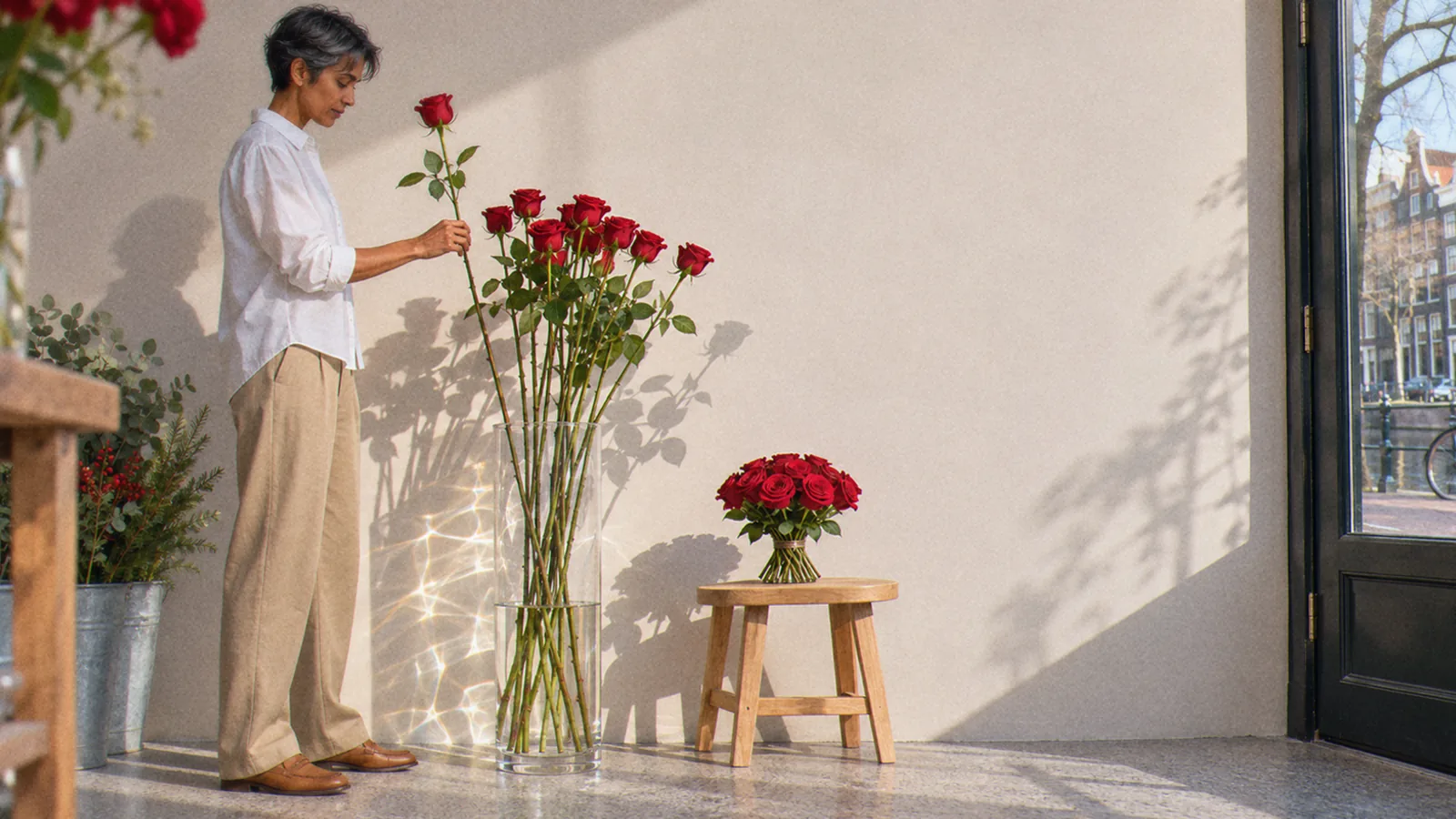
Yes, but they are rare, and they are a showpiece rather than a bouquet. Ecuadorian stems are reported to reach about 120 cm, and one grower lists lengths up to 150; popular lengths are reported to be around 60. Claims of person-tall roses are travel-blog lore, best treated like a fisherman’s account of the one that got away.
“Meter-long roses” is a trade nickname, not a grade. They suit a hall, a lobby or a floor vase, and occasions meant to be seen from across the room. At that height a bunch is top-heavy, so it needs a broad, steady vase and a spot where nobody will brush past it.
50 cm vs 70 cm roses: what length should I buy?
Decide by the form and the vase first, then spend what remains on whatever the recipient will actually see.
| If the bouquet is… | Length to choose | Why |
|---|---|---|
| Round, hand-tied | 50–60 cm | The stems are cut to the bouquet’s proportions, so extra length may be cut away. |
| Box or hatbox | The shortest grade offered | The stems are cut short to fit, so the grade stops mattering. |
| Tall, one variety, recipient owns a tall vase | 70–80 cm | The stems are the point, and there is somewhere to show them. |
| Tall, vase unknown | 60–70 cm, and ask about a vase | Tall enough to read as tall, and less to lose if someone recuts to fit a modest vase. |
| Floor vase or grand gesture | 90 cm and up | Worth it only where the room and the vase can carry the height. |
| You want bigger flowers | Any length; ask for head size | Head size is graded separately and depends mostly on the variety. |
Where the length won’t show, you may prefer more stems (our guide to how many flowers to put in a bouquet helps with the count) or a variety with larger heads. Long-stem red roses for a December anniversary are the usual exception: a tall red sheaf says something a round posy doesn’t, and what red roses mean explains why.
What should I write in the order comment?
Four things belong in the order comment: the length grade, understood as a minimum; the head size in centimeters, since it is a separate measure; whether the stems will be cut down for the form you chose; and whether a vase is included, and how tall it is. A short, specific note is easier for a florist to act on than a long hopeful one. For the order steps themselves, see how ordering works.
Tall bouquet, please. Keep the roses at their full 70 cm.
Round hand-tied bouquet, please. I’ve picked the short grade and the number of roses in the order form.
The recipient may not have a tall vase. Can one be included for 80 cm stems?
Hatbox arrangement, so no need for long stems. If you have a choice of variety, I’d prefer the largest heads.
Before delivery we send you a photo of the bouquet, so you see it before the recipient does.
If something is wrong with the bouquet, write to us within 24 hours with a photo and we will sort it out. See how our guarantees work.
The photo shows what a tape measure can’t. Length is the only part of a rose’s grade that comes down to a number. Everything else is judgment, first the florist’s and then yours. The postharvest specialists at UC Davis fit the whole matter into one sentence: “Objective grading is based on stem length; subjective grading is based on flower maturity, stem straightness, stem caliper, and quality of flower and foliage.”