Are black roses real? What they mean and when to give them
Even the official paperwork won’t call it black. When Turkey registered the famous karagül (“black rose”) of Halfeti as a protected designation of origin, the document described its color as a near-black dark red. That answer holds for every rose there is. No naturally black rose exists: the darkest varieties are very deep reds, and the flat, ink-black roses filling Instagram and TikTok this winter are usually dyed or sprayed.
What a black rose means is a looser question. In Victorian Britain black was the color of mourning dress; in China it is white. For decades the black rose has also been an anarchist emblem, a long way from a funeral. A near-black bouquet can read as grief, defiance or simply good taste: which one depends far more on the occasion and the card than on the petals.
The verdicts come first, in a short list. The chapters after it take the interesting beliefs apart, and a table near the end sorts the occasions where a dark bouquet works from the ones where it doesn’t.
Six beliefs about black roses, with verdicts
Most of what circulates about black roses is half right, and half right is the kind of wrong that lasts longest.
- No
Black roses grow in natureNo rose makes a black pigment. The “black” ones carry red pigment so concentrated that the eye stops registering it as red.
- Dyed
The jet-black roses in shops are a new varietyThey are often pale roses colored by uptake, dipping, spraying or injection.
- Half true
The roses of Halfeti prove itThe roses are real and remarkably dark. By their own official description they are also dark red, and the claim that they grow nowhere else is an internet legend.
- Depends
Black always means deathBlack is the mourning color in much of the West and in Japan. In China it is white. The old flower dictionaries never agreed with each other anyway.
- Unproven
Everyone is buying black this winterSome florists and gift guides report interest. The sales figures going around have no reliable source behind them.
- With care
A dark bouquet can be a good giftFor the right person, yes. Burgundy with a lighter accent and a clear card is often a safer choice.
Black Baccara and the other roses that almost get there
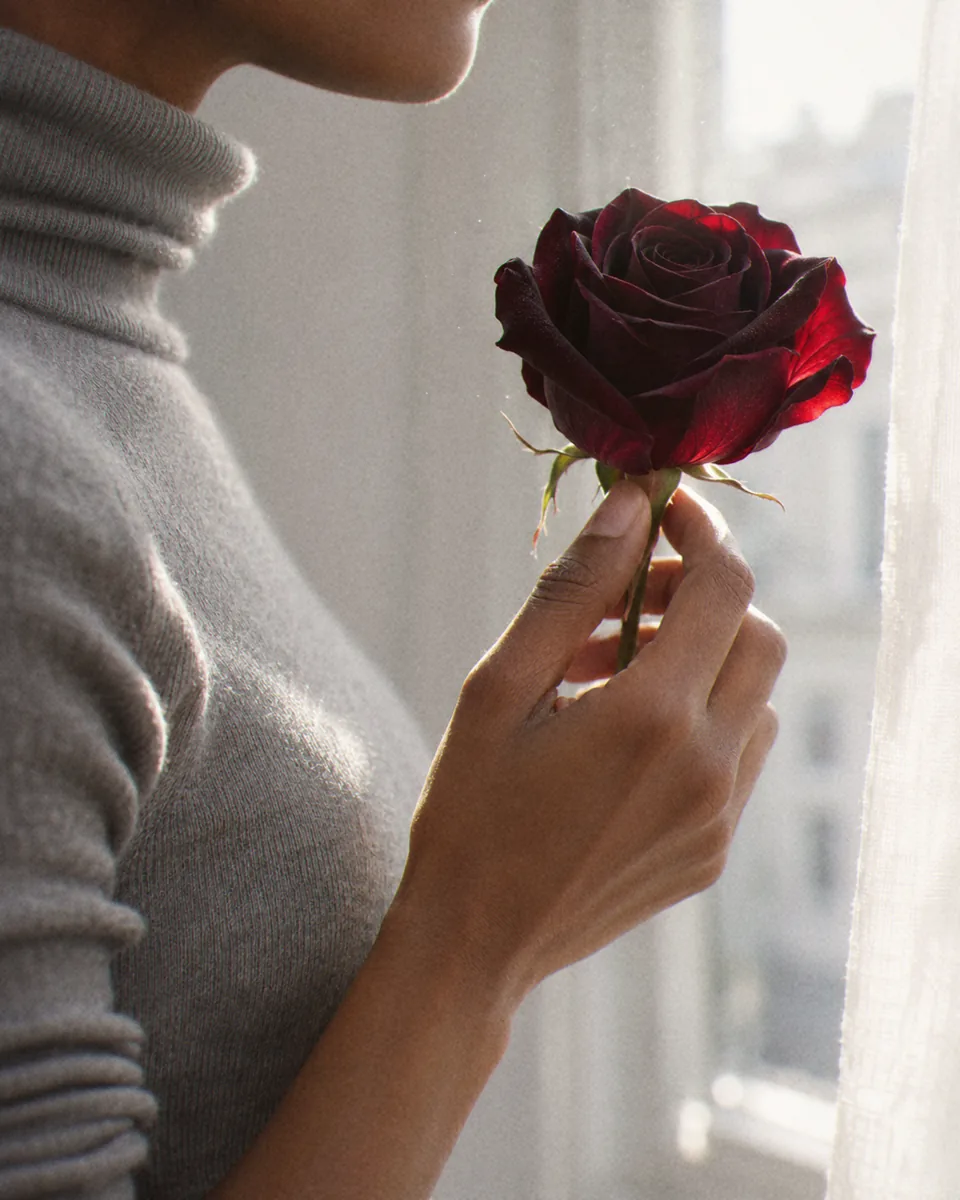
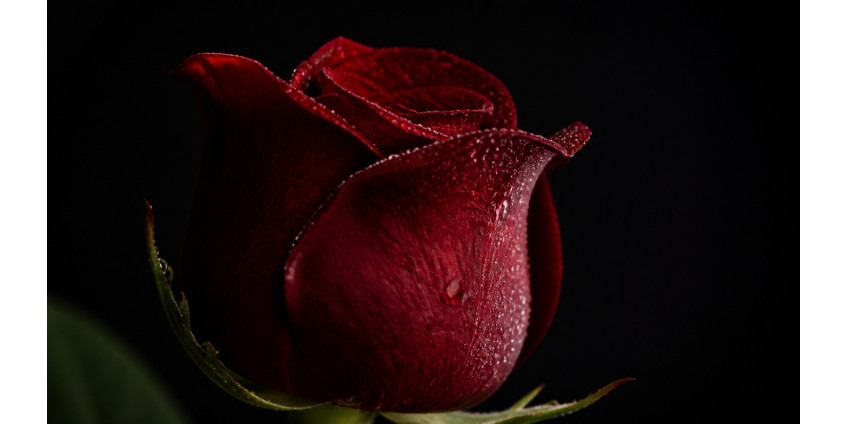
“Real black doesn’t exist in roses,” says Matthias Meilland, of the French breeding house behind one of the best-known dark roses on the market. A rose has no black pigment; it has anthocyanins, the same red and purple pigments that color an ordinary red rose, packed so densely in the darkest varieties that they absorb most of the light falling on the petal. The velvet finish does the rest: a matte, finely textured surface sends little light back, and the shadows between the petals deepen into something a phone camera happily calls black.
Temperature pushes the color further: a study published by the Japanese Society for Horticultural Science found that rose petals grown at 20 °C and 10 °C turned dark red and velvety. A dark rose looks darkest in a cool shop or on a gray afternoon, and gives itself away in warm light: turn it toward a sunny window and red comes up at the base of the petals, where it was hiding all along.
When most people say “black rose,” they mean ‘Black Baccara’ (breeder code MEIdebenne), a Hybrid Tea from Meilland credited to Jacques Mouchotte and introduced in 2000, still grown today as a cut flower. Meilland calls it one of the darkest roses in the world; rose references class it as a dark burgundy. The rose that set the standard for black is cataloged as red.
It has company in the shadows: ‘Black Magic’ (TANkalcig), bred by Hans Jürgen Evers and introduced by Rosen Tantau in 1995, winner of the Golden Rose of Baden-Baden in 2000; ‘Black Gold’, with outer petals Meilland calls almost black; and older names such as ‘Barkarole’ and ‘Black Beauty’, always listed as dark shades and never as black. Our guide to what red roses mean, shade by shade carries on where these roses stop.
A black rose is a red rose that has learned to keep its voice down.
Dyed black roses: how they’re made and how to spot one
So what are the flat, ink-black roses in the videos? Usually pale roses, often white ones, that changed color before they ever reached the shop. The trade has four ways of doing it, and each leaves its own fingerprint.
- Uptake
- Cut stems stand in a dyed solution and draw it up through their water-carrying vessels to the petals. The tint often shows in the stem and the leaf veins as well.
- Dip
- Only the flower heads go into the color. The leaves stay green and give nothing away.
- Spray
- A water-based color goes onto the bloom from outside. It sits on the surface of the petal and can come off on whatever touches it.
- Injection
- Growers push dye into the living stem with fine needles, anywhere from six inches to two feet below the bloom, usually six hours or more before cutting. The roses they start with are often white. Newer dyes are gentler on vase life than the old ones were.
Telling a dyed rose from a dark variety is mostly a matter of looking in the right places. Tinted vase water is a first clue, and Floralife calls it perfectly normal. Color in the stem or leaf veins points to uptake; dye that rubs off on your fingers or a sleeve points to spray or dip. Florists also go by a rule of thumb: an even, matte black from rim to base may suggest dye, since natural dark roses tend to vary more.
Then there is the window test from the photograph above. A natural dark variety shows red or burgundy when you hold it to the light, most clearly at the base of the petals and more so as the bloom opens.
None of this makes a dyed rose a bad buy; it is a different object, closer to a dark accessory than a flower that grew that way. It does ask for one precaution: natural flowers standing in the same water can pick up the tint, so give dyed stems a vase of their own.
The black roses of Halfeti: what is documented and what is legend
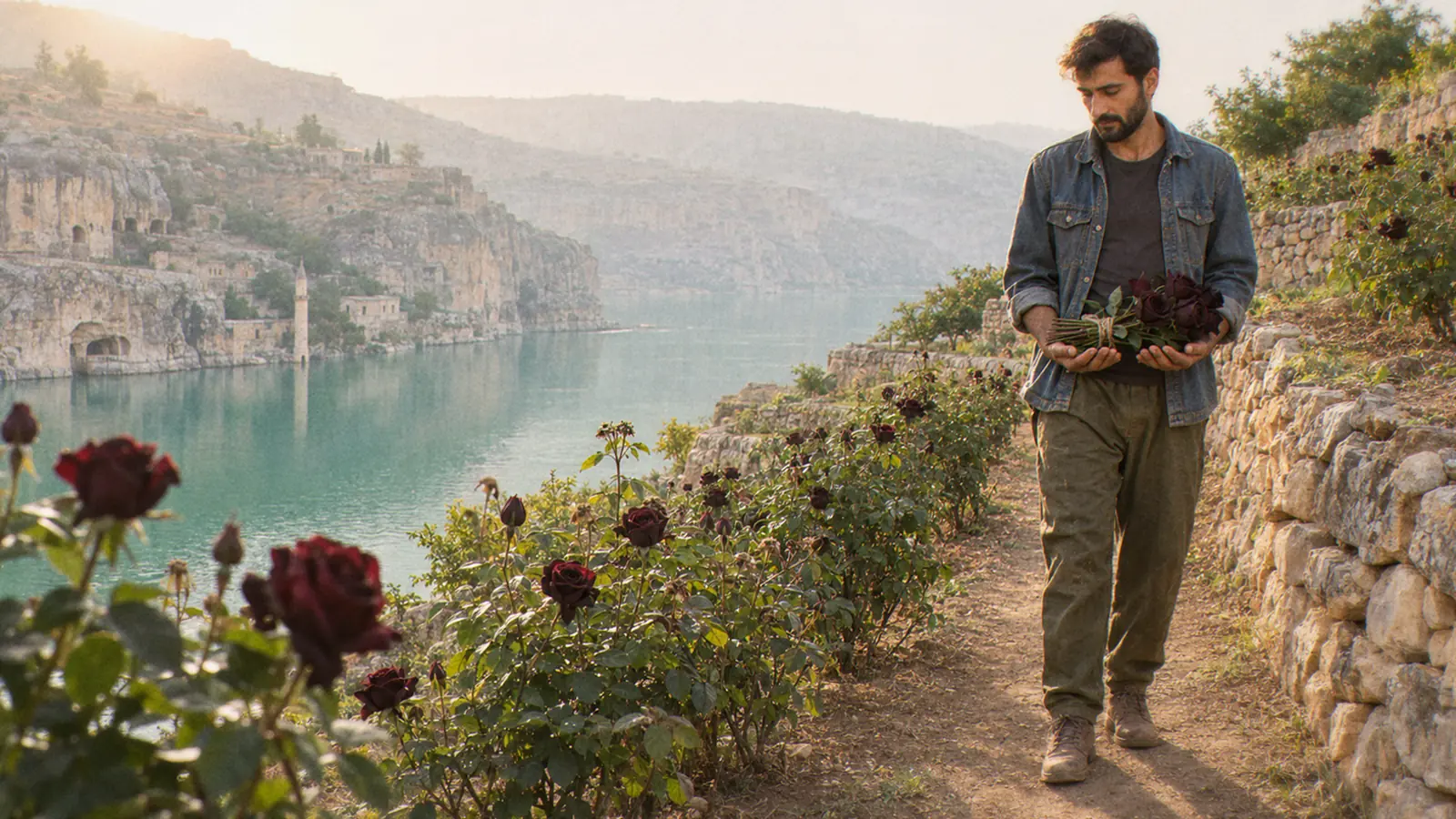
Halfeti is a small district in Şanlıurfa province in southeast Turkey, on the Euphrates. Its karagül is the rose most often offered as proof that black roses grow in nature, usually with the extra claim that they grow nowhere else on earth.
Part of the story is on record. When the Birecik Dam was completed in 2000, its reservoir flooded the old town, and the rose was saved and replanted on higher ground, where a local official says the soil is more acidic. On March 1, 2021, Turkey’s Patent and Trademark Office registered Halfeti Karagülü as a designation of origin, naming a white line down the middle of the petals as its distinguishing mark and describing the color (attributed to local day length and temperature) as a near-black dark red.
The famous claim is another matter. A 2026 AFP report described the “only place in the world” claim as an internet urban legend, with experts calling the roses very dark burgundy or crimson. Prof. Ali İkinci, a botanist at Harran University, says the karagül is not endemic to Halfeti: the local climate and soil simply make it bloom darker there, and it may descend from the French rose ‘Louis XIV’ of 1859, though that origin is unproven. A Paris museum botanist, Frédéric Achille, called the excitement “much ado about nothing.”
Even at home the black is seasonal. Turkish press reports say it shows darkest in April, May, September and October, and the district’s agriculture director names May and June as the best time to see it, when the harvest begins. The buds look black. Open, the flowers turn the color of rich red wine.
The petals go to Istanbul makers of cologne, lokum (Turkish delight) and ice cream, and the name has traveled further than the flower: the London perfumer Penhaligon’s sells a fragrance called Halfeti. The rose itself stays local, so a “Halfeti black rose” bouquet delivered abroad is likely a dark cut variety or a dyed one.
Black rose meaning: mourning, farewell, rebellion
Black as the color of Western mourning is old, going back to ancient Rome; Victorian Britain turned it into a discipline of heavy black dress. In Japan, mourning clothes (mofuku) are mainly black. In China white is the traditional color of mourning, so the black rose there is a borrowed Western symbol rather than an inherited one.
Then come the flower dictionaries. The Victorian “language of flowers” gave the black rose meanings ranging from hatred and despair to death, or rebirth, which is a generous spread for a single flower. The dictionaries disagreed with each other and were never standardized, so treat them as a parlor game with a long memory, not a code anyone is bound by. Our florist’s guide to flower symbolism takes the same view of most of that canon.
But the black rose has a life well outside the funeral parlor. It is an established anarchist symbol, borrowed by Black Rose Books in Montreal and the Black Rose Anarchist Federation, founded in 2014. For plenty of people it simply belongs to dark romance, a matter of taste with no doctrine behind it: someone who dresses in black may read a dark bouquet as “you know me,” where their grandmother would read something else entirely.
So the same bouquet can carry two messages at once. If you are sending abroad, the color conventions worth knowing are collected in flower etiquette around the world.
Is everyone buying black roses this winter?
Not that anyone can show. The sales figures circulating online trace back to no retailer or trade report, and the pages repeating them don’t even agree with one another.
What can be said is modest: some florists and gift guides report interest in dark roses, naming ‘Black Magic’ or velvet-toned stems like ‘Black Baccara’. Meanwhile Pantone’s Color of the Year for 2026, announced December 4, 2025, is Cloud Dancer, a white, the first since the program began in 1999. If the season has a headline color, it is the opposite of black.
None of this argues against a dark bouquet. It only means you are choosing it for the person rather than for the algorithm. Our look at floristry trends for 2026 sorts what lasted from what stayed on Instagram.
When a dark bouquet works, and when it doesn’t
This is guidance rather than law, built on the meanings above and on what tends to land well.
| Situation | Dark bouquet? | What works |
|---|---|---|
| A partner who loves dark style | Yes | ‘Black Baccara’ or another very dark red, with a card that makes the compliment plain. |
| A birthday | With care | Burgundy roses with cream or blush accents, so the bouquet reads as a celebration. |
| A first date | Better not | Deep red says romance. Near-black leaves them guessing. |
| A colleague | No | Something lighter. Ambiguity makes a poor office gift. |
| Condolences in the UK, Western Europe or Japan | No | Black belongs to mourning dress, but black flowers are not a standard sympathy choice. White or soft colors are safer. |
| A recipient in China | With care | Black-rose symbolism is less established there. White is the color tied to death, so avoid all-white gifts for happy occasions. |
| A Halloween party, October 31 | Yes | A night when a very dark bouquet can fit the mood. |
The pattern is simple: the better you know the person, the darker you can go. For a loss, our guide to sympathy flowers etiquette covers what to send when you can’t be there.
If you want the depth without the doubt, build from burgundy: ‘Black Baccara’ and ‘Black Magic’ are classed as dark red, giving you the look without any dye. Add dark purple calla or burgundy ranunculus for texture, then something light: cream roses, blush, pale greenery, so the dark flowers read as velvet rather than mourning. A few honest words on the card settle whatever the color leaves open; see what to write on a flower card.
One practical point for ordering abroad: our flowers never cross borders, so a partner florist in the recipient’s city makes the bouquet from the dark roses they have on hand. Ask for “deep burgundy roses” rather than “black” if you want the natural kind. See the whole process in how ordering works.
Before delivery we send you a photo of the bouquet, so you see it before the recipient does. If something is wrong with it, write to us within 24 hours with a photo and we’ll sort it out: see how the delivery photo and guarantee work.
Whatever the label says, turn the rose to the light before you decide what it means.