Flower etiquette around the world: numbers, colors and occasions
Flowers cross a language barrier without a dictionary. They can also say something you never meant. A dozen red roses means romance in New York, yet many people in Moscow, older ones especially, would set an even count like that on a grave. White chrysanthemums are a grave flower from Paris to Seoul. Four stems, from Beijing to Tokyo, are a small, unintended remark about death.
The good news is that almost every rule of flower etiquette around the world comes down to three things: how many stems there are, what color they are, and what the occasion is. Get those right, pay a little attention to how the bouquet is handed over, and you can send flowers to nearly any country without causing offense. The safe default is easy to remember: an odd number of stems that isn’t 9 or 13, no white chrysanthemums, and mixed colors rather than all white.
What follows is the longer map. It goes country by country, and it keeps the customs people still live by apart from the ones the internet made up.
The short answer: three things that travel badly
The first is the number of stems. In several countries a count carries a meaning of its own. Even numbers belong to the dead in Russia and much of the former Soviet world, and the word for four sounds like the word for death in Chinese, Japanese and Korean.
The second is color, white above all. Across East Asia an all-white bouquet reads as mourning, and the white chrysanthemum is the funeral flower in Japan and Korea. In France and Italy the chrysanthemum in any color belongs to the cemetery.
The third is the occasion. The same flower can be festive in one setting and funereal in another, sometimes within one country. In India, marigold garlands hang at weddings and are also laid around a funeral pyre, so the day and the place decide what they mean.
Why so much meaning in a bunch of stems? In most of the countries in this article, flowers do two jobs: they celebrate the living and they honor the dead, and the two have to be kept apart somehow. Some did it by counting, some by color, and some by setting one particular flower aside for the cemetery. Once you know which method a country uses, its rules stop looking arbitrary.
That is also why the safe default works so widely. Five or seven stems steer clear of every unlucky number on the list. Mixed colors can’t be mistaken for a mourning arrangement. Leaving out white chrysanthemums removes the one flower most likely to be read as condolence. A bouquet built this way may not be the boldest thing you ever send, but nobody will need it explained.
The unlucky number of flowers, from Moscow to Tokyo
Counting stems sounds fussy until you realize how many people do it without thinking. Here is what the common numbers mean, and where.
Russia and the post-Soviet world. Even counts go on graves, to funerals and to war memorials on Victory Day, May 9. For the living, give 1, 3, 5 or 7.
China, Hong Kong, Singapore, Japan, Korea. Four sounds like death: sì and sǐ in Mandarin, shi in Japanese, sa in Korean. In China, 14 and 24 are best avoided too.
Japan. Nine is read ku, a word that also means suffering, so it is avoided alongside four.
Russia and much of Europe. This is more a florists’ habit than a rule. Plenty of people would simply rather not get thirteen.
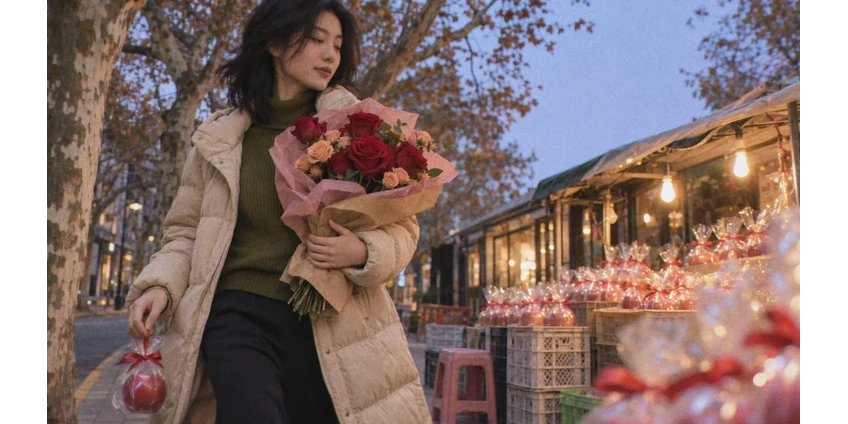
USA, UK, Latin America. The dozen red roses is the romantic standard, and nobody there worries about odd or even.
The safe count. It is odd, it is neither 9 nor 13, and it reads as a gift wherever you send it.
The Russian rule fades as the bouquet grows, though nobody agrees on exactly where. Russian sources put the cut-off at ten stems, or thirteen, and one suggests counting anything above a dozen in half-dozens. All of them agree that a large mixed arrangement is exempt, since nobody stands at the door counting forty stems of mixed greenery. The rule is aimed at the small, deliberate bouquet: three roses or four, five tulips or six.
The rule isn’t only Russian, either. The same preference for odd counts turns up in Germany, Austria and Switzerland, and it is traditional in France. In parts of Poland, Czechia, Hungary and Romania, some people still keep even numbers for funerals. If you grew up with this rule, don’t assume everyone shares it, and don’t assume you are the only one who does.
The awkward case is twelve roses sent from New York to Moscow. To the sender they mean romance. An older recipient may think of a cemetery, even though some Russian sources would already count a dozen as large enough to be exempt. If you are torn between eleven and thirteen, choose eleven. Our guide to how many flowers to give covers counts in more detail.
Flowers to avoid as a gift, and the colors of mourning
White is the color of funerals in China, Hong Kong, Japan, Korea and Vietnam, and in many parts of India. A single white rose in a mixed bouquet is no problem. An all-white arrangement is a different matter, especially one built around white chrysanthemums or white lilies. Younger recipients in big Chinese cities tend to mind less than their grandparents do. When you are sending to someone whose age and habits you don’t know, add color.
The chrysanthemum gets into trouble on two continents for two different reasons. In East Asia the problem is white. In Catholic Europe the problem is the flower itself. In France, Belgium and Monaco it belongs to La Toussaint, All Saints’ Day on November 1. In Italy it belongs to Il Giorno dei Morti, the Day of the Dead on November 2. In Poland and Czechia it fills the cemeteries for All Saints and All Souls. Brazil keeps the same habit for Finados on November 2. Away from these countries and dates, a colorful chrysanthemum is an ordinary bouquet flower. Our chrysanthemum guide explains where it can be sent safely.
Russia has its own memorial flower, the red carnation (gvozdika). It is the standard flower for veterans and war memorials on May 9, its red long tied to the Soviet flag, and it often appears at funerals in even numbers. Older people may find carnations official or mournful. Carnations are making a comeback in modern bouquets, including wedding ones, so this association is softening.
Marigolds show how much depends on the setting. In Mexico, cempasúchil (the Mexican marigold, also called flor de muerto, “flower of the dead”) belongs to the Day of the Dead, when its petals mark paths for the departed on November 1–2. In Thailand the marigold’s name, dao rueang, is linked to prosperity, and the flower is a temple and offering flower. In India it is both festive and funereal. Frangipani, with its creamy petals, is linked to death in Hong Kong and to funerals in many parts of India, so leave it out of anything celebratory.
Most flower etiquette is a way of keeping the living and the dead apart.
Flower giving customs by country
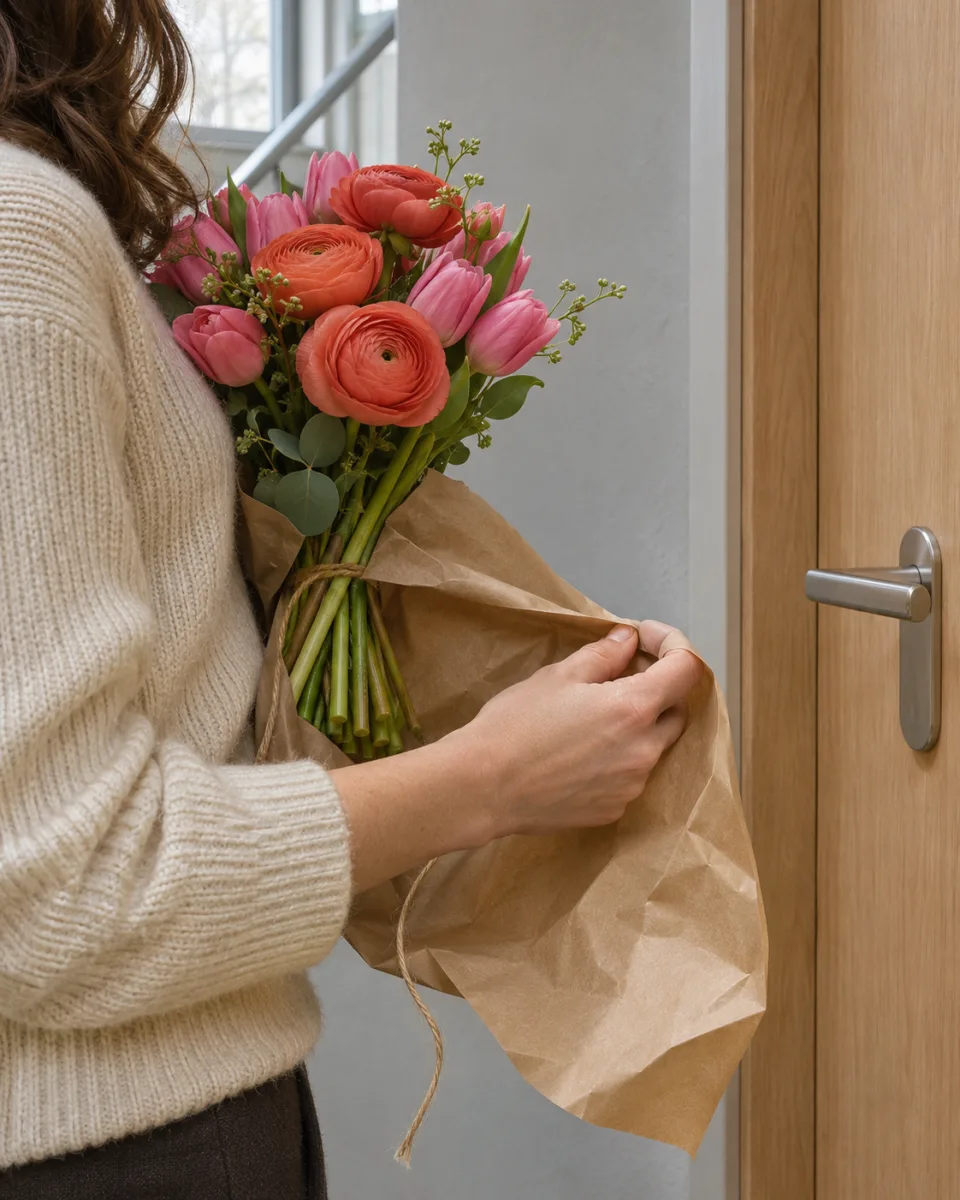
Some rules have nothing to do with the flowers and everything to do with how they are handed over. In Germany, Austria and Switzerland the guest traditionally removes the paper before giving the bouquet to the host. The paper was there to protect the flowers on the way, so it isn’t considered part of the gift. Clear cellophane has relaxed the habit, but brown paper still tends to come off at the door.
The same households have a view on red roses. A red rose is a declaration of love, so a hostess gets something else. That makes sense once you picture her husband taking the coats in the hallway.
In the Gulf, the question is who gives and who receives. In conservative Saudi homes, flowers are not a suitable gift from a man, though a woman may bring them to her hostess. A man should never send flowers to his host’s wife or to any unrelated woman, and he shouldn’t ask after her either. Address the gift to the household or to the host, and the problem never arises.
Europe
France · Belgium · Italy · Germany · Austria · Switzerland · Poland · Czechia
Keep chrysanthemums for the cemetery. Odd counts are the safe choice. Some French sources also link carnations to funerals. In Italy, black and gold wrapping belong to mourning, so pick another color of ribbon.
Russia and the former USSR
Russia · Kazakhstan · Uzbekistan
In Russia and many post-Soviet homes, small bouquets go in odd numbers. Red carnations are for memorials. Gift wrapping usually stays on, while cheap patterned cellophane is frowned upon.
East Asia
China · Hong Kong · Singapore · Japan · South Korea · Vietnam
Avoid four stems everywhere here except Vietnam, nine in Japan, and all-white bouquets throughout. In Korea, mourners lay single white chrysanthemums at the altar, and condolence wreaths are white and yellow chrysanthemums.
The Gulf and Egypt
Saudi Arabia · UAE · Qatar · Egypt
Address flowers to the household rather than to a woman outside the family. Apply the same courtesy in the UAE, Qatar and Egypt as in Saudi Arabia.
Israel
Tel Aviv · Jerusalem · Haifa
Many households buy flowers on Friday for Shabbat. This is a custom rather than a religious duty, and a Friday morning delivery suits it well.
Latin America
Mexico · Brazil · Argentina · Chile · Peru · Colombia
Don’t give cempasúchil in Mexico in early November, or chrysanthemums in Brazil around Finados. Yellow, on the other hand, is a happy color across the region.
Yellow flowers, wrapping paper and other superstitions
Every list of flower taboos mixes living customs with stories that have been copied from blog to blog. Here is how the best-known ones hold up.
- Myth
Yellow means separationRussian folk etiquette read yellow as joy, warmth and wealth. The separation idea is much younger, and Moscow’s Vechernyaya Moskva newspaper traces it to a once-popular song. Some older recipients still take yellow badly, so for a grandmother, mix it with other colors.
- Unproven
Yellow means death in MexicoThis appears only in listicles. Every year many Mexicans give each other yellow flowers on purpose, which is hard to square with it.
- Unproven
Purple means mourning in BrazilNo reliable source confirms it. In Brazil the chrysanthemum is the flower that marks the dead, whatever its color.
- Fading
Unwrap the bouquet in RussiaTraditional etiquette asked for it, but today the gift wrap usually stays on. What people really dislike is cheap cellophane.
- Size matters
Even numbers, any sizeThe rule applies to small bouquets. A big mixed arrangement is exempt in Russia, even if the stems happen to add up to an even number.
- Real
Four stems in East AsiaThe link between four and death is strong enough that hospitals and funeral halls in Korea skip the fourth floor or label it “F”. Younger people care less, but no recipient will mind if you avoid four.
- Real
Chrysanthemums for a French hostNever give them. To your host, they are flowers for La Toussaint, and they will arrive looking like a condolence.
Get-well flowers, and what not to give in Japan
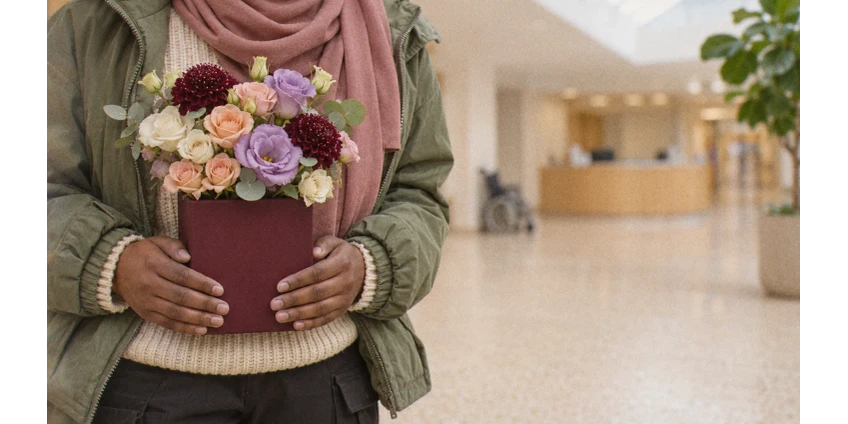
Hospitals are where good intentions most often meet a closed door. Many NHS trusts in the UK ban flowers in intensive care and high-dependency units, and some ban them on all wards, Sheffield among them. The usual reason is bacteria in vase water, although a 2009 report in the BMJ found no evidence of infections caused by vases. Many hospitals in the US and Canada keep flowers out of intensive care, citing infection and allergy risk. In Turkey, at least one state hospital, in Torbalı, does not accept vase bouquets in patient areas because of infection risk. In all these cases the answer is the same: check with the ward first, or send the flowers to the patient’s home so they are waiting for the homecoming.
Japan has a whole vocabulary for get-well gifts, and most of it is wordplay. Don’t send a potted plant to a hospital. Plants “take root”, netsuku, which sounds exactly like the netsuku that means being laid up in bed, so a pot suggests a long stay. Camellias (tsubaki) are out because the whole flower head drops at once, and the image is a falling head. Cyclamen is out because its name, shikuramen, begins with shi and ku, death and suffering in a single word. Lilies and lotus are also best avoided, and some Japanese hospitals accept no flowers at all.
In Japan the choice of get-well flowers really does matter; elsewhere, hospital rules are usually the bigger obstacle. A modest, colorful bouquet of cut flowers, sent to the home after discharge, works in Osaka and in Ohio alike.
When the calendar changes the meaning
The same bouquet can mean different things depending on the date. Early November is the most delicate stretch of the year: chrysanthemums fill cemeteries across Catholic Europe and Brazil, and cempasúchil marks the way home for the dead in Mexico. Russia has its own memorial day on May 9, when red carnations go to memorials. Flowers sent in those weeks should stay clearly festive, with colors that couldn’t be mistaken for a memorial wreath.
Other dates work in your favor. In Argentina, Chile and Peru, yellow flowers are given on September 21, the first day of the southern spring. In Mexico and Colombia the same custom falls on March 21, although both dates now circulate. The trend began with the Argentine telenovela Floricienta (2004–05) and its song “Flores amarillas”, then went viral on TikTok in September 2021. In Israel, Friday has its own quiet flower custom. In Thailand, jasmine is the Mother’s Day flower. Our world calendar of flower-giving days sets them out month by month.
Some occasions have changed within living memory. For years, Saudi Arabia’s religious police raided shops around February 14 and confiscated red roses and other red gifts. In February 2018, red roses were sold openly, and a former head of the religious police in Makkah called the day a “positive social event”. No formal decree ever lifted the ban, so it is better described as a custom that has relaxed than as a rule that was abolished.
Grief is the occasion where flowers are least certain to be welcome. Flowers are generally not sent to a Jewish funeral or to a shiva house, the home where the family mourns for seven days. Food or a charity donation is the usual gesture, and visitors to a grave leave small stones instead of flowers. Our guide to sympathy flowers across cultures covers the rest of the world.
When in doubt
You can’t know every family’s habits, and you don’t have to. A handful of choices covers almost every case.
- Send to the homeHomes have no ICU rules, and a delivery to the household spares everyone the question of who the flowers are “for”.
- Count to an odd numberFive, seven or eleven stems. In a large mixed arrangement the count stops mattering.
- Mix the colorsUse color to make the bouquet unmistakably festive, and leave out white chrysanthemums.
- Name the occasion on the cardA line such as “Happy birthday” or “Welcome to your new home” settles any doubt about what the flowers mean. For wording, see what to write on a flower card.
- Check the photoBefore delivery we send a photo of the bouquet, so you can see the count and colors for yourself.
The bouquet itself is made on the day of delivery by a florist in the recipient’s own city, which means the flowers come from local stock, not from a box that crossed a border. The etiquette is yours to choose. The simplest version fits in a single sentence: an odd number, mixed colors, and a card that says why.