Oseibo gift ideas: can flowers be a Japanese year-end thank-you?
In Japan the year-end thank-you, oseibo, is deliberately modest, and an expensive box can be the rude one, because it leaves the recipient feeling they owe you. Do flowers count? Not in the customary sense. Japanese etiquette guides describe oseibo as food, drink, sweets and condiments, and flowers don’t appear on their lists. A small winter plant or a New Year arrangement can still go out as a seasonal greeting alongside the usual box. It has to stay modest, avoid a few unlucky associations and reach someone who is allowed to accept it.
Most of the awkwardness foreigners cause at this time of year comes from good intentions brought over from home: the Christmas reflex, the urge to impress, the assumption that flowers are welcome anywhere. Each has a Japanese answer, and the answers are more practical than mysterious.
These are the beliefs that cause most of the trouble, each with a short verdict:
- No
“Oseibo is Japan’s Christmas present”It thanks people for the past year’s favors, and its clock is set by the New Year. December 25 isn’t even a public holiday in Japan.
- No
“A bigger gift shows more respect”An expensive gift leaves the recipient feeling in your debt. The usual band is ¥3,000–5,000.
- Half true
“Flowers are never oseibo”Etiquette guides list consumables only. Department stores still sell winter plants as year-end greetings.
- Hospitals only
“Potted plants are unlucky”The “taking root” taboo applies to the sick. For a business, the same idea is a good omen.
- Wrong occasion
“An orchid is the safe business gift”A potted phalaenopsis is associated with openings and promotions, not standard oseibo.
- No
“They’ll have to send something back”The usual reply is a thank-you letter within about three days.
- No
“Anyone can accept oseibo”Public servants and staff at many companies are restricted, and the government rules name flowers outright.
- Usually fine
“Mourning cancels oseibo”Oseibo is a thank-you, not a celebration. Wait out the 49 days and use plain white paper.
What oseibo is, and why it isn’t a Christmas present
The word means “year-end.” The custom grew out of offerings made to the head of the family before the New Year. Today it thanks the people who mattered in your life and work for the favors of the past twelve months, and it traditionally travels upward: from junior to senior, from supplier to client, from student to teacher. In December the gift counters of Japanese department stores fill up, and many of the buyers are choosing gifts for business contacts as they make their year-end round of clients. Oseibo has a summer twin, ochūgen, which goes to the same kind of people between early July and mid-August.
Christmas exists in Japan as a cheerful commercial custom of its own, but December 25 is an ordinary working day and oseibo has nothing to do with it. The traditional start of the season is kotohajime, December 13, the day New Year preparations begin.
Where the season ends depends on which guide you read and where the recipient lives, as the table below shows. One retail guide notes that more people now start in late November. For a foreign sender the safe reading is simple: aim for the first half of December, and treat the 20th as the line for Tokyo.
| Window | When | What the gift is called |
|---|---|---|
| Traditional start | December 13 (kotohajime) | Oseibo |
| Eastern Japan (Kanto, Tokyo) | One guide: late November to about December 20 | Oseibo |
| Western Japan (Kansai) | Mid-December to about December 20–25, depending on the guide | Oseibo |
| Missed the window | After New Year’s Day, until January 7 in Kanto or January 15 in Kansai | Onenga, a New Year gift |
| Later still | After the New Year period (matsu no uchi) until risshun, the old calendar’s first day of spring | Kanchū omimai, a midwinter greeting |
A late gift is not a lost cause, then. It simply changes its name, and the label on the wrapping changes with it.
Arrival matters as much as the date. People are often away at year end and offices close for the holidays, so tell the recipient when to expect the parcel, especially if it is chilled: a refrigerated parcel is normally held for only about three days, counting the day it arrives. A short greeting that lands before the gift is considered polite. In 2026 both December 13 and December 20 fall on a Sunday, which is worth remembering if you’re sending to an office address. If flowers are part of the plan, the lead times for international orders are in our guide to holiday flower delivery deadlines abroad.
Why a bigger gift is the ruder one
A typical oseibo costs ¥3,000–5,000. Guides suggest around ¥5,000 for a boss or someone you owe a great deal, around ¥3,000 for a business contact or an acquaintance, and about ¥10,000 as a ceiling, kept for someone who went well out of their way for you.
The reason for the restraint is the whole point of the custom. Japanese guides warn that an overly expensive gift ki o tsukawaseru: it makes the recipient feel they now owe you something. Oseibo is supposed to settle the year’s account of favors, and a lavish box opens a new one. A foreign partner who sends something grand as a show of respect has, in effect, handed the client a bill.
The contents are just as light. Popular choices are ham, Western-style sweets, coffee, condiments and seafood, things that get eaten or used up and leave nothing behind. The list of what to avoid is more pointed: cash and gift certificates, combs, handkerchiefs, footwear, writing instruments, and anything with a blade, which suggests cutting ties.
The wrapping carries a message of its own. The box goes into noshi paper printed with a red-and-white cord called mizuhiki, tied in a chōmusubi. That is a bow knot reserved for happy events that may happen again, which suits a thank-you you mean to repeat next year. Above the cord the label reads “oseibo,” and the sender’s name goes below it. Foreigners are usually advised to buy from a department store, where the counter can add the noshi for you. The finished parcel is plain and slightly formal, and anyone in Japan can read it from across the room.
Can you give flowers in Japan at year end?
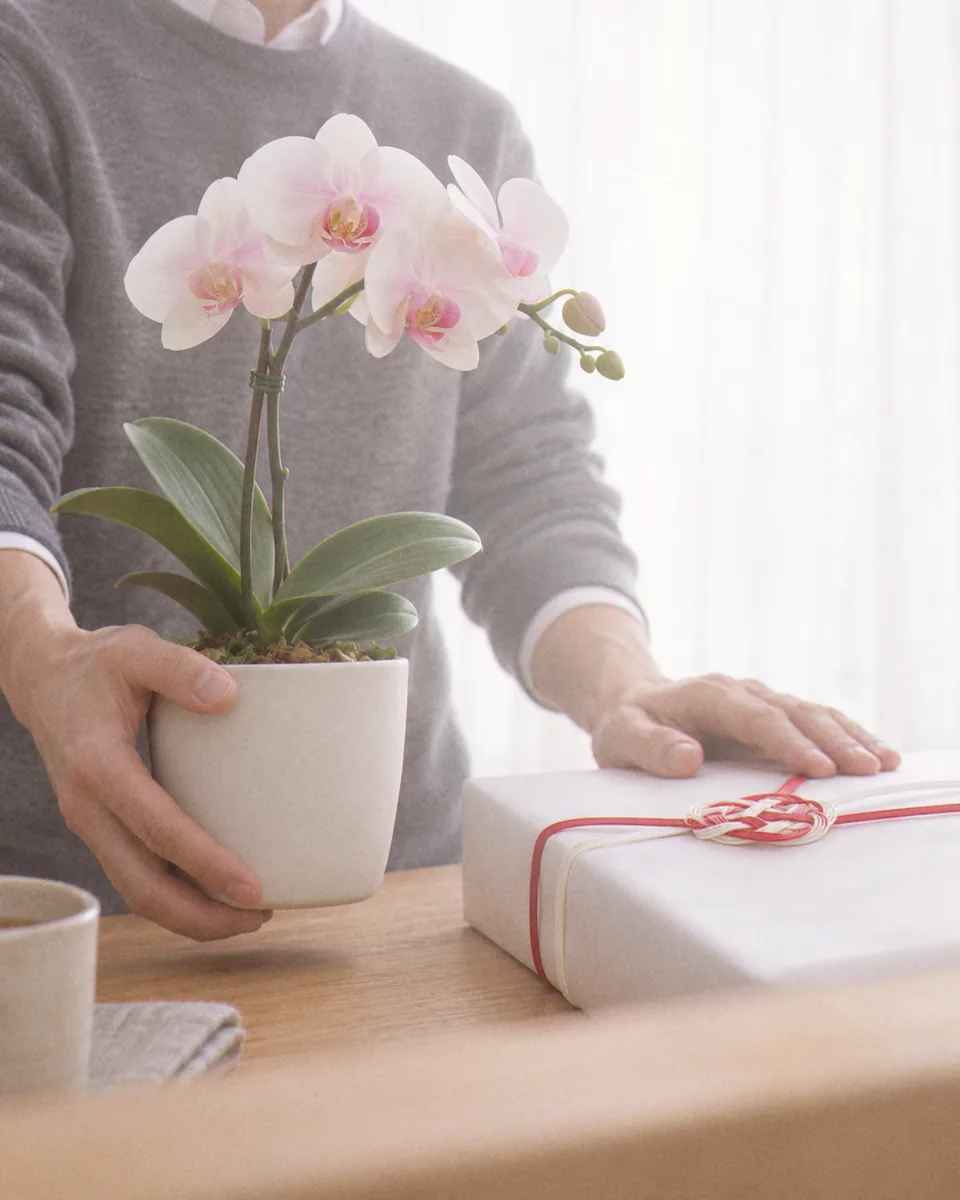
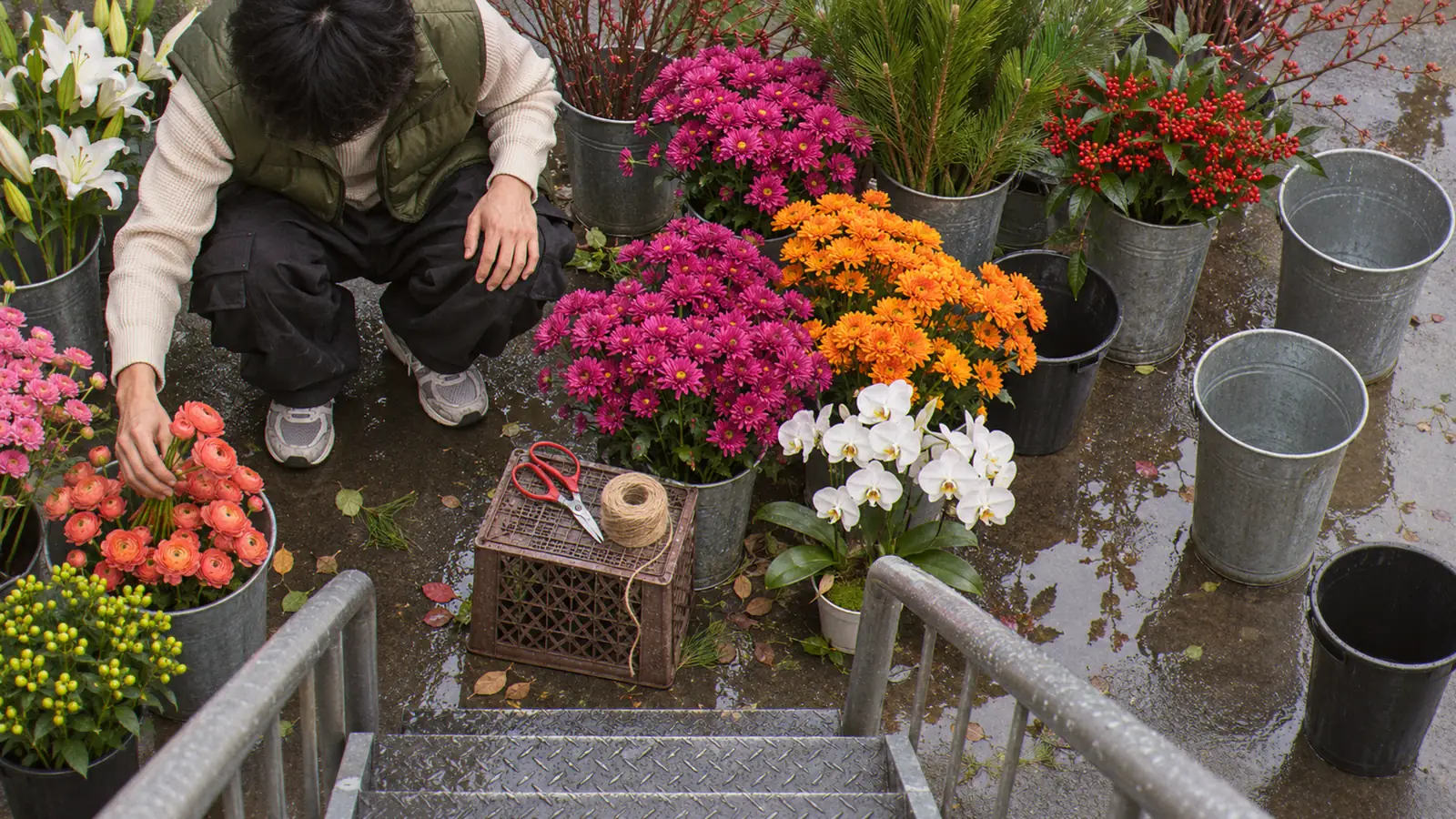
Yes, with a qualification. The etiquette guides that set out what oseibo should be describe consumables and leave flowers out entirely, so a bouquet sent on its own won’t read as oseibo, whatever the card says. Some retail listings offer potted cyclamen and geishun yoseue (New Year planters with narcissus, ornamental cabbage and nandina) as seasonal greetings. A shop isn’t an etiquette manual, though: the listings show what sells as a year-end greeting, not what etiquette counts as oseibo.
So a plant can travel with the thanks without being the thanks. If you want flowers involved, choose something wintry or New Year in spirit and keep it within the same modest budget. Send it in addition to the customary gift, not in place of it, and time it to arrive before the office closes for the year.
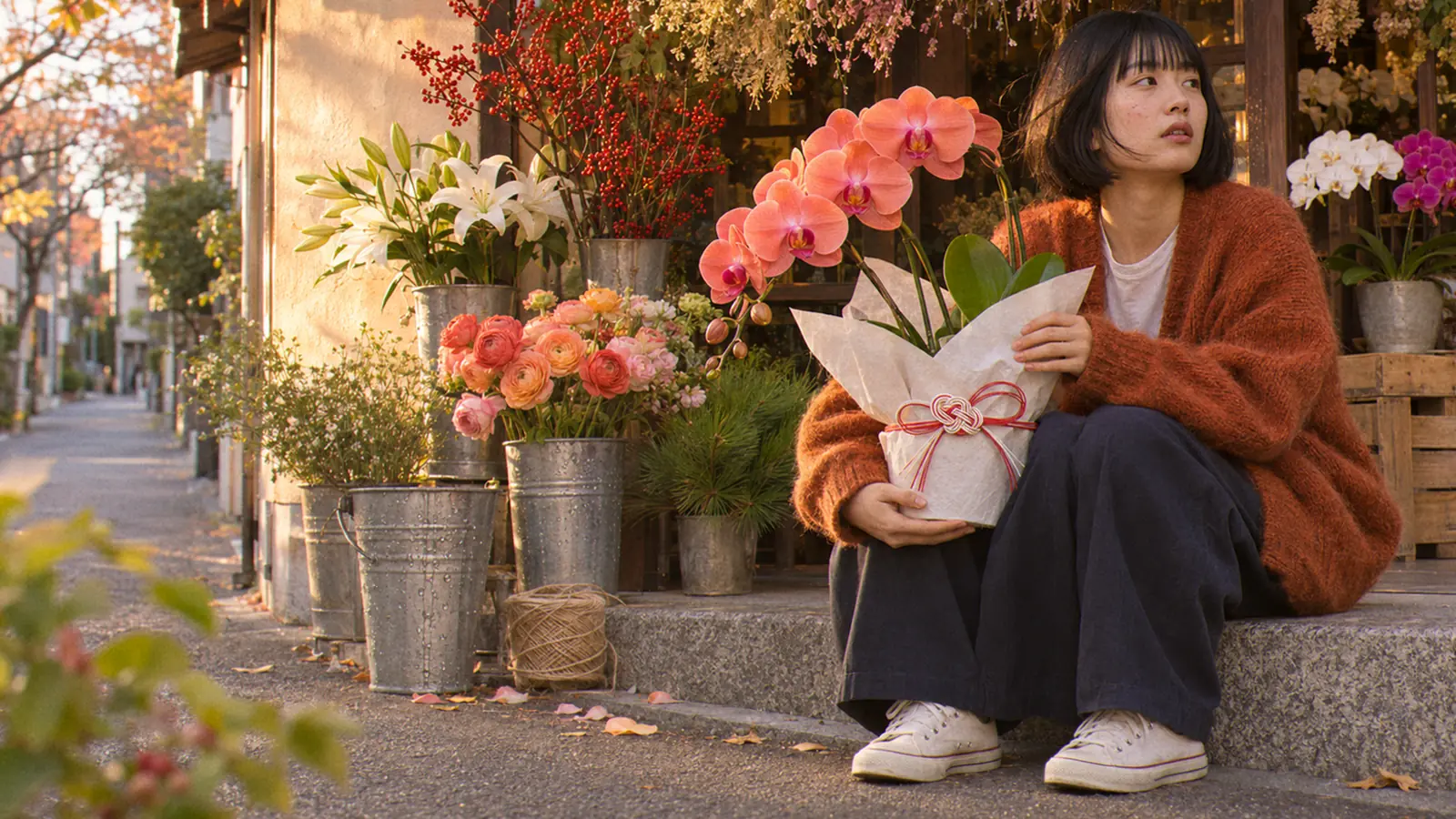
The phalaenopsis orchid, kochōran in Japanese, is where good intentions go most visibly astray. In Japanese business it is the standard gift for a store opening, a new appointment or an office move. Florists’ rule of thumb points to its faint scent, scarce pollen and long-lasting blooms. No source checked associates it with oseibo. A tall, celebration-sized orchid sent in late December can look like congratulations for an occasion that has not occurred. If your contact really has just been promoted, send the orchid for that, and keep our phalaenopsis watering and reblooming guide close at hand.
The flowers themselves never cross a border. Our florist arranges them in the recipient’s city on the day of delivery, and you see a photo of the arrangement before the recipient does. In December that photo shows you exactly how large your greeting turned out. If something is wrong with it, our delivery guarantee gives you 24 hours to write to us with a photo.
If the recipient’s city is in our network, choose a small seasonal arrangement and add your own message on the card. Suggested wording, in Japanese and in English, comes two chapters further on. See how ordering works.
Roots, numbers and white flowers
The belief that potted plants are unlucky in Japan takes a rule for one occasion and stretches it over all of them. For hospital visits the taboo is real. Netsuku, “to take root,” sounds like netsuku, “to become bedridden,” and nobody wants to wish a patient a long stay. For a business, the same rooted plant can be a good omen, which is why potted orchids are standard opening gifts.
The hospital list is worth knowing anyway, because parts of it apply beyond hospitals. Camellia and sasanqua are left off because the whole flower head drops at once. Cyclamen is on the list too: its name, shikuramen, evokes shi and ku, which recall “death” and “suffering.” White flowers can suggest loneliness, and deep red ones suggest blood. Yet cyclamen is sold in some winter gift ranges, and one florist’s rule of thumb is that it is rarely a problem as a year-end gift. Still, if the person you are thanking has been ill this year, choose something else.
Numbers follow the same logic of sound. Four (shi) and nine (ku) are avoided in stem counts and amounts; one guide also avoids thirteen stems. Chrysanthemums are the subtler case. The imperial crest is a chrysanthemum and the flower is widely admired, but its link with funerals and graves can make it an unlucky gift. White chrysanthemums are best avoided outside a funeral setting. There is a wider tour of these signals in our guide to flower etiquette around the world. A bunch of nine white chrysanthemums manages to trip three of these signals at once.
What comes back instead of a parcel
Many foreigners hesitate because they fear setting off a chain of return gifts. For oseibo, none is expected. The recipient answers with a thank-you letter, oreijō, ideally within about three days of the gift arriving, and that settles the matter. Some guides note that between friends or peers a gift of similar value may come back. A client or teacher you are thanking would normally only write.
That shapes your own card. It should give thanks, offer the gift, look forward to next year, and stop there. One sentence is better left out: telling the recipient there is no need to send anything back can come across as presumptuous, as though you had expected them to. The Japanese set phrases handle this more gracefully. The first card below uses them, with a gloss underneath, and the others are English versions for a recipient who reads English comfortably. Our guide to what to write on a flower card has more on tone.
Honnen mo taihen o-sewa ni narimashita. Kokoro bakari no shina desu ga, o-osame kudasai. Rainen mo dōzo yoroshiku onegai itashimasu.
Thank you for your help and your patience this year. A small winter greeting from our team, with best wishes for the New Year.
Thank you for everything you taught me. I wish you a calm and happy New Year.
With thanks for the past year, and warm wishes for a healthy winter.
People who have to say no
The last myth can cause real trouble for the very person you meant to please. Japan’s national public servants may not accept money or goods from rigai kankeisha, “interested parties,” meaning anyone whose business they handle in an official capacity, whatever the occasion. The regulation names farewell gifts, congratulatory gifts, condolence money and kyōka, offered flowers. Gifts from people outside that circle have to stay within what society considers reasonable, and a genuine private friendship, such as one from university, is judged case by case. Officials at deputy-director level and above in a ministry must report any gift from a business worth more than ¥5,000. Local government staff follow their own municipal rules.
Private companies can be just as firm. Some have a zōtō kinshi, a no-gifts policy, and a box that arrives anyway can leave the recipient choosing between sending it back and explaining it. A quiet question to someone in their office spares you both.
Mourning works the other way round: people expect a ban, and there isn’t one. Oseibo thanks rather than celebrates, so it can go to someone who lost a family member this year, and a sender who is in mourning may send it too. Wait until the 49-day period after the death has passed. Wrap the gift in plain white paper without the red-and-white cord, and skip the New Year gift in January, sending a midwinter greeting, kanchū omimai, in its place.