How to water a phalaenopsis orchid, and what to do when the flowers fall
Water a phalaenopsis when the bark in its pot is almost dry and the roots have turned silvery gray. Soak it thoroughly, then let every drop drain away. In a heated home that often works out to about once a week, but let the roots set the schedule rather than the calendar. When the flowers fall, the plant isn’t dying. It is resting, and a healthy one can flower again.
The reason for all that caution is the plant’s origin. In the wild a phalaenopsis doesn’t grow in soil at all. It clings to the bark of tropical trees with its roots hanging in open air, drenched by rain and dried again by the wind. Bark that never gets the chance to dry out suffocates those roots, and rot finishes the job. Overwatering kills far more of these plants than thirst does.
In shops it goes by the name moth orchid. The Greek root, phalaina, is usually said to mean “moth-like,” although the same word can also mean “whale,” and the botanist who named the genus in 1825 never explained his choice. Most potted orchids sold are phalaenopsis, so if someone hands you an orchid this winter, it is almost certainly this one. What follows is the winter version of its care, for homes with a radiator under a cold window.

The first two weeks after the gift
A phalaenopsis that arrives in December has had a busy month. It left a warm, evenly lit greenhouse, passed through a shop and crossed a frozen street to reach you. Expect it to sulk a little. A few buds may yellow and drop in the first days. Florists see this often after a cold spell, a draft or simply a change of address, and on its own it usually says little about the health of the leaves and roots.
Take off the paper sleeve once the plant is indoors and set it somewhere bright, away from the radiator and not touching the glass. Then look at the roots before you reach for the watering can. The plant may well have been watered before it left the shop, and if the roots are green and the bark is dark and damp, the kindest thing you can do is nothing.
Don’t repot it now, however tight the pot looks. A phalaenopsis can be repotted at any time of year as long as its roots are actively growing, but a plant in flower gains nothing from the upheaval, and it is already coping with one move. Wait until the flowers are over and you can see fresh green tips on the roots.
If you share your home with a cat, you can relax a little. The ASPCA lists phalaenopsis as non-toxic to cats, dogs and horses. Non-toxic is not the same as edible, and a chewed leaf can still upset a stomach, but this is one of the safer plants to bring into a house with pets. Our guide to flowers that are safe for cats and dogs covers the rest of the holiday table, and if the orchid came alongside a poinsettia or an amaryllis, there is a separate guide on keeping those two alive past the holidays.
How to water a phalaenopsis orchid, step by step
Most moth orchids are sold in a clear plastic pot of bark, slipped inside a ceramic cover pot. Keep that arrangement for now, because the clear pot is your gauge.
- Read the rootsSilvery gray roots and pale, dry-looking bark mean it is time. Green roots and damp bark mean wait a few days. A silvery root that is still firm to the touch is healthy, only thirsty.
- Learn the weightLift the pot just after watering and again when it is dry. Within a couple of weeks your hand will tell you more than any schedule.
- Take it to the sinkLift the inner pot out of the ceramic one and water it over the sink. Poured straight into the cover pot, water gathers at the bottom where you can’t see it.
- Soak it throughRun room-temperature water slowly through the bark until it pours from the drainage holes, or stand the inner pot in a bowl of water for a few minutes. You will see the roots turn green as they fill.
- Drain completelyLet it drip until it stops before you put it back. Check the cover pot an hour later, and if any water has collected there, tip it out.
How quickly the bark dries depends on the room far more than on the plant. American extension services and the Royal Horticultural Society in Britain all give “about once a week” as a starting point, not a rule, and say to adjust it to the warmth and humidity of your home.
| Your home | How the bark dries | What to do |
|---|---|---|
| Heated flat in winter | Steadily in warm, dry air, faster near a radiator | Check the roots every few days; about once a week is a common result |
| Cool room or north-facing window | Slowly; bark can stay damp for two weeks or longer | Water a little less often, as the RHS suggests for winter, and only when the roots are silver |
| Warm, humid summer | The plant drinks more in warm weather | Check more often and shade it from strong sun |
| Air-conditioned home | Cool, very dry air | Keep it out of the vent stream; mist the leaves and aerial roots |
| Clear pot in a ceramic cover | Water collects unseen at the bottom of the cover | Water in the sink; tip out anything left in the cover pot |
| Moss instead of bark | Holds far more water than bark | Water only when the top feels dry |
If you are unsure, wait a couple of days and look again. The RHS rule is never to let the roots dry out completely and never to let the plant stand in water, and between those two edges there is plenty of room. A firm silver root is thirsty, not dying. The roots to worry about are black or brown ones that squash between your fingers.
Ice cubes for orchids: what the study actually found
You may have heard the tip of giving an orchid three ice cubes a week instead of watering it. For a tropical plant it sounds alarming, and plenty of gardeners dismiss it on sight. The trick has been tested, though. In 2017 researchers from Ohio State University and the University of Georgia published a study in the journal HortScience whose title gives the answer away: ice cube irrigation of potted phalaenopsis in bark “does not decrease display life.”
They grew plants of four cultivars in bark for four to six months. One group got three ice cubes once a week; the other got the same volume of room-temperature water.
Plants in the trial. Four cultivars, all potted in bark, the way most moth orchids are sold.
The bark cooled this far. It was back to about 21 °C (70 °F) within five hours.
Roots touching the ice. They reached roughly this temperature and showed no cold injury.
Flower life in both groups. Leaves and roots were unharmed by the ice.
In this study, ice caused no cold injury. It isn’t a miracle either. The study covered phalaenopsis in bark over a few months, so nobody knows how plants fare on ice for years, and the researchers warned that cubes resting against the leaves can damage them: put them on the bark. Three cubes are also a small, slow drink. They wet the bark where they melt and never flush it through, which in a dry, heated flat may leave much of the root ball thirsty, and plants in moss were never part of the test. Soaking and draining remains the safer default.
Light, warmth and the cold windowsill
A moth orchid wants bright light with no direct sun. An east window is the classic spot; a west window works behind a sheer curtain. The RHS suggests giving the plant as much light as you can in winter, because it encourages flowering, and shading it in summer.
For warmth, the RHS says to keep the plant above 16 °C (61 °F), with nights around 16–19 °C. Sources differ on daytime temperatures, roughly 18–27 °C, and much above 27 °C the plant becomes reluctant to flower.
A northern winter sets a particular trap. In Moscow, Berlin or London the windowsill is the brightest place in the flat and, at night, the coldest. A leaf pressed against frosty glass sits well below room temperature, and in an older HortScience study, pitting appeared on phalaenopsis leaves below 10 °C and was worst after eight hours at 2 °C. Keep the leaves a hand’s width from the pane, and if you draw the curtains at night, don’t shut the orchid outside them with the cold. A radiator directly below the sill is the opposite problem, a column of hot, dry air rising straight through the leaves.
Air-conditioned homes in Dubai or Doha have the dry air without the cold glass. Keep the plant out of the stream from the vents and follow the RHS advice for hot weather: mist the leaves and aerial roots daily, or stand the pot on a saucer of damp gravel so the moisture evaporates around the plant rather than soaking into the bark.
What to do when orchid flowers fall off
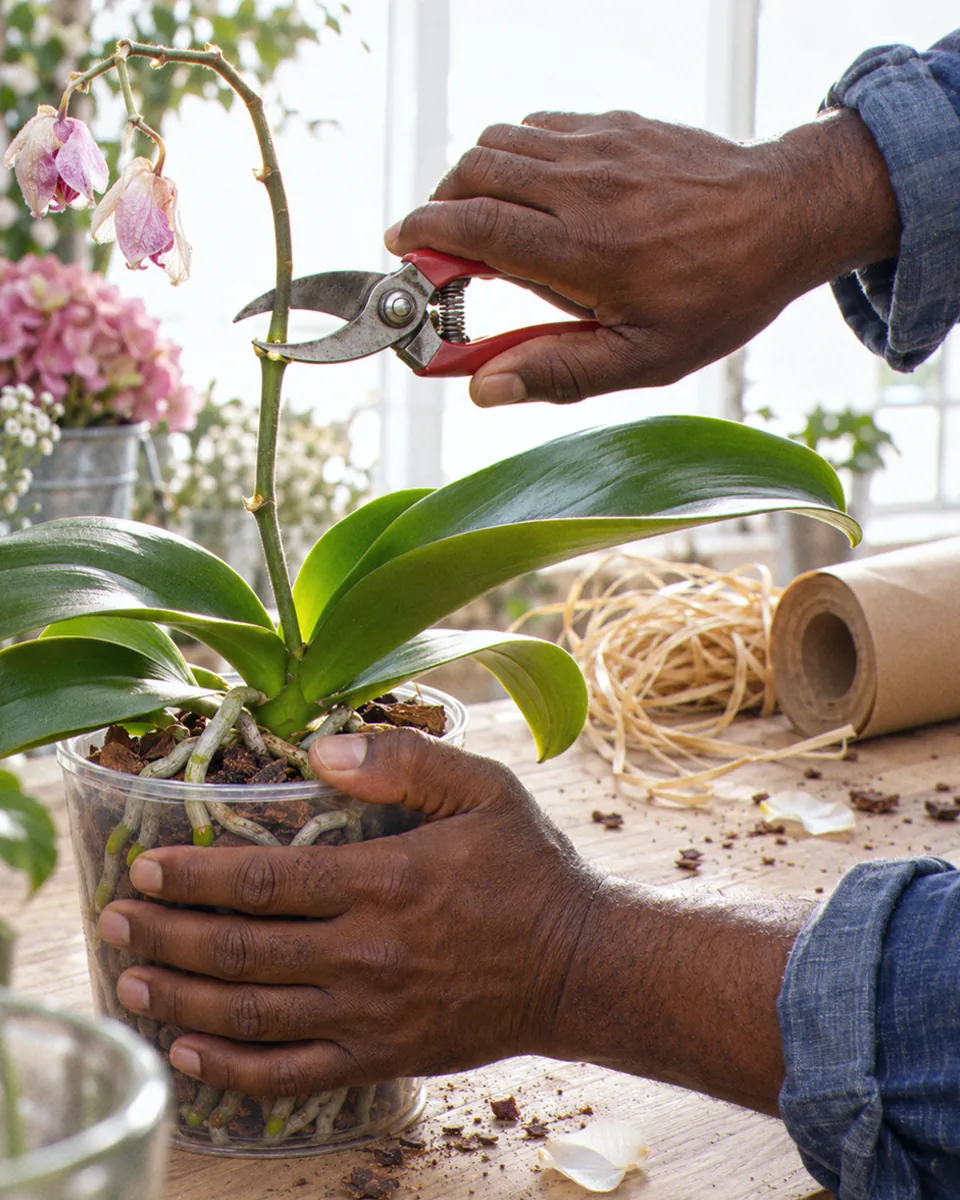
The flowers drop one at a time, often starting with the oldest at the bottom of the spike. If the leaves are firm and the roots are green or silver, nothing is wrong. The plant has finished a long effort and is resting, and for a while it will put its energy into leaves and roots instead.
What to do with the bare stem is the part that puzzles most new owners. Look along it and you will see small bumps, each wrapped in a thin, papery sheath. These are nodes, dormant buds that can grow a side branch, occasionally a keiki (Hawaiian for “baby,” a small plantlet with roots of its own), and sometimes nothing at all. A node that has already grown something won’t grow again.
A new branch from the old spike is possible. The New York Botanical Garden says it may flower 8–12 weeks after the cut, but only if the plant is still growing vigorously, and the American Orchid Society adds that this second bloom is typically smaller and weaker and that letting the plant rest is often the better choice. In practice, a large plant with thick, firm leaves can afford an encore. A small or tired one should be left to rebuild.

Cut above a node
- For a green spike on a strong plant.
- With several unused nodes, cut just above the second one, counting up from the base, and below any brown or dry section.
- Use clean, sharp pruning shears rather than kitchen scissors.

Cut at the base
- A brown or dry spike won’t flower again, so take it off as low as you can.
- Do the same when no unused nodes are left.
- Many growers cut old spikes right back by midsummer so the plant can recover.

Leave it alone
- Star-shaped “novelty” phalaenopsis with short spikes can often flower again from the same spike.
- Don’t cut those while the spike is still green.
A brand-new spike, from the old one or from among the leaves, needs a signal. Research at Michigan State found that warm days, more than warm nights, hold a phalaenopsis back: plants kept at a constant 29 °C produced no flowers in 20 weeks. Extension advice puts the trigger at roughly 3–5 weeks with days below about 25 °C, and the RHS suggests moving a healthy plant that won’t flower somewhere about 5 °C cooler for a month or so. A cool bedroom in a northern winter often does this with no effort on your part. Nothing guarantees a new spike, but a rested plant in good light that gets a cool spell has a fair chance.
These rules belong to the moth orchid. Some other orchids, including certain Dendrobium, flower again from the same spike, and Cymbidium and Vanda keep different routines altogether.
Why are my orchid leaves turning yellow?
Most worrying signs on a moth orchid have a plain explanation, and only a couple call for quick action.
- One yellow lower leaf
- A single old leaf at the bottom that yellows slowly can be normal aging; let it fall on its own. Several leaves yellowing at once, or yellowing alongside soft roots, can point to a problem, often involving water.
- Wrinkled, limp leaves
- The plant is short of water. Either it has been underwatered, or the roots are too damaged to drink. Check the roots before you water more.
- Mushy, dark roots
- Rot, almost always from too much water. Take the plant out, cut away the soft roots back to firm tissue and repot in fresh bark, then water carefully.
- Roots climbing out of the pot
- Aerial roots are normal: the plant is doing what it would on a tree. Don’t cut them. The RHS suggests misting them in warm, dry rooms.
- Pitted or glassy patches
- Typical of cold damage from a frosty pane or a chilly walk home. Move the plant away from the cold and watch the new growth.
- When to repot
- After flowering, once the roots show fresh green tips. Use orchid bark rather than potting soil, and a clear pot so you can keep reading the roots.
An orchid as a gift: meaning, and who it suits
The word “orchid” comes from the Greek orchis, “testicle,” after the paired underground tubers of European ground orchids. That is the source of the old association with fertility and virility, though it describes a meadow plant and has nothing to do with a tropical moth orchid on a windowsill. The other meaning is newer. In Victorian Britain wealthy collectors competed so fiercely for rare hothouse orchids that the craze was nicknamed “orchidelirium,” and by tradition the flower has carried an air of luxury and refinement ever since.
Florists tend to recommend an orchid for people a bouquet doesn’t quite fit. It suits a colleague, because it is neutral and lives happily on a desk, and a mother-in-law, because it looks considered without being intimate. It suits a man for whom an armful of roses would feel like a lot (there is a whole piece on giving flowers to men), and someone with allergies, since a phalaenopsis has very little scent. A bouquet is the better choice when the moment itself is the point: one evening, a table that needs filling, or a friend who travels constantly and would come home to a dry pot.
Winter offers plenty of occasions: Christmas Eve on December 24 in Germany, Austria, Switzerland and the Nordic countries, Christmas on December 25, New Year’s Day, and Orthodox Christmas on January 7. Russian Mother’s Day falls on the last Sunday of November (November 29 in 2026), and March 8 is not far off. A card turns the plant into a message, and a line of care instructions written warmly does two jobs at once. For more ideas, see our guide to what to write on a flower card.
For a desk that deserves better than a stapler. Water it when the roots go silver and leave it in peace otherwise.
Thank you for always making me feel at home. This one likes a bright window and a quiet corner, so I thought of you.
No roses, as promised. It lives in a pot, drinks when its roots turn silver and asks no questions.
Flowers without the sneezing. Happy New Year, and may it bloom again when the tree is long gone.
Sending an orchid abroad in winter
A moth orchid comes from warmth and suffers in cold air. USDA guidance is to hold phalaenopsis above 20 °C in transit, and in simulated shipping trials chilling damage was worse at 15 °C than at 20 °C and grew the longer the plants were stored. A plant carried across a frozen courtyard needs full wrapping, as little time in the cold as possible, and never a wait on a doorstep or in a parked car.
When you send flowers through jfloo, nothing crosses a border. A partner florist in the recipient’s city makes up the order on the day of delivery, so the only cold stretch is the one between the shop and the door. Before delivery we send you a photo, so you see the order before the recipient does. With an orchid, that means you know exactly which plant, pot and color will arrive. For addresses, timing and the rest of the practical side, our guide on how to send flowers internationally walks through it.

On choosing: a clear inner pot inside a ceramic cover is the most practical gift, because the recipient can read the roots from the first day. White is the classic and sits easily in any room; pink is warmer and more festive. If the card includes a single line of care, such as “water when the roots turn silver,” you have handed over most of this article in six words.