Thanksgiving cactus vs Christmas cactus: how to tell them apart and gift one
Look at the edge of a stem segment. If it ends in sharp, claw-like teeth and the flowers carry yellow pollen, you have a Thanksgiving cactus; if the edges are rounded and scalloped and the anthers are pink to purplish-brown, it’s a true Christmas cactus. Most plants sold under the Christmas name are Thanksgiving cacti or hybrids that look like them, which is why yours may be in full flower before the turkey. Buds can fall after sudden changes in temperature, light or position, so move a gift plant as little as possible and keep it away from cold and drafts on the way.
The names themselves are a small American joke that has traveled badly. The Thanksgiving in question is the US one, on the fourth Thursday of November (November 26 in 2026). Canada celebrates on the second Monday of October, October 12 in 2026, so in Toronto the plant turns up some six weeks late for its own holiday. In London, Berlin and Warsaw there is no Thanksgiving to speak of, and in Russia the plant is simply called dekabrist, “the December one,” though it, too, often opens in November.
What follows has two halves. The first is a test you can do with the pot in your hands. The second is the part plant-care guides tend to skip: how to pick one out as a gift, get it across a frozen city and see it through its first week in someone else’s home.
How to tell a Christmas cactus from a Thanksgiving cactus
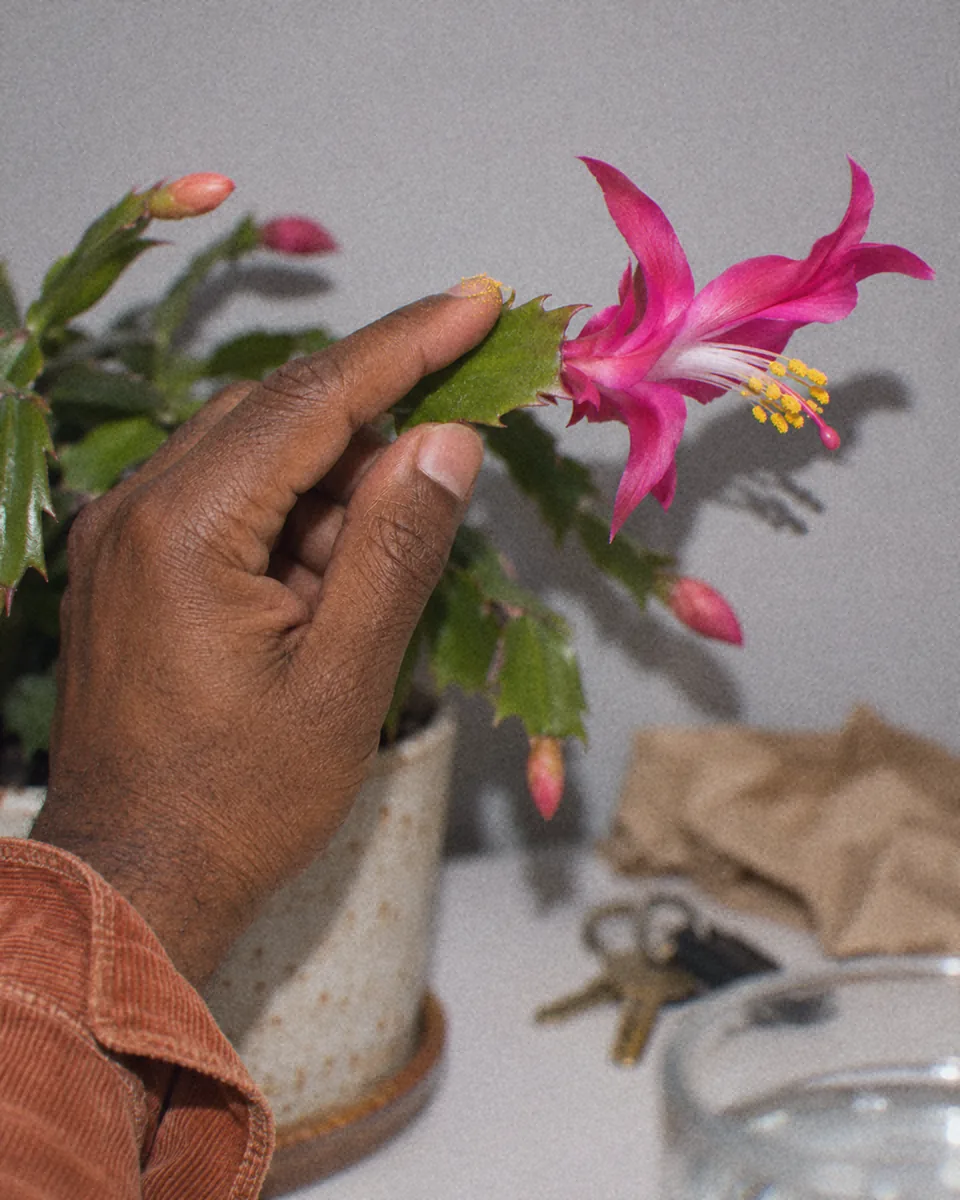
A holiday cactus has no leaves in the usual sense. Its stems are built from flat green segments, joined end to end like links in a chain, and the shape of each link is the most reliable clue you have. The flowers help too, but only once they open.
Color tells you nothing. Thanksgiving cacti come in red, pink, peach, purple, orange and white, and the classic Christmas cactus is a rosy red that plenty of Thanksgiving cultivars match. Two plants in identical pink can belong to different groups, so don’t let the bloom decide.
One caveat before the test. Modern cultivars are often crosses of the two, and some show a little of each: faint points that have softened into curves, or pollen somewhere between yellow and pink. For most plants on a supermarket shelf the test settles it. If yours sits in between, call it a hybrid and give it the same care.
- Hold up one segmentPick a mature segment near the middle of the plant, not a pale new one at the tip, and look along its edges.
- Count the pointsTwo to four sharp, claw-like points along the edges of each segment mean Thanksgiving cactus. Smooth, rounded scallops mean Christmas cactus.
- Check the pollenLook into an open flower at the anthers, the tiny heads at the ends of the stamens. Yellow points to Thanksgiving; pink to purplish-brown points to Christmas.
- Watch which way the flowers faceThanksgiving flowers are lopsided and held level or tilted upward. Christmas flowers are more symmetrical and hang down, like small lanterns.
Thanksgiving, Christmas and Easter cactus side by side
There is a third cousin, sold in spring, and it’s worth knowing so you don’t confuse it with the other two when it turns up at a garden center in March.
| Plant | Segment edges | Flowers | Telltale detail | Blooms |
|---|---|---|---|---|
| Thanksgiving cactus (Schlumbergera truncata) | 2–4 sharp, claw-like teeth | Asymmetrical, held level or upward | Yellow anthers | From mid- to late November |
| Christmas cactus (S. × buckleyi) | Rounded, scalloped | More symmetrical, hanging; classically rosy red, about 3 in (7.5 cm) across | Pink to purplish-brown anthers | Around December 25 |
| Easter cactus (gaertneri) | Smoother, with 4–6 slight ripples | Star-shaped and symmetrical | Small bristles at the segment edges | Spring, around Easter (March 28, 2027) |
The true Christmas cactus is a Victorian creation, a cross raised by W. Buckley in England and first recorded in 1852, which is why it carries his name. The Easter cactus has had a less settled life. Botanists have moved it between genera several times, and two DNA studies in 2011 came to different conclusions, so you’ll find it labeled Schlumbergera gaertneri, Hatiora gaertneri or Rhipsalidopsis gaertneri depending on the grower. All three names mean the same plant.
Why a “Christmas” cactus blooms in November
Despite the name, this is no desert plant. Holiday cacti come from the coastal mountains of southeastern Brazil, where they grow on tree branches and in rock crevices in cool, shaded, humid forest. In their habits they have more in common with an orchid than with a prickly pear: they like bright, filtered light and no baking sun.
They also don’t own a calendar. What tells them to flower is the length of the night and the coolness of the air, and Clemson University’s extension service puts figures on it:
Of unbroken darkness. Each night, starting around mid-September, for buds to form.
At least. The long nights need to run in a row; a lamp switched on every evening breaks the darkness.
16–20 °C in autumn. The comfortable range while the plant is making buds.
10–15 °C at night. Nights this cool set buds regardless of day length, only more slowly.
Other extension services give slightly different numbers, but the logic holds everywhere. Thanksgiving types simply answer the lengthening nights sooner than the Christmas hybrid does, so in a cool northern apartment they open in November no matter what the tag says. Iowa State adds the flip side: in rooms kept above 70 °F (21 °C), flowering can fail even when the nights are long enough.
Choosing a holiday cactus as a gift
The instinct is to buy the plant in fullest flower, because it looks most like a present. Resist it. A cactus that is already wide open will spend its best days in your hallway and the recipient will get the second half of the show. A safer choice is a plant with one or two flowers just opening and many buds already showing color. Iowa State’s advice is not to move holiday cacti until the first flowers begin to open, and that is your shopping rule too.

Take this one
- One or two flowers just opening, with plenty of buds already showing color.
- Plump, firm segments that feel like a crisp leaf of lettuce.
- Soil that is evenly damp, not dust-dry and not standing in water.
- A plant that sits steady in its pot when you tilt it gently.

Leave this one
- Limp, wrinkled or yellowing segments, often a sign of root trouble from overwatering.
- Fallen buds on the soil or the shelf: it has already started shedding.
- A soggy pot sitting in a sleeve full of water.
- A display right by the automatic doors, where every customer lets in a gust of winter.
On color, choose for the room the plant is going to rather than for the label. Red reads as Christmas, white and pale pink suit almost any home, and the peach and coral Thanksgiving cultivars look less seasonal, which helps if the recipient will keep it on a sill all year.
A holiday cactus is the rare present that does best when nobody fusses over it.
Getting it there through a frozen street
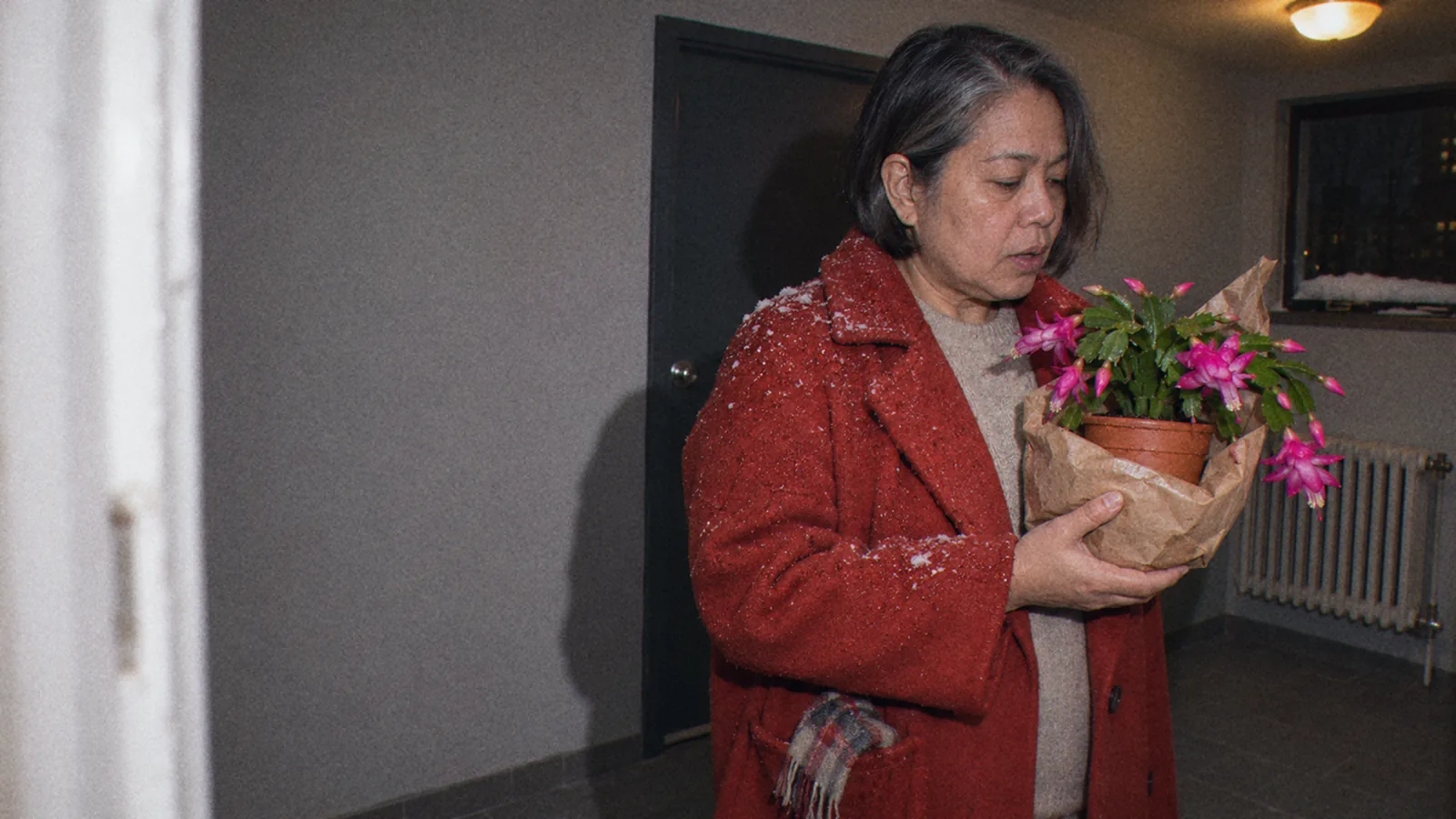
A tropical forest plant meeting a Chicago wind chill is the scenario that ends in a pile of buds on the carpet. Sudden temperature changes and cold drafts are among the causes of bud drop that extension services name, and a winter doorstep supplies both.
The florists’ rule of thumb is simple: have it wrapped for the trip, carry it close to your body, and don’t leave it in a cold car, on a doorstep or in an unheated hallway. Once inside, let it sit in its wrapping for a while to come up to room temperature before you unwrap it.

If the person lives in another city, a budding plant in a shipping box faces exactly the swings of temperature that make it drop buds. A gift arranged locally and handed over in person skips that trip, a principle laid out in our guide to sending flowers to another country. Whoever does the delivering, ask three things: will it be fully wrapped, will it be handed to a person rather than left at the door, and can it go on a day someone is actually home.
The first week in its new home
The recipient’s job is easier than it sounds: choose one spot and commit to it. Bright, indirect light is ideal, a few feet back from a window or on a sill that doesn’t get hard afternoon sun. Keep it away from radiators, heating vents, fireplaces and cold drafts.
Then leave it there. Many growers also advise against turning the pot while it’s in bud, on the theory that buds that have angled toward the light don’t like having the light swapped around. Nobody has proved that turning the pot causes bud drop, but sudden changes in light do, so it costs nothing to leave it facing the same way.
Watering during flowering is the one thing that does need attention. The soil should stay evenly moist: touch the surface, and when it feels dry, water until it drains, then empty the saucer. Standing water can lead to root rot, and soil that dries right out can cause bud drop. There is no right number of days between waterings, because a pot near a warm wall drinks faster than one in a cool bedroom.
Since nobody reads care leaflets, the gift card is a good place for the instructions. A few lines that would work, and plenty more in our guide to what to write on a flower card:
It flowers when the nights are longest. Seemed right for this winter. Bright spot, no radiators, and please don’t move it around.
Care instructions: pick a place and leave it be. Water when the top of the soil feels dry. Sounds like you on a Sunday.
For the new apartment. Rest it somewhere cool after Christmas, and it may bloom again next season.
We checked: this one is non-toxic to cats, though it is best kept out of reach. Merry Christmas from both of us.
Why is my Christmas cactus dropping buds?
Extension services name the same usual suspects: sudden changes in temperature or light, moving the plant too early, soil that is too wet or too dry, and warm, dry rooms. Here is each one, and how much you can do about it.
- Avoidable
A temperature shockCold air on the way home, a draft from the door, a radiator switching on beside it. Wrap well in transit and pick a spot with an even temperature.
- Avoidable
Moving it too earlyMoving a plant before its first flowers open can contribute to bud drop. Choose one with one or two flowers just opening and plenty of colored buds.
- Fixable
Soil drying outLetting the mix dry out too much can cause bud drop. Keep it evenly moist during budding and flowering.
- Partly
OverwateringSoggy soil and a full saucer lead to limp segments and rotting roots. Empty the saucer and let the top dry; damage to the roots takes longer to mend.
- Fixable
Warm, dry air or too little lightOverheated rooms with parched winter air hurry the buds off. A cooler, brighter spot away from heaters gives the remaining buds a better chance.
- Normal
Too many budsA plant that set more than it can carry may let a few go on its own. If most stay, nothing is wrong.
A plant that has dropped everything isn’t dead. Keep the soil lightly moist and the conditions stable; it may grow on and flower again.
Is a Christmas cactus safe for cats and dogs?
It’s one of the safer holiday plants you can bring into a home with animals. The ASPCA lists Christmas cactus as non-toxic to cats, dogs and horses.
Non-toxic doesn’t mean harmless to chew, though. The plant is fibrous, and a mouthful of it can irritate the gut mechanically. The ASPCA’s professional service reports dogs that ate it with vomiting and diarrhea (sometimes with blood), loss of appetite and lethargy, and loss of coordination has been reported in cats. So the honest summary is this: no poison, but a pet that has eaten a lot of it, or seems unwell afterward, should see a vet. Either way, keep it out of reach of pets that like to chew.
For poinsettias, amaryllis and the rest of the season’s flowers, see our guide to flowers that are safe for cats and dogs.
Christmas cactus care after flowering
When the last flowers drop, the plant wants a quiet spell. Move it somewhere a little cooler and water less often, letting the soil dry between waterings instead of keeping it evenly moist. It is resting, and soggy soil can damage the roots. Through spring and summer treat it as an ordinary bright-room houseplant; if you’re building a windowsill collection, our piece on indoor plants that survive real life has good company for it.
Getting it to bloom again is a matter of giving it back its Brazilian autumn. From mid-September, put it in a room nobody lights at night, a spare bedroom or a cool hallway, and keep it on the cool side. Once buds appear, bring it to where it will flower and stop moving it. In a drafty northern apartment this often happens with no effort at all, which may explain why the cactus on a grandmother’s chilly windowsill so often blooms on cue year after year.
If the cactus shares the holidays with a poinsettia or an amaryllis, both have their own after-season routine, set out in how to keep a poinsettia and an amaryllis alive past the holidays. And for the flowers that other countries reach for in late December, there is our tour of Christmas flowers around the world.