Dubai Miracle Garden season: why the UAE’s flowers bloom in winter
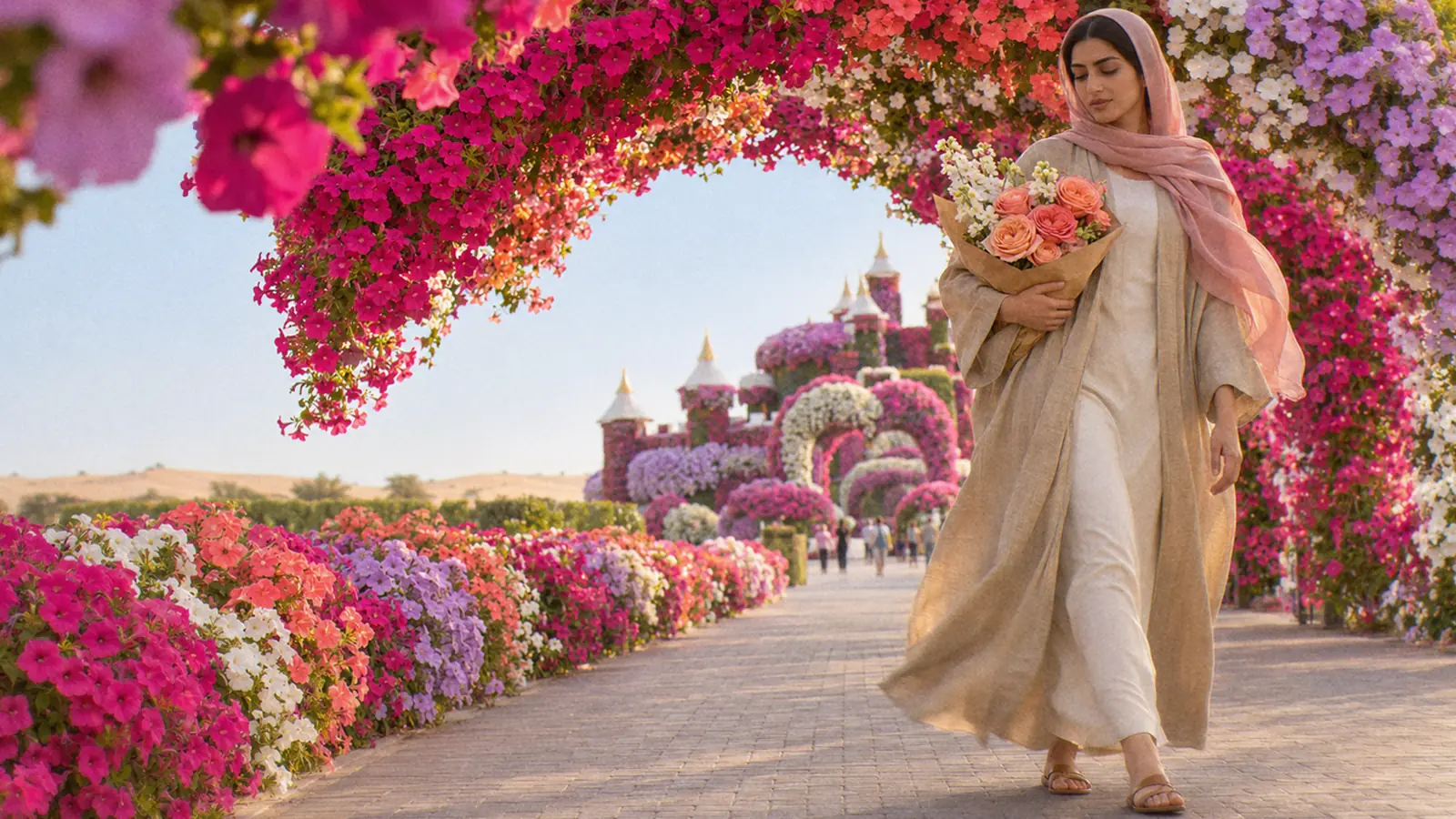
At night, after the last visitors leave the Dubai Miracle Garden, thin drip lines carry water to the roots of its flower beds. Dubai blooms in winter because its summer is too hot for flower beds: with daytime highs around 42 °C and nights that stay near 31 °C, bedding flowers cannot survive, so the garden is planted in autumn and blooms through the cool months. The Miracle Garden’s 15th season runs from October 8, 2026 to May 31, 2027, and then the gates stay shut through the hottest months.
If you come from Europe or North America, the calendar here runs backwards. At home, gardens go quiet in December and the flower shows open in spring. In Dubai the beds fill up in autumn, peak through the months when a northern garden is bare, and are handed back to the sun by early summer.
The turn of November and December brings Commemoration Day, National Day and the Shopping Festival within five days of each other. For anyone sending a bouquet, those five days mean many offices closed for the holiday and a city full of guests, so it pays to know where the recipient will actually be.
A calendar turned upside down
At Dubai’s airport the average daytime high in December is 26.5 °C, and in January 24.4 °C, with nights around 15–17 °C. That is roughly a European early summer, the weather people plan garden parties around. In August the average high is 41.9 °C, and the average nighttime low is 31.5 °C.
Winter here, roughly late October to mid-April, is also the closest thing the city has to a wet season. Dubai gets only about 79 mm of rain a year, but most of it falls between December and March. Summer, from late April to early October, brings the heat and heavy humidity on top of it. The garden closes over those months because, at average temperatures around 40 °C, strolling among flower beds stops being a pleasure and turns into an endurance test.
For comparatively mild weather, visit from December to February, when the average highs are in the mid-twenties. The garden stays open through spring, but by May the average high is already 38 °C, so a late visit is better made in the evening. This season is also longer than earlier ones, which usually ended in April. If an older guide tells you the garden is closed in May, it was written for a different year.
Inside the garden, where the water comes at night
The garden sits in Al Barsha South 3, inland from the coast, and opened on February 14, 2013, Valentine’s Day. Getting there is easy without a car: the Red Line metro to Mall of the Emirates, then the seasonal RTA bus 105 or a 10–15 minute taxi ride. From Abu Dhabi, Etihad Rail runs to Al Yalayis in about an hour, and a taxi covers the last twenty minutes or so.
Inside, the scale is the point. The garden counts 72,000 m² of outdoor garden, more than fifty large floral displays and, by its own figure, over 200 million flowers each season. Many of those flowers grow on frames rather than flat in beds, trained into walls, arches and whole sculptures. Past displays have reportedly set Guinness records: the largest vertical garden in 2013, an Emirates A380 built as a flower structure, and an 18-meter Mickey Mouse topiary in 2018.
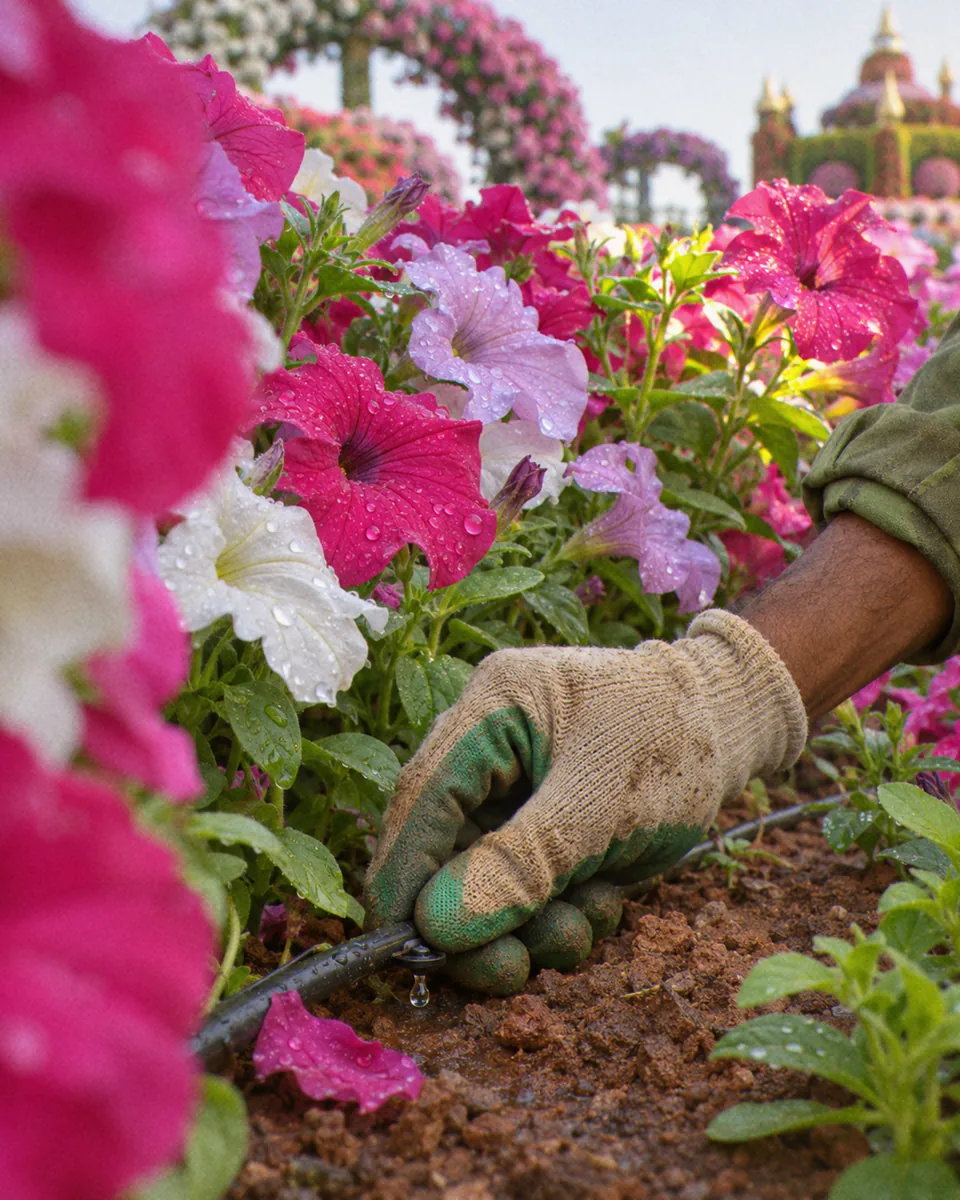
The garden is drip-irrigated with treated wastewater, about 757,000 liters (200,000 US gallons) a day, and it waters at night, after closing, when the sun isn’t there to steal it. Garden officials say Dubai Municipality supplies treated grey water, which the garden filters again before it reaches the beds. That is ordinary practice in the city: Dubai irrigates its public green spaces widely with reclaimed water.
Walk through in the late afternoon and you can see the system if you look down: thin lines tucked under the foliage, running along each row to the base of the plants.
The practical details are below. Prices and hours are from the garden’s official site as of November 23, 2026, and hours may change on holidays and event days.
| Item | Price or time | Good to know |
|---|---|---|
| Season 15 | October 8, 2026 to May 31, 2027 | Open every day; closed over summer |
| Opening hours | 9:00–21:00, last entry 20:30 | Some reports give later weekend hours; the official site says 9 to 9 daily |
| Adult ticket | AED 105 | VAT included |
| Child, 3–12 | AED 84 | VAT included |
| Under 3, People of Determination | Free | |
| Butterfly Garden | +AED 42 with a Miracle Garden ticket | AED 52.50 on its own |
| UAE residents with Emirates ID | Dh70 adult, Dh50 child, excluding VAT | Reported by Khaleej Times; not shown on the official page. Residents get in free on their birthday this season |
Flags on the lampposts
Leave the garden and drive back toward the city in late November, and the decorations change color. The week begins quietly. November 30, a Monday this year, is Commemoration Day, Yawm Al Shaheed (“Martyrs’ Day”), established in 2015 and marked with a minute’s silence at 11:00 and flags at half-mast. It is a solemn day, not one for festive flowers.
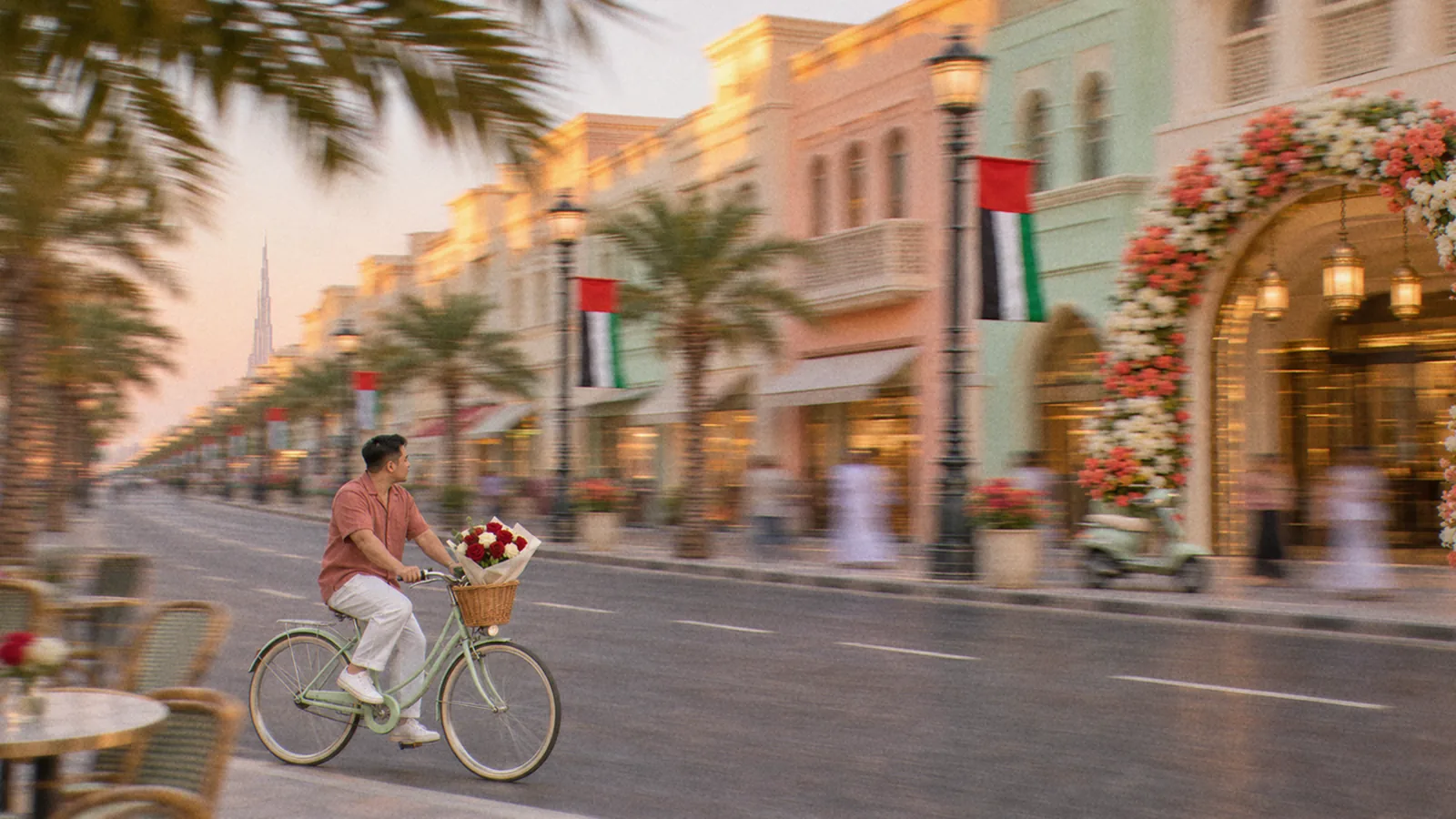
Two days later the mood turns. December 2, a Wednesday in 2026, is National Day, Eid Al Etihad, “Union Day”, marking the union of December 2, 1971, when six emirates came together; Ras Al Khaimah joined on February 10, 1972. This year is the 55th, and the celebrations share the UAE’s “Year of Family” theme. Red, green, white and black, the colors of the flag, take over lampposts, balconies, car windows and shop fronts. If you want a bouquet to nod to the day, the flag hands you the palette: red and white flowers with plenty of green.
Timing matters if you are sending something. The public sector is off from Wednesday, December 2 to Friday, December 4 and returns on Monday, December 7; the private sector gets a shorter break, reported as two days. An office address that works in an ordinary week may be locked that Thursday, so for National Day flowers a home address is the safer choice.
On Friday, December 4, the Dubai Shopping Festival opens its 32nd edition and runs for 45 days, until January 17, 2027. The malls dress up for it, and the city fills with concerts, light shows, promotions and prize draws. The dates move every year (last season it ran from December 5 to January 11), so check before you plan around them. For flowers, the festival mostly means visitors: friends in hotels, relatives over for the holidays, a birthday that falls in the middle of all this. If you are ordering from another country, our guide to sending flowers abroad covers the basics.
Grown here, flown in
So are the roses in a Dubai bouquet local? Mostly not. The winter season that fills the Miracle Garden belongs to bedding plants grown in the ground. Cut flowers are a different trade, and most of the ones sold in the UAE are imported all year round. Nobody publishes a reliable split between local and imported stems.
The map of where they come from is fairly clear. UAE trade press names Kenya as the main source of roses, the Netherlands for lilies and premium varieties, and Colombia for hydrangeas. Even the floral foam, wraps and ribbon come from far away, mainly from China. Ecuadorian roses arrive on Emirates SkyCargo freighters from Quito, a route that began in December 2013. Dubai also works as a hub for that cargo, with flowers moving on to Europe, the Middle East and Asia.
One label is worth reading carefully. The Netherlands works largely as an auction and re-export center, so a “Dutch rose” often describes the route a flower took rather than the place it grew. If you are choosing between them, our comparison of Ecuadorian, Dutch and local roses explains what actually differs in the vase.
Relying on the air has a cost. In March 2026, shipments were held at airports, freight rates jumped, and some stock was trucked in through Oman and Saudi Arabia; the price of floral foam rose from AED 34 to AED 75 a box. For a city whose bouquets mostly arrive by plane, trouble at the cargo terminals soon shows up in the florist’s cooler.
Our own part in this is simpler. When you order through jfloo, nothing crosses a border on your behalf: our florist in Dubai makes the bouquet on the day of delivery from what is in the city, and we send you a photo before it reaches the recipient. You can browse what our florists make in our Dubai catalog, add a card with your own words, and pay by bank card or PayPal.
The day the gates close
The garden’s season runs well past December, and the calendar keeps bringing reasons to send flowers. Ramadan is expected to begin around February 8, 2027, with Eid al-Fitr expected on March 9 or 10, depending on the moon sighting. Mother’s Day in the Arab world is fixed on March 21, a Sunday in 2027, and many residents also mark the second Sunday of May, which falls on May 9. Eid al-Adha is expected on May 16 or 17, still inside the garden’s season.
Then, on May 31, the garden closes. For a sender, that date is a useful signal: by the time the gates shut, the heat has already arrived. From May the average daytime high is 38 °C, and from June to September it stays at 40–42 °C, with nights of 28–31 °C. The hottest stretch runs from about May 19 to September 24.
In that heat a bouquet needs more looking after than it does in January; our notes on keeping a bouquet alive in the heat and the general care guide for cut flowers go through what helps.
If a bouquet arrives in Dubai and something is wrong with it, write to us within 24 hours with a photo and we’ll sort it out. See how our guarantees work.
If you are sending flowers to someone in Dubai between June and September, tell them the bouquet is coming, so it doesn’t sit by a sunny door while they are out.