How to keep a poinsettia alive, and an amaryllis, past the holidays
To keep a poinsettia alive, give it bright light without direct sun, a room at about 18–21 °C away from drafts and radiators, and water only when the top of the soil feels dry. An amaryllis asks for nearly the same, with one difference: it keeps its flowers longer in a slightly cooler spot. Too much water and cold drafts can quickly spoil a holiday plant, and both mistakes are easy to avoid once you know where to look.
That is the whole of it, and many people who receive one of these plants never need more. Trouble starts with the particulars. The poinsettia that looked splendid on the doorstep begins shedding leaves on the second day. The amaryllis arrives as a fat bulb with a green spear, and nobody in the house can say if it wants water today or should be left alone. Neither plant is especially fussy. Both react quickly, and visibly, to a bad spot.
What follows takes the plant from the moment it crosses your threshold to the following winter, when an amaryllis can flower again and a poinsettia, in patient hands, can just about be coaxed back to red. The last chapter is for anyone sending one to a parent or a colleague in another country. The stories behind these plants, and how they became part of Christmas in so many homes, are in our piece on Christmas flowers around the world.
The short answer for both plants
Here are the essentials side by side. Where advice differs slightly from one source to another, the table gives the cautious end of the range.
| What it needs | Poinsettia | Amaryllis |
|---|---|---|
| Temperature | 18–21 °C by day; a little cooler at night (around 16 °C) is fine | Normal room warmth while growing; below about 18 °C once in flower, so the blooms last longer |
| Light | Near a bright window, out of direct sun, never touching the glass | Bright light, some direct sun while growing; out of direct sun once the buds show color |
| Watering | When the top 2.5 cm of soil feels dry, then drain fully | When the surface is dry; moist, never soggy. A waxed bulb gets no water at all |
| How long it looks good | Several weeks, well past New Year | About two weeks per flower, sometimes longer |
| Next winter | Reblooming is possible but a real project | A potted bulb can flower again, for decades with care |
| Pets | Mildly irritating | Toxic, the bulb especially |
If you remember only one line for each plant, remember these. The poinsettia wants warmth, brightness and a steady temperature, and its roots must never stand in water. The amaryllis wants light while it grows, a cooler room once it blooms, and its pot turned a little every time you water it.
The first hour after delivery
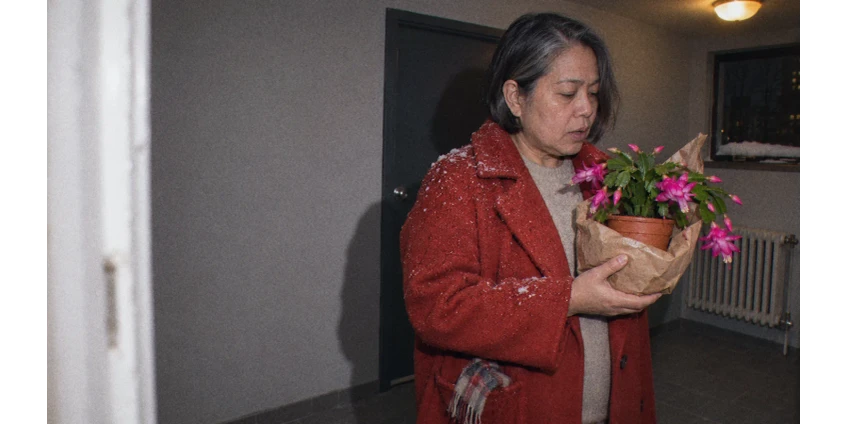
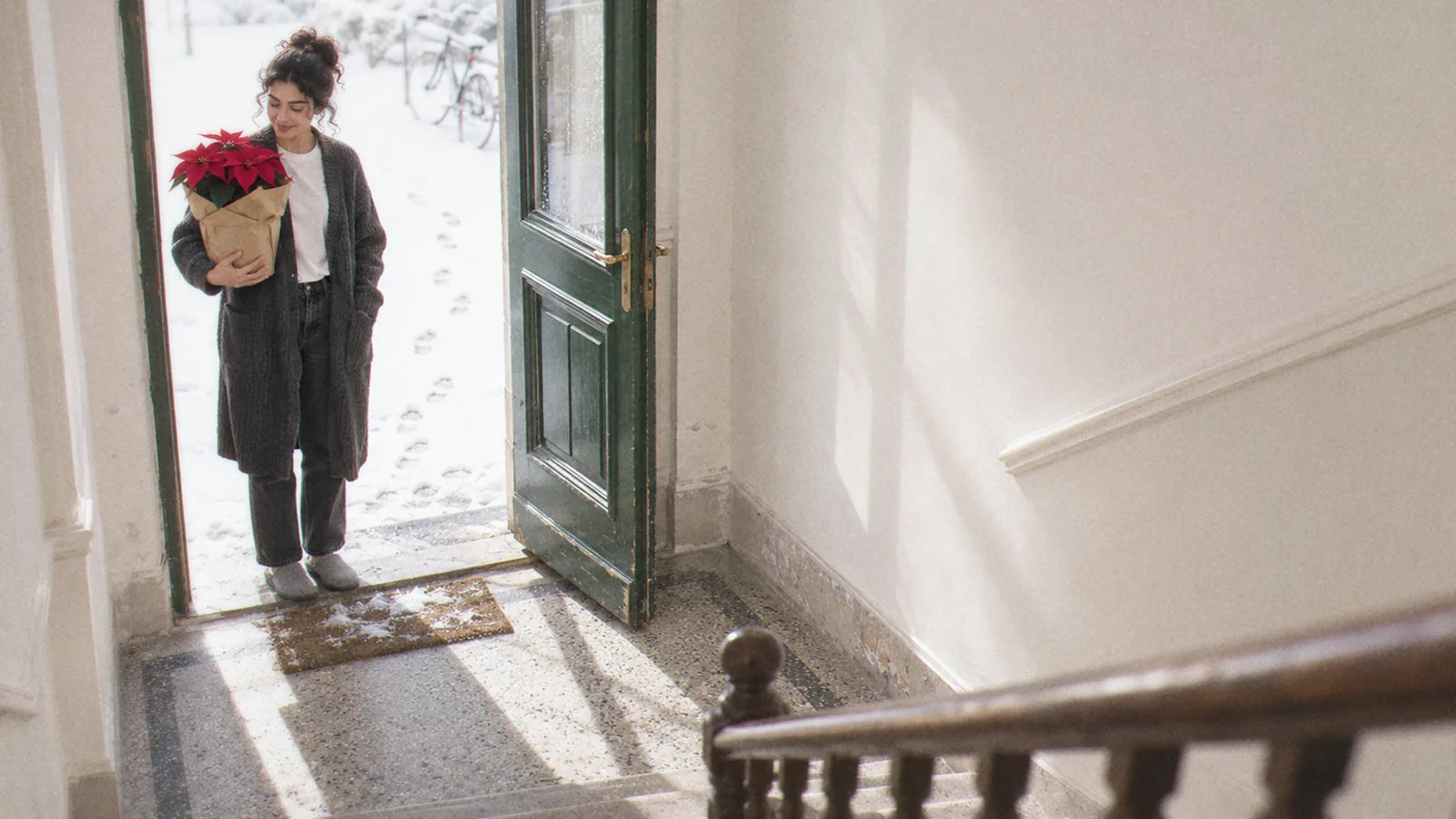
The most dangerous minutes in a poinsettia’s December are the ones it spends outdoors. Frost, even briefly, can blacken its colored bracts and leaves and make them fall, and chilling damage can begin around 10 °C, worsening with longer exposure. So the first hour is mostly about getting it inside and finding out what it brought with it.
- Bring it straight inDon’t leave it on the step, in the porch or in a parked car while you finish another errand. An unheated car can injure or kill a holiday plant quickly.
- Slide off the sleeveThe paper or plastic sleeve was its coat for the trip. Ease it up and over the top of the plant instead of pulling the pot down through it, so the bracts aren’t dragged along the paper.
- Look inside the foilHoliday pots often come dressed in decorative foil or a cachepot. Tip the pot and check for water lying at the bottom. If there is any, pour it away, then remove the foil or poke a few holes through its base.
- Feel the soilPush a fingertip in. If the top couple of centimeters are dry, water the plant in the sink until water runs from the drainage holes, let it finish dripping and put the cover back. If it is damp, leave it be.
- Choose a spot and keep it thereEvery move from a cool room to a warm one is another temperature swing, and temperature swings can make poinsettias drop leaves. Decide once, using the next chapter.
Where to put a poinsettia in winter
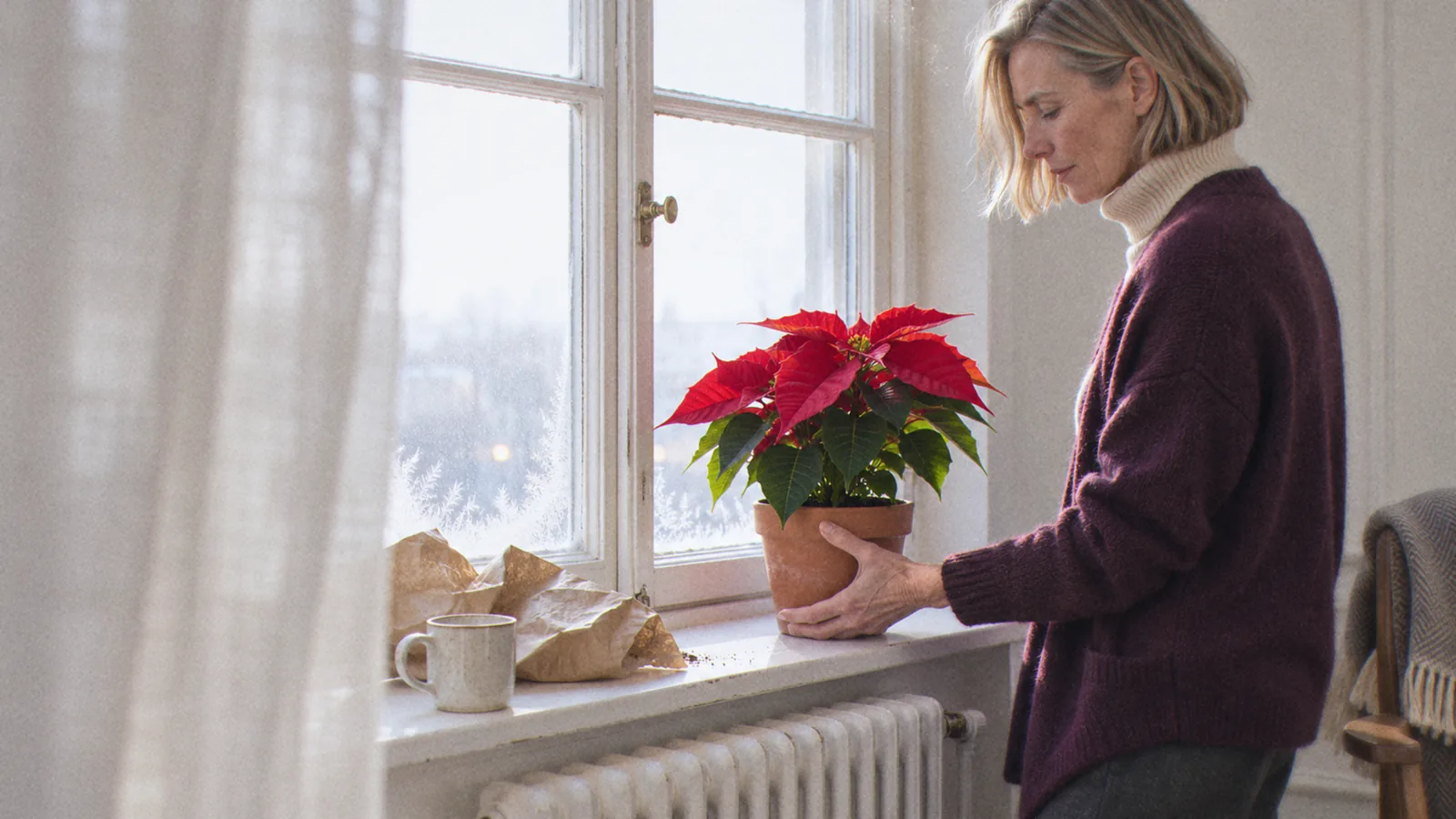
The right place is bright and steady. Near a window, so the plant gets plenty of daylight, but out of direct sun that could scorch the leaves, and never touching the glass. Keep it away from radiators, heating vents and fireplaces, which push warm, dry air across it, and away from outside doors, which let in a gust of cold every time someone comes home.
A winter window can be bright on the room side while the area against the pane gets cold after dark. In a Stockholm flat in December, where daylight is short and every hour of it counts, the windowsill is the obvious place, and it is also where the radiator sits, sending heat straight up into the leaves. The answer is usually a small table a little back from the glass: close enough for the light, far enough from the cold pane and the rising heat.
Two homes that seem like opposites can be equally hard on a holiday plant. A Moscow apartment with the central heating running at full strength is warm and very dry, and the air coming off the radiators parches the leaves. A London terraced house with a drafty hallway is mild by comparison, but the temperature lurches each time the front door opens. One is too warm and dry, the other unsteady, and a poinsettia answers both the same way, by letting its leaves go.
At night a slightly cooler room suits a poinsettia, as long as the change is gradual rather than a blast of cold. An amaryllis in bloom actively prefers the cool: below about 18 °C its flowers last longer, so once the buds show color, move it out of direct sun to the coolest bright room you have. A spare bedroom with the heating turned down will do nicely.
How to water an amaryllis and a poinsettia without drowning them
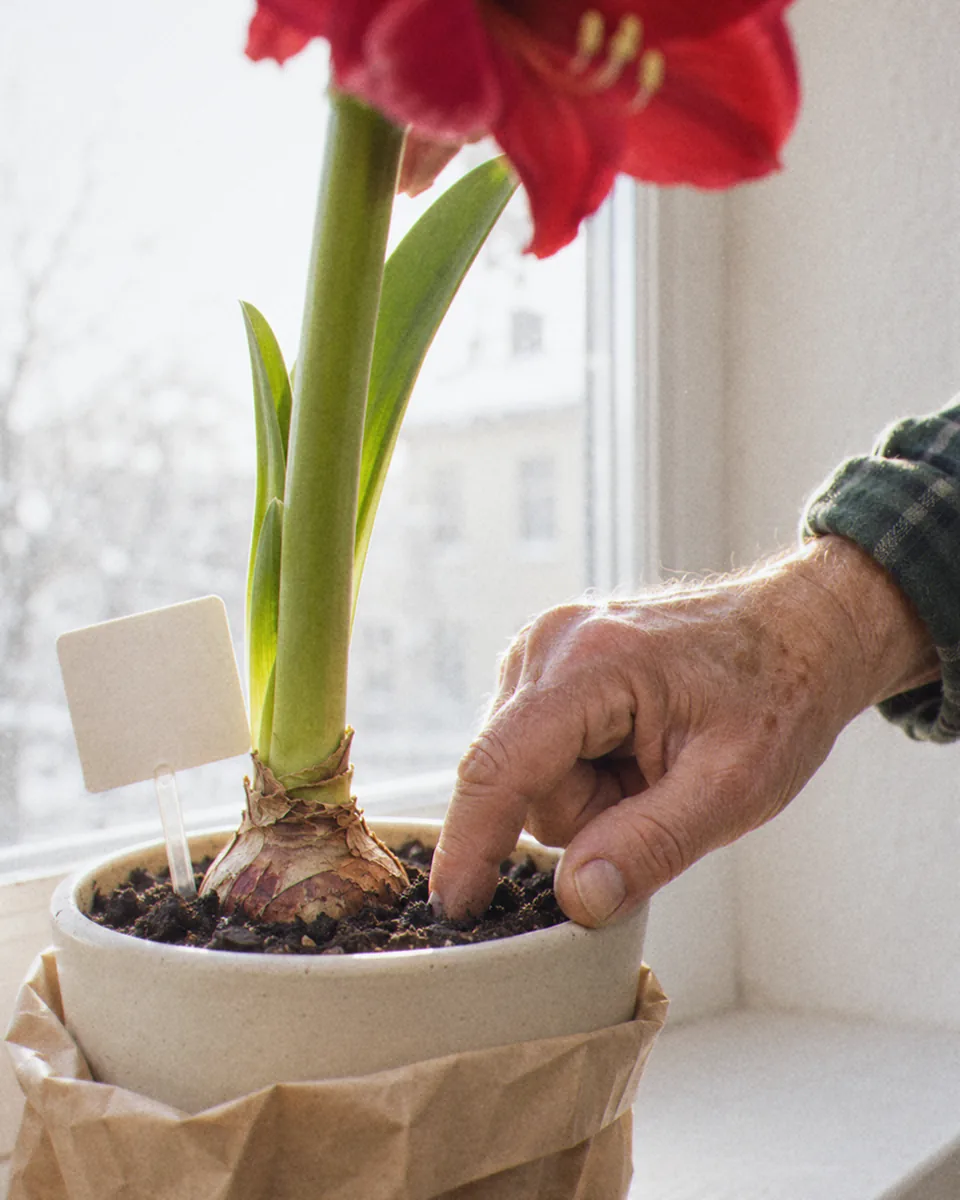
The finger test is the only watering schedule these plants respect. Press a fingertip into the soil. For a poinsettia, water when the top 2.5 cm (about an inch) feels dry. For a potted amaryllis, water when the surface is dry and keep the soil moist but never soggy; advice on how deep to let it dry varies, but nobody suggests leaving the pot in water. Check by touch every day, since a heated room dries soil faster than you would guess.
When it is time, water thoroughly. Lift the plant out of its foil or cachepot, stand it in the sink and pour until water runs freely from the drainage holes. Let it finish dripping, then return it to its cover. After that, leave it alone until the finger test tells you the top is dry again.
Foil can hide a watering problem in holiday plants. It looks festive, and it also forms a watertight cup. Water poured from above runs through the soil, collects in the foil and stays there out of sight, so the roots sit in a puddle and begin to rot. A plant with soggy roots can wilt, the wilting looks like thirst, and its kindly owner waters it again. If you want to keep the foil for the look, poke holes in its base, stand the pot on a saucer and empty the saucer after every watering.
Poinsettia dropping leaves: what each sign means
A poinsettia reports nearly everything through its leaves. The red parts that make it a Christmas plant are not petals but bracts, colored leaves around tiny true flowers, and they fall for the same reasons the green ones do.
- Leaves dropping
- Usually a sudden change of temperature, a draft or uneven watering. Look at what is nearby: an outside door, a heating vent, a radiator. Move the plant somewhere steady and water by the finger test rather than by the calendar.
- Yellow leaves
- Too much water or too little light. Check the foil for a hidden puddle first, then try a brighter spot, still out of direct sun.
- Black, limp leaves after delivery
- Cold on the way: frost, or a long wait somewhere chilly. Keep the plant warm and steady and see how the rest of it holds up.
- Wilting
- A useful rule of thumb is to check the soil and foil before you reach for the jug. Dry and light: water thoroughly. Wet and heavy, or water standing in the foil: drain it and let the top dry out.
When the cause is unclear, start with the soil and the foil, then think about where the plant stands. Many poinsettias that lose leaves in December are either sitting in trapped water or living somewhere the temperature refuses to hold still.
Amaryllis care while it is in flower
First, a matter of names. The Christmas amaryllis sold in shops is botanically Hippeastrum, a bulb from Central and South America; the true Amaryllis is an African plant rarely grown indoors. Almost everyone goes on calling the shop plant amaryllis, and so does this guide. What matters more is which of two forms has arrived, because they are cared for in opposite ways.
Bulb in a pot of soil
- A potted bulb flowers about 5–8 weeks after planting, so a bulb with no bud yet in early December may be right on schedule.
- Water when the surface is dry and never let it stand in water.
- Bright light while it grows; some direct sun is fine until the buds color.
- After flowering it can be grown on and brought back into bloom next winter.
Waxed bulb
- The roots have been removed, a wire set into the base and the bulb sealed in wax.
- It has no soil and no access to water, so you don’t water it at all.
- It flowers within a few weeks on the food stored inside the bulb.
- It is sold as a one-season decoration. Reblooming is possible if the wax and wire come off and the bulb is planted, but unlikely.
A flowering stalk can grow tall and top-heavy, and it leans toward the window as it rises. Turn the pot a little each time you water and the stalk will come up straight. If it still tips, push a thin cane into the soil near the rim of the pot, clear of the bulb, and tie the stalk to it loosely with soft twine.
Each flower lasts about two weeks, sometimes longer. The cooler the room and the less direct sun on the open blooms, the longer the show goes on, which is why the amaryllis is happiest in exactly the spot a poinsettia would find a shade too chilly.
Will my amaryllis bloom again? Poinsettia care after Christmas
An amaryllis is a plant you can keep for years; with good care, a bulb can flower for two decades or more. The trick is to stop treating it as a decoration once the flowers fade and start treating it as a bulb that is building next winter’s bloom. The usual cycle runs like this.
- After flowering
Cut off the faded flowers. Once the stalk begins to yellow, cut it down near the bulb. Keep every leaf: the leaves feed the bulb.
- Spring and summer
A sunny window, regular watering and houseplant fertilizer once a month. Let the leaves grow as much as they like.
- Late September
Stop watering and move the pot somewhere cool and dark.
- About two months
Rest at around 10 °C, dark and dry. Cut the leaves back once they turn brown.
- Waking up
Bring it into the light and start watering again. Flowers usually appear 4–6 weeks after growth resumes.
The rest isn’t strictly required, since an amaryllis can rebloom without one. The cool, dry pause is mainly a way of timing the flowers so they land in December rather than whenever the bulb pleases. To plan it, count back from when you want blooms: about two months of rest, then 4–6 weeks of regrowth before the flowers open.
The poinsettia deserves a more honest answer. It colors up in response to long nights: from around October 1 it needs at least 14 hours of unbroken darkness every night, with bright light by day, for about eight weeks or more. Color begins to show after six to eight weeks and is full at about twelve. Even a brief interruption in the darkness can prevent flowering, which is why devoted growers end up carrying the pot into a closet every evening for two months. Before all that comes a year of upkeep: less water after Christmas (though never so little that the stems shrivel), a hard cutback to 15–20 cm in spring, repotting, and pinching out new growth through the summer.
A poinsettia that lasts until the decorations come down has done its job. An amaryllis is only getting started.
Some people love that kind of project. If you are not one of them, enjoy the poinsettia while it looks good, which with decent care means several weeks, well past New Year, and then compost it with a clear conscience. Treating it as a seasonal plant is an entirely reasonable choice. For something green that carries on all year with less ceremony, our guide to indoor plants that won’t die has better candidates.
Pets, children and the poinsettia myth
The old story that poinsettias are deadly does not hold up. A large study of nearly 23,000 poinsettia exposures reported to US poison centers found no deaths, and the great majority of cases were never treated in a health facility. The sap is an irritant: a cat or dog that chews the leaves may get an upset mouth or stomach and sometimes vomit, and animal poison specialists describe the plant as generally overrated in toxicity.
The amaryllis deserves more respect. It is toxic to cats and dogs, and the bulb is the part to worry about most. Keep both plants out of reach of pets and small children, and if you are worried, call your vet or doctor. There is a fuller list of what is and isn’t safe around animals in our guide to pet-safe flowers and allergies.
Sending a poinsettia or amaryllis to someone abroad
A potted plant and a bouquet ask different things of the person who receives them. A bouquet wants a vase and fresh water (our cut-flower care guide covers the rest). A plant wants a decision about where it will live and a fingertip in the soil every day. For a parent who enjoys tending things, a plant can be the gift that is still there in spring. For a colleague who spends the holidays traveling, a bouquet may be the kinder choice.
With jfloo, flowers never cross a border. A partner florist in your recipient’s city makes and delivers the bouquet on the day of delivery. In December the risky part is the last stretch, from the courier’s hands to a warm room, so time the gift for when someone is home to open the door and carry the plant straight in.
Before delivery we send you a photo of the bouquet, so you see it before your mother or your colleague does. A card with your own message goes with it, and for a plant the most useful thing you can write may be a single care line. In Germany and Sweden the main gift evening is December 24; across much of the network it is Christmas Day, December 25. In Russia, New Year on January 1 is the bigger occasion, with Orthodox Christmas following on January 7. Our guide to sending flowers internationally covers addresses, timing and the other practical details.
Merry Christmas, Mom. Bright window, not touching the glass, away from the radiator. Water only when the top of the soil is dry, and tip out any water in the foil.
For your desk, with thanks for this year. It likes light, dislikes drafts and would rather be a little thirsty than drowned.
Turn the pot a little each time you water and the stem will grow straight. When it has finished flowering, keep the leaves: it can bloom again next winter.
God Jul from far away. Keep it bright, keep it away from the radiator, and keep it out of the cat’s reach.
For warmer words to go around the practical ones, see what to write on a flower card.