How to choose flowers for someone, even if you can’t name a single one
To choose flowers for someone, start from what you already know rather than from flower names: who they’re for and why, where they’ll stand, and how long they need to look good. Those answers rule out most of a catalog, and you can choose from what’s left by mood and color. If you know a flower the person genuinely loves, order that and set the rest of this advice aside.
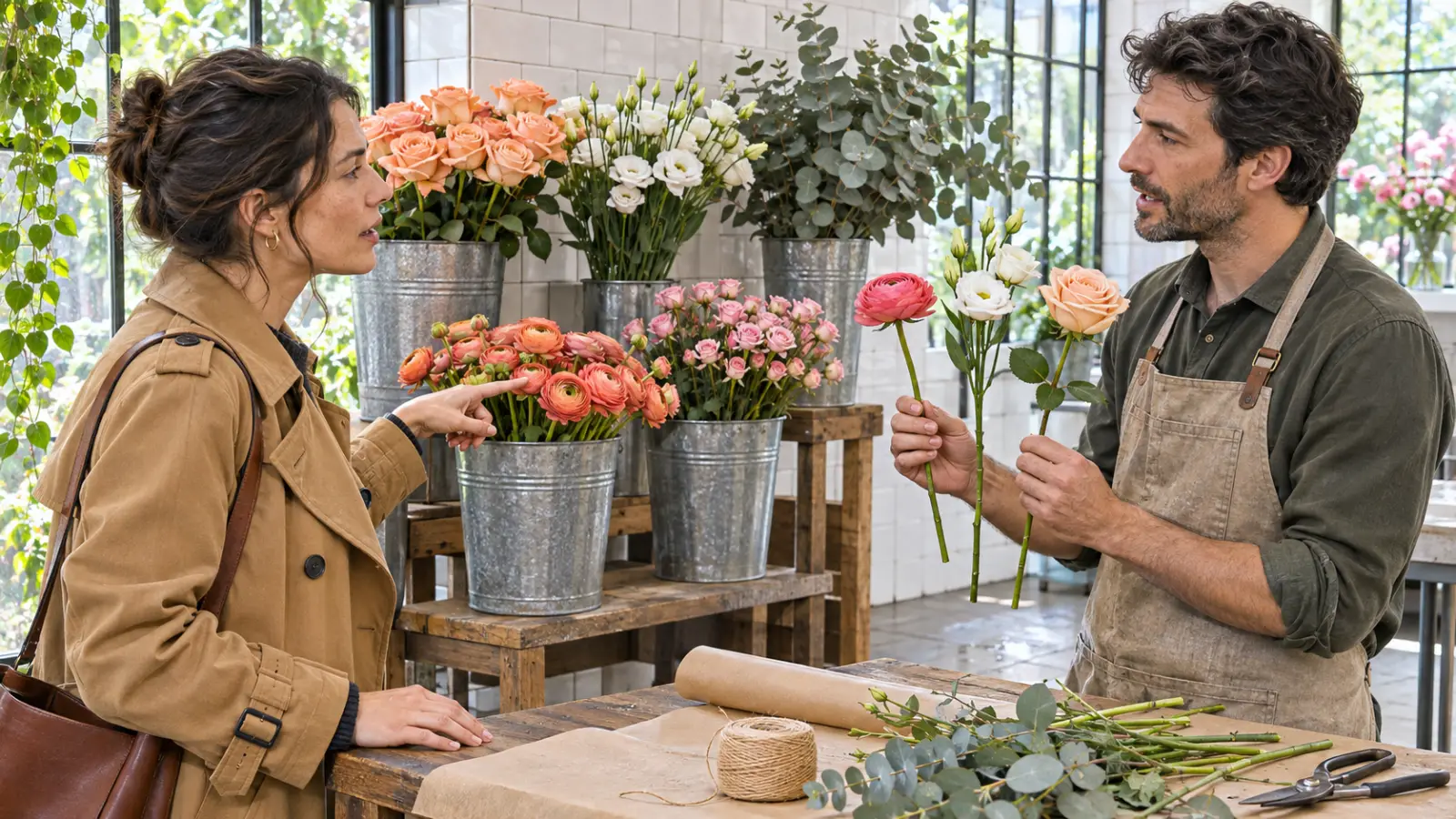
Catalog vocabulary mostly describes how a bouquet is built. Vase life is how many days cut flowers keep looking good in water, an estimate that depends on variety, handling and room temperature. Floral foam is the soaked, spongy block boxes and baskets are built on: the florist pushes each stem in, and it feeds water slowly, so the arrangement needs no vase, just daily water poured into the foam.
One more trap: a single flower can carry two names. Lisianthus and eustoma are the same plant, the trade name and the botanical one, and catalogs use both.
Where do I start if I know nothing about flowers?
Decide in this order: the person and occasion, where the flowers will stand, and how long they need to last. Size, format and color follow almost on their own, each answer narrowing the next.
Take a friend stuck in a hotel: rooms rarely have a vase, so a loose bouquet is out; choose a box or basket that stands on its own. A father recovering from surgery at home will see the flowers for weeks, which points to the long-lasting end of the table below. A sister celebrating a new job tonight can have flowers that peak this evening and fade by the weekend.
Knowing the person overrides all of it. If your mother always slows at the tulips, or your friend has kept the same fern alive for years, start there.
How big should the bouquet be?
Size follows the relationship and the room. A large bouquet suits an anniversary or a milestone birthday, when the gesture is meant to be seen, and feels like too much on a second date, as thanks to a neighbor, or in a studio apartment with one small table.
When you can’t picture their home, go medium: generous, fits an ordinary vase, and doesn’t make anyone clear a shelf. For stem counts, roses especially, see our guide to how many flowers to put in a bouquet. One custom matters for anyone from Russia or the former USSR: odd numbers are for the living, even for funerals.
Bouquet, box or basket: what if they don’t have a vase?
Format comes down to where the flowers will live once the courier has left; the three options behave quite differently.

Hand-tied bouquet
- Needs a vase about half its height.
- Stems can be recut, and the bouquet rebuilt shorter as the first flowers fade.
- Forgives a day when nobody changes the water.

Hatbox or flower box
- Stems sit in wet floral foam, so no vase is needed.
- Good for hotels, offices and busy people.
- The foam needs topping up daily; once dry, it’s fatal to the flowers. Stems can’t be recut.

Basket
- Also built on foam, with a handle for carrying.
- Suits a reception desk, a party table or a narrow bedside shelf.
- Same daily water as a box.
If you have no idea whether they own a vase, choose a box; it needs a little water every morning, so mention that in your card. For anyone in hospital, call the ward first: some wards, intensive care especially, don’t accept flowers at all. The recipient can find the daily routine in our guide to caring for a bouquet and a flower box.
Which flowers last the longest?
These figures come from university trials or, failing that, florists’ experience. They show what a flower can manage with fresh water and a cool room, not a promise: a warm apartment shortens every line.
| Flower | With good care | Worth knowing |
|---|---|---|
| Cymbidium orchid | often about a month | Sensitive to ethylene, the gas ripening fruit gives off. |
| Chrysanthemum | about 20 days | A florists’ figure rather than a trial result. |
| Carnation | about 2 weeks, up to 4 at best | Stems treated against ethylene often last 1.5–2 times longer. |
| Anthurium | up to 3 weeks | Below about 10 °C it browns and dies, so keep it out of the fridge and cool rooms. |
| Lisianthus (eustoma) | 10–14 days or more | Most varieties easily reach 10 days. |
| Strelitzia | up to 2 weeks | A florists’ figure. |
| Alstroemeria | about 2 weeks | The leaves may yellow before the flowers do. |
| Standard rose | about 10 days | Varies a lot by variety. |
| Sunflower | 8–12 days | Responds well to flower food in the water. |
| Hydrangea | varies widely | No single figure holds across types. |
| Tulip | about 5–7 days | Keeps growing in the vase and bends; a cool room slows it. |
| Garden rose | 4–7 days | A full, romantic bloom that rarely sees a second week. |
| Peony | no reliable figure | Choose it for the day itself, not for a week. |
| Sweet pea, dahlia, delphinium | under a week | For an occasion today, not one that has to last. |
Gerbera, ranunculus, lilies and callas are left out deliberately. Their vase life swings so widely with variety and handling that any single number would mislead you.
A mixed bouquet doesn’t fade all at once: garden roses and sweet peas go first while lisianthus and chrysanthemums carry on, so for a few days it simply gets smaller. If you can’t send a second bouquet for weeks, build from the top of the table, and save peonies and garden roses for tonight.
What colors should I pick?
Treat color as mood rather than a code. Lists of what each color “means” contradict each other, and the person opening the door won’t be consulting one; what they notice is the feeling of the bouquet as a whole. Pale pink, cream and lilac read as soft and tender; orange, yellow and hot pink feel celebratory; burgundy, deep red and plum feel more formal, which suits a boss or a milestone.
A tonal bouquet, several shades of one color, looks calm and deliberate; a contrasting one looks cheerful and louder. An all-white bouquet can disappear against white walls, worth remembering for an office or a new apartment. When you order, describe the mood in words (“warm and cheerful, for a new job”), since florists work from a mood far more easily than a list of color names.
White needs one caution: in many families in China, Korea and Japan, white flowers, especially chrysanthemums and lilies, belong to funerals, so an all-white bouquet for a birthday or promotion can land badly. This varies by family and generation, and white is common at Western-style weddings. Our guide to flower etiquette around the world goes country by country.
Spray rose, garden rose, lisianthus: what’s the difference?
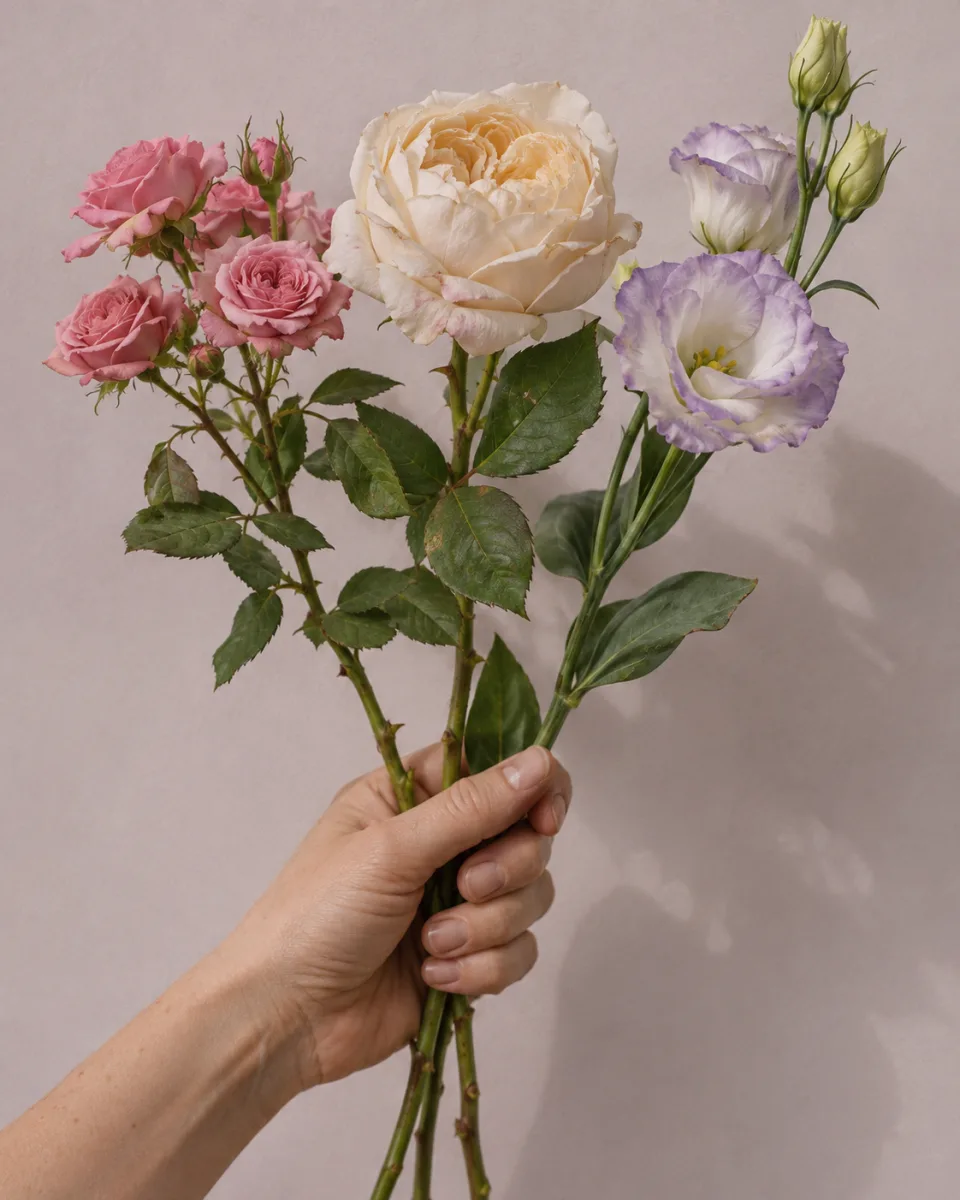
A standard rose is the one everyone pictures: one bloom on a long, straight stem, opening slowly from a tight bud. It lasts about ten days and suits a classic bouquet, a single color, or anything that should look formal.
A spray rose carries several small heads on one stem, some open and some still in bud; it reads full and relaxed rather than grand, and suits a medium bouquet or a box. More on varieties in our spray rose guide. A garden rose is cup-shaped and packed with petals, the romantic one of wedding photographs, and lives four to seven days: choose it when tonight is what counts.
Lisianthus looks like a softer rose from a distance, with ruffled, papery petals. As open flowers fade, side buds keep opening, which is why it often outlasts the roses beside it. If you want the look of roses for up to two weeks, choose lisianthus.
The other words in a catalog description tell you how the bouquet is put together.
- Hand-tied, or spiral
- Stems laid in a spiral and tied where they cross; the bouquet keeps its shape, so the tie stays on in the vase.
- Mono and mixed
- Mono is one kind of flower, which looks deliberate. Mixed is several kinds, which fade in stages.
- Focal and line flowers
- Focal flowers are the large blooms the eye lands on: roses, hydrangea. Line flowers are tall spikes that give height: stock, delphinium.
- Filler
- Small flowers that fill the gaps between focal ones. Gypsophila, or baby’s breath, is the most familiar.
- Greenery
- Ruscus with its small glossy leaves, pistacia (florists call it “fisticus”) and silvery eucalyptus.
- Stock and ranunculus
- Stock (Matthiola incana) is dense spikes of small flowers, sold as stock or matthiola. Ranunculus is the Persian buttercup, a round flower of tightly layered petals.
- Floral foam
- The block under boxes and baskets. A 2019 RMIT University study found it sheds microplastic that small water animals eat, and the Royal Horticultural Society has banned it at its shows, Chelsea included. Foam-free florists use chicken wire or a kenzan, the heavy needle holder used in ikebana.
- Ecuadorian rose
- Grown on highland farms in Ecuador, many of them roughly 2,400–2,800 m up. Growers credit the cool highland air and steady equatorial light for the large heads; “the equator straightens the stems” is an oversimplification.
What mistakes are easy to avoid?
The most common mistake is size: a bouquet too big for its room. When in doubt, size down and spend the difference on longer-lasting flowers.
The serious one is lilies in a home with a cat. True lilies (Lilium, including Asiatic and Easter lilies) and daylilies can cause kidney failure in cats; even pollen or vase water is enough, and treatment started after about 18 hours rarely helps. Callas and peace lilies aren’t true lilies and cause only mouth irritation, but still don’t belong where a cat can chew them. If there might be a cat, ask for no lilies and check our list of flowers that are safe for cats and dogs.
Chrysanthemums are a cultural trap: in France, Belgium and parts of Italy they’re the flower taken to graves around All Saints’ Day on November 1, so many wouldn’t give them as a house gift. And peonies, however lovely, are wrong when the flowers must last a week.
If you know she always buys freesias, or that he grew sunflowers as a boy, a modest bunch of exactly those will mean more than a big bouquet chosen at random.
Quick ideas by recipient
- Partner or date: something small enough to carry, and nothing bulky if it’s arriving at a restaurant table.
- Mother or grandmother: long-lasting flowers such as lisianthus or alstroemeria, in warm, calm tones.
- Colleague or boss: a box for the desk, so nobody has to hunt for a vase at the office.
- A man: graphic, sturdy stems, such as anthurium, strelitzia or a branch of cymbidium.
- Someone recovering: long-lasting and low in scent, and a call to the ward before you order.
When the person is in another city or country, the flowers don’t need to travel: with jfloo, a florist makes the bouquet on the day of delivery, and we send you a photo before delivery, so you see it before they do. A card with your own words goes along; if you’re unsure what to say, see examples of what to write on a flower card. The steps are laid out on how ordering works.