Fresh flowers on a Christmas tree: how to put them in and keep them alive
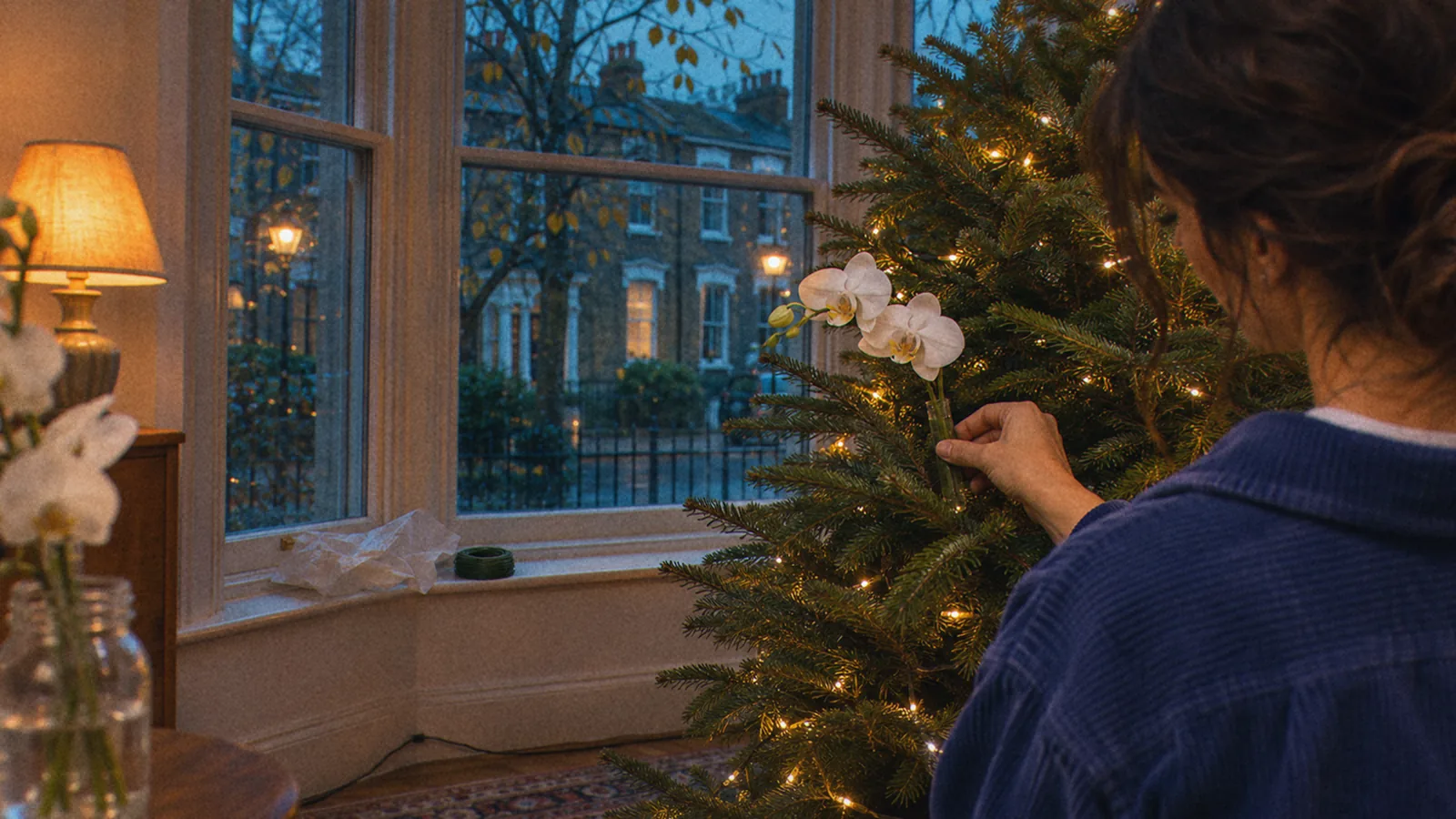
A slim water tube holding a few milliliters, wired to a branch behind the needles, is how florists keep an orchid alive on a Christmas tree. So yes, you can put fresh flowers on a Christmas tree, as long as every fresh stem gets its own hidden tube. In a tube, a cymbidium orchid can last 3–6 weeks, a rose about a week on a warm tree, and fresh hydrangea often less. Dried or preserved stems need no water at all and will see the season out.
The tree you saw in a florist’s window, with white orchids hovering between the baubles, worked on exactly those terms. What it didn’t have to cope with was a living room. Yours has a radiator under the window and a string of warm bulbs, the heating goes up when guests come, and the tree may stand from early December to January 7. Most cut flowers can’t last five weeks in that air. A few can, and the rest can be swapped as long as you plan for it.
What follows is the workroom method, adapted for a home, with honest lifespans for each flower. The calendar matters as much as the flowers. A London tree that goes up in the first week of December wants different flowers from a Moscow yolka (the New Year tree) dressed at the end of the month.
A florists’ idea for 2026
One florists’ trend list for the 2026 holidays puts it third: “Bring flowers onto the Christmas tree.” The note behind it is plainer than the photographs it inspires. “The Christmas tree is becoming another place for floral creativity,” it says, and it suggests that “dried flowers, preserved botanicals, berries, branches and other natural elements can be tucked between ornaments.”
Notice what that list leaves out: orchids, hydrangea heads and water tubes. Those come from florists who tuck orchid stems into trees in water tubes and praise how long they last there. The evidence for the trend is trade commentary, with no search or sales figures behind it, so treat it as an idea worth trying in your own front room.
The sensible version starts with the list’s own suggestion. Dried and preserved stems carry the shape of the tree, and a handful of fresh flowers in tubes goes at eye level, where someone will lean in to check whether they’re real.
Orchids on the Christmas tree, and what copes without water
Everything on a Christmas tree wants to dry out. Fine, nearly everything. Warm air rises from the radiator and the bulbs add heat of their own. A cut stem hanging in that air loses water through its petals far faster than it would in a cool vase.
The cymbidium is the exception florists rely on. Research on orchid vase life found that water uptake doesn’t limit a cymbidium’s life, mainly because it transpires (loses water through its surfaces) very slowly. Florists regard it as the best bet for a short spell without water. Nobody has published how long that spell can last, though. Treat it as a safety margin and still give the stem a tube.
The phalaenopsis is the moth orchid with flat, round petals, the one most people picture when they hear “orchid,” and it behaves almost the opposite way. Its vase life is often cut short by vascular occlusion, the florists’ term for vessels in the stem that clog and stop carrying water. Without a tube it gives up quickly, so it always goes in one. The potted plant the stems came from is another matter, and our guide to watering a phalaenopsis and getting it to rebloom covers it.
Florists’ rule of thumb: fresh hydrangea without water is a one-evening decoration.
For anything that has to last, choose what needs no water at all: dried flowers, preserved botanicals, berries and bare or berried branches. Dried hydrangea is the classic choice: one big, papery head fills a gap that would take a dozen small ornaments. If you want to dry your own, florists warn that shop-bought fresh heads don’t dry as full as ones from a garden. The three ways to dry a bouquet still apply, and our hydrangea guide explains why fresh heads drink so much.
Floral water tubes: how they work
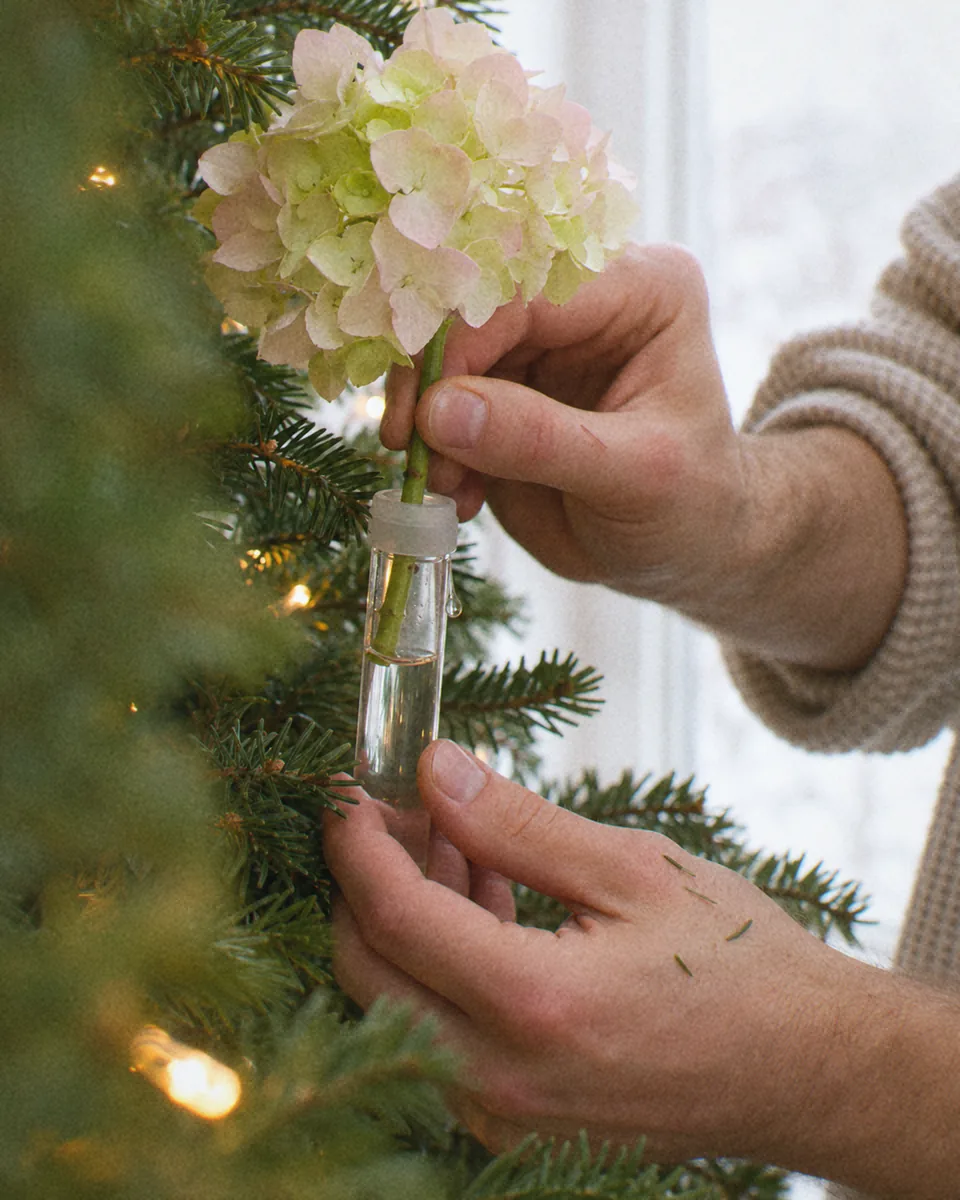
A water tube is a small capped vial: the stem goes through the cap, and its cut end stays under water for as long as there is water left. That last condition is the whole job. Small tubes hold only a few milliliters, so check every tube daily and top it up.
The cut matters as much as the water. A freshly cut stem left in the air can draw an air bubble into its vessels, and the bubble lodges there, blocking any water that arrives later. Florists cut at about 45° and push the stem into the tube at once, before air can get in.
Hydrangea shows why. In trials at NC State, hydrangea lasted as little as about 4.5 days in plain water, and longer with flower preservative and slightly acidic water. In each case the end came when blocked stem ends upset the flower’s water balance, which is why the cut counts as much as what is in the tube.
Glass tubes look lovely if they show, but they weigh more. Plastic ones are lighter and sit better on a thin branch. Either way, the tube should be the last thing anyone notices.
Flower turned outward, tube turned inward, both upright: that is most of the craft.
How to put real flowers in a Christmas tree
The order matters, because the tubes are the most fragile things on the tree and should go on last.
- Dress the tree firstLights first, then garland and ornaments. Add the flowers last, so nothing gets knocked loose and you can see where the gaps are.
- Fill the tubesUse cool water with a little flower food, and put the caps on. Do this at the kitchen table, well away from the lights.
- Cut and insert at onceCut each stem at about 45° with a sharp knife and push it through the cap straight away, before air can get into the fresh cut.
- Wire the tube to a branchWrap thin florist’s wire twice around the tube and the branch, close to the trunk where the branch is thickest. Keep the tube upright or nearly so. A tube hung cap-down leaves the stem end in air as the water level drops.
- Hide itTurn the flower outward and the tube inward, behind needles, a bauble or a loop of ribbon.
- Top up daily, lights offSwitch off and unplug the lights first, then refill each tube from a small jug or a syringe. Wipe any drips off the branches and cables.
How many flowers you use is a matter of taste. One florists’ rule of thumb for an all-hydrangea tree is at least ten big heads for a 6 ft (1.8 m) tree. Orchids go further, because a single cymbidium stem carries a whole ladder of blooms. Whatever you use, keep the fruit bowl in another room. Ripening fruit gives off ethylene, a gas that ages flowers faster, and orchid suppliers specifically warn against it.
How long do fresh flowers last on a Christmas tree?
The figures below come from vase-life research and growers. Nobody has measured flowers on a tree, and a warm room near the lights pushes every number toward the low end.
| Flower | In a water tube | Without water | Through to January 7 |
|---|---|---|---|
| Cymbidium orchid | 3–6 weeks, kept away from ripening fruit | Copes with a short spell better than most; no published day count | Yes, in a tube |
| Phalaenopsis orchid | 5 days to 6 weeks, depending on variety; florists usually say 2–4 weeks; on a warm tree, plan for 1–3 | Not an option: the stem clogs | With one swap |
| Hydrangea, fresh | From about 4.5 days in plain water; longer with flower food | Florists’ rule of thumb: one evening at most | Swap weekly |
| Rose | About 8–12 days in vase trials; on a warm tree, about a week | A rough guide: half an hour to a few hours, depending on the heat | Swap weekly |
| Dried or preserved stems | No water needed | The whole season | Yes |
A tree that stays up until January 7 stands for five or six weeks if it went up at the end of November. Only cymbidium in tubes and dried or preserved stems last that long. Treat everything else as a guest: plan one swap for phalaenopsis and a weekly one for roses and fresh hydrangea.
Lights, water and the cat
A tree with flowers in it has water a few centimeters from the cables, where a tree normally has none. That calls for a few changes of habit.
- No
Old filament lightsElectrical Safety First, a UK charity, recommends LED lights. They run at extra-low voltage, which greatly reduces the risk of electric shock, and that matters on a tree full of water.
- Never
Topping up with the lights onSwitch off and unplug the lights before any water goes near the tree, whether into the stand or a tube. Don’t let cables lie in water or on wet branches.
- Yes
Certified lights, checked every yearThe NFPA, the US fire protection body, advises lights certified by an independent testing lab. Check them for damage before they go up, and switch them off when you go to bed or leave home.
- No
Candles near the flowersKeep the tree at least 3 ft (about 1 m) from any heat source, including fireplaces, radiators and candles. The distance also helps the tubes, which empty fastest where it’s warm.
- Not with cats
True liliesLilies (Lilium) and daylilies cause kidney failure in cats. Every part is dangerous, including the pollen and the water the flowers stood in. Without treatment, kidney failure can develop within about 36–72 hours.
- Careful
HydrangeaIt is toxic to dogs and cats and can cause vomiting, diarrhea and listlessness. Serious poisoning is rare, but heads on the lower branches are within easy reach.
- Safe
Phalaenopsis and rosesThe ASPCA lists both as non-toxic to dogs and cats. Cymbidium has no entry there, so its safety is unknown. Either way, keep tube water and the tree stand out of reach.
- Not a rose
“Christmas rose”Hellebore borrows the name but is no rose, and it is toxic to pets.
A real tree adds a risk of its own: it dries out. The NFPA advises cutting about 2 inches (5 cm) off the trunk before the tree goes into its stand and watering it every day. In one of its demonstrations, a dry tree was fully in flames in under 20 seconds. Lilies, hydrangea and other household plants are covered in more detail in our guide to flowers that are safe for cats and dogs.
Real tree or artificial
The flowers don’t much mind which kind of tree they sit in. What changes is the air around them and how long the tree can stay up.

Real tree
- It drinks from its stand and dries out in a warm room, and the needles it drops gather on the tubes.
- German guides suggest putting it up no more than about 12 days before Christmas, which also suits fresh flowers.
- Water the stand daily. One UK survey found that only 45.8% of people with real trees say they water them regularly.
- Wire the tubes near the trunk, where the branches are stiff enough to hold them.

Artificial tree
- It doesn’t dry out, so it can go up early with dried stems and take fresh ones later.
- Many artificial trees have wire-cored branches that can bend around a tube and hold it in place.
- The tubes are the only water on the tree, so the wet spots are easy to find and check.
- Skip the hairspray. A British survey found that one person in eight sprays it on an artificial tree, and it is flammable.
When the tree goes up, and when the flowers go in
The calendar decides which flowers you can use. A tree that stands for five weeks is a different job from one that stands for ten days, and customs vary more than most people expect.
Britain and the US
United Kingdom · United States
Some people start on the first Advent weekend, at the end of November. In Britain, according to a YouGov survey, the first week of December is the most popular time, chosen by more than a third of households; about a quarter more dress the tree the following week, and only about one in ten in November. In the US, many families put the tree up after Thanksgiving, which falls on November 26 this year. Either way, the tree stands for three weeks or more before Christmas Day.
Germany, Austria, Switzerland
Germany · Austria · Switzerland
Tradition says the tree goes up and is dressed on Christmas Eve, December 24, a Thursday this year. Few still wait: in Germany only about one household in eight does, and most decorate in early or mid-December. If you keep the old custom, almost any fresh flower will last through the holidays.
Russia and the CIS
Russia · Moscow · the CIS
The main winter holiday is Novy God, New Year, on January 1, and the tree is a New Year tree, the yolka. Many families dress it in the last weeks of December. In Russia, January 1–6 and January 8 are public holidays (novogodnie kanikuly), and January 7 is Rozhdestvo, Orthodox Christmas, so trees often stay up until the 7th or 8th. Peter I is often credited with the custom, but his decree of 1699 ordered homes to be decorated with branches of fir, pine and juniper, not trees. The yolka as people know it returned after a letter in Pravda in late December 1935.

Put dried and preserved stems on the tree the day it goes up, and time the fresh flowers to the day that matters. For a London Christmas tree, tube the roses or hydrangea a day or two before December 24, so they are at their best on Christmas Day, a Friday this year. A cymbidium can go in a week or two earlier. For a Moscow yolka, put the fresh flowers in around December 30 and let a cymbidium carry the tree through January 7. By then the roses will have been swapped once, and the dried hydrangea near the top will look exactly as it did on New Year’s Eve.
Flowers for the tree, ordered from abroad
If the tree stands in someone else’s living room, in another city or another country, you can still send what goes on it. jfloo takes the order, and a partner florist in the recipient’s city makes the arrangement and delivers it. The flowers never cross a border: they are arranged locally on the day of delivery. We send you a photo of the bouquet before it is delivered, so you see the stems before they reach the tree, and a card with your own words can go with them.
Be specific when you order. Ask for cymbidium or phalaenopsis stems with water tubes included, and for dried or preserved hydrangea if the tree will stand into January. If there is a cat in the house, say so and ask for no true lilies. Ask, too, that the orchids be kept away from fruit, since ethylene shortens their life. A matching arrangement for the table beside the tree follows the same rules. Christmas and New Year flowers around the world has ideas for the recipient’s country, and how ordering works walks you through the steps. In the busiest weeks, plan around the holiday delivery deadlines abroad.
If something is wrong with the bouquet, write to us within 24 hours with a photo and we will sort it out. How our guarantees work.
The rest happens at the tree: a tube, a twist of wire, and someone topping it up each morning with the lights switched off.