Why do Chinese people give apples on Christmas Eve? A Shanghai story
An apple sits in a twist of clear cellophane, tied at the top with a red ribbon, and on its skin, where the red never quite arrived, there is a pale Chinese character. Growers stick a stencil to the fruit before it ripens, and the covered patch stays light, so the word grows into the apple instead of being printed on it. People in Shanghai, and across China, give apples like this on Christmas Eve because of a pun: Christmas Eve in Mandarin is píng’ān yè, the “peaceful night,” and the word for apple, píngguǒ, starts with the same syllable. So the apple becomes a píng’ān guǒ, a “peace apple,” and handing one over means wishing someone a safe and peaceful year.
Most foreigners who notice the wrapped apples on December stalls have no idea why a single piece of fruit is being sold as a present. The reason is that one shared syllable, and it also tells you what a Chinese friend may expect from you on December 24.
One syllable, two characters
Start with the dictionary, where píng’ān is a plain everyday word. It means “safe and sound,” “without mishap”: what you wish someone before a long drive, what you hope to hear after a storm. Nothing about it is Christian or festive.
The festive layer came with a song. When “Silent Night” was translated into Chinese, its title became píng’ān yè, and the name of the carol slid onto the night itself. Christmas Eve in Mandarin is still called after it. So the evening carries, in its very name, the wish to get through safely.
Then comes the apple. Píngguǒ is written with a different character from píng’ān, but the first syllable sounds exactly the same, píng, in the rising second tone. In a language where a shared sound can carry a meaning across from one word to another, that was enough. Put the two together and you get píng’ān guǒ, the peace apple: a piece of fruit that says “stay well” the moment it changes hands.
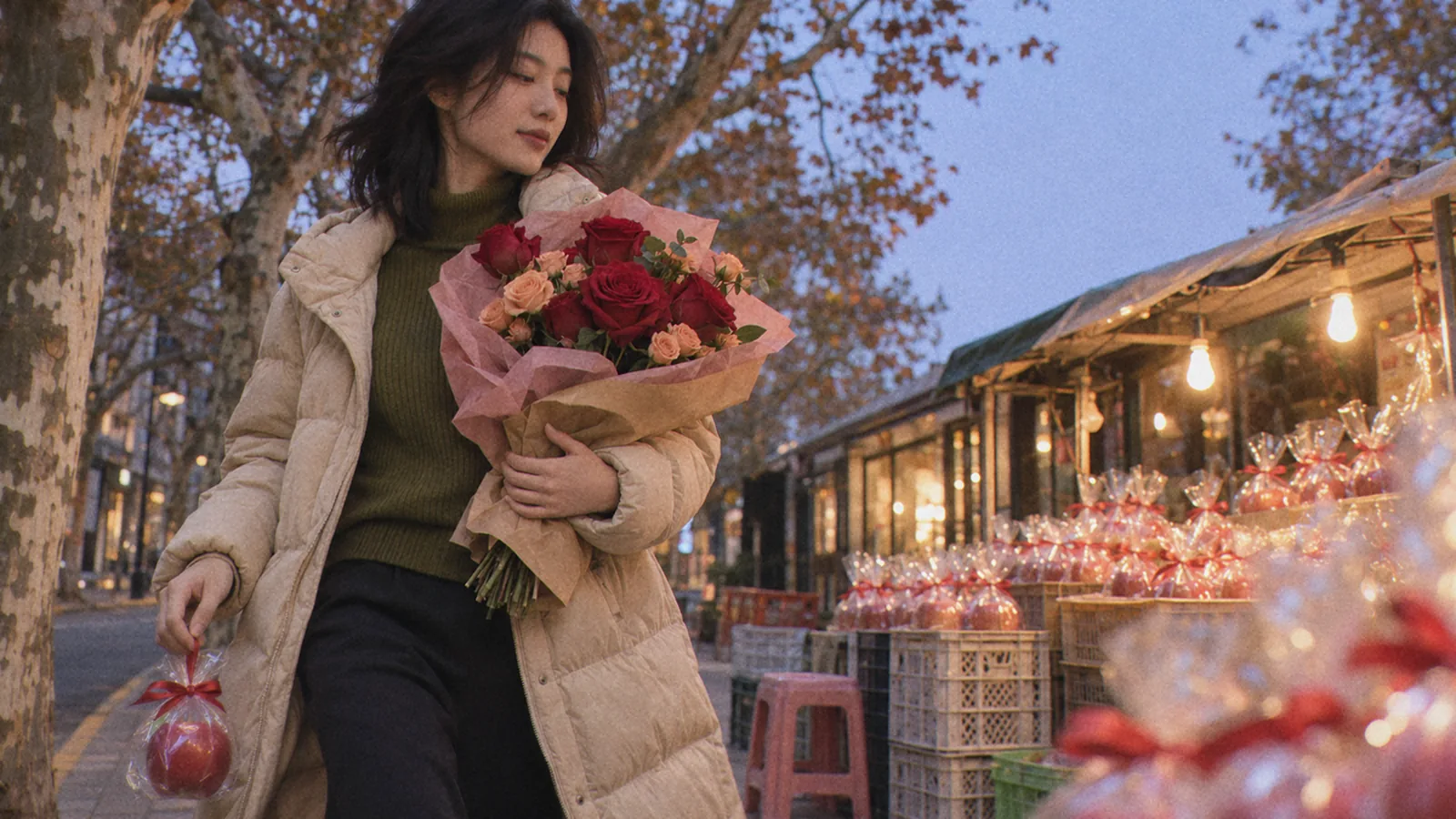
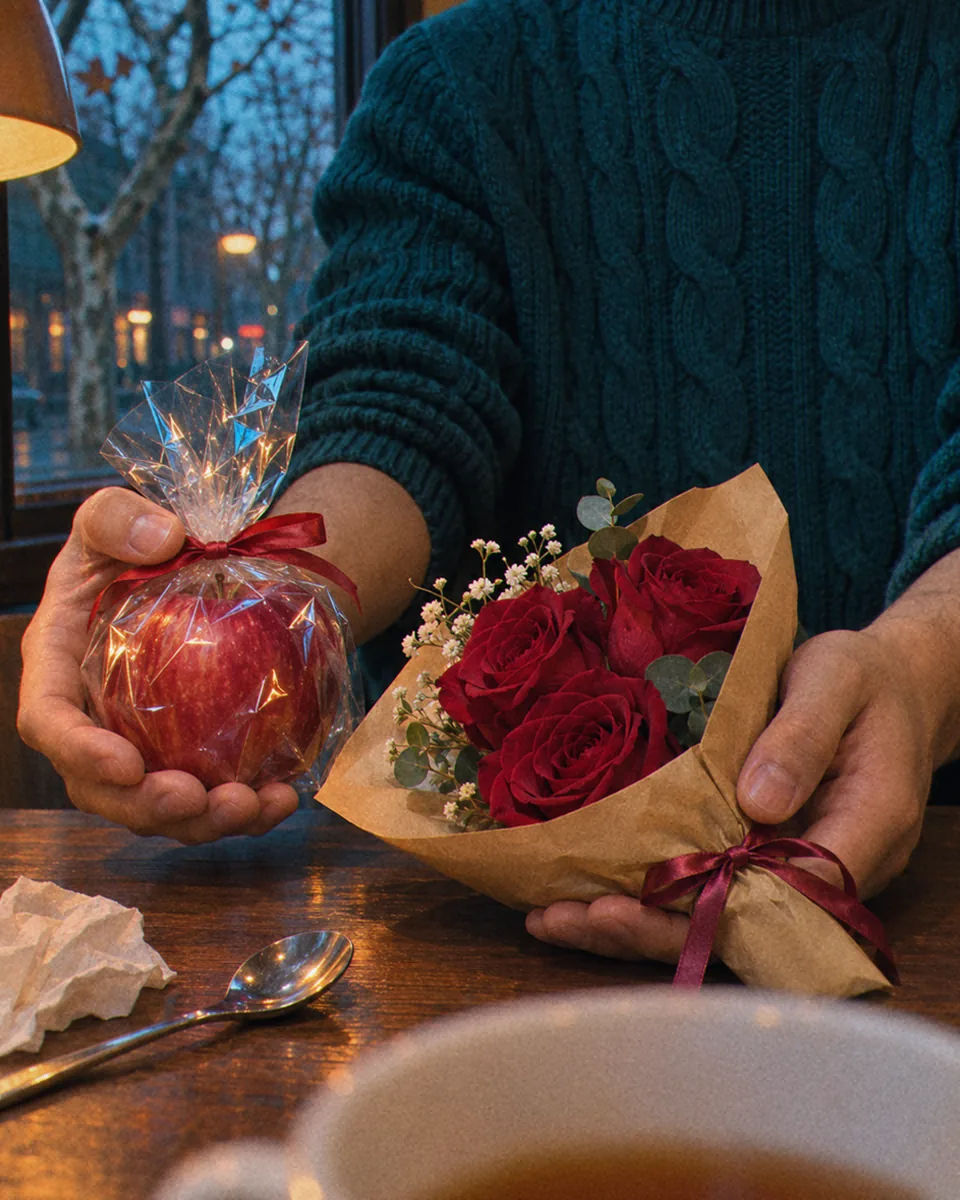
The gift is modest and generously wrapped: an apple in bright cellophane with a ribbon, sometimes in a heart-shaped box or a tin with chocolates and flowers. Some carry a stenciled word on the skin. Friends and coworkers give them to each other, couples exchange them too, and they change hands on December 24 or in the days just before.
A Christmas that arrived without a day off
To see why an apple and not a church service became the sign of the season, you have to know what Christmas is in mainland China. It is not a public holiday. The State Council’s holiday list for 2026 names New Year, Spring Festival, Qingming, Labor Day, the Dragon Boat Festival, Mid-Autumn and National Day, and stops there. December 25 is an ordinary working day, and few people mark it as a religious feast.
What arrived instead was the mood of Christmas: lights, music, shop windows, sales, a reason to go out on a winter evening. It came as a commercial holiday, and Chinese cities shaped it to fit their own habits. Christmas Eve became a night to spend with friends or on a date. Even churches draw crowds that evening more for the candlelight and the atmosphere than for faith.
The apple belongs entirely to that local version. The folklorist Ai Jun has called it “a wholly Chinese phenomenon,” “harmless fun and not religious.” Tian Zhaoyuan, of the folklore department at East China Normal University in Shanghai, put it more drily: “more commercial than cultural.” China Christian Daily describes the custom as “entirely homegrown, rooted in the Chinese love for homophonic puns”. Nobody can say exactly when it began, but by 2013 Chinese and foreign newspapers were already writing about it.
That year’s reports give a sense of its scale. A seller on Taobao, the big online marketplace, said most of the buyers were young men shopping for their girlfriends and asking for romantic messages on the cards. Orders tripled after December 22. A boxed apple online sold for RMB 68, while street vendors near university campuses asked RMB 6 for a single wrapped one. Those are 2013 prices; peace apples cost more on December 24 because they are sold as presents, not produce.
Churches took up the pun from the other side. Many hand out free peace apples to everyone who comes to the Christmas Eve service, a friendly opening for visitors who came for the candles. There is also a niche folk game: you buy an apple with 24 ten-cent coins collected from 24 different friends. Some say the friends must all have different surnames and that 24 stands for the solar terms of the Chinese year; others say it simply stands for the date, the 24th.
Shanghai in the week of the solstice
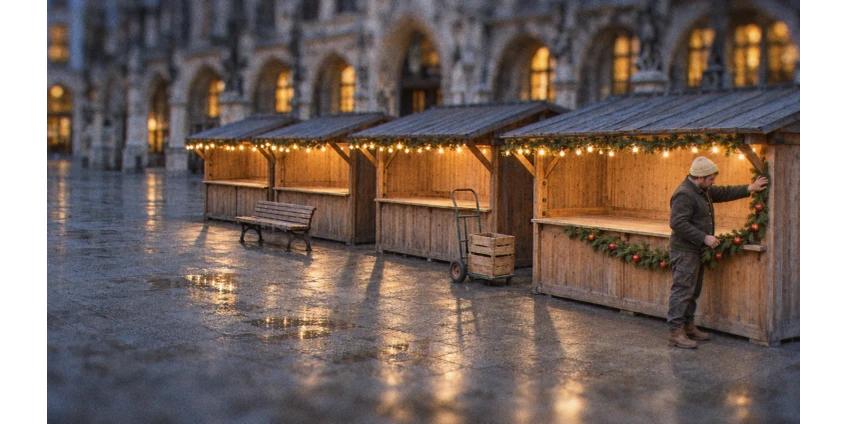
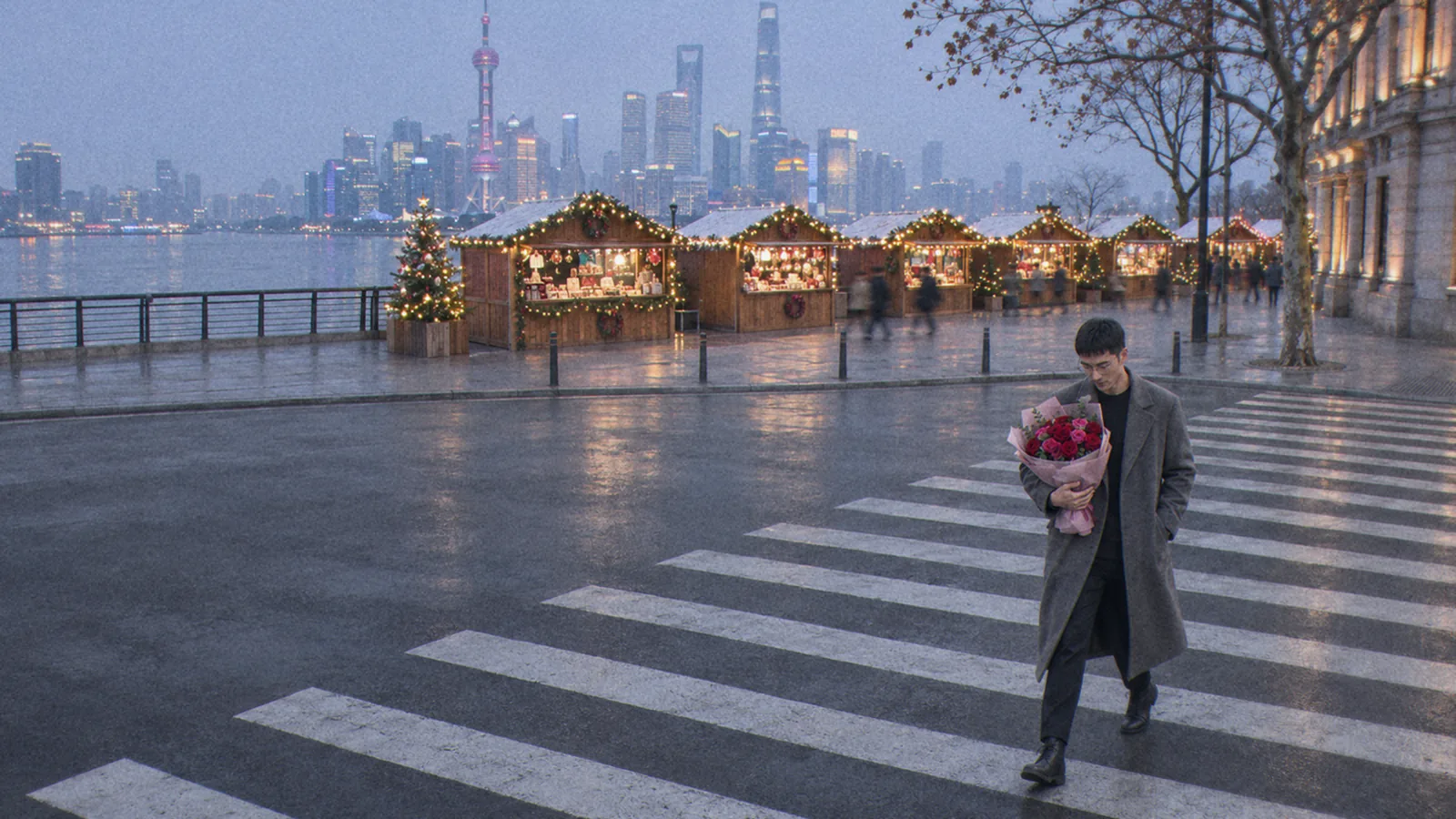
In Shanghai the season has a German corner: the Christkindlmarkt on the Bund, a Christmas market in the German style. It stands in Waitanyuan, “the source of the Bund,” on the pedestrian stretch of Yuanmingyuan Road between Beijing Dong Lu and Nan Suzhou Lu, at the YiFeng Galleria, just behind the north end of the riverfront. This year it is open from November 25 to December 27: Wednesday to Friday from 3 p.m. to 10 p.m., weekends from noon to 10 p.m., closed Mondays and Tuesdays. Tickets go through the SmartShanghai app or the WeChat mini-program “SmTk”: RMB 30 in advance on weekdays, RMB 38 on weekends, RMB 40 and RMB 48 at the door; some busy weekends cost more, and door tickets are not guaranteed. Children under 1.2 meters go in free with an adult.
Beyond the market, the rest of the city dresses up too. Shopping streets are strung with lights, malls put up their trees, and restaurants fill with couples. In Shanghai, many young couples plan a date around Christmas Eve and shop the seasonal sales; others go out with friends.
Two days before the apples, on December 22, comes Dongzhi, “winter’s extreme”: the winter solstice, one of the 24 solar terms of the Chinese calendar, and not a public holiday.
What travels with the apple
An apple on its own is a friendly gesture, the kind of thing classmates and colleagues swap without much thought. Between partners it usually comes with company, and the commonest company is a small bouquet: something you can hold in one hand while the apple sits in the other.
For a partner, red roses are the obvious choice and, in China, an unambiguous one: they are the flower of love and romance, and on Christmas Eve they match the red of the apple and the ribbon. Our piece on what red roses mean goes through the shades if you want something deeper or softer. Colored lilies and tulips are also read as love and admiration. For a friend or a colleague, keep it light and bright: a few warm-toned stems, a small mixed posy, nothing that looks like a declaration.
Two things are best left out. White is the color of mourning in China, so an all-white bouquet, however wintry it looks to European eyes, can send the wrong message. Chrysanthemums are the flower used to remember the dead, especially at Qingming, the spring tomb-sweeping festival, and Shanghai’s own city guide calls them the flower Chinese people would never give as a present. As a florists’ rule of thumb, avoid bunches of four: sì, four, sounds close to sǐ, death; suggested counts include six, nine, eleven and twelve. These habits, and the ones in other countries, are collected in our guide to flower etiquette around the world.
The gift boxes sold in December follow the same logic as the apple. An orange is often tucked in beside it, because chéng (“orange”) sounds like chéng (“sincerity”), along with chocolates or a few flowers. Whatever you put together, the apple is the center, and it costs more than usual for the same reason the box does: in the week before December 24 it is a greeting first and fruit second.
When you can’t hand it over yourself
If your partner, friend or colleague is in Shanghai and you are not, you cannot put the apple in their hand. What can travel is the bouquet and the words with it.
Our florist in Shanghai arranges the flowers on the day of delivery, so nothing is flown in from abroad. Before the bouquet goes out we send you a photo, so you see it before your recipient does, and a card with your own message travels with it. The Shanghai flower catalog shows what our florists in Shanghai make, and how ordering works walks through the steps, including payment by bank card or PayPal.
- November 25
The Christkindlmarkt on the Bund opens.
- December 22
Dongzhi, the winter solstice. A festival much older than Christmas, and not a day off.
- December 24
Christmas Eve, a Thursday in 2026. Peace apples, dinners, the market open from 3 p.m.
- December 25
A Friday and a normal working day. Most people are at their desks.
- January 1
Yuandan, New Year’s Day: a public holiday, unlike Christmas.
Timing follows the shape of the Chinese holiday, and these are the dates to plan the delivery around. In 2026 Christmas Eve is a Thursday, and the evening is when the apples and flowers matter, so ask for delivery on December 24 itself or on the 23rd if you would rather it be waiting. Avoid aiming for the 25th: it is a working Friday, the festive moment has passed, and your recipient may be in an office across town. If you are sending to several countries at once, our article on holiday flower delivery deadlines abroad explains how early to book.
The card is where you can carry the pun across. A line in Mandarin, even a short one, shows you know what the evening means. Each line below is given in characters, the way it would be written on the card, with pinyin and a translation so you know exactly what you are sending.
平安夜快乐 (píng’ān yè kuàilè)
圣诞快乐 (shèngdàn kuàilè)
祝你平平安安 (zhù nǐ píngpíng’ān’ān)
平安夜快乐。I can’t hand you an apple tonight, so these roses will have to carry the wish.
More ideas for short messages that sound like you are in what to write on a flower card. And if something is wrong with the bouquet, write to us within 24 hours with a photo and we will sort it out, as described on the guarantees page.
The next big date on the Chinese calendar is Chunjie, the Spring Festival, on February 6, 2027. Our tour of Christmas and New Year flowers around the world covers the flowers people send around the turn of the year.