Our Lady of Guadalupe flowers: why Mexico fills with roses on December 12
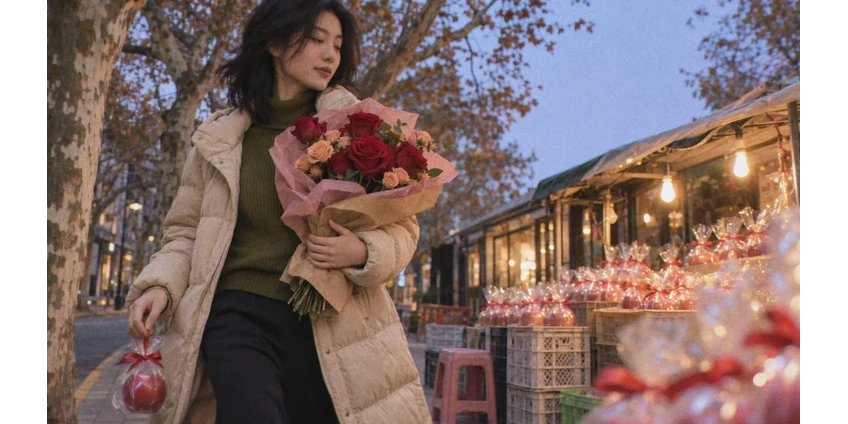
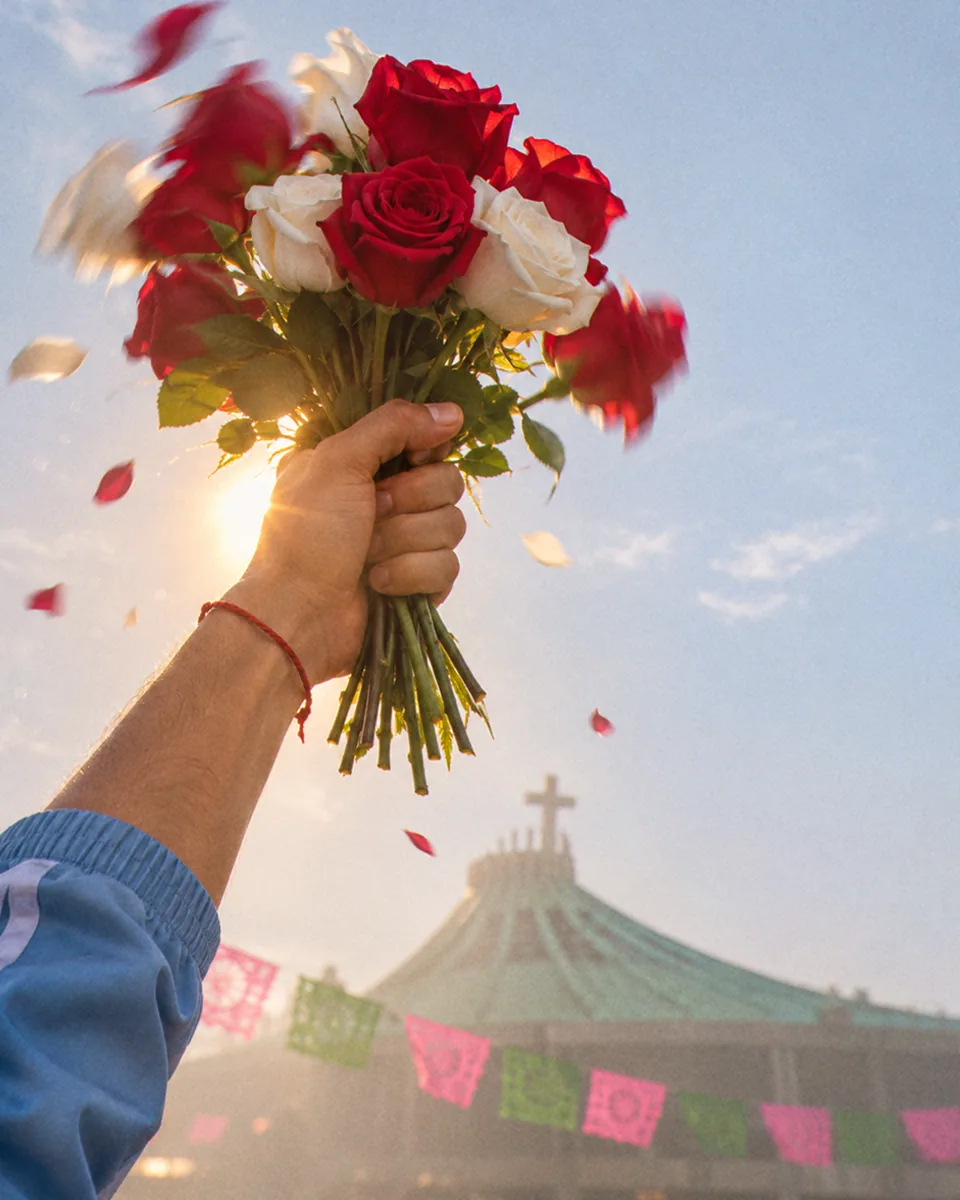
On the night of December 11, pilgrims gather in the plaza at the foot of Tepeyac hill in northern Mexico City. Mariachi bands play, Indigenous dancers move through the crowd in procession, and some pilgrims cover the last stretch on their knees, many of them holding roses. At midnight the crowd sings Las Mañanitas, the song Mexicans sing on a birthday, to the Virgin of Guadalupe: December 12 is her feast, and she is the patroness of Mexico. Roses belong to the day because, in the tradition behind it, roses found on a winter hill were the sign itself.
The feast is kept across Mexico and in Mexican and Latino parishes in the United States, and on both sides of the border it is a day for roses. If someone you love lives in Mexico City or Monterrey, or in a Mexican family in Los Angeles or Chicago, the short answer to what you should send is roses, delivered to their home on December 11 or early on the morning of the 12th. The reasons for roses, and for that night rather than the day after, go back to the same hill almost five centuries ago.
Four days on Tepeyac
Tepeyac is a hill in what is now the north of Mexico City, and in December it is dry country: stone, thorn, prickly pear and mesquite. According to tradition, on Saturday, December 9, 1531, a lady appeared there to Juan Diego, an Indigenous man from Cuautitlán whose Nahuatl name was Cuauhtlatoatzin. She asked for a church to be built on the spot and sent him to the bishop, Juan de Zumárraga, to say so.
The bishop was not ready to take the message on trust. When Juan Diego came back on Sunday, the 10th, he was asked for a sign, something to show where the request had really come from. Then the story turns away from the hill. On Monday his uncle, Juan Bernardino, fell gravely ill, and on Tuesday, December 12, Juan Diego set out to fetch a priest for him. On the way the lady met him again and told him his uncle was already well. The tradition counts four apparitions to Juan Diego in all; some accounts add a fifth, the one to his uncle.
She sent him to the top of the hill to gather the sign himself. The account is precise about what he should have found up there, which is nothing: the summit was rock and thorn, and it was the middle of December. Instead he found flowers like those of Castile, fresh and fragrant and wholly out of season. He gathered them into his tilma, the coarse cloak he wore, and carried them to the bishop’s house, where the servants could not take them from him.
In front of the bishop he opened the cloak. The roses fell to the floor, and on the cloth, as the tradition tells it, was the image of the Virgin. That moment is the feast. The first apparition came three days earlier; December 12 is the day of the roses, and that is why the flower belongs to this date.
Flowers like those of Castile
Castile is a long way from Tepeyac, and the story knows it. The Nican Mopohua, the Nahuatl telling whose title means “here is told”, describes the flowers as “flores como las de Castilla”, flowers like those of Castile. Britannica puts it more plainly: roses native to Castile, the bishop’s homeland. The usual reading follows from there. A Spanish bishop, an ocean away from home, was asked to believe a message brought by an Indigenous man, and the proof came in a form he could not mistake: the roses of his own country, on a hill of thorns, in December.
That double impossibility, wrong place and wrong season, is what the roses carry. A handful of wildflowers from Tepeyac would have proved nothing, since they grew there anyway. Only roses that had no business being there could count as evidence, and that is the meaning people still bring to the Basilica on December 12. The scarlet nochebuena, the poinsettia, belongs to the Christmas weeks that follow and has its own story among the world’s Christmas flowers.
People sometimes ask which rose, exactly. In Mexico “rosa de Castilla” is still the everyday name for a fragrant, old-fashioned pink rose, and it is tempting to draw a straight line from that garden rose to the legend. Nothing in the story draws it. The account speaks of roses a Spanish bishop would recognize, not of a particular variety, so any rose you choose carries the meaning.
Color is just as open, and nothing in the tradition prescribes red or white. Red reads as warmth and devotion (more on what red roses mean), white as quiet and respect (see what white roses mean), and a mixed bunch says both. Choose by the person who will receive them, since there is no rule to break.
A cloak above the altar
The story covers nearly five centuries; the thing at its center measures about 1.7 × 1.05 m. It is an ayate, a coarse cloak woven from ixtle, the fiber of the maguey (agave) plant, and today it hangs above the altar of the new Basilica of Guadalupe, which opened in 1976 at the foot of Tepeyac. Pilgrims who walk all night arrive to see a piece of plant fiber a little taller than most of them, hung high enough to be seen over the heads of the crowd.
The paper trail is younger than the story. A shrine stood at Tepeyac by 1556 at the latest, but the oldest written accounts of the apparitions date from the mid-1600s: Miguel Sánchez’s Imagen de la Virgen María, printed in 1648, and the Nican Mopohua, published in Nahuatl the following year by Luis Laso de la Vega. Whether he wrote it, or Antonio Valeriano did in the previous century, is still argued over. So are other details, among them the year Zumárraga was consecrated bishop, which some sources put in 1533 and others in 1534.
On July 31, 2002, John Paul II canonized Juan Diego at the Basilica in Mexico City, and his own feast now falls on December 9, the date of the first apparition. The Mexican December therefore has two Guadalupe days three days apart: the man on the 9th, the roses and the image on the 12th.
- 1531
December 9–12: four apparitions to Juan Diego on Tepeyac, as the tradition tells it, ending with the roses and the tilma.
- 1556
A shrine stands at Tepeyac by this year at the latest.
- 1648–1649
The first printed accounts: Miguel Sánchez in Spanish, then the Nican Mopohua in Nahuatl.
- 1976
The new Basilica opens, and the tilma is hung above its altar.
- 2002
Juan Diego is canonized at the Basilica on July 31.
The night of the eleventh
Las Mañanitas, roughly “little mornings”, is what Mexicans sing to someone on their birthday, and the feast of Guadalupe opens with it. The song is sung to the Virgin at midnight between December 11 and 12. In 2025 the Basilica’s schedule listed “Mañanitas a la Virgen de Guadalupe y misa” at 00:00, and television coverage from the Basilica began an hour earlier, at 11 p.m. Mexico City time, though some broadcasters started at half past.
The crowd that night is counted in millions. By the Mexico City government’s estimate, about 13 million pilgrims came to the Basilica in 2025, a record (the count for 2024 was 12.3 million). They arrive in every way the body allows. Some come on their knees, some singing, some dancing, some walking in silence, and many of them are keeping a manda, a vow made earlier and fulfilled by the walk itself.
Other cities have a Tepeyac of their own. In Monterrey the Basílica de Guadalupe in Colonia Independencia is the main pilgrimage site, and the walking starts weeks ahead: in 2025 the first pilgrimages began on October 12. There too the special hours start on the night of the 11th.
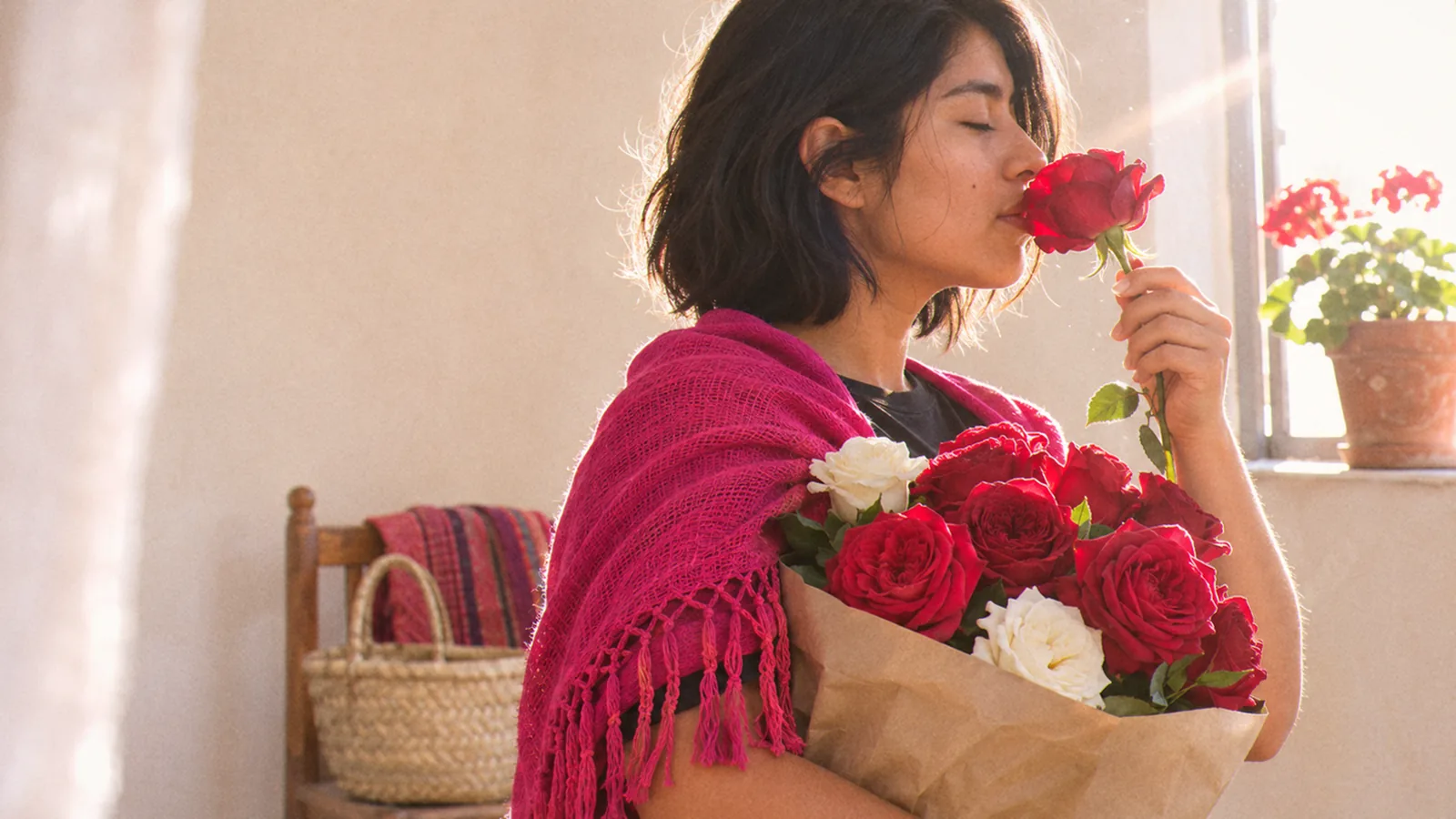
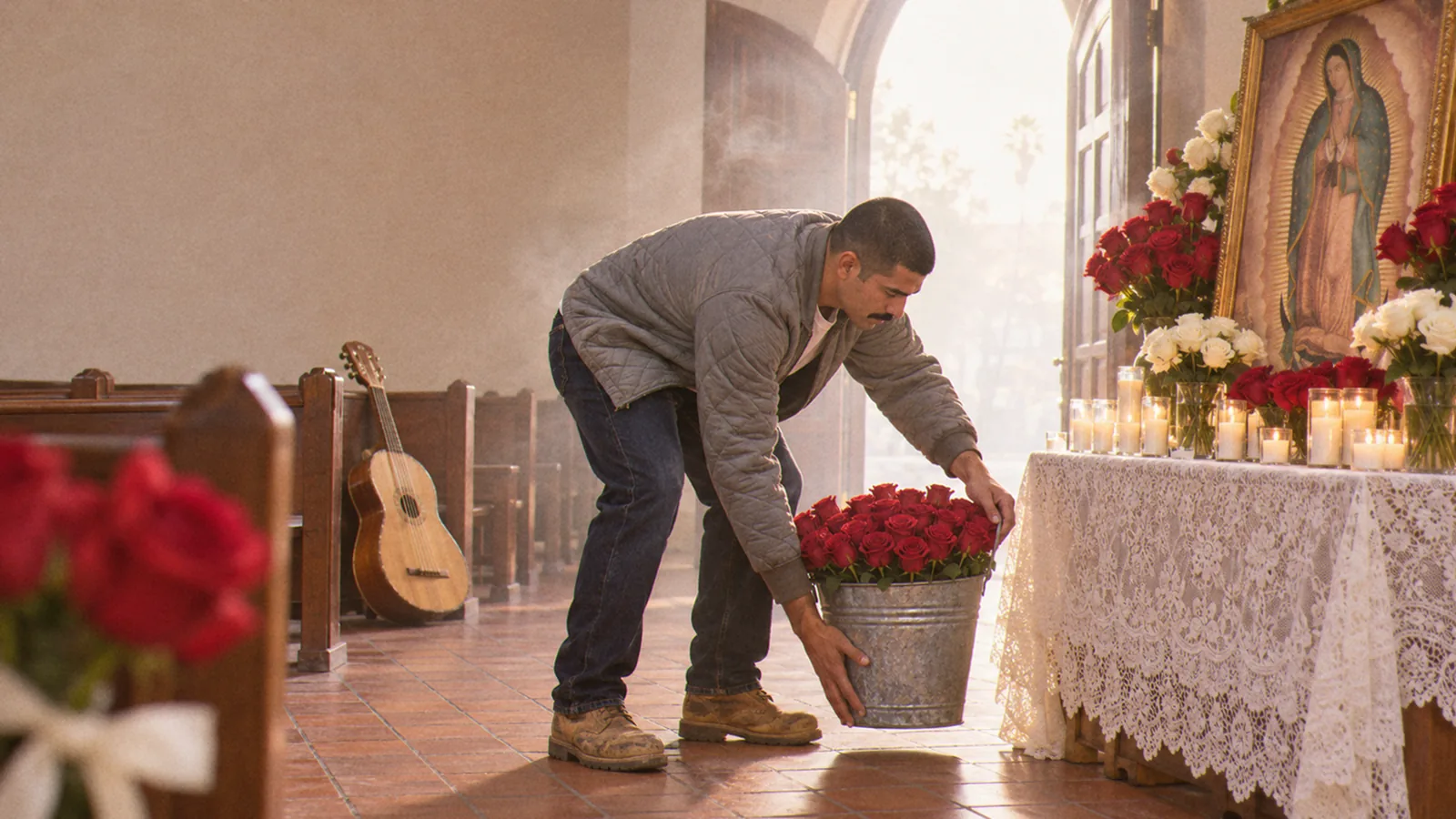
Away from the basilicas the feast is smaller and closer to home. Parish churches may fill with flowers, and some families keep a home altar with an image of the Virgin, candles and roses. Roses that arrive from abroad can end up in either place, carried to the parish or set beside the candles at home.
Tepeyac, rebuilt in Illinois
The custom crossed the border with the people who keep it. In the United States, as the Argentine paper La Nación describes it, Mexican and Latino communities mark December 12 with Masses, processions, traditional dances, Las Mañanitas, offerings and parish festivals, in California, Texas and Arizona, and in Illinois, Nevada, New Mexico, Colorado and Florida.
Northwest of Chicago, the Shrine of Our Lady of Guadalupe in Des Plaines has its own Cerrito del Tepeyac, a little Tepeyac hill. Univision’s report from 2019, the 488th anniversary, describes thousands gathered there in the cold on the night of December 11, more than a hundred riders arriving on horseback, and pilgrims who had walked six hours from a Chicago parish. The music was banda, brass-band music rather than mariachi, and the gathering is described as the most attended Guadalupe celebration after the Basilica itself. A rose in an Illinois December is as far out of season as the ones on Tepeyac.
In Los Angeles the Archdiocese describes the same night with mariachi and Las Mañanitas, a tradition it sees as linking Mexico and the United States.
Roses for the eve
For anyone sending flowers from abroad, the story settles most of the choices. Send roses, because on this day they are the sign rather than decoration. Make them red, white or mixed, whichever suits the person. And send them to the home, not to the church. No custom forbids church deliveries, but a courier cannot hand roses to one person in a crowd of thousands, and the person receiving them will usually want to carry them to Mass or set them on the home altar with their own hands.
Then time them for the eve. The feast begins at midnight between December 11 and 12, so roses that turn up on the 13th arrive after it is over. December 12 is not a public holiday in Mexico: offices and schools stay open, although many banks close, because the bankers’ association treats it as the bank workers’ holiday. Your recipient may be at work in the daytime and at church at night, which makes daytime on December 11 the safest moment, with the morning of the 12th as the second choice. In 2026 the 11th falls on a Friday and the 12th on a Saturday. In Mexico City, the northern districts around the Basilica deserve a thought: in 2025 a security and traffic operation with road closures ran there from December 9 to 14. Our guide to December flower delivery deadlines abroad covers how early to order, and how ordering works takes you through the rest.
The roses do not travel from wherever you are. Our florist in the recipient’s city arranges the bouquet on the day of delivery. Before delivery we send you a photo of the bouquet, so you see the roses before the person receiving them does.
A card with your own message goes with the flowers, and it can be in Spanish. A simple line is “Feliz día de la Virgen de Guadalupe” (“Happy Day of the Virgin of Guadalupe”). Keep the rest warm and plain and leave the theology to the parish. There are more ideas in what to write on a flower card, and a few lines that suit this night are below.
Feliz día de la Virgen de Guadalupe. Estas rosas van con todo mi cariño.
Feliz día de la Virgen. Cántenle bonito las Mañanitas esta noche, y una estrofa por mí.
Happy feast day. Roses for your altar, sent from a long way off.
Thinking of you tonight while you sing Las Mañanitas. Keep one rose aside for me.