St Lucia Day in Sweden and a Nordic Christmas: the flowers of December
What is St Lucia Day, and does it change when your flowers should arrive in Stockholm, Oslo, Copenhagen or Helsinki? Lucia falls on December 13. It is a morning of candlelit processions in white gowns, and it opens the Nordic Christmas season. Christmas itself comes eleven days later, on the evening of December 24, which is the main celebration in Sweden, Norway, Denmark and Finland. A gift should therefore arrive by the 23rd or the morning of the 24th, not on the 25th.
That one day is easy to miss if you grew up opening presents on Christmas morning. In the Nordic countries the 25th is a quiet public holiday after the big night, so a bouquet delivered then turns up once the celebration is over. Below: what Lucia is, which flowers the season brings into each of the four countries, and how to time a delivery around both dates.
What is St Lucia Day, and when is it?
St Lucia Day (Luciadagen) is December 13 every year, on a fixed date; in 2026 that is a Sunday. The day belonged to the saint in the Swedish Catholic calendar until the 16th century, and the date stayed in the year after the Reformation.
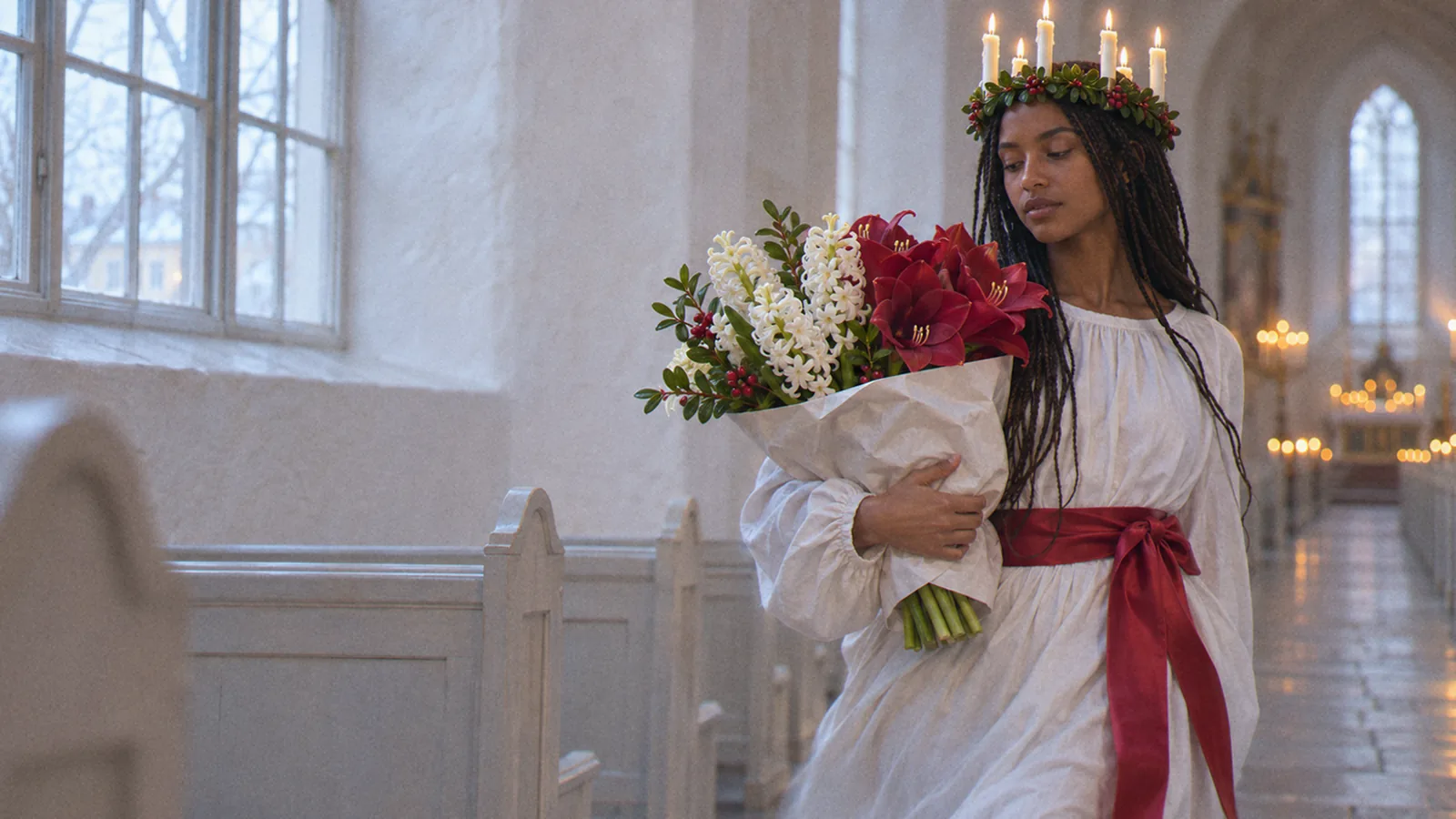
The heart of it is the luciatåg, a procession. Lucia walks first with light on her head, followed by the tärnor (handmaidens) and the stjärngossar (star boys), all in white, carrying candles and singing the Lucia songs. Lucia usually wears a red sash, said to stand for the saint’s martyrdom or for the dowry she gave away. Processions happen in the morning, in schools, churches and workplaces, and there is an official one broadcast across Sweden.
Then there are the buns: lussekatter, saffron buns named for the day, usually shaped into an S. Saffron only entered them at the end of the 19th century, making the bun younger than the custom it goes with.
Why December 13? Under the old Julian calendar the longest night fell on December 12–13, until Sweden switched to the Gregorian calendar in 1753. The first recorded Lucia figure appeared in a Swedish home in 1764, though the custom only took hold in the 1900s, shaped largely by Skansen, Stockholm’s open-air museum, which still holds Lucia on December 12–13.
What is the Lucia crown made of?
A crown of candles, set in a wreath. Whether that wreath is greenery, and which plant, depends on whom you read, and the sources do not agree.
The Nordic Museum in Stockholm describes today’s Lucia as wearing “a crown of candles”; it mentions lingonberry branches only for the singing angel of older folk custom who may have inspired her, a figure with “a crown of lingonberry branches, gold or silver paper”. Sweden’s official site speaks of “light in her hair” and a crown of electric candles in a wreath. Norway’s encyclopedia, Store norske leksikon, calls it simply a lyskrans, a wreath of lights, without naming a plant, while many English descriptions and Stockholm tour operators speak of lingonberry twigs, lingonris.
So if you see a photo of a bare candle crown, or one ringed with lingonberry twigs, neither is wrong by these accounts.
Is Lucia celebrated in Norway, Denmark and Finland too?
Yes, in all three, but each country took the custom in its own way and at a different time.
Norway borrowed Lucia from Sweden in the 1950s; it is mostly a children’s day, with kindergartens and schools holding a candle procession, singing “Sankta Lucia” and handing round lussekatter. In Nordic folk belief the saint got tangled up with Lussi, a spirit of Lussinatt, the night of December 12–13, which gives the sweet morning a darker shadow.
Denmark got its first Lucia procession in 1944, during the German occupation, at the National-Scala in Copenhagen, promoted by the Norden Association. The Nordic Museum calls it “a silent protest against the occupation”, and that December the young princesses Margrethe and Benedikte took part with their mother, Crown Princess Ingrid.
Finland has kept Lucia since the late 1800s, and it became a symbol of identity for the Swedish-speaking minority. The country also crowns a national Lucia, Finlands Lucia, organized by Folkhälsan with broadcaster Yle and the newspaper Hufvudstadsbladet, chosen by public vote (a format now being reviewed). On December 13 at 17:00 she is crowned in Helsinki Cathedral and leads a parade through the city center, watched by about 30,000 people.
When is Christmas celebrated in Scandinavia?
On the evening of December 24. In all four countries Christmas Eve is the main event: dinner, presents and the family together. The Nordic Museum puts it simply: Nordic Christmas is often centered on the eve rather than on the official holiday.
| Country | December 24 is called | What the day holds | Worth knowing |
|---|---|---|---|
| Sweden | julafton | The main day of celebration. Donald Duck (Kalle Anka) airs on TV at 15:00, as it has since 1960. | Not a statutory holiday, but the country largely shuts down. |
| Norway | julaften | Christmas dinner and presents in the evening. | The tree is often decorated on lille julaften, December 23. By law most shops close at 16:00 on the 24th. |
| Denmark | juleaften | Families hold hands and dance around the tree, singing, usually before the presents. | Lillejuleaften is December 23; the 25th and 26th are the public holidays. |
| Finland | jouluaatto | At 12:00 the Declaration of Christmas Peace is read from a balcony on Turku’s Old Great Square, in Finnish and Swedish. | It has been broadcast since 1935. |
December 25 and 26 are public holidays everywhere: juldagen and annandag jul in Sweden, the first and second juledag in Norway and Denmark, joulupäivä and tapaninpäivä in Finland. A “Christmas Day” delivery lands on a closed, quiet day after the main evening, and in Norway, only grocery and kiosk outlets under 100 m² may stay open past 16:00 on the 24th.
Which flowers do Swedes put out in December?
Hyacinths, amaryllis and poinsettias, mostly in pots, with tulips as the old favorite in vases.
The poinsettia, julstjärna or “Christmas star” in Swedish, is among the best-selling flowering pot plants in the country, alongside the hyacinth and the azalea; the white variety is sometimes called the “advent star”, fitting for a season counted in candles. The amaryllis goes by riddarstjärna, “knight’s star” (Hippeastrum to botanists), and Lund University’s Biological Museum calls it a very popular pot plant and part of the Christmas decorations.
Tulips are the older story. Around 1900, Christmas flowers in the Nordic countries were mainly bulbs: tulips, tazettas (a bunch-flowered narcissus) and hyacinths. In the home of the Swedish artist Karin Larsson, tulips often stood at Christmas in vases with pine branches, a pairing that still looks right on a December table. Our florist’s guide to tulips covers which types hold up in a warm room, and Christmas flowers around the world compares the whole Nordic lineup with other countries’.
Why is the hyacinth a Christmas flower in Sweden and Finland?
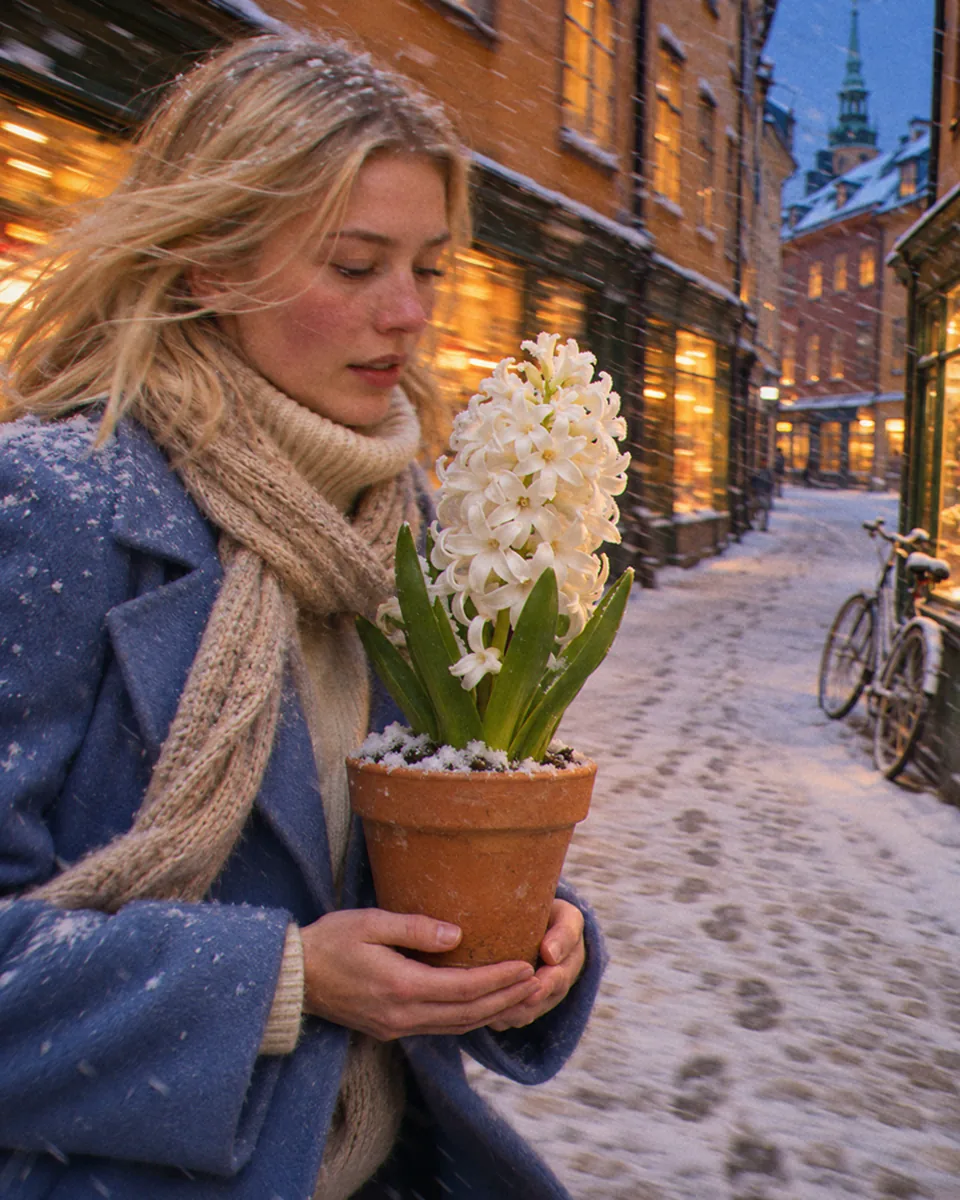
Hyacinths can be forced to flower in midwinter, months ahead of their spring season. Sources place them in Swedish Christmas homes by the late 1800s.
The plant probably reached Sweden in the 17th century, though the dates of its Christmas career vary by source. One account mentions a Lund firm advertising hyacinths for Christmas Eve in 1888, and Blomsterfrämjandet, the Swedish flower industry’s promotion body, says that by about 1900 hyacinths in hyacinth glasses (a vase shaped to hold the bulb just above the water) were common in middle-class homes; claims that the custom goes back to the 1700s are poorly supported. Like other Christmas flowers, it began in well-off households and spread from there, reaching everyday Finnish homes only after the wars.
Practical timing helps too. A forced bulb blooms for about 12–15 days, according to Lund University, so a hyacinth that opens around Lucia carries through to Christmas Eve.
The hyacinth may look old-fashioned, but in Finland it still outsells the other Christmas plants: in 2019 Finns bought about 2.7 million hyacinths against 1.8 million poinsettias and just under a million amaryllis, figures a Helsinki City Museum researcher gave to Yle. Those three make up the traditional trio: hyasintti, joulutähti and ritarinkukka. Our hyacinth guide explains the colors and how the bulbs behave indoors.
What do Danes and Norwegians choose?
A 2025 Norwegian retailer survey put poinsettia first; in Denmark, Christmas bouquets are commonly given or received. Tulips don’t appear on the Danish list of Christmas plants from Bolius, the homeowners’ knowledge center; it is décor blogs that add them.
A survey from the Norwegian garden retailer Plantasjen, October 2025, gives a rough picture: the julestjerne (poinsettia) was the favorite of 33% of respondents, amaryllis of 15%, the julerose or Christmas rose of 12%, and the hyacinth (svibel) of 9%, a falling share. Treat the numbers as indicative, since the method wasn’t published; the poinsettia has topped the ranking six years running, and Norway has grown its own since the 1930s.
The Christmas rose deserves a word, because the name promises more than the plant delivers. It is a hellebore (Helleborus), not a rose, and the pure species rarely flowers by Christmas. Plants sold in bloom in December are usually hybrids bred to oblige.
For Denmark, the homeowners’ knowledge center Bolius lists the poinsettia, amaryllis (ridderstjerne), hyacinths in pots or on glass, cyclamen (alpeviol), azalea, Christmas cactus and juletop (the South African bulb Veltheimia), and notes that many people give or receive Christmas bouquets, julebuketter. Danish décor blogs add tulips and the Christmas rose, though the institutional list does not.
Pot or bouquet: which is the usual gift?
Pot plants dominate the volume figures (Finland’s millions are almost all pots), while bouquets are also a normal Christmas gift in Denmark.
A Swedish garden retailer presents potted Christmas plants as gifts. A pot does ask for some care; if you want the recipient to keep an amaryllis going into the new year, forward our article on keeping a poinsettia and an amaryllis alive past the holidays.
A bouquet asks for nothing but a vase, which suits a busy week. With jfloo the flowers never cross a border: our florist in the recipient’s city arranges it on delivery day. A card with your own message goes with it, and a line in the local language, such as god jul in Swedish, Norwegian and Danish or hyvää joulua in Finnish, shows you know which evening matters.
By which day should the flowers arrive?
By December 23, or the morning of December 24 at the latest. In 2026 that means Wednesday the 23rd or Thursday morning the 24th. For Lucia flowers, aim for December 13 itself, a Sunday this year.
- Choose the date firstPick the 23rd if the recipient will be busy or traveling on the 24th; if you choose the 24th, plan for early delivery. In Norway, shops shut at 16:00 that day, and the afternoon belongs to the family.
- Check the address for that dayChristmas Eve is spent at home or with relatives, so ask where the recipient will actually be on the 23rd and 24th.
- Book aheadOur guide to holiday delivery deadlines abroad sets out how far ahead to book.
- Write the cardMention the occasion by its local name. God jul on a card arriving on the 23rd says more than a generic greeting on the 25th.
- Look at the photoBefore delivery we send you a photo of the bouquet, so you see it before the recipient does.
Is there anything to avoid when sending flowers to the Nordics in December?
Mostly the wrong day. Beyond timing, a few cautions are worth knowing, and they depend on who lives in the home.
If someone in the household has asthma or allergies. Finnish home-economics advice from the Martta organization suggests keeping hyacinths out of such homes, since the scent is strong and the plant contains alkaloids that can trigger reactions; botanists list it among scent-allergy culprits. A bouquet without hyacinth may be the safer choice.
If there are small children or pets. The same Martta advice says to avoid poinsettias in homes with small children. The popular belief that it is deadly doesn’t hold up; it can irritate rather than kill, and veterinary poison lists rate it only mildly toxic to pets. Our guide to flowers safe for pets and allergy sufferers covers the rest of the December lineup.
If the delivery would land on the 25th or 26th. Move it earlier. Both are public holidays in all four countries, and the celebration they follow will already have happened the night before.